Connect with us

Published

on

CATL

As per top media reports, China’s battery leader, Contemporary Amperex Technology Co. Ltd. (CATL), has stopped operations at a key lithium mine. This move surprised commodity markets and led to a rise in lithium prices. The shutdown occurred because of an expired mining license. It also comes as Beijing tightens control over excess capacity in the lithium sector.

CATL’s Major Lithium Hub Falls Silent

CATL’s mining license for the Jianxiawo lithium project in Yichun, Jiangxi, expired on August 9, 2025. Without approval to continue, the company closed the mine. CATL is now seeking a renewal. They aim to restart operations “as soon as possible.” However, experts believe the process may take at least three months due to current regulations.

Reuters highlighted that the Jianxiawo site, hailed as the “Lithium Capital of Asia,” produces over 46,000 metric tons of lithium carbonate equivalent (LCE) each year. This amount is about 3–6% of the world’s expected output for 2025. Even a short disruption at this key facility impacts global supply chains.

Beijing’s Crackdown on Overcapacity

This shutdown fits into Beijing’s broader efforts to control fast-growing industries. Officials target sectors with overcapacity, including steel, coal, and renewable materials. The lithium industry, which surged during the 2020–2022 price boom, is now under scrutiny.

Recently, authorities also ordered Zangge Mining in Qinghai province to halt production. CATL’s closure is the first major suspension in Yichun, showing that no company is safe from government actions.

Cost Pressures Threaten Viability

CATL’s cost structure shows the challenges miners face. Reports suggest production costs at Jianxiawo are around RMB 100,000 ($13,920) per ton, much higher than current market prices. This means the mine has been operating at a loss, which regulators may consider when reviewing its license renewal.

If Beijing aims to cut oversupply, delaying permits for high-cost operations like Jianxiawo could help stabilize prices.
CHINA lithium

Lithium Stocks Surge on Supply Jitters

The market reacted quickly to CATL’s announcement. Lithium carbonate futures on the Guangzhou Futures Exchange jumped 8% to the daily limit. The shutdown led to a surge in lithium stocks, and shares of lithium miners worldwide rose sharply. Investors expected a tighter lithium supply and higher prices.

As per Bloomberg,

  • In Hong Kong, Tianqi Lithium’s shares jumped 19% and China’s Ganfeng Lithium rose by 21%.

Australian miners also saw strong gains in a single day due to speculative buying. Even North American lithium producers, who faced heavy losses, gained renewed interest. For instance, Albemarle also benefited from rising investor optimism

Traders believed China’s supply cuts could benefit global competitors. Analysts say this rally shows both short-term speculation and hope for lithium price recovery from Beijing’s actions.

Regulatory Hurdles Ahead

Renewing a mining license in China involves multiple reviews. Environmental impact assessments, land use compliance checks, safety protocols, and community impact studies are all part of the process. Authorities also assess resource utilization efficiency to ensure sustainable operations.

Will Lithium Supply Shocks Shake CATL’s EV Battery Dominance?

Lithium is essential for electric vehicle (EV) batteries, especially lithium iron phosphate (LFP) types that dominate CATL’s production. With CATL holding a 37.9% share of the global EV battery market in the first half of 2025, any disruption to its lithium supply could lead to wider effects.

For CATL, the stakes are high. The Jianxiawo mine is crucial for its business model, supplying lithium for battery production and reducing reliance on imports. A prolonged shutdown may force the company to source more lithium abroad, increasing costs and complicating logistics.

Higher raw material costs, supply bottlenecks, and delivery delays may impact automakers relying on CATL’s batteries. Although the global market is oversupplied, local disruptions can still cause temporary price spikes and strain supply chains.

China’s Expanding Lithium Mining Power

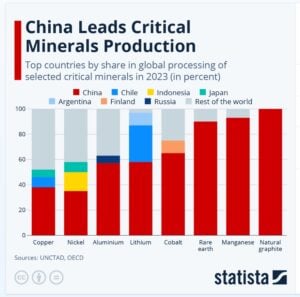
Despite challenges, China’s lithium dominance is expected to grow. Fastmarkets predicts the country will surpass Australia as the world’s largest lithium producer by 2026, with 8,000–10,000 metric tons more output than its rival. This is a significant increase from 2023, when China ranked third after Australia and Chile.

However, many Chinese producers struggle with current prices, and government actions could reshape the industry. The goal seems to be a more efficient sector with stronger environmental compliance.

Market Outlook: Short-Term Lift, Long-Term Questions

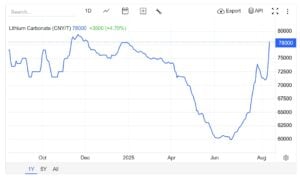
Trading Economics highlighted that, in August, lithium carbonate prices climbed above CNY 75,000 per tonne, reaching their highest level since March.
lithium prices
Source: Trading Economics

Analysts see CATL’s shutdown as a short-term price stabilizer, potentially forcing smaller high-cost miners to merge or exit. Producers may prioritize efficiency and compliance to avoid similar issues. Last but not least, Jianxiawo’s closure underscores the lithium market’s fragile balance and signals that unchecked mining growth may be ending.

The post Lithium Prices Jump as CATL Shuts Major Jianxiawo Mine in China appeared first on Carbon Credits.

Continue Reading

Carbon Footprint

Want a simpler way to buy carbon credits? Discover our carbon marketplace

Published

on

Most businesses that decide to act on their net-zero targets reach the same point of friction. Buying carbon credits has meant tracking down brokers, sitting through sales calls, and requesting a quote just to learn a price, sometimes with limited proof of what you are buying.

Continue Reading

Carbon Footprint

Climate-Linked Supply Chain Risk Is Already in Your P&L

Published

on

The earnings calls that quietly reframed climate from sustainability question to operating risk.

Three earnings calls in the last 18 months tell the story without any help from a press release.

Hershey, May 2024: cocoa price exposure compresses margin, and the company attributes part of the cost shock to West African weather. Olam, July 2024: coffee climate exposure quantified in the annual report. JBS, January 2025: supply chain climate disclosures expanded materially in response to investor pressure and regulatory expectation. None of these companies issued the announcement as climate news. They issued it as financial news. The climate-linked supply chain risk did not arrive with a sustainability framing; it arrived as a P&L line.

You are probably reading this article because you suspect the same thing is happening to your business. This piece walks through what is showing up on which earnings calls, how procurement and finance leaders are quantifying the exposure, and what serious corporates are doing about it before the regulator asks.

Where climate risk has already appeared in earnings

The pattern is consistent across resource-intensive sectors. A weather event compresses supply, the price spikes, the cost flows through the income statement, and the analyst on the call asks whether the event is anomalous or structural. Increasingly, the honest answer is the second one.

Cocoa is the cleanest example. The 2023 to 2024 West African harvest fell sharply on the back of erratic rainfall and disease. Cocoa futures more than tripled. Companies with concentrated West African sourcing absorbed the cost; companies with diversified sourcing absorbed less. The exposure was not climate as ESG topic. It was climate as cost of goods.

Coffee follows the same pattern. Brazilian and Vietnamese harvests have moved on weather more sharply across the last several seasons. Roasters with long-tenor supplier relationships and origin diversification have managed the volatility; roasters with spot-market exposure have not. Wheat, sugar, palm oil, beef: the same dynamic in different commodities, a pattern the IPCC AR6 Working Group II report projects will intensify across agricultural systems through mid-century.

What this means: climate risk is no longer a footnote in the 10-K. It is a line item the CFO has to explain on the call.

The three commodity exposures that hit margin first

For most companies with material Scope 3 exposure, three exposures dominate the near-term P&L risk.

  • Concentrated single-origin sourcing in a climate-vulnerable region. If your tier-one supply for any material commodity sits in one geography, you have a concentration risk that climate amplifies. Diversification across origins is the obvious hedge, but it takes years to build and requires relationships you cannot acquire by tender.
  • Supplier financial fragility under climate stress. Smallholder farmers, who supply a large share of the global cocoa, coffee, and palm oil market, do not carry the balance sheets to absorb yield shocks. When yields collapse, they exit. When they exit, your supply base shrinks, and the surviving suppliers raise prices. The risk is structural, not cyclical.
  • Logistics and storage exposure to extreme weather. Hurricane disruptions to Gulf shipping, drought-driven Panama Canal restrictions, flooding in European inland waterways: each of these has moved input costs in the last three years, a pattern documented in Munich Re’s natural catastrophe data. The exposure shows up as a one-quarter event in the financial press but accumulates over time on the cost line.

TCFD and ISSB disclosure changes

The disclosure architecture has now caught up with the risk. The Task Force on Climate-related Financial Disclosures, whose recommendations are now embedded in the ISSB’s IFRS S2 climate standard, requires companies to disclose climate-related risks across physical and transition categories, with quantification where possible.

For physical risk specifically (the climate-linked supply chain risk you are reading about), the disclosure must address both acute exposures (extreme weather events) and chronic exposures (gradual changes in temperature, precipitation, and growing seasons). The disclosure must address the time horizon over which the risk is material, the parts of the value chain exposed, and the financial impact under different scenarios.

The CSRD imposes similar requirements under European law, with double materiality (both financial and impact materiality) embedded in the assessment. The practical effect: your auditors and your investor relations team now need a defensible answer to the climate-linked supply chain risk question, and the answer needs to be quantified.

What procurement and finance can do now

Three actions matter near-term.

Map your exposure. Most companies do not have a clear view of which tier-one and tier-two suppliers sit in which climate-vulnerable geographies. Without the map, you cannot quantify the risk, and without the quantification, you cannot disclose it credibly. The map is the foundation, and World Resources Institute climate risk research provides useful public tooling to start.

Diversify and deepen, in that order. Diversification across origins reduces concentration risk, but the deeper move is to invest in the resilience of the suppliers you already have. Regenerative practices, agroforestry, soil health interventions: these reduce yield volatility under climate stress and protect your input cost trajectory.

Embed the climate spend inside procurement, not outside it. Treating climate risk as a sustainability cost line subordinates it to the ESG budget. Treating it as a procurement and resilience investment puts it in the budget that matters, which is the cost-of-goods budget that the CFO defends quarterly.

Nature-based supply chain investments are the asset class designed for exactly this purpose. They sit inside the value chain, they reduce climate-linked supply risk, they generate verifiable Scope 3 reductions, and they produce the documentation an auditor and a regulator can both test.

If you are quantifying climate-linked supply chain risk in advance of the next earnings cycle or the next disclosure period, the carbon and sustainability experts at Carbon Credit Capital can help you map your exposure and structure a Dual-Value Model response that addresses reduction, resilience, and disclosure-readiness in a single program. Schedule a consultation.

Continue Reading

Carbon Footprint

Where should an SME start with a carbon action plan?

Published

on

More and more small and medium-sized businesses are hearing the same question from their larger customers: What is your carbon footprint? That question now travels down entire supply chains, and it arrives next to tender requirements, certification criteria, and rising customer expectations.

Continue Reading

Trending

Copyright © 2022 BreakingClimateChange.com

