

Rudecindo Espíndola’s family has been growing corn, figs and other crops for generations in the Soncor Valley in northern Chile, an oasis of green orchards in one of the driest places on Earth – the Atacama desert.
Perched nearly 2,500 metres above sea level, his village, Toconao, means “lost corner” in the Kunza language of the Indigenous people who have lived and farmed the land in this remote spot for millennia.
“Our deep connection to this place is based on what we have inherited from our ancestors: our culture, our language,” said Espíndola, a member of a local research team that found evidence that people have inhabited the desert for more than 12,000 years.
This distant outpost is at the heart of the global rush for lithium, a silvery-white metal used to make batteries for electric vehicles (EV) and renewable energy storage that are vital to the world’s clean energy transition. The Atacama salt flat is home to about 25% of the world’s known lithium reserves, turning Chile into the world’s second-largest lithium producer after Australia.
For decades, the Atacama’s Indigenous Lickanantay people have protested against the expansion of the lithium industry, warning that the large evaporation ponds used to extract lithium from the brine beneath the salt flats are depleting scarce and sacred water supplies and destroying fragile desert ecosystems.
Espíndola joined the protests, fearing that competition for water could pose an existential threat to his community.
But last year, he was among dozens of Indigenous representatives who sat across the table from executives representing two Chilean mining giants to hammer out a governance model that gives Indigenous communities living close to lithium sites a bigger say over operations, and a greater share of the economic benefits.

A pioneering deal
The agreement is part of a landmark deal between state-owned copper miner Codelco and lithium producer the Sociedad Química y Minera de Chile (SQM) to extract lithium from the salt flats until 2060 through a joint venture called NovaAndino Litio.
The governance model that promises people living in Toconao and other villages around the salt flats millions of dollars in benefits and greater environmental oversight is the first of its kind in mineral-rich Chile, and has been hailed by industry experts as the start of a potential model for more responsible mining for energy transition metals.
NovaAndino told Climate Home News the negotiations with local communities represented an “unprecedented process that has allowed us to incorporate the territory’s vision early in the project’s design” and creates “a system of permanent engagement” with local communities.
The company added it will contribute to sustainable development in the area and help “the safeguarding of [the Lickanantay people’s] culture and environmental values”.
-
West Africa’s first lithium mine awaits go-ahead as Ghana seeks better deal
Ghana wants to benefit from the scramble for lithium but its reliance on mining firms for revenue and expertise weakens its ability to negotiate preferential terms, experts say -
Campaigners sue Chilean government over copper mining pollution
The case comes after Climate Home News revealed that uncontrolled air pollution has put people’s health at risk in Chile’s copper mining heartland -
Argentina’s pioneering glacier law on the line as Milei bets on copper rush
President Javier Milei wants Congress to relax groundbreaking glacier protection legislation to boost mining, but opponents say the environmental risks are too great


For mining companies, such agreements could help reduce social conflicts and protests, which have delayed and stalled extraction in other parts of South America’s lithium-rich region, known as the lithium triangle.
“Argentina and Bolivia could learn a lot from what we’re doing [here],” said Rodrigo Guerrero, a researcher at the Santiago-based Espacio Público think-tank, adding that adopting participatory frameworks early on could prevent them from “going through the entire cycle of disputes” that Chile has experienced.
Justice at last?
As part of the governance deal, NovaAndino has pledged to adopt technologies that will reduce water use and mitigate the environmental impacts of lithium extraction.
It has also committed to hold more than 100 annual meetings with community representatives to build a “good faith” relationship, and an Indigenous Advisory Council will meet twice a year with the company’s sustainability committee to discuss its environmental strategy, company sources said. The meetings are due to begin next month.
To oversee the agreement’s implementation, an assembly – composed of representatives from all 25 signatory communities – will track the project’s progress. In addition, NovaAndino will hold one-on-one meetings with each community to address issues such as the hiring of local people and the protection of Indigenous employees.

Espíndola said the deal, while far from perfect, was an important step forward.
“Previously, Indigenous participation was ambiguous. Now we talk about participation at [every] hierarchical level of this process, a very strong empowerment for Indigenous communities,” said Espíndola, adding that it did not give local communities everything they had asked for. For instance, they will not hold veto power over NovaAndino’s decisions or have a formal shareholder role.
But after years of conflict with mining companies, a form of “participatory justice is being done”, he said.
Not everyone is convinced that the accord, pushed by Chile’s former leftist government, marks progress, however.
“Not in our name”
The negotiations have caused deep divisions among the Lickanantay, some of whom say greater engagement with mining companies will not stop irreparable damage to the salt flats on which their traditional way of life depends. Others fear the promise of more money will further erode community bonds.
In January 2024, Indigenous communities from five villages closest to the mining operations, including Toconao, blocked the main access roads to the lithium extraction sites. They said the Council of Atacameño Peoples, which represents 18 Lickanantay communities and was leading discussions with the company, no longer spoke for them.
Official transcripts of consultations on the extension of the lithium contracts and how to share the promised benefits reveal deep divisions. Tensions peaked when communities around the mining operations clashed over how to distribute the multimillion-dollar windfall, with villages closest to the mining sites demanding the largest share.
Eventually, separate deals establishing a new governance framework over mining activities were reached between Codelco and SQM with 25 local communities, including a specific agreement for the five villages closest to the extraction sites.

The division caused by the separate deal for the five villages “will cause historic damage” to the unity of the Atacama desert’s Indigenous peoples, said Hugo Flores, president of the Council of Atacameño Associations, a separate group representing farmers, herders and local workers who oppose the mining expansion.
Sonia Ramos, 83, a renowned Lickanantay healer and well-known anti-mining activist, lamented the fracturing of social bonds over money, and for the sake of meeting government objectives.
“There is fragmentation among the communities themselves. Everything has transformed into disequilibrium,” said the 83-year-old.
“[NovaAndino] supposedly has economic significance for the country, but for us, it is the opposite,” she said.
The company told Climate Home News it has “acted consistently” to promote “transparent, voluntary, and good-faith dialogue with the communities in the territory, recognising their diversity and autonomy, and always respecting their timelines and forms of participation”.
A one-off deal or a model for others?
The NovaAndino joint venture is a pillar of Chile’s strategy to double lithium production by 2031 and consolidate the copper-producing nation’s role in the clean energy transition as demand for battery minerals accelerates.
Chile’s new far-right president, José Antonio Kast, who was sworn in last week, promised to respect the lithium contracts signed by his predecessor’s administration – including the governance model.
Still, some experts say the splits over the new model highlight the need for legislation that mandates direct engagement and minimum community benefits for all large mining projects.
“In the past, this has lent itself to clientelism, communities who negotiate best or arrive first get the better deal,” said Pedro Zapata, a programme officer in Chile for the Natural Resource Governance Institute.
“This can be to the detriment of other communities with less strength. We cannot have first- and second-class citizens subject to the same industry,” he added.
The government is already negotiating two more public-private partnerships to extract lithium with mining giant Rio Tinto, which it said would include a framework to engage with Indigenous communities and share some of the revenues. The details will need to be negotiated between local people, the government and the company.
Sharing the benefits of mining
Under the deal in the Atacama, NovaAndino will run SQM’s current lithium concessions until they expire in 2030 before seeking new permits to expand mining in the region under a vast project known as “Salar Futuro” – a process which will require further mandatory consultations with communities.
Besides the participatory mechanism, the new agreement promises more money than ever before for salt flat communities.

Depending on the global price of lithium and their proximity to the mining operations, Indigenous communities could collectively receive roughly $30 million annually in funding – about double what SQM currently disburses under existing contracts.
When taking into account the company’s payments to local and regional authorities, contributions could reach $150 million annually, according to the government.
To access these resources, each community will need to submit a pipeline of projects they would like funding for under a complex arrangement that includes five separate financial streams:
- A general investment fund will distribute funding based on each village’s size and proximity to the mining sites
- A development fund will support projects specifically in the five communities closest to the extraction sites
- Contributions to farmers and livestock associations
- Contributions to local governments
- A groundbreaking “intergenerational fund” held in trust for the Lickanantay until 2060
For many isolated communities in the Atacama desert, financial contributions from mining firms have funded essential public services, such as healthcare and facilities like football pitches and swimming pools.
In the past, communities have used some of the benefits they received from mining to build their own environmental monitoring units, hiring teams of hydrogeologists and lawyers to scrutinise miners’ activities.
Espíndola said the new model could pave the way for more ambitious development projects such as water treatment plants and community solar energy projects.

Competition for water
The depletion of water resources is one of local people’s biggest environmental concerns.
To extract lithium from the salt flats, miners pump lithium-rich brine accumulated over millions of years in underground reservoirs into gigantic pools, where the water is left to evaporate under the sun and leaves behind lithium carbonate.
One study has shown that the practice is causing the salt flat to sink by up to two centimetres a year. SQM recently said its current operations consume approximately 11,500 to 12,500 litres of industrial freshwater for every metric ton of lithium produced.
NovaAndino has committed to significantly reduce the company’s water use by returning at least 30% of the water it extracts from the brine and eliminating the use of all freshwater in its operations within five years of obtaining an environmental permit.
-
Bolivia’s shift to the right renews ambition to mine vast lithium reserves
The election of a centre-right president after 20 years of socialist rule could open up the nation’s lithium reserves to foreign investment – the US is paying attention -
‘The state doesn’t want to know’: Doctors raise alarm on children’s health crisis in Chile’s copper heartland
Autism and cancer cases are soaring in Chile linked to pollution from copper mining critical for the energy transition, doctors say -
Lithium tug of war: the US-China rivalry for Argentina’s white gold
As global competition hots up to secure lithium supplies for batteries, China is boosting its investments in Argentina while the US courts President Javier Milei


Cristina Dorador, a microbiologist at the University of Antofagasta, told Climate Home News that reinjecting the water underground is untested at a large scale and could impact the chemical composition of the salt flats.
Continuing to extract lithium from the flats until 2060 could be the “final blow” for this fragile ecosystem, she said.
Asked to comment on such concerns, NovaAndino said any new technology will be “subject to the highest regulatory standards”, and pledged to ensure transparency through “an updated monitoring system with the participation of Indigenous communities”.
High price for hard-won gains
For the five communities living on the doorstep of the lithium pools, one of the biggest gains is being granted physical access to the mining sites to monitor the lithium extraction and its impact on the salt flats.
That is a first and will strengthen communities’ ability to call out environmental harms, said Sergio Cubillos, the community president of Peine, the village closest to the evaporation ponds. It could also give them the means to seek remediation through the courts if necessary, Espíndola said.
Gaining such rights represents long-overdue progress, Cubillos said, but it has come at a high price for the Lickanantay people.
“Communities receiving money today is what has ultimately led to this division, because we haven’t been able to figure out what we want, how we want it, and how we envision our future as a people,” he said.
Main image: A truck loads concentrated brine at SQM’s lithium mine at the Atacama salt flat in Chile (Photo: REUTERS/Ivan Alvarado)
The post Landmark deal to share Chile’s lithium windfall fractures Indigenous communities appeared first on Climate Home News.
Landmark deal to share Chile’s lithium windfall fractures Indigenous communities

A relatively ambitious deal to reduce the shipping industry’s 3% of global emissions now looks more likely after four days of closed-door talks in London, observers say.
The International Maritime Organization (IMO), which oversees the negotiations, said there had been “constructive discussions” and “genuine willingness within the group to make concrete further progress”.
Em Fenton, senior director at the NGO Opportunity Green who attended the talks last week, said they “demonstrated a strong spirit of solidarity in the face of blatant attempts to undermine the credibility, ambition and equity of a hard-fought multilateral agreement”.
After several years of debate, governments provisionally agreed in April 2025 on a “Net-Zero Framework” (NZF) – a series of emissions reduction targets for shipowners aimed at incentivising them to use cleaner fuels, backed up with financial rewards for meeting the targets and fees for missing them.
But in October 2025, after a high-profile intervention by US President Donald Trump and threats of US sanctions and visa restrictions, the US convinced a majority of voting nations to postpone the adoption of the NZF for a year.
UCL analysis found that, of those who expressed a view at last week’s talks, 38 were in favour of an NZF-style solution while only 17 were against. Those opposed are “consistently composed of strongly fossil fuel-aligned governments”.
An observer of the talks, who did not want to be named, said the countries opposed include the US, Russia, India, Thailand, Argentina, Ecuador and Uruguay, as well as eight oil-rich Gulf nations and shipowner-reliant Liberia and Panama. Governments that support an NZF-style deal include China, Brazil, Mexico, Türkiye, Canada, Australia, Chile, nine African nations, most European countries and small islands.
A new framework to tackle shipping emissions could be adopted if two-thirds of countries that are present and signed up to a regulation called Marpol Annex VI – endorsed by just over 100 states – vote in favour of it, as they did in April 2025.
UCL’s analysis said it was “reassuring” that governments which had taken strong positions in the media against the NZF were being more compromising in the negotiations.
Tweaks are probable
While there is majority support for the NZF, UCL said adopting it would be difficult politically. “The process from here could therefore be as much about producing what appears to be a new package, but one that broadly ends up with similar outcomes in relation to objectives,” UCL argued.
But tweaking the NZF, which resulted from years of negotiations, comes with risks, it warned. For example, changes could reduce the new system’s planned support for low-income countries, turning them against it. Fenton said compromising should not mean “abandoning the principle of justice in the maritime transition”.
UCL said the speed at which shipowners must reduce their ships’ emissions or face fees is likely to be reduced in the short-term but raised in the long-term to meet a goal of net zero emissions by mid-century.
-
Palestine: Israel’s bombing has left Gaza vulnerable to climate change
With homes, hospitals and water storage destroyed, Palestine’s government says that Gazans have little protection from climate impacts and sets conditional emissions targets -
More support needed to power Africa’s food systems with renewables, experts say
Renewable energy could help African food businesses boost productivity and competitiveness, but the upfront cost, fragmented markets and limited financing stand in the way -
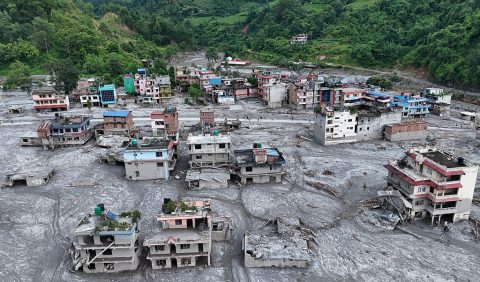
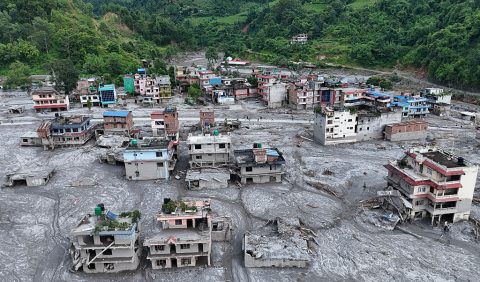
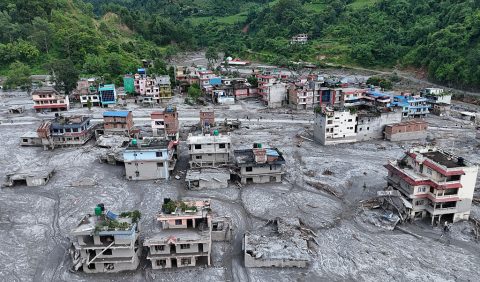
Loss and damage fund urged to hold crisis meeting on Nepal
The new fund is coming under pressure from developing nations to respond quickly to climate disasters rather than just financing longer-term projects


This was a compromise put forward by NZF-supporter Brazil. However, an analysis by the the Institute of Marine Engineering, Science and Technology (IMarEST) has found that this change would lead to more overall emissions than the original NZF trajectory.
UCL has warned it could incentivise liquefied natural gas as a shipping fuel over greener options, which include hydrogen-based methanol and ammonia.
Analysis by UCL and the Rocky Mountain Institute suggests that, while a slower start to the NZF would reduce transport costs in the short term, it would increase them later due to the costs involved in switching the industry over from more polluting fuel to cleaner fuel.
NZF won’t meet emissions goals
IMarEst’s analysis finds that even in its current form – the most ambitious deal on the table – the NZF will not be sufficient for shipping to meet its emissions reduction goals.
It says that only a Pacific proposal to place a levy on ships’ total emissions – rather than just those above a certain level – would meet the industry’s targets to reduce emissions 20% between 2008 and 2030, 70% by 2040 and then reach net zero “by or around, i.e. close to 2050”. This is highly unlikely to be adopted.
Additional talks will be held from November 23-27 and from November 30-December 3 before a potentially final round of official negotiations begins on December 4.
The post London talks raise hopes for green shipping deal appeared first on Climate Home News.
Climate Change
At regional summit, Pacific islands ask for COP31 support for clean energy and finance
At a key leaders’ summit in Palau, Pacific island nations burdened by worsening climate change impacts and costly fossil fuel imports called for November’s COP31 climate summit to deliver finance to help the region transition to renewable energy and build more resilient communities.
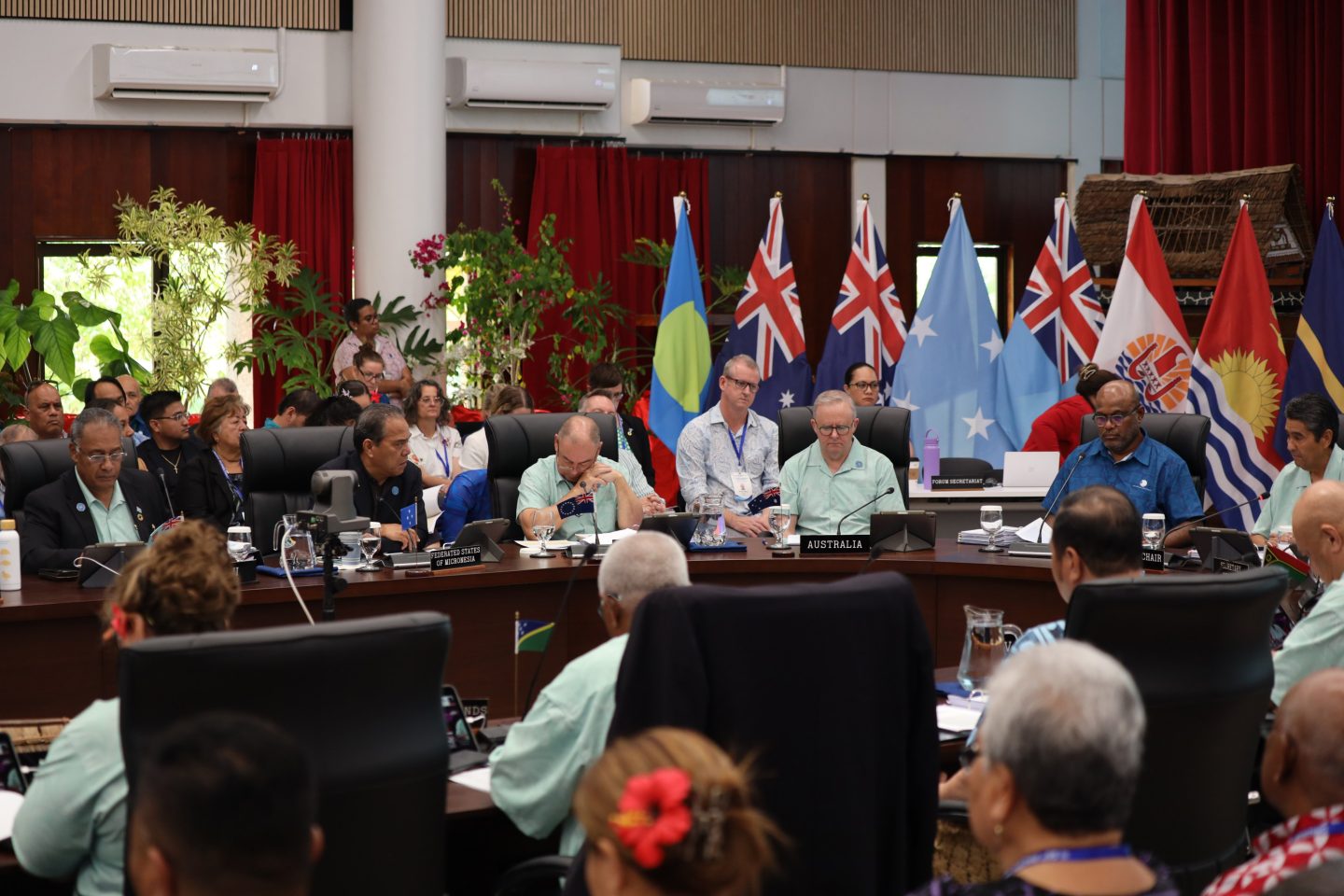
Heads of government from the 18-member Pacific Islands Forum (PIF) – which includes COP31 co-president Australia – met in Palau’s capital Koror for a week-long summit, where they demanded access to climate finance, ocean action and a regional boost for renewables at COP31.
Palau’s president Surangel Whipps Jr. said during a plenary session that the Pacific must focus on delivering climate and ocean commitments. “It will require greater regional leadership, stronger regional coordination and, above all, unity of purpose,” he said.
The meeting, which ended last Friday, was marked by the absence of some leaders – among them the heads of state of the Solomon Islands, Vanuatu and Fiji, which will host a preparatory session for COP31 in October (referred to as the pre-COP31). There were also tensions over Taiwan’s participation, with China objecting to its presence as an observer.
The forum’s final declaration, published after it ended and signed by all its members, reaffirms that climate change is the “single greatest threat to the security, livelihoods and wellbeing of Pacific peoples”, and notes “the importance of a focused, high-level declaration” at the pre-COP31 to build “political momentum towards COP31”.
-
Palestine: Israel’s bombing has left Gaza vulnerable to climate change
With homes, hospitals and water storage destroyed, Palestine’s government says that Gazans have little protection from climate impacts and sets conditional emissions targets -
More support needed to power Africa’s food systems with renewables, experts say
Renewable energy could help African food businesses boost productivity and competitiveness, but the upfront cost, fragmented markets and limited financing stand in the way -
Loss and damage fund urged to hold crisis meeting on Nepal
The new fund is coming under pressure from developing nations to respond quickly to climate disasters rather than just financing longer-term projects
Australia and Pacific islands have invited world leaders to attend the pre-COP31 gathering, which will be held in Fiji and Tuvalu from October 5 to 8. While usually a technical meeting for negotiators, the island nations aim to issue a political declaration at the gathering calling for strong outcomes in Türkiye.
Chris Bowen, Australia’s climate minister and COP31 president of negotiations, said in a speech during the Pacific forum that his country is “determined to use COP31 to progress the agenda to make it easier for countries to access the climate finance they need”.
“We won’t miss the opportunity to ensure COP31 is a Pacific COP. Not just because of the location of pre-COP but because of the agenda we are shaping through the Action Agenda at COP31,” he said.
The Action Agenda is a large portfolio of climate initiatives and coalitions uniting governments, businesses and civil society outside of the formal negotiations on everything from health to methane emissions.
Renewable energy investment plan
Announced a year ago, the island nations launched a $14-billion investment plan for a “100% Renewable Blue Pacific” at the forum in Palau. The plan lists strategic projects that would reduce the region’s high dependence on fossil fuel imports, whose soaring costs have become a major burden since the Iran war.
The projects include a $52-million programme managed by Australia to develop off-grid renewables in remote communities across the Pacific, as well as a $100-million blended finance fund aimed at supporting private-sector investments in wind and solar, among others.
Currently, some countries in the Pacific are spending up to a quarter of their GDP importing diesel to power electricity generation, according to a new report by the University of New South Wales in Australia. The investment plan launched at the forum aims to reduce these costs by adding 2.2 gigawatts of renewable generation and around 9 gigawatt hours of electricity storage.
To channel funds into the region, the plan also highlights the role of the recently established Pacific Resilience Facility (PRF), a regional fund that seeks to swiftly disburse funds to climate-vulnerable communities at the local level. Bowen said he would promote the facility to world leaders attending COP31 and “ask for their support”.
Call to transition away from fossil fuels
Separately, the forum endorsed the Belau Declaration which emphasises the need to keep the 1.5C Paris Agreement temperature goal alive. A UN report last week showed that overshooting this limit is now inevitable, but deep emissions cuts could still bring global temperatures back down by the end of the century.
Pacific nations expect to rally support for this declaration at the pre-COP, with Fiji’s climate minister Lynda Tabuya saying in a statement: “Palau is where we build the political mandate. Pre-COP is where we take it to the world.”
The political declaration also says that countries must accelerate the global transition away from fossil fuels “towards a renewable energy future”, and calls for greater recognition of the importance of ocean health in addressing climate change.
UN sets out narrow path back to 1.5C warming after inevitable overshoot
As part of the forum’s outcomes in Palau, countries also noted Tuvalu’s efforts to host the second global conference on transitioning away from fossil fuels, which will gather government representatives in April next year to follow up on this year’s inaugural conference in Santa Marta, Colombia.
Speaking to journalists at the forum, Vanuatu’s climate minister Ralph Regenvanu questioned Australia’s role in talks about phasing out fossil fuels at COP31, adding that “the very least a country like Australia should be doing is stopping future expansion, and it’s not doing that”. During the PIF, the country approved the extension of a major mine that digs and exports coal for steel-making, giving it permission to keep producing until 2055.
Rising seas trigger “development emergency”
As leaders met in one of the world’s regions most threatened by sea-level rise, UN Secretary-General António Guterres released a new report warning that rising seas are now “one of the most profound threats to populations around the world in developed and developing states alike”.
Presenting the report at UN headquarters in New York, Assistant Secretary-General for Economic Development Navid Hanif said rising sea levels are not a “future risk any more” but an accelerating “development emergency” that could hinder progress in vulnerable regions like the Pacific and least developed countries.
The report warns that seas are rising “faster than at any point in recorded history”, with 2024 setting a new record of 5.9 millimetres. This has been driven by human-induced climate change mainly through a process known as thermal expansion – where rising heat causes the ocean to expand – as well as the melting of ice sheets.
Pacific islands seek backing for new regional fund ahead of COP31
The report notes that about 1.2 billion people around the world are exposed to coastal flooding, and says some low-lying islands in Vanuatu, the Solomon Islands and Fiji are already facing forced relocations. Globally, rising seas could cost more than $1 trillion every year by 2050, it adds.
“We cannot stop sea level rise this century but we can determine how much worse it becomes. About half a metre of sea level rise is already locked in in this century because of warming that has already occurred, but beyond that our choices matter enormously,” Hanif told journalists.
Bill Hare, CEO of think-tank Climate Analytics, said the report was a “wake-up call” to the leaders of high-emitting countries that their failure to cut carbon emissions is “creating major risks for the future alongside the impacts we can already observe around us”.
Guterres is set to host a high-level meeting on addressing the threat of sea level rise this month during the UN General Assembly, where countries are expected to adopt a declaration that calls for stronger action, expanded access to finance and “ongoing dialogue” to tackle the issue.
The post At regional summit, Pacific islands ask for COP31 support for clean energy and finance appeared first on Climate Home News.
At regional summit, Pacific islands ask for COP31 support for clean energy and finance
Israel’s bombardment of Gaza during the conflict that broke out in October 2023 has wrecked progress towards adapting the enclave to climate change and left two million Gazans vulnerable to heatwaves, drought and disease, the Palestinian Authority (PA) said in a new climate plan submitted to the United Nations.
Palestine’s third nationally determined contribution (NDC), uploaded to the UN climate body’s website this week, says that while “the aggression on the Gaza Strip did not make the climate worse”, “it removed the housing, water and sanitation systems, health facilities, energy networks, roads and livelihoods through which people absorb a climate they were already struggling with.”
The 91-page document lists the types of infrastructure it says Israel has destroyed and notes how the destruction will worsen the impacts of climate change. It says the bombing of hospitals and rising hunger have make it harder for Gazans to cope with the health impacts of climate-driven heatwaves and waterborne diseases.
The destruction of water tanks, boreholes and desalination plants, meanwhile, have left Gazans struggling with the effects of water shortages and drought, while mass unemployment reduces people’s ability to afford climate-driven price rises. The erasure of most of the Strip’s homes makes it more difficult for people to avoid the sun’s increasing heat, the NDC said.
Many Gazans are now living in the ruins of collapsed buildings or in makeshift shelters and tents that offer little or no protection from high temperatures.
Palestine’s previous goals to cut emissions and adapt to climate change in Gaza, expressed in its last NDC five years ago, were based on a pre-war baseline that “no longer describes anything that exists”, the NDC says. Progress made since 2021 has now been destroyed, it adds.
Green reconstruction of Gaza
Instead of continuing to aim for these adaptation and emissions-reduction goals, the PA is now calling for the green reconstruction of Gaza. It says buildings should be constructed again in an energy-efficient manner with solar panels and served with modern water, waste and transport systems.
While the PA, controlled by the Fatah political party, continues to claim legitimate control of Gaza, the strip was effectively governed by Fatah’s rival Hamas between 2007 and the recent war. Control is now split between Israel and the political wing of Islamist militant group Hamas, after a US-backed ceasefire took effect in October 2025, although a UN-backed committee plans to take over.
-
Germany uses funding to pressure climate groups on Israel-Gaza war
Many Global South climate groups are funded by the German government, a political ally of Israel, and feel unable to criticise Israel’s military action in Gaza -
Loss and damage fund urged to hold crisis meeting on Nepal
The new fund is coming under pressure from developing nations to respond quickly to climate disasters rather than just financing longer-term projects -
More support needed to power Africa’s food systems with renewables, experts say
Renewable energy could help African food businesses boost productivity and competitiveness, but the upfront cost, fragmented markets and limited financing stand in the way

The United Nations, European Union and World Bank have jointly estimated that Gaza needs $71.4 billion of investment in the next two years to recover and build back. This process should be Palestinian-led, they said in April.
But US President Donald Trump has said the US should “take over” and “own” Gaza and redevelop it as the “Riviera of the Middle East”. Israel’s right-wing prime minister Benjamin Netanyahu has said that Israel should control the territory with civil administration managed by Palestinians favourable to Israel.
With occupation, targets conditional
In the other part of Palestine, the West Bank, the Palestinian Authority carries out some government functions, but ultimate control rests with Israel, which has occupied the West Bank since 1967.
Because Israel controls planning in most of the West Bank, the NDC argues that the PA cannot pursue all the climate projects it wants. In addition, Israel restricts the movement of PA officials, making data collection difficult, and controls the West Bank’s electricity supply meaning that the PA cannot control whether it comes from dirty or clean sources of energy.
Given this situation, the NDC says that all of Palestine’s new climate targets are conditional but it will aim to reduce emissions 12.8% below a business-as-usual baseline by 2035 and 17.1% by 2040. If the Israeli occupation ends and Palestine regains full sovereignty over its land and resources, it will aim for reductions of 15.1% and 19.1% by 2035 and 2040 respectively under an “independence pathway”.
That could allow, for example, for greater electrification and reducing emissions per unit of growth, the document said.
To achieve the 2035 emissions-reduction target and adapt to the impacts of climate change, the PA says it needs $8.6 billion in total. This funding would be spent on measures like encouraging solar farms and rooftop solar and scaling up solar water heating to cover four-fifths of households. To complement the planned increase in solar power, the authority wants to modernise the electricity grid and install battery storage.
In the transport sector, it aims to promote the uptake of electric vehicles, develop bus rapid transit corridors and scrap old polluting trucks and buses. In Gaza in particular, it wants to deploy 66 electric buses when the conflict ends.

To adapt to climate-driven drought, the NDC includes initiatives to reuse wastewater through treatment plants, build desalination plants in Gaza to remove salt from seawater, and promote irrigation for farmers.
The new climate plan was prepared by Palestine’s Environment Quality Authority, with support from the United Nations Development Programme and the governments of Britain and Spain.
The United Nations recognised Palestine’s statehood in 2012 and it joined the UN’s climate convention and signed the Paris climate agreement – which requires countries to submit more ambitious NDCs every five years – in 2016.
The Israeli foreign ministry did not respond to a request for comment. But in late 2024, then Israeli climate envoy Gideon Behar told Climate Home News that the war and the resulting environmental destruction in Gaza was the fault of Hamas.
The post Palestine: Israel’s bombing has left Gaza vulnerable to climate change appeared first on Climate Home News.
Palestine: Israel’s bombing has left Gaza vulnerable to climate change



-
Climate Change1 year ago
Guest post: Why China is still building new coal – and when it might stop
-

 Greenhouse Gases2 years ago
嘉宾来稿:满足中国增长的用电需求 光伏加储能“比新建煤电更实惠”
-
Greenhouse Gases1 year ago
Guest post: Why China is still building new coal – and when it might stop
-

 Climate Change2 years ago
嘉宾来稿:满足中国增长的用电需求 光伏加储能“比新建煤电更实惠”
-
Climate Change2 years ago
Bill Discounting Climate Change in Florida’s Energy Policy Awaits DeSantis’ Approval
-

 Renewable Energy11 months ago
Sending Progressive Philanthropist George Soros to Prison?
-
Greenhouse Gases1 year ago
嘉宾来稿:探究火山喷发如何影响气候预测
-

 Carbon Footprint2 years ago
US SEC’s Climate Disclosure Rules Spur Renewed Interest in Carbon Credits