

Mark Lutes is senior advisor for global climate policy at WWF. He specialises in UNFCCC climate negotiations, shipping decarbonisation and carbon finance.
If all goes well, on April 11, the International Maritime Organization (IMO) will announce that governments have reached a deal to put the global shipping sector on course to net-zero emissions by 2050. Countries must not miss this opportunity to secure this landmark agreement.
Despite the shipping business accounting for around 3% of global emissions, the Paris Agreement on climate change does not contain mechanisms to control planet-heating emissions from shipping or aviation. So this deal has the potential to be a significant moment that finally aligns this critical industry with global climate targets. It would in fact be even stronger than the largely voluntary Paris accord, with mandatory enforcement of targets.
Final steps for global shipping decarbonisation
In July 2023, the IMO reached agreement on a substantially strengthened greenhouse gas (GHG) emissions strategy that contained the targets the IMO is now discussing how to achieve. These included 20% emission reductions from 2008 levels by 2030 – but striving for 30% – and achieving net-zero emissions “by or around, i.e. close to” 2050.
If countries agree on measures to achieve these targets at talks next week, it will require shipping companies to transition to using zero or near-zero fuels or alternative power sources over the next 25 years – essentially a fossil fuel phase-out in the sector. This is both necessary and possible, bringing both environmental benefits and long-term certainty and sustainability to the industry.
Fossil fuel nations to see value of their economies shrink under new UN-agreed measure
The IMO strategy also calls for shipping companies to strive for 10% zero or near-zero emissions fuels and energy sources for ships by 2030. This wording is important because it excludes liquefied natural gas (LNG) which proponents hail as a ‘transition fuel’ but has modest emission reductions at best and a risk of lock-in.
Energy efficiency measures are also a key part of the proposed strategy. The implementation of a Carbon Intensity Indicator has begun but is now undergoing a review. Successful energy efficiency measures are vital for reducing energy demand and also delivering important environmental co-benefits, including lower speeds which reduce underwater noise and whale strikes.
However, the most important measures for meeting the sector’s net zero targets relate to the energy that powers the ships. This is why negotiations have been focused so far on two measures: a Global Fuel Standard and an economic measure such as a carbon price or levy.
A global fuel standard for ships
A Global Fuel Standard would set a target or limit on the amount of GHG emissions per unit of energy for fuels. There is broad agreement on the need for a standard, but many key technical details remain to be worked out. These details can determine whether the “striving” targets will be met, what fuels and energy sources are incentivised, and whether new fuels will be sustainable and whether full life-cycle (well-to-wake) emissions of fuels are taken into account.
A well-designed standard should provide strong incentives for the development and deployment of zero or near-zero fuels – principally e-fuels produced using renewable energy, and limit the use of LNG and biofuels with high life-cycle emissions. Strong environmental safeguards are also vital to ensure these new fuels do not result in deforestation and other negative land use impacts.
Financing the transition
The most politically challenging issue for negotiators has been the economic measure or carbon price for the shipping sector.
There is broad agreement that revenue is needed for two main purposes – first, to invest in new zero emission fuel sources, especially e-fuels produced using renewable electricity, and to close the price gap between these fuels and other more polluting fuels; and second, to ensure a just transition to a zero-emissions shipping sector, by helping those countries most affected by rising shipping prices resulting from higher-cost fuels, especially prices of food and other essential goods for remote islands and least developed countries. Some also want the funds to be used to support broader activities, like adapting to climate impacts.
The majority of countries participating in the talks, and many shipping sector bodies and environmental observer groups, have supported a broad-based carbon price on shipping emissions, although there are a wide range of views on the amount of the levy, ranging from around $18 to $150 per tonne of CO2e emissions. Other countries, especially some large developing economies that depend on shipping for exports of basic commodities, are strongly opposed to a universal levy, but are open to designing the fuel standard in a way that can generate some amount of revenue.
Agreement on financing mechanism is essential
Whatever the final design, it is vital that the agreed measures generate sufficient and predictable financing to ensure a just transition in the sector and to accelerate the production of zero and near-zero GHG emission fuels, especially e-fuels. Some form of levy is likely to be agreed as part of the Global Fuel Standard mechanism, if not as a stand-alone carbon price.
The IMO’s ability to reach an agreement by April 11 will likely hinge on a resolution of this contentious issue. Success here would not only be a step forward for shipping, but could also send a strong signal about the enduring power of multilateralism. This high-stakes negotiation comes at a very sensitive time for the international community with cooperation seemingly at a low ebb.
In this context, an agreement to decarbonise a key global sector would send a positive signal to countries now developing their national climate plans under the Paris Agreement, and to COP30 in November in Brazil, where key decisions must be made on the next steps for global efforts to combat climate change.
The post Landmark deal to put shipping on course for net-zero is in sight appeared first on Climate Home News.
Landmark deal to put shipping on course for net-zero is in sight

The conference is one of the largest aimed at preparing for hurricane season, which begins June 1. A task force report on potential reforms to the agency also remains on hold.
ORLANDO, Fla.—A major conference to help communities prepare for hurricane season kicked off Monday without the agency that coordinates federal disaster response.
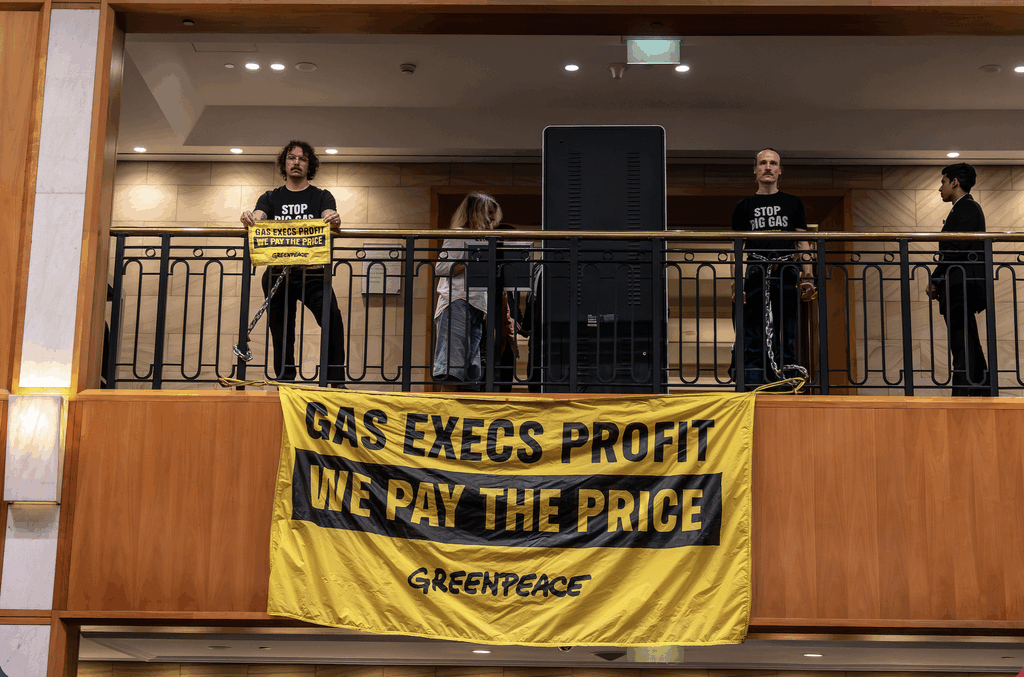
Right now, Greenpeace activists are standing up to Big Gas at a major gas conference in Sydney.
Inside the Sheraton Grand Hotel, executives from fossil fuel companies have gathered alongside lobbyists, investors and political allies to plan the future of gas in Australia – and how to maximise their profits.
So Greenpeace has stepped in to call it out. Activists have dropped a banner inside the venue with a clear message: Gas Execs Profit. We Pay The Price.
We need your help to spread the message that we won’t stand by and let this happen.
What’s really going on
Gas corporations are making billions in windfall profits from global conflicts – from Ukraine to Iran – while Australians pay the price with higher energy bills and climate damage.
And they want more.
More drilling. More exports. More profit.
Why Greenpeace took action today
This conference is where it all comes together. Behind closed doors, gas executives, lobbyists, investors and political allies are meeting to push for more gas expansion, no doubt using global instability as their justification.
That’s why Greenpeace couldn’t let this gathering go uninterrupted.
Big Gas is counting on people not paying attention. Let’s prove them wrong.
Share the video to call out Big Gas.
What needs to happen now
Gas is expensive. It’s volatile. And it ties our energy system to global instability.
But there is a better way. Renewable energy is already cheaper, more reliable, and made right here in Australia. It’s the fastest path to lower bills, real energy security and a safer climate.
To get there, we need to:
- properly tax the gas industry and its exports
- stop expanding gas
- and speed up the transition to homegrown renewable energy.
Share this video far and wide to show just how much support there is to tax Big Gas properly and speed up the transition to renewable energy.
This is just the beginning
This action is part of a growing movement to stand up to Big Gas and challenge the power it holds over our government and society. The Federal Government has a role to play – starting by taxing gas corporations properly and then accelerating the transition to homegrown renewable energy.
Together, we can show just how much support there is for change and make it impossible for decision-makers to ignore.
What you can do
- Follow along on our social channels.
- Share the video far and wide to show how much support there is.
- Sign the petition to tell Albo to stand up to Big Gas – because if we can, he can.
BREAKING: Greenpeace activists disrupt major gas conference in Sydney
SYDNEY, Tuesday 31 March 2026 — Two Greenpeace Australia Pacific activists have been arrested following a peaceful protest at the Australian Domestic Gas Outlook conference in Sydney, where they dropped a banner that said — “Gas Execs Profit. We Pay The Price” and held banners saying “Tax Gas Profits”.
Photos and B Roll video of the protest and arrests are available here
Live updates on Greenpeace Instagram
The two activists were arrested by police around 9:00am AEDT and taken to Day Street Police Station. Information on this morning’s gas conference disruption can be found here.
Solaye Snider, Campaigner at Greenpeace Australia Pacific, said: “Greenpeace activists have taken a strong stand today against profit hungry gas corporations and lobbyists, who see horrific global wars as an opportunity to price gouge and profiteer, while everyday people pay the price.
“Australians have had enough of gas corporations like Santos and ConocoPhillips ripping us off, leaving us with nothing but empty pockets and climate damage. The gas industry is aggressively lobbying against being fairly taxed and pushing to drill for more gas. Change requires showing up and speaking out, and that’s what these activists have done today.
“Greenpeace Australia Pacific stands by our activists, and stands with all communities who are peacefully fighting for a safe and clean energy future. The right to peaceful protest is a fundamental pillar of a healthy democracy and a basic right of all Australians.”
-ENDS-
Media contacts:
Lucy Keller: +61 491 135 308 or lkeller@greenpeace.org or Kate O’Callaghan: +61 406 231 892 or kate.ocallaghan@greenpeace.org
Greenpeace activists arrested after disrupting major gas conference in Sydney



-
Greenhouse Gases8 months ago
Guest post: Why China is still building new coal – and when it might stop
-
Climate Change8 months ago
Guest post: Why China is still building new coal – and when it might stop
-

 Greenhouse Gases2 years ago
嘉宾来稿:满足中国增长的用电需求 光伏加储能“比新建煤电更实惠”
-
Climate Change2 years ago
Bill Discounting Climate Change in Florida’s Energy Policy Awaits DeSantis’ Approval
-

 Climate Change2 years ago
嘉宾来稿:满足中国增长的用电需求 光伏加储能“比新建煤电更实惠”
-
Climate Change Videos2 years ago
The toxic gas flares fuelling Nigeria’s climate change – BBC News
-

 Renewable Energy5 months ago
Sending Progressive Philanthropist George Soros to Prison?
-

 Carbon Footprint2 years ago
US SEC’s Climate Disclosure Rules Spur Renewed Interest in Carbon Credits