

Although his legislation failed, the late Connecticut Senator and one-time vice presidential candidate kept attention on the issue after the U.S. withdrawal from the Kyoto protocol.
Senator Joseph Lieberman did more than perhaps any member of Congress to seek a middle ground solution on climate change—an effort that, had it succeeded, would have put the United States at least 20 years ahead of where it is today in cutting greenhouse gas emissions.

Delegates will soon gather in the Turkish resort city of Antalya for UN climate negotiations, against a backdrop of war, energy crisis and climate extremes.
At COP31, nations will try to find agreement on various issues, including climate finance for developing countries and a global “just transition” towards a cleaner economy.
This summit is unusual due to its joint presidency, which means that Australia is leading the negotiations while Turkey hosts the conference.
Outside the formal negotiations, Turkey is also pushing its own priorities as part of a wider “action agenda”, including electrification, oceans and “green industrialisation”.
In order to track parties’ positions on key negotiating points and wider issues at COP31, Carbon Brief has analysed around 100 documents and captured them in the interactive table below.
The first column shows the countries and UN negotiating blocs, the second shows the topics up for debate and the third indicates specific issues within those topics.
The final column indicates the positions that the parties have expressed on each topic. These range from “priority” – meaning the party is likely to be pushing the issue – to “oppose”, meaning it is likely to push against it.
This is a “living document” that will be updated over the course of COP31.
Please get in touch if you would like to offer additions by emailing policy@carbonbrief.org.
Brief explanations of the key issues and jargon-filled language that permeate the talks can be found below the interactive table.
Just transition
At COP30 in Brazil in 2025, nations agreed to establish a practical mechanism to help drive a “just transition” to a low-carbon economy.
Key aspects of this “Belém-Antalya mechanism” (BAM) – often referred to as the “just transition mechanism” (JTM) – were agreed during the June climate negotiations this year, but many details are missing and dividing lines remain between parties.
Parties have disagreed about the scope of the mechanism and whether it should be tied to the provision of finance.
Nevertheless, following progress in June within the “just transition work programme” (JTWP), civil society groups highlighted that getting the mechanism up and running is a “key expected outcome” from COP31.
Climate finance
Climate finance is always a highly contested issue at UN climate negotiations.
Developing countries have successfully pushed for a “work programme” on climate finance to feature on the conference agenda.
These parties see this programme as a way to pressure developed countries into providing more funding from their public coffers, specifically under Article 9.1 of the Paris Agreement. Some are even proposing a “burden sharing” arrangement for climate-finance provision.
This comes against a backdrop of major donors cutting their aid budgets and the Trump administration in the US pressuring multilateral development banks (MDBs) to drop their climate objectives.
Developed countries, which have traditionally been responsible for providing finance, would prefer to keep a broader focus on issues such as improving access to existing finance and broadening the range of donors. Some developing countries, such as small-island states, also support these goals.
Nations have also been discussing Article 2.1c of the Paris Agreement under the “Veredas dialogue”. This focuses on making all global “financial flows” consistent with climate action.
Countries have different views about what this involves, with developing countries again hoping to keep the focus on developed countries’ responsibilities to financially support them.
Adaptation and mitigation
At negotiations in June, parties were unable to agree on the details of a “global goal on adaptation” (GGA), which is intended to drive climate adaptation worldwide.
Having agreed at COP30 on a list of 59 “indicators” – ways to assess progress towards the GGA – nations now need to refine these before COP32 in Addis Ababa, Ethiopia. This is a highly technical process that involves a taskforce working out how to use and track these indicators.
Broadly, developing countries stress the importance of finance to fund adaptation efforts, rather than simply to track progress. They also want reassurances about a pledge made last year to “triple adaptation finance”.
At the June climate negotiations, negotiators also failed to make any progress when discussing the mitigation work programme (MWP) – the only formal agenda item that concerns cutting greenhouse gas emissions.
Among other things, parties disagreed on whether the MWP should continue running over the next few years, or simply be brought to a close.
Global stocktake and NDCs
Back in 2023, the first “global stocktake” (GST) of the Paris Agreement set out the state of climate action and what needed to be done to set the world on course.
On mitigation, nations agreed to a package of measures, including “transitioning away from fossil fuels”, tripling renewable energy and “halting and reversing deforestation” by 2030.
Some of these outcomes remain contentious among certain parties, particularly large, developing countries and those with economies that rely on fossil-fuel exports.
Developing countries have persistently argued that they need more climate finance to implement the global stocktake outcomes.
Parties were meant to update their climate plans under the Paris Agreement, informed by the first global stocktake, by 2025. These plans, known as nationally determined contributions (NDCs), cover the period out to 2035.
So far, only 150 parties – responsible for three-quarters of global emissions – have submitted new NDCs.
Iran, Vietnam, Egypt and Argentina are among those without new NDCs – and the US has withdrawn its climate plan under the Trump administration.
Some parties, such as the EU, have stressed the need for countries to submit their new NDCs ahead of COP31 – and to ensure they are aligned with the 1.5C temperature limit.
COP31 will also see the launch of the second global stocktake, which will conclude in 2028.
Action agenda and other issues
Turkey will be pushing its “action agenda” priorities at COP31, including global targets for electrification, reducing waste and reducing building-sector emissions.
(The Australian “presidency of negotiations” is intending to pursue a “cover text” decision at COP31 that may capture some of these wider targets, such as the electrification goal.)
The action agenda is meant to provide a complementary track to the formal negotiations, where governments and non-state actors can advance specific, real-world solutions.
A new COP31 presidency effort dubbed the “climate implementation bridge” is also meant to complement these ambitions by turning NDC goals into an “investable project portfolio”
Some parties have explicitly signalled their support for various elements beyond the formal negotiations, in the run-up to COP31.
For example, a joint letter signed by 105 parties called for COP31 to “put the ocean at the heart of climate action” by embedding ocean-based climate action in the UNFCCC architecture.
The post Interactive: Who wants what at the COP31 climate change summit appeared first on Carbon Brief.
Interactive: Who wants what at the COP31 climate change summit
Prepared by a coalition of nine Western Australian union, industry, conservation, and community organisations—including UnionsWA, the Conservation Council WA, and the Smart Energy Council—the WA Clean Energy, Jobs & Industry Plan provides a practical roadmap to transform Western Australia into a clean energy powerhouse while creating thousands of secure local jobs.
Western Australia stands at a pivotal crossroads: lead the global clean energy economy or watch investment, future industries, and secure jobs go elsewhere. The WA Clean Energy, Jobs & Industry Plan outlines a transformative blueprint to harness the state’s world-class solar and wind resources. Discover how legislated renewable targets, green iron manufacturing, and a dedicated regional training strategy can generate tens of thousands of local jobs, lower household bills, and build a resilient, net-zero future for all Western Australians.

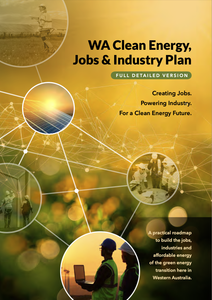
WA needs a clear and forward-thinking plan if it is going to become a competitive renewable energy powerhouse and maintain its economic strength through the energy transition.
“Western Australians know a faster renewable energy transition will lower their household expenses and prevent harmful climate pollution. But the community also needs clear direction to ensure this transition will create jobs, lower costs and not cause undue environmental harm.
“Here, sectors representing a broad range of interests have laid the groundwork for those outcomes, clearly outlining what is needed to create a future for WA that is good for the environment, for the climate, for workers and for the economy.
Summary
The WA Clean Energy, Jobs & Industry Plan sets out a strategic roadmap to position Western Australia as a global clean energy superpower while creating thousands of secure local jobs.
The report establishes three overarching goals:
- Creating local employment.
- Maintaining industrial competitiveness.
- Lowering household energy costs
To realize this vision, the framework details actionable measures to follow on from the recent WA Government announcement of a 75% Renewable Energy Target by 2031 for the South West Interconnected System. This includes developing a statewide Renewable Energy Target, coordinating statewide workforce and training pipelines, strategically planning regional infrastructure to safeguard high-value biodiversity and cultural heritage, and ensuring equitable benefit-sharing through household electrification incentives and First Nations equity partnerships. Ultimately, the plan highlights that establishing clear policy and regulatory certainty will unlock lower energy bills, boost power reliability, and secure the state’s global competitiveness in emerging green commodity export markets.

Key Findings
- Statewide Renewable Energy Target and Emissions Reduction Targets: The report calls for a statewide RET and 1.5°C aligned emission reduction targets to remove policy risk, lower capital costs, and attract clean energy investment.
- Transformative Job Creation: Accelerating the transition offers massive employment prospects, including up to 8,800 solar and battery jobs by 2050, as well as 24,000 ongoing and 11,000 construction jobs in a commercial green iron industry.
- Industrial Electrification & Competitiveness: Requiring large gas users to adopt binding electrification timetables and providing concessional financing will protect existing energy-intensive manufacturers from rising energy costs and impending domestic gas shortfalls.
- Green Commodity Export Leadership: Western Australia can build new export markets in green iron, green ammonia, and offshore oil/gas decommissioning by constructing shared common-user infrastructure and setting dedicated Green Commodity Export Targets.
- Coordinated Workforce & Training Pipeline: To address critical skill shortages the plan recommends establishing a WA Clean Energy Jobs Plan 2050, three regional training hubs, and dedicated pathways for female and under-represented apprentices.
- Environmental Safeguards & Community Benefits: Fast-tracked development must be paired with State Planning Policies that avoid high-biodiversity and cultural heritage lands, mandate new data centres to run on additional renewable power, and deliver household electrification rebates and First Nations equity partnerships.
What you can do
WA has an opportunity to lead on sustainable, clean energy and associated industries. You can help by:
- Sending an email to Environment Minister Murray Watt and Prime Minister Anthony Albanese, calling on them to reject Browse.
- Sharing this story to help more Australians understand what’s at stake.
- Encouraging your friends and family to take action.