

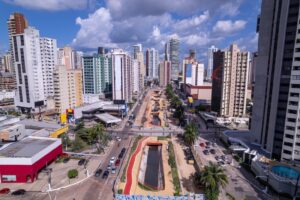
The centrepiece of every UN climate summit is for countries to negotiate the wording of a large number of legal agreements – and COP30 in the Brazilian city of Belém is no different.
These texts are hashed out behind closed doors in the “blue zone” at the COP, where diplomats from nearly 200 nations haggle over every paragraph and each individual verb.
Over the course of the two-week summit, negotiators will be trying to reach consensus on more than 100 separate agreements – but, first, they must agree which issues are on the agenda.
The complexity of this process can make it challenging to keep track of what countries are fighting about and how negotiations are progressing.
Carbon Brief’s real-time text tracker, below, offers a helping hand by decoding the agenda and keeping a searchable record of every document for each part of the negotiations.
The first column of the interactive tracker lists the topic of each agenda item, with further columns including dates, page counts and links to the original PDFs.
The table is searchable via the interactive text box and can be sorted using the arrow icons.
Key negotiations at COP30 include those on the “global goal on adaptation”, as well as the question of whether or how to reform the COP process itself, a discussion that appears on the agenda under the innocuous heading: “Arrangements for intergovernmental meetings.”
While most of the items on the agenda are agreed in advance, parties can suggest late additions. These must be signed off before negotiations can begin, often resulting in an “agenda fight”.
Recent negotiations have all started with an agenda fight over two proposals from the Like-Minded Developing Countries (LMDCs) – a group that includes China, India and Saudi Arabia.
The LMDC proposals relate to the provision of climate finance by developed countries – under Article 9.1 of the Paris Agreement – and to what they describe as “unilateral trade measures”, a term understood to include the EU’s carbon border adjustment mechanism (CBAM).
The LMDCs have asked again that these issues be included on the agenda at COP30.
Ahead of the opening of the summit, Carbon Brief’s text tracker counts 111 substantive items on the agenda, not including procedural matters, such as the election of COP officials.
However, it is likely that not all of these items will ultimately end up being included.
The figure below illustrates the status of the COP30 negotiations overall, in a traffic-light format. Each agenda item is colour-coded according to its current status.
For topics shown in red, negotiators have not yet managed to put anything down on paper, perhaps because parties have fundamentally different views on how they should proceed.
For items in orange, negotiators are working on an “informal text”, which is an early draft setting out the views of different parties, but not yet expressed in formal legal language.
Once a draft legal agreement becomes available, topics will be colour-coded yellow. At this point, areas of remaining disagreement will be denoted in the text with [square brackets] and “options”.
As such, texts with many square brackets or options tend to be an indicator of a high level of disagreement between parties within this negotiation track. For this reason, the tracker table above counts and displays the number of outstanding brackets and options in each document.
During the course of the summit, negotiators may work through multiple iterations of text on each agenda item. These documents may include “bridging text”, designed to resolve differences of opinion and to find a “landing zone” that all groups can agree on.
Agreement is reached on a given topic once all brackets and options have been resolved, at which point the issue will be coloured green in Carbon Brief’s traffic-light chart.
Where agreement cannot be reached, discussions may be subject to “rule 16”, meaning negotiations are postponed until the next session. These topics are colour-coded grey.
The figure below gives an at-a-glance overview of the status of the main topics up for negotiation.
As parties narrow down the options and brackets towards the end of each summit, they start to generate “clean” texts, which contain no areas of disagreement and can be converted into “draft decisions” that are ready for formal adoption at the closing plenary of the meeting.
Finally, at the closing plenary, each draft decision must be gavelled through by the COP president, signifying its formal adoption as a legal agreement and outcome of the summit.
This last step is usually a formality, but dramatic exceptions are possible.
During the closing plenary at COP29, the president of the meeting failed to adopt a deal relating to the “global stocktake” from 2023, which had called for “transitioning away” from fossil fuels.
Carbon Brief also ran text trackers for COP28 and COP29.


The post Interactive: Tracking negotiating texts at the COP30 climate summit appeared first on Carbon Brief.
Interactive: Tracking negotiating texts at the COP30 climate summit

Climate Change
Greenpeace delivers 47 metre-long petition with half a million signatures to Woodside HQ following major gas protest
Greenpeace delivers 47 metre-long petition with half a million signatures to Woodside HQ following major gas protest
PERTH, Monday 19 October 2026 — Dozens of Perth community members delivered a giant petition, signed by almost half a million people, to Woodside’s corporate headquarters this morning, calling on the government to save Scott Reef from Woodside’s reckless Browse gas proposal.
Dressed in sea creature costumes and hats, supporters carried one of Australia’s biggest environmental petitions to Woodside’s headquarters, and a local choir performed a ‘Scott Reef’ rendition of Angie McMahon’s iconic cover of ‘Reckless’ by Australian Crawl.
On the sidelines of the Perth Global Citizen Now event, it comes following a two day-long protest at Woodside’s Scarborough gas platform that saw activists scale and occupy the Floating Production Unit calling to “Stop Woodside’s Dirty Gas” and “Save Scott Reef”. The activists were taken from the platform by police helicopter on Sunday afternoon.
David Ritter, CEO at Greenpeace Australia Pacific, said: “Less than a day after two Greenpeace Australia Pacific activists were arrested for their peaceful protest at Woodside’s Scarborough gas platform to save Scott Reef, we are here again with another message to Woodside: half a million of us do not want your dirty gas at Scott Reef.
“Community pressure on Woodside is rising. Today we are here to show Woodside that they can’t ignore half a million people who want Scott Reef protected, not turned into an industrialised gas zone.
“Woodside can’t be trusted with our oceans. Woodside’s plans to drill up to 57 toxic wells at Scott Reef, Australia’s largest oceanic reef, putting endangered pygmy blue whales at risk, and jeopardising a nesting ground for unique green sea turtles.
“We Australians love our oceans and this is an opportunity for our governments to do the right thing, to reject Woodside’s reckless drilling plans, and save Scott Reef.”
-ENDS-
Media contact
Kate O’Callaghan on +61 406 231 892 or Emma Sangalli on +61 431 513 465
Climate Change
Greenpeace Australia Pacific activists in police custody after two-day protest against Woodside’s Browse gas project at Scott Reef
PERTH, Sunday 18 October 2026 — Two Greenpeace Australia Pacific activists are in police custody after occupying a gas platform at Woodside’s Scarborough gas project, in peaceful protest of the fossil fuel corporation’s plans to drill for oil and gas at Scott Reef.
NEW footage and photos of the peaceful protest available here and on Instagram
The activists used specialised climbing equipment to scale and attach themselves to a Floating Production Unit (FPU), a key piece of gas processing infrastructure at the Scarborough gas field over 200km off the coast of Exmouth, at around 05:45am AWST on Saturday and proceeded to occupy the platform for two days, displaying banners reading “Stop Woodside’s Dirty Gas. Save Scott Reef.”
Special police forces landed a helicopter on the FPU at around 11:30am AWST. The activists safely removed themselves from their equipment before being taken into police custody around 1:00pm AWST. At the time of writing, no charges have been laid.
David Ritter, CEO at Greenpeace Australia Pacific, said: “It takes guts and conviction to do what our activists have done, peacefully protesting Woodside’s reckless gas plans at Scott Reef.
“Woodside’s plans to drill up to 57 toxic wells at Scott Reef are outrageous. If allowed to go ahead Woodside would turn Scott Reef, Australia’s largest oceanic reef, home to nesting green sea turtles and elusive pygmy blue whales, into an industrial gas zone. Around half a million people have called on our governments to stop Woodside and to save Scott Reef.
“Our activists are highly trained and experienced in these activities. West Australia has a proud history of peaceful, democratic protest at sea, to protect our oceans from environmental threats. From whaling in Albany in the seventies, to Woodside’s threat to Scott Reef today, there’s more than fifty years of history, of Greenpeace taking action off WA’s coast to protect the places we love.
“Peaceful protest has long been part of what has given us so many of the things that are great about Australia and is part of the fabric of our democracy and our national identity.”
“The right to peaceful protest is fundamental to a healthy democracy. From Australia to the Arctic and the Amazon, Greenpeace has been peacefully protesting for more than 50 years to expose the biggest environmental threats around the world. We will not be silenced by corporations like Woodside who actively try to stop everyday people from speaking out against their reckless plans.
“Woodside’s reckless proposal to drill at Scott Reef is an unacceptable risk to Scott Reef and to the climate, which our government should emphatically reject.”
Speaking from the Rainbow Warrior, Captain of the Rainbow Warrior Hettie Geenen, said:
“It felt powerful watching from the Rainbow Warrior as these brave activists scaled Woodside’s enormous and imposing gas infrastructure, which has no place at Scott Reef. We are all out here because we feel an urge to act, in the face of Woodside’s grave threat to Scott Reef and to our climate. Now we ask for the Australian government to act too, and reject Woodside’s reckless Browse project.
“Just before this peaceful protest, the Rainbow Warrior sailed to Scott Reef, where our whole crew got to witness the magic of an untouched, healthy reef ecosystem full of marine life. It was my second time visiting Scott Reef with the Rainbow Warrior. When you see Scott Reef up close and witness its magic first hand, it is impossible not to feel driven to try and protect it.”
The activists sailed to Scarborough on the Rainbow Warrior, Greenpeace’s flagship vessel, which is in the region campaigning to protect Australia’s oceans, including Scott Reef.
-ENDS-
Media contact
Greenpeace Australia Pacific media team in Perth on +61 406 231 892 or +61 407 581 404 or email media.au@greenpeace.org
Climate Change
GREENPEACE GAS PROTEST DAY TWO: Activists spend first night on Woodside’s Scarborough gas platform, “in this for the long haul”
- NEW footage and photos available here and on Instagram – more being uploaded today.
- Interviews available with campaigners on board the Rainbow Warrior on request.
Greenpeace Australia Pacific activists have slept overnight on Woodside’s Floating Production Unit and dropped a massive 12×14-metre banner reading “Stop Woodside’s Dirty Gas. Save Scott Reef”.
Two activists have set up temporary hanging tents on the South East pillar, while the other two returned to the Rainbow Warrior late yesterday afternoon, after fulfilling their initial role. The activists will occupy the platform for as long as possible.
The environmental advocacy group is peacefully protesting Woodside’s plans to drill for oil and gas at Scott Reef as part of its Browse proposal.
Sakyo Noda, one of the Greenpeace Australia Pacific activists, said: “As a Japanese person living in Australia, I feel incredibly passionate about stopping Australia’s gas exports to Asia.
“Despite what the gas industry tells us, Australia’s gas is not helping to decarbonise Asia. It is simply not true. We shouldn’t be allowing fossil fuel companies like Woodside to extract new fossil fuels, let alone at extraordinary places like Scott Reef”.
Aboard the Rainbow Warrior, Geoff Bice, WA Campaign Lead at Greenpeace Australia Pacific, added, “Everyone is in good spirits. We’re in it for the long haul.”
Links:
Photos and video of Scott Reef here
Audio and footage of yesterday’s press conference here
Content and live updates will be uploaded to a live blog and Instagram
In-person interviews in Perth with David Ritter, CEO of Greenpeace Australia Pacific, can be organised. Dial-in, SimSat and Zoom interviews with Geoff Bice, WA Campaign Lead at Greenpeace Australia Pacific, currently aboard the Rainbow Warrior, can be organised.

Greenpeace delivers 47 metre-long petition with half a million signatures to Woodside HQ following major gas protest

Dictators
Greenpeace Australia Pacific activists in police custody after two-day protest against Woodside’s Browse gas project at Scott Reef
-
Climate Change1 year ago
Guest post: Why China is still building new coal – and when it might stop
-

 Greenhouse Gases2 years ago
嘉宾来稿:满足中国增长的用电需求 光伏加储能“比新建煤电更实惠”
-
Greenhouse Gases1 year ago
Guest post: Why China is still building new coal – and when it might stop
-

 Climate Change2 years ago
嘉宾来稿:满足中国增长的用电需求 光伏加储能“比新建煤电更实惠”
-

 Renewable Energy12 months ago
Sending Progressive Philanthropist George Soros to Prison?
-
Climate Change2 years ago
Bill Discounting Climate Change in Florida’s Energy Policy Awaits DeSantis’ Approval
-
Greenhouse Gases1 year ago
嘉宾来稿:探究火山喷发如何影响气候预测
-
