

The head of the United Nations body governing the global shipping industry has said that greenhouse gases from the global shipping industry will fall, whether or not the sector’s “Net Zero Framework” to cut emissions is adopted in October.
Arsenio Dominguez, secretary-general of the International Maritime Organization, told a new year’s press conference in London on Friday that, even if governments don’t sign up to the framework later this year as planned, the clean-up of the industry responsible for 3% of global emissions will continue.
“I reiterate my call to industry that the decarbonisation has started. There’s lots of research and development that is ongoing. There’s new plans on alternative fuels like methanol and ammonia that continue to evolve,” he told journalists.
He said he has not heard any government dispute a set of decarbonisation goals agreed in 2023. These include targets to reduce emissions 20-30% on 2008 levels by 2030 and then to reach net zero emissions “by or around, i.e. close to 2050”.
-
US-led alliance wins a year’s delay in adoption of green shipping deal
The IMO’s Net-Zero Framework will be up for approval again in October 2026, after the US and Saudi Arabia persuaded countries not to vote on it as planned -
Big fishing nations secure last-minute seat to write rules on deep sea conservation
A treaty to protect the high seas entered into force this week with the backing of over 80 countries including late ratifications by Japan, China and Brazil


Dominguez said the 2030 emissions reduction target could be reached, although a goal for shipping to use at least 5% clean fuels by 2030 would be difficult to meet because their cost will remain high until at least the 2030s. The goals agreed in 2023 also included cutting emissions by 70-80% by 2040.
In October 2025, a decision on a proposed framework of practical measures to achieve the goals, which aims to incentivise shipowners to go green by taxing polluting ships and subsidising cleaner ones, was postponed by a year after a narrow vote by governments.
Ahead of that vote, the US threatened governments and their officials with sanctions, tariffs and visa restrictions – and President Donald Trump called the framework a “Green New Scam Tax on Shipping”.
Dominguez said at Friday’s press conference that he had not received any official complaints about the US’s behaviour at last October’s meeting but – without naming names – he called on nations to be “more respectful” at the IMO. He added that he did not think the US would leave the IMO, saying Washington had engaged constructively on the organisation’s budget and plans.
EU urged to clarify ETS position
The European Union – along with Brazil and Pacific island nations – pushed hard for the framework to be adopted in October. Some developing countries were concerned that the EU would retain its charges for polluting ships under its emissions trading scheme (ETS), even if the Net Zero Framework was passed, leading to ships travelling to and from the EU being charged twice.
This was an uncertainty that the US and Saudi Arabia exploited at the meeting to try and win over wavering developing countries. Most African, Asian and Caribbean nations voted for a delay.
On Friday, Dominguez called on the EU “to clarify their position on the review of the ETS, in order that as we move forward, we actually don’t have two systems that are going to be basically looking for the same the same goal, the same objective.”
He said he would continue to speak to EU member states, “to maintain the conversations in here, rather than move forward into fragmentation, because that will have a very detrimental effect in shipping”. “That would really create difficulties for operators, that would increase the cost, and everybody’s going to suffer from it,” he added.
The IMO’s marine environment protection committee, in which governments discuss climate strategy, will meet in April although the Net Zero Framework is not scheduled to be officially discussed until October.
The post IMO head: Shipping decarbonisation “has started” despite green deal delay appeared first on Climate Home News.
IMO head: Shipping decarbonisation “has started” despite green deal delay

Colombia’s president Gustavo Petro announced last week that his government will “withdraw from the international investment arbitration system because the courts end up resolving disputes in favor of private entities”.
The move follows an open letter to Petro from 200 international economists – among them Nobel prize winner Joseph Stiglitz and French economist Thomas Piketty – calling for the country to leave the Investor-State Dispute Settlement (ISDS) system to “ensure that it does not stand in the way of its transition away from fossil fuels”.
The ISDS system allows investors – many linked to fossil fuel projects – to sue governments in an international arbitration court over disputes. This mechanism has been used by polluting companies to challenge environmental measures.
“Why do we agree to sign contracts where, in the event of a dispute, it is a private arbitration center in the contractor’s country that ultimately decides whether our country is in the right or not, and, generally speaking, we lose?” Petro said on March 25.
-
British company forces Italy to pay €190m for offshore oil ban
Rockhopper used the Energy Charter Treaty to sue the Italian government for foregone profits and plans to invest the compensation in further drilling -
Governments risk $340bn in legal claims for limiting oil and gas projects, study finds
Investors could use obscure treaties to lock countries into polluting energy systems and delay climate action, researchers warn -
Iran war could boost fossil fuel phase-out push, says Colombian minister
Colombia’s environment minister Irene Vélez Torres said she hopes that a new fossil fuel phase out summit in Santa Marta can cement a coalition of countries


The Colombian president added that several other countries, including the United States, have left or are in the process of leaving this system. In Europe, for example, many governments have started the process of leaving the Energy Charter Treaty, an energy investment mechanism, in an attempt to prevent it from shielding fossil fuel projects.
“I undoubtedly believe we have opened a global debate, not just a Colombian one”, he told an event in Bogota held to launch a report on his government’s economic reforms and their results.
Signatories to the open letter celebrated the move but warned that withdrawing from the system is a complex process and would be easier if it was coordinated with other countries, particularly those in the Global North.
Kyla Tienhaara, Canada Research Chair in Economy and Environment and Associate Professor at Queen’s University, said “it would be preferable for ISDS access to end immediately, which means coordinated action among states.”
She added that such a “coalition of the willing” could set terms on ending treaties in an efficient way, or modify them in a way that removes ISDS protections.
Mario Osorio, Research Fellow at the American think tank Center for Economic Policy and Research (CERP) and also a signatory of the open letter, said in a statement that he hoped that Colombia will now “help to lead other countries in exiting ISDS”, which has “too often stood in the way of needed measures to mitigate climate change”.
High exposure to lawsuits
Harro van Asselt, professor of Climate Law at the University of Cambridge, told Climate Home News that it remains unclear how the Colombian government is planning to cut ties with the ISDS system, but it could include re-negotiating or terminating existing investment agreements.
If the country seeks to terminate treaties – which van Asselt said is the more “nuclear” option – it could trigger so-called “sunset clauses”, which allow investors to still access ISDS for a period of 5 to 20 years after the agreements have been ceased. These clauses can be cancelled if both parties agree to it.
A 2025 paper by researchers at Boston University showed Colombia could be significantly exposed to lawsuits, as an estimated 129 oil and gas projects are covered with ISDS provisions – the most of any country in the Amazon basin.
At last year’s COP30, the country vowed to ban all oil and gas drilling in the world’s largest rainforest, which, if implemented to existing projects, could trigger multi-billion dollar lawsuits, according to the paper. In 2015, neighbouring Ecuador lost a $1.7 billion case with oil major Occidental for ending an oil concession, while Venezuela lost an $8.5bn judgement with ConocoPhillips in 2019 for nationalising oil assets.
The Colombian American Chamber of Commerce, an industry body that promotes American investments in the country, said in a statement that the move away from the ISDS system “deepens uncertainty” for investors. Its president María Claudia Lacouture added that disputes don’t arise from the system itself but from “changing rules, reduced predictability, a lack of institutional coordination, and weaknesses in preventing unlawful harm.”
Several other countries including Indonesia, South Africa, Bolivia and India have moved to cut ties with the ISDS system, while Brazil and Suriname avoided its provisions altogether in their investment deals. Tienhaara said this has not stopped investment in these countries.
However, she added that “it would be easier for Colombia (and other countries in the Global South that might be interested in following this path) if other countries, particularly from the Global North, would support them through an ISDS-free alliance”.
Ramping up support
While it is not the first country to move away from the ISDS system, experts said Colombia has an opportunity to rally other countries to follow their path, as it prepares to host the first Conference on Transitioning Away from Fossil Fuels in the Caribbean city of Santa Marta.
Van Asselt said that the country sends a “crucial” signal ahead of the conference, suggesting that to move away from coal, oil and gas governments need to look at broader reforms of international finance and investment.
Tienhaara added that “it is excellent that Colombia is showing leadership, but they should not have to”, as the ISDS system was set up by developed countries and international agencies like the World Bank, who should be leading efforts to reform it.
“In many ways, the current situation mirrors that of climate action more broadly – countries in the Global South like Colombia and the Pacific Islands are leading the transition away from fossil fuels when it should be the big polluters in the Global North taking responsibility,” she said.
The post Colombia pledges to exit investment protection system after fossil fuel lawsuits appeared first on Climate Home News.
Colombia pledges to exit investment protection system after fossil fuel lawsuits
In February, the Border Patrol requested access to Big Bend Ranch, Seminole Canyon and Bentsen-Rio Grande Valley State Parks. The access request included 14 parcels in Big Bend Ranch as first steps in a discussion of easement rights, leasing or purchasing the property.
Federal officials have already traced a path for a border barrier through multiple Texas state parks, according to documents obtained by Inside Climate News.
Climate Change
DeBriefed 2 April 2026: Countries ‘revive’ energy-crisis measures | Record UK renewables | Plug-in solar savings
Welcome to Carbon Brief’s DeBriefed.
An essential guide to the week’s key developments relating to climate change.
This week
Crisis responses
OIL SUPPLIES: The International Energy Agency (IEA) warned that oil supply disruptions will worsen in April due to the Iran war, reported CNBC. The outlet added that the IEA was considering another release of strategic oil reserves. Meanwhile, US exports of liquefied natural gas (LNG) reached an “all-time high” in March, with shipments to Asia more than doubling from the previous month, said Reuters.
‘SLOWER GROWTH’: The International Monetary Foundation (IMF) warned that “all roads lead to higher prices and slower growth worldwide” if the war continues to choke oil, gas and fertiliser supplies, reported the Guardian. The IMF said the UK and Italy were “especially exposed by their reliance on gas-fired power”, the newspaper added.
EU PREPARES: The EU is considering “reviving energy-crisis measures” it used at the start of the Ukraine war, including “grid tariffs and taxes on electricity”, according to Reuters. France is considering new actions to electrify its economy and cut dependence on fossil imports, said Le Monde. Elsewhere, BBC News rounded up crisis responses from around the world – including fuel rationing, fuel tax cuts, home working and free public transport.
COAL ‘SHORT-LIVED’: Some countries announced plans to delay coal-plant shutdowns. Italy plans to push back its coal-power phaseout to 2038, according to Reuters. Germany will review whether to reactivate reserve plants, reported Bloomberg. South Korea also extended three plants set to close this year, said the Korea Times. However, a separate Bloomberg comment piece stated that “any shift to burn more coal in 2026 will be short-lived”
Around the world
- GAS SCRAPPED?: New Zealand’s government cast doubt over plans to build an LNG import terminal as rising gas prices have worsened the economics, said the New Zealand Herald. Separately, plans for Vietnam’s largest LNG power plant may be scrapped in favour of a new renewable energy project, according to Reuters.
- PHASEOUT SUMMIT: Climate Home News reported that 46 countries – including major oil producers – have confirmed they will attend the fossil-fuel phaseout summit being held in Colombia later this month.
- INDIAN SUMMER: India is “forecast to experience higher than normal heatwave days through June, raising the risk of power shortages” as the Middle East conflict worsens energy strains, reported Bloomberg.
- AFGHANISTAN FLOODS: Heavy rainfall and floods across Afghanistan have killed at least 48 people and damaged communities, following years of drought, said Kabul Now.
- WIND BUYOUTS: In an effort to halt remaining US offshore wind projects, the Trump administration is offering buyouts to developers in exchange for fossil-fuel investments, according to the Financial Times.
66%
The annual increase in forest loss in Indonesia in 2025, according to Indonesian biodiversity thinktank Auriga Nusantara, reported by Reuters.
Latest climate research
- New research explores “patterns of distributional justice” in the mitigation scenarios used in the IPCC’s sixth assessment | npj Climate Action
- Antarctic surface melt will expand by more than 10% by 2100, if future greenhouse gas emissions continue to be high | Nature Communications
- The evolution of the urban heat island effect in Chinese cities is “not unidirectional, but depends on localised urbanisation and greening dynamics” | PNAS Nexus
(For more, see Carbon Brief’s in-depth daily summaries of the top climate news stories on Monday, Tuesday, Wednesday and Thursday.)
Captured
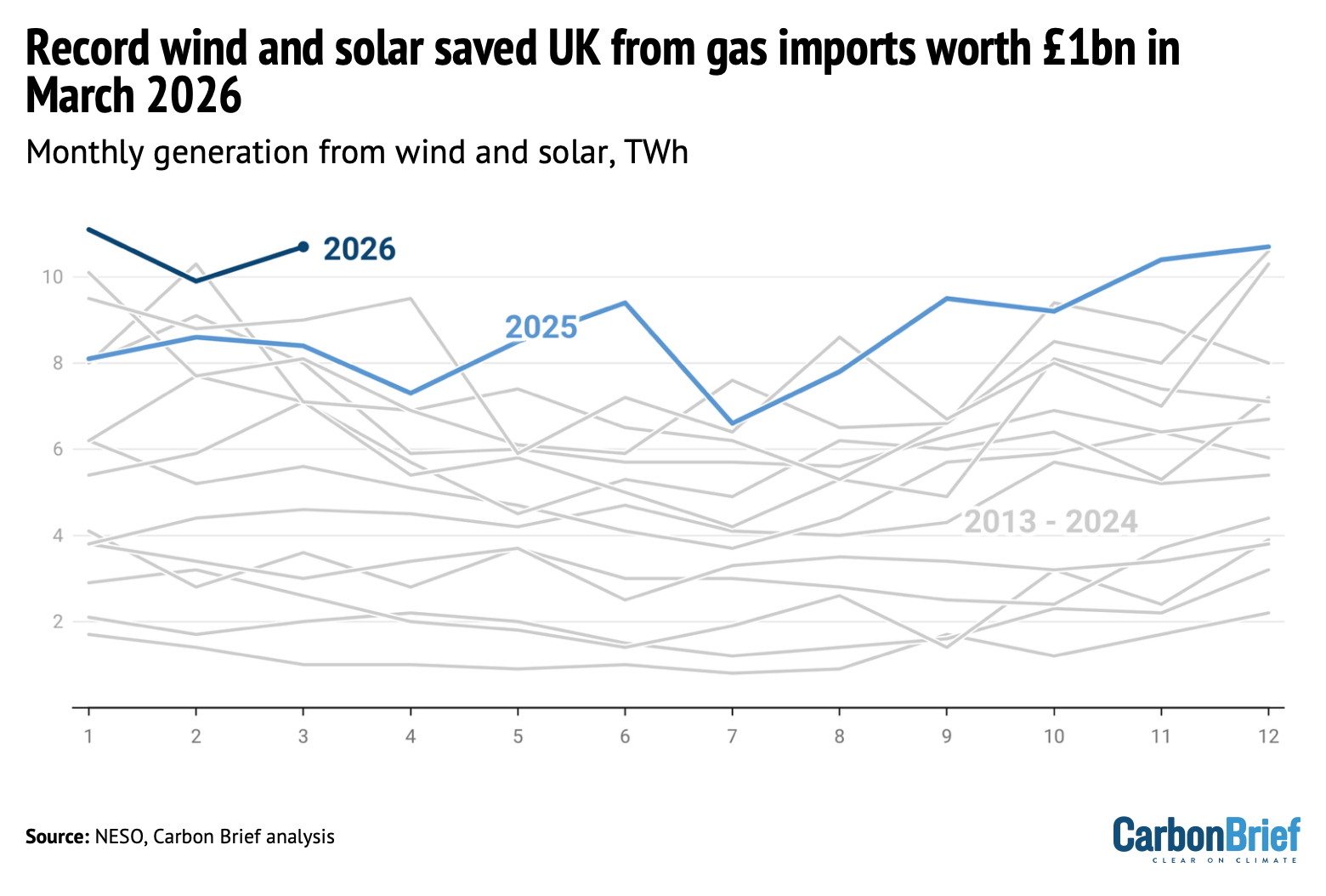
Carbon Brief analysis found that Great Britain has generated record levels of combined wind and solar output so far this year. The chart above shows monthly wind and solar output, which reached 11 terawatt hours (TWh) in March 2026. At current high gas prices, this saved the UK nearly £1bn worth of gas imports for the month, according to the analysis.
Spotlight
How ‘plug-in’ solar could reduce bills
This week, Carbon Brief analysis finds that plug-in solar panels could save a typical household £1,100 over a 15-year lifetime.
In response to the ongoing energy crisis, the UK government announced on 15 March a package of clean-energy measures to “boost” energy security. Among these was the introduction of “plug-in” solar panels to the UK.
Plug-in panels
Compared to rooftop solar, smaller plug-in solar systems consisting of one to two panels can be easily installed on balconies, in gardens and other outdoor spaces. They can be plugged directly into home sockets without the need for additional wiring, reducing electricity taken from the grid and thereby cutting bills.
Plug-in solar has already taken off in Germany, with official registrations already exceeding 1m installations (the actual number could be up to 4m). Other growing markets include France, Spain, the Netherlands and the US.
Panels could be available in the UK “within months” at retailers, such as Lidl and Sainsbury’s, according to the government. (Many of the products from EcoFlow, one of the main providers of plug-in solar in the UK, are already sold out online.)
The government said it will work with relevant bodies to update electrical regulations to allow the use of plug-in solar. The Institution of Engineering and Technology (IET) has advised homes to get their wiring checked before installing.
Costs and benefits
To assess the potential impact of plug-in solar, Carbon Brief conducted a cost-benefit analysis for an 800-watt (W) installation in a typical two-to-three bedroom home in London. The assumptions are approximate and will vary for different locations and set-ups.
Optimally placed panels – south-facing and tilted at around 40 degrees – would generate around 820 kilowatt hours (kWh) each year in London – at a “load factor” of 12% – according to the EU’s PVGIS database.
Actual output is likely to be lower, due to sub-optimal placement – such as vertically on balconies – as well as orientation and shading.
A report by trade body Solar Power Europe noted these factors could cut 30-60% from optimal output. This analysis assumes a 45% reduction from optimal output.
If a household is able to use 90% of the output – typical for such installations – then the panels would provide 400kWh of electricity each year, enough to meet 15% of typical demand.
This will vary on the household usage patterns, but running appliances such as washing machines during peak daylight hours could improve capture rates.
This could save £110 on electricity bills each year, meaning the upfront cost of around £500 could be paid back within 5 years, according to Carbon Brief’s analysis.
Assuming the panels last 15 years, total net savings over their lifetime could reach £1,100.
These savings assume a fixed unit cost of 27p/kWh, based on predictions for July 2026.
If electricity prices surged to 34p/kWh for a prolonged period – as they did during the 2022 gas price crisis – then annual savings could increase to around £140, further reducing the payback time.
If module costs fall over time as more suppliers enter the market, this could reduce the upfront cost and payback time.
If 3m households take up plug-in solar – comparable to Germany’s current deployment – this would generate 1.2 terawatt hours (TWh), less than 1% of UK demand.
While this would not significantly cut UK emissions overall, it could still save the households more than £330m in total and avoid around two tankers’ worth of imported liquified natural gas (LNG) each year, according to Carbon Brief’s analysis.
Unlocking participation
Aside from its economic benefits, plug-in solar could unlock participation in the clean-energy transition for a wider percentage of the population.
For example, renters make up around one-third of UK households and lack control over the installation of rooftop solar and heat pumps. Plug-in solar would enable them to engage in and benefit from clean energy in their homes.
This spotlight was also published on Carbon Brief’s website.
Watch, read, listen
HEAT HEADS: The BBC’s Climate Question podcast spoke to two women from Sierra Leone and Mexico about their role as “chief heat officers” for their cities.
OYSTER DIE-OFF: A feature in the Guardian explored how warming seas are causing mass die-offs of Japan’s oysters, threatening the shellfish trade.
SOLAR SWITCH: Climate Home News examined how Nigerian homes and businesses are increasingly switching from backup generators to solar power.
Coming up
- 8 April: International Energy Agency rare earth special report launch, Paris
- 10 April: Djibouti presidential election
Pick of the jobs
- Grantham Institute for Climate Change, research fellow | Salary: £49,017-£57,472. Location: London (hybrid)
- Stop Climate Chaos Scotland, advocacy lead | Salary: £35,000. Location: Scotland (remote)
- The 19th News,contract climate reporter | Salary: $50 per hour. Location: US (remote)
DeBriefed is edited by Daisy Dunne. Please send any tips or feedback to debriefed@carbonbrief.org.
This is an online version of Carbon Brief’s weekly DeBriefed email newsletter. Subscribe for free here.


The post DeBriefed 2 April 2026: Countries ‘revive’ energy-crisis measures | Record UK renewables | Plug-in solar savings appeared first on Carbon Brief.


-
Climate Change8 months ago
Guest post: Why China is still building new coal – and when it might stop
-
Greenhouse Gases8 months ago
Guest post: Why China is still building new coal – and when it might stop
-

 Greenhouse Gases2 years ago
嘉宾来稿:满足中国增长的用电需求 光伏加储能“比新建煤电更实惠”
-
Climate Change2 years ago
Bill Discounting Climate Change in Florida’s Energy Policy Awaits DeSantis’ Approval
-

 Climate Change2 years ago
嘉宾来稿:满足中国增长的用电需求 光伏加储能“比新建煤电更实惠”
-
Climate Change Videos2 years ago
The toxic gas flares fuelling Nigeria’s climate change – BBC News
-

 Renewable Energy5 months ago
Sending Progressive Philanthropist George Soros to Prison?
-

 Carbon Footprint2 years ago
US SEC’s Climate Disclosure Rules Spur Renewed Interest in Carbon Credits