

At the end of May, the leaders of Australia’s fossil fuel extraction industry and their enablers in business and government descended on the Brisbane Convention Centre for the annual Australian Energy Producers (AEP) conference.
This time Greenpeace was there to send a message they couldn’t ignore: all members of this fossil fuel lobby group are complicit in fuelling the climate crisis. For companies claiming to support climate action, it’s time to cut ties with the AEP!
With an amazing team of volunteers, we covered the conference surrounds with posters, handed out hundreds of ‘Special Program Supplements’ as people entered the venue, decorated the bathroom mirrors with some cheeky slogans to force attendees to seriously  reflect, and had our message heard in the media too!

(Keep scrolling for more photos)
And this is just the start.
Australian Energy Producers: the dodgiest fossil fuel lobby group you’ve never heard of
Though not a household name, Australian Energy Producers has an outsized influence on Australian politics. It is the peak body for the fossil fuel industry, comprising approximately 200 members who collectively produce around 95% of Australia’s oil and gas.
Since 1959, the AEP have actively opposed science-aligned climate policies that would control the pollution of the fossil fuel industry. Today, the group continues to aggressively advocate for dirty gas projects like Woodside’s North West Shelf and spend big on ad campaigns to influence public perception of fossil fuels.
Some of its members are the usual suspects: fossil fuel giants like Woodside, Shell, Santos, and Exxon-Mobil.
But you might be surprised to hear that not everyone in AEP are fossil fuel producers. Groups like UNSW, Curtin University, ANZ, PwC, EY, Deloitte and KPMG also hold membership in this profit-hungry group that lobbies for more dirty gas on their behalf.
Warning: If your company or university is a member of this fossil fuel lobby group, you are supporting a toxic industry and may even be at risk of legal action. Find out more
What did Greenpeace do at the AEP conference?
Instead of telling you exactly everything we did, why not put yourself in the shoes of the audience we hoped to reach with our creative interventions:
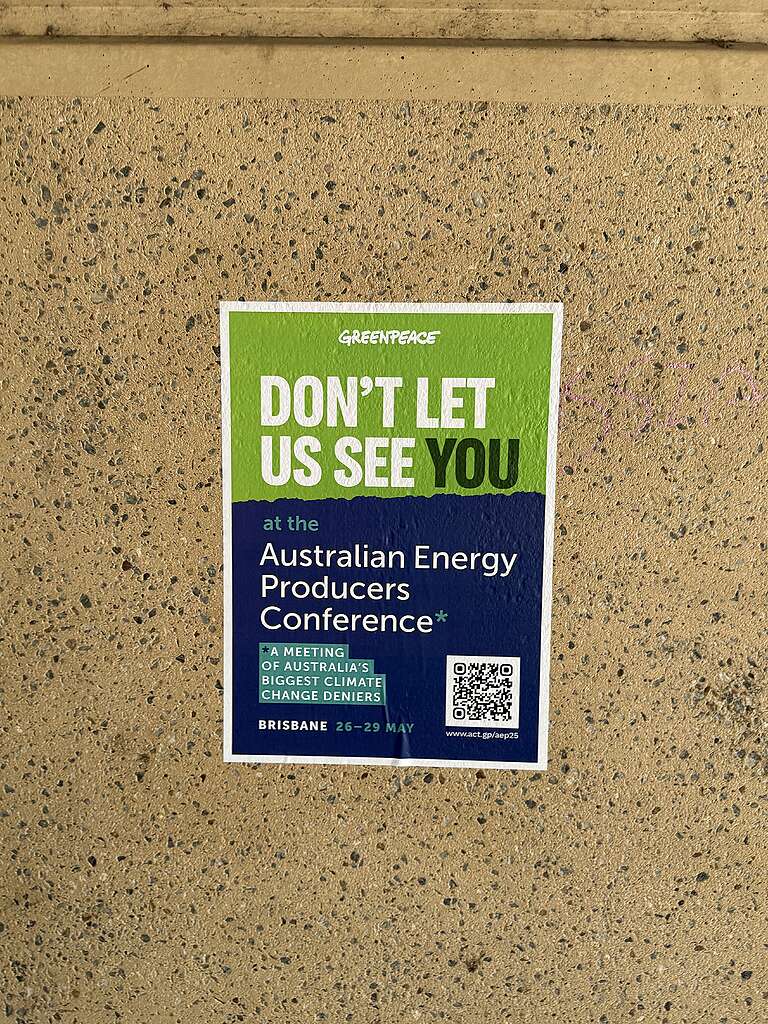
You work at an AEP member company like PwC and you’re on your way to the conference on Monday morning. Most of the time you feel pretty good about your job and your company. You’re proud of your company’s strong commitments to reaching net zero emissions and you brought your keep-cup to the event. As you search for the entrance your reflection catches you off guard on the opposite wall. It’s a Greenpeace poster embedded with a shiny mirror, calling the conference “a meeting of Australia’s biggest climate deniers.” You keep walking.
Later that day you check your LinkedIn App to see if any of your networking has paid off in new connection requests. *Sigh* only a post in your feed and a DM from Greenpeace with another dig about the fossil fuel lobby group.
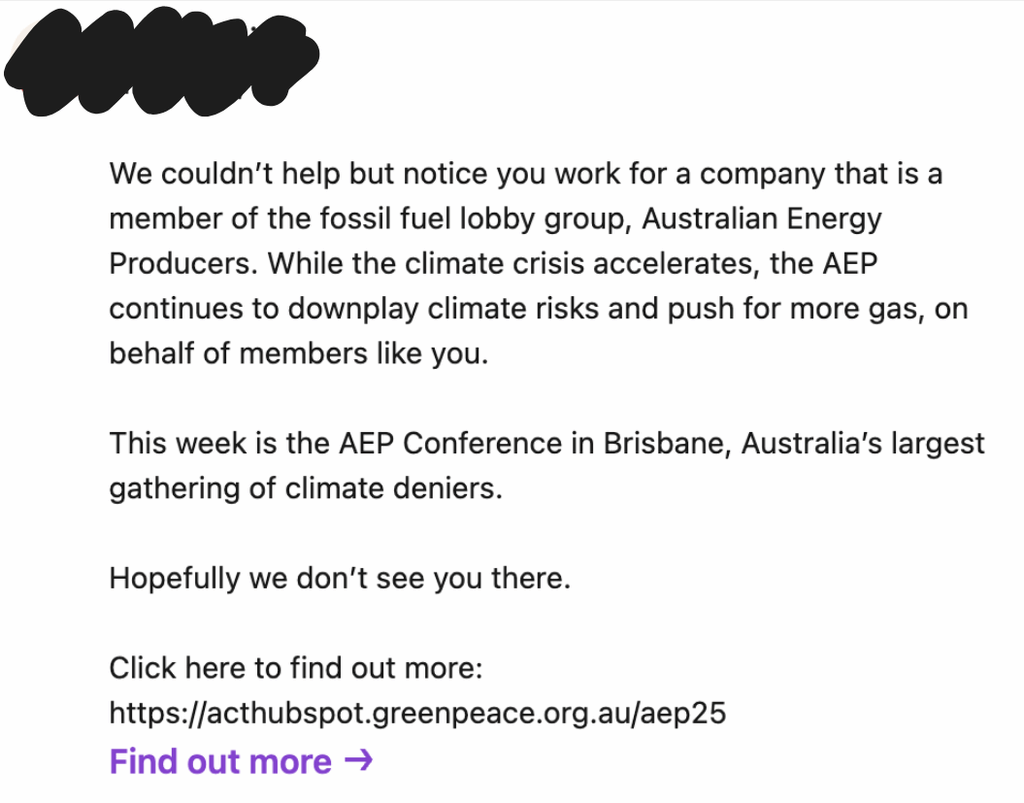
You start to feel a little uncomfortable.
Day 2:
A friendly volunteer with a suit and lanyard points you in the direction of the conference and offers you a Special Program Supplement. Great, you needed one of those!

On your way into the first session you make a pit stop in the bathroom. Washing your hands afterwards you have to rub your eyes a few times to check if you’re starting to imagine things. Nope, it’s real. Right above your reflection is a sign clear as day “I’m the problem, it’s me.”

PwC isn’t the problem though…we do our part on climate, you think! But the words sound emptier than they did before.
Once inside you take your seat and open up the program supplement.
It reads: Australian Energy Producers is a fossil fuel lobby group who is fuelling climate change. And now we have found out who is really behind them…
YOU.
Just like Big Tobacco lied about cigarettes being safe, Big Gas is lying to you about fossil fuels. Drilling for more gas is incompatible with a safe climate.
The person to your right notices the mirror in your program and leans over to take a look. You both laugh it off and roll your eyes, but you’re starting to feel a bit sick. You reach into your bag to grab a notebook and notice another “I’m the problem sticker” that’s stuck between the pages.

You’d like to get out for some air. But Woodside CEO Meg O’Neil is on a tirade blaming young people for climate change and it would be an awkward moment to stand up. You clap politely instead.
Gas is a dirty fossil fuel driving dangerous climate change
In spite of the enormous advertising budgets used by Australian Energy Producers and many of its members to make gas seem ‘clean’ and ‘natural,’ gas is a polluting fossil fuel!!! Do we need to say it louder for the people in the back?
Coal, oil and gas account for over 75% of the global greenhouse gas emissions that are driving climate change. Gas is primarily made up of methane, which is even more polluting than carbon dioxide. When burned for energy, gas produces carbon dioxide. In Australia, gas accounts for at least 21% of carbon dioxide emissions. But methane and carbon dioxide also leak out into the atmosphere at every stage of gas production and transport, and tracking technology shows that more dangerous greenhouse gasses are released than are officially measured. When the processing and transportation of liquefied natural gas (LNG) are taken into account, there’s nothing “clean” about it: gas is a more polluting fossil fuel than coal.
New gas is incompatible with the world’s goal to limit warming to 1.5 degrees
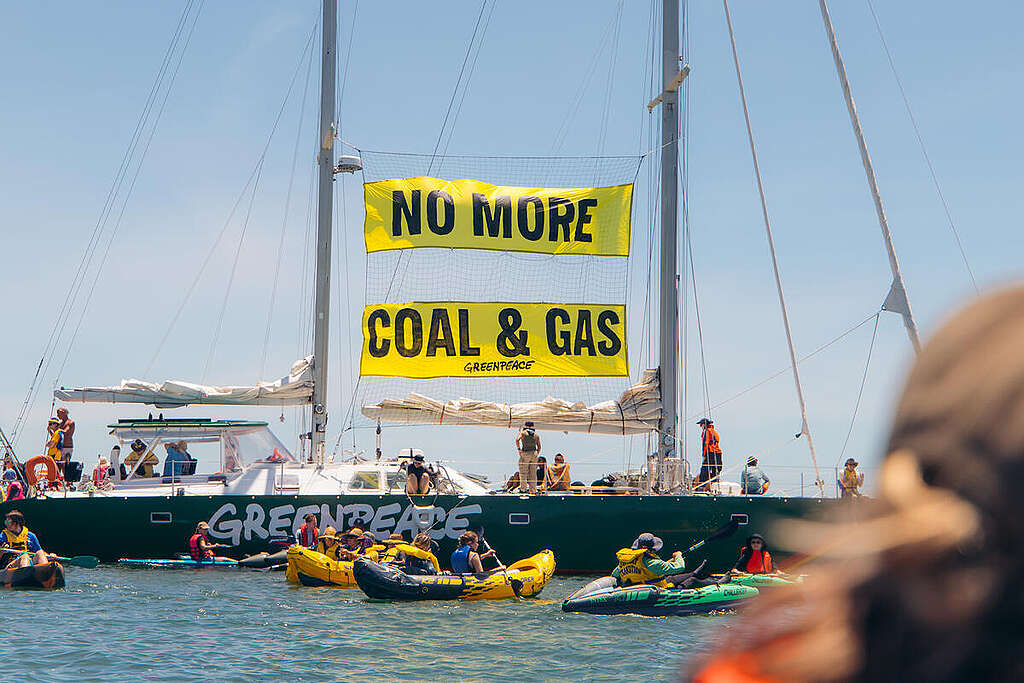
The protest sought to increase pressure on the Australian government to commit to a timeline for a fair and fast phase out away from all fossil fuels, starting with no more coal and gas.
Australia is the world’s third largest exporter of fossil fuels, and the Newcastle Port is the world’s largest coal export port. On the final day of the “protestival”, 170 people were arrested while out in their kayaks blocking the channel to prevent coal ships from passing, successfully forcing one coal ship to turn around.
While Australian Energy Producers like to say “we don’t get to net zero without natural gas” – and use this as justification for further gas expansion, the reality is we won’t get to net zero with new gas.
The International Energy Agency’s landmark Net Zero by 2050 report concluded that no new investment in oil, gas or coal is needed to reach net zero by 2050. Reaching net zero globally by 2050 is essential to limit global warming to 1.5C, in keeping with the Paris Agreement temperature goal – a legally binding international treaty on climate change which Australia is a Party to.
The Intergovernmental Panel on Climate Change has warned that existing fossil fuel projects could already push us past the 1.5C target. There is a large consensus that new oil and gas projects are fundamentally incompatible with the Paris Agreement, confirmed by the International Institute for Sustainable Development.The good news is, we don’t need to – as around 80% of Australia’s gas is currently exported, and demand for gas is falling domestically as we electrify everything and consumers look for alternatives because of high gas prices. And there is much more that can be done to reduce gas demand and power our homes and businesses with clean energy instead.
Time to quit Australian Energy Producers?
While climate change accelerates, Australian Energy Producers keep pushing fossil fuel interests. Claiming to support Net Zero while acting in ways that would make it impossible to attain simply doesn’t cut it in 2025.
Any company who is an Associate Member of AEP is complicit.
But if companies and universities want to stand on the right side of history, it’s not too late to cut ties with the AEP and cancel their membership.
We need everyone on board to support the renewable energy solutions that will power the clean transition and provide sustainable, well paid jobs, while we work together to keep fossil fuels in the ground.
Is your company an AEP member? Email us at Quit-AEP@greenpeace.org for more information on how you can raise this issue as an employee.
Not an AEP member but still concerned about its fossil fuel agenda? Sign the petition for no new fossil fuels!

Climate Change
“Sink or swim”: WA Gov hugely underestimating decline in regional gas demand while sleeping on green exports, new report finds
PERTH, Tuesday 13 October 2026 — A new report from Greenpeace Australia Pacific and Springmount Advisory reveals green commodity exports are an untapped economic opportunity for Western Australia in a declining Asian gas market, while offering a genuine solution for decarbonising Asia.
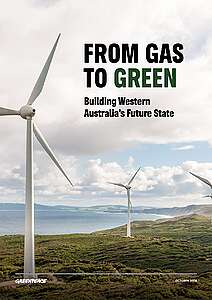
From Gas to Green: Building Western Australia’s Future State is a comprehensive analysis of the declining gas market in Asia, and the untapped economic opportunity for WA to become a global leader in green commodity exports while driving the regional shift away from fossil fuels.
The report offers key recommendations for the WA Government to support regional decarbonisation through an orderly phase out of gas exports in favour of green iron and other green exports. It comes as global climate leaders from across business, politics and advocacy prepare to meet for the Global Citizen Now: Perth event focused on decarbonising WA.
Key findings:
- Gas demand is falling across WA’s core markets in Asia: Gas demand fell in 2025 and is projected to continue to decline, driven by a combination of global geopolitical factors and domestic concerns.
- Policy shifts in key markets since the war on Iran now prioritise renewables and nuclear over gas: Japan, South Korea and China have legislated energy plans that prioritise renewables and nuclear over gas.
- New WA gas would arrive in a saturated, uncertain Asian market filled with cheaper gas: The US is now the world’s largest liquefied gas producer and plans to double its capacity as it also targets Asian markets.
- Green commodities offer a real solution to sustain WA’s economy: WA can lead Australia’s green commodity exports, which by 2060 could be worth almost a trillion dollars.
- Exporting more WA gas is likely to delay or impede Asia decarbonisation: Despite claims by the gas industry, there is no evidence that WA gas is displacing coal in Asia, and in fact diverts resources from genuine decarbonisation options.
Geoff Bice, WA Campaign Lead at Greenpeace Australia Pacific said: “As our export partners in Asia shift away from expensive and polluting gas, the WA Government has a golden opportunity to pivot our economy to green exports, like green iron, which is the most effective way to help our region to decarbonise.
“The writing is on the wall: gas is in decline, renewables are our future. In this context, it makes zero sense for the government to encourage high risk projects like Woodside’s reckless Browse gas proposal at Scott Reef.
“This report clearly shows that the WA Government faces a choice: sink or swim. They can either allow the gas industry to keep ripping off West Australians and continue propping up its decline, or choose the path that will deliver enormous benefits to the state and the world by becoming a leader in the rapidly expanding green economy.”
Tom Quinn, Managing Director of Springmount Advisory: “Western Australia prospers when it looks to the future and builds for future demand. Twenty years from now, what the world needs is green commodities made using WAs abundant renewable resources. Just like it did with iron ore in the 1950s and gas in the 1970s, WA should look to the future and build what the world will need, not sunsetting industries like gas that are already past their peak.”
-ENDS-
Media contact
Kate O’Callaghan on 0406 231 892 or kate.ocallaghan@greenpeace.org
Lucy Keller on 0491 135 308 or lucy.keller@greenpeace.org
A report from Greenpeace Australia Pacific and Springmount Advisory reveals the untapped green economic opportunity for Western Australia in a declining Asian gas market, which also offers a genuine solution for decarbonisation in Asia.
Is Western Australia clinging to a fading gas industry while a thriving green future passes it by? As major Asian trading partners rapidly pivot away from volatile gas imports toward cheap solar and battery storage, this report exposes a high-stakes choice: risk becoming stranded in an oversupplied fossil fuel market, or harness WA’s unmatched sun and wind to lead the global clean energy transition.
Summary
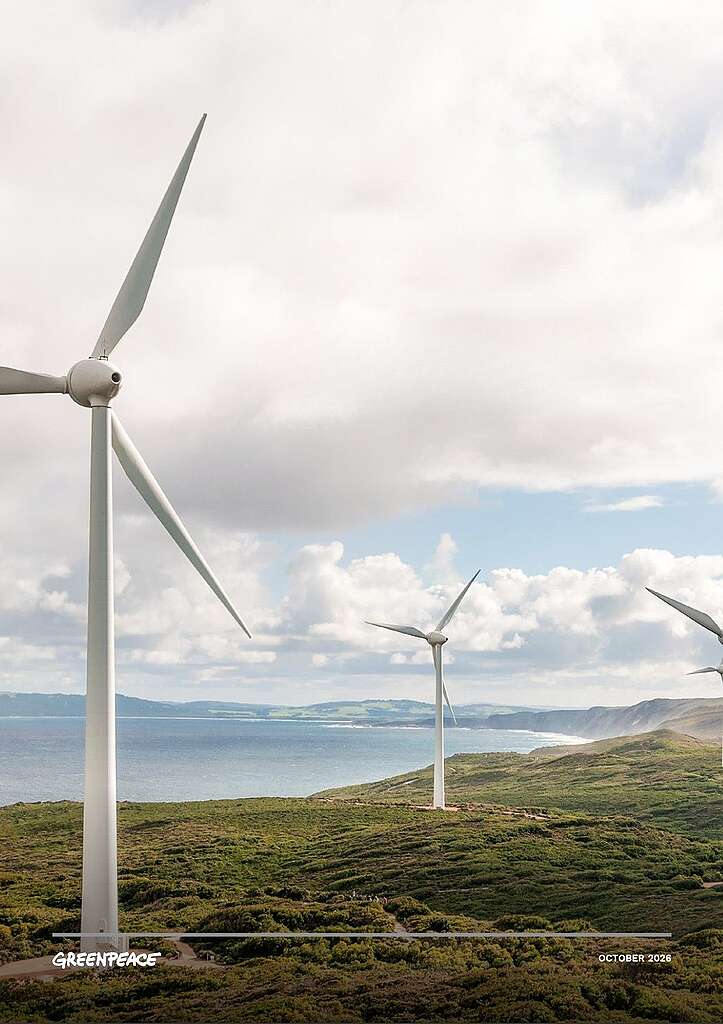
From Gas to Green: Building Western Australia’s Future State reveals that Western Australia (WA) faces a critical juncture as falling Asian gas demand, geopolitical gas supply volatility and accelerating renewable energy deployment undermine the long-term economic viability of gas exports. By harnessing its world-class wind and solar resources, the report demonstrates that WA can execute an orderly phase-out of gas and pioneer a green commodity export economy that could generate $987 billion in economic value by 2060, create 24,000 ongoing jobs, and drive a 9.6% reduction in global greenhouse gas emissions.
Key Findings
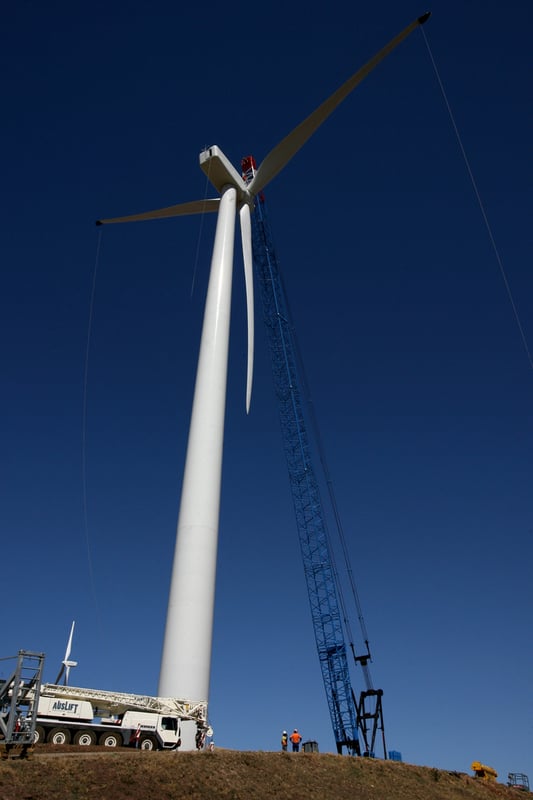
- Gas demand is falling in Asia – WA can no longer rely on gas exports: Gas demand in core Asian markets fell in 2025 and is projected to continue to decline in 2026. Legislated energy plans in Japan, South Korea, and China now prioritise renewables and nuclear over gas.
- Asia is increasing renewables, importing gas just gets in the way: Evidence from markets like Thailand suggests that gas imports are increasingly crowding out cheaper renewable energy investments and battery storage rather than displacing coal, locking in more emissions over time.
- Green commodities offer a real solution to decarbonise Asia – this is a major win for WA: With world-class renewables, WA can lead Australia’s green commodity exports, which by 2060 could be worth almost a trillion dollars ($987 billion) and support a genuine 9.6% reduction in global emissions.
Recommendations to WA government
Recommendation 1: Plan an orderly gas phase-out aligned with a trading partner pivot plan
Implement a managed, orderly phase-out of gas exports aligned with trading partners’ decarbonisation pathways, rather than waiting for demand to collapse, by:
- Developing and implementing a staged phase-out of gas facilities aligned with feedstock supply expiry or typical end of facility lifespans.
- Committing to no new gas development for gas expansion, including Browse and Kimberley fields.
- Developing new, reciprocal trade relationships with existing gas trade partners, structured to progressively replace gas exports with green commodities – integrated with recommendation 2.
Recommendation 2: Develop an integrated green commodity export strategy, positioning WA as a global green iron manufacturing hub
Establish an integrated green commodity export strategy that immediately prioritises green iron development, positioning WA as a global green iron manufacturing hub, by:
- Committing to green commodity export targets to give industry and investors a clear demand signal.
- Prioritising green iron as the lead sector within the broader green commodity strategy, given WA’s iron ore endowment and first-mover potential.
Recommendation 3: Reject false solutions such as carbon dumping (CCS) and blue hydrogen
Reject carbon dumping (also described as carbon capture and storage, or CCS) and blue hydrogen as viable decarbonisation technologies, and prioritise green hydrogen and proven renewables for clean energy and fuel production by:
- Excluding blue hydrogen projects (and CCS-dependent projects) from all government support programs.
- Requiring existing hydrogen-based production (including ammonia, methanol, synthetic fuels) to have clear, near-term transition timelines to switch to green hydrogen production.

What you can do
Together, we can push for a prosperous green future.
You can help by:
- Sending an email to Environment Minister Murray Watt and Prime Minister Anthony Albanese, calling on them to reject Browse.
- Sharing this story to help more Australians understand what’s at stake.
- Encouraging your friends and family to take action.
REPORT: “From Gas to Green” Building Western Australia’s Future State
Cleaner cooking projects in the UN carbon market will have to set aside a share of their credits to insure against the risk that the trees they save are lost to fire, drought or logging, after the