

China’s coal demand is set to drop by 2027, more than cancelling out the effects of the Trump administration’s coal-friendly policies in the US, according to the International Energy Agency (IEA).
Global coal demand is due to grow by 0.5% year-on-year to reach record levels in 2025, according to the latest figures in the IEA’s annual market report.
Yet this will be reversed over the next couple of years, as a faster-than-expected expansion of renewables in key Asian nations and “structural declines” in Europe push coal demand down, the agency says.
While US coal demand is set to continue falling, the decline will be slower than expected last year, due to new federal government efforts to support the fuel.
However, the IEA’s upward revision of an extra 38m tonnes (Mt) of US coal use in 2027 is dwarfed by an even larger 126Mt downward revision in China’s coal use.
‘Unusual trends’
Coal demand will reach 8,845Mt around the world in 2025. This is slightly (44Mt) higher than the IEA had forecast in its 2024 coal market report.
The agency notes some “unusual regional trends” impacting this growth, including a 37Mt year-on-year increase in US coal demand in 2025 to 516Mt. This is 59Mt (17%) higher than the IEA projected in 2024.
A new suite of measures under the Trump administration have supported the short-term use of coal, including the modernisation of existing coal plants and reopening shuttered ones.
EU coal use declined at a slower pace than expected due to lower wind and hydropower output, according to the IEA. Nevertheless, the bloc “continues its structural decline” in coal demand, driven by renewables expansion, carbon pricing and coal phaseout pledges.
India saw an unexpected dip in coal consumption in 2025, linked to a strong monsoon season that increased hydropower output and curbed electricity demand.
In China, which accounts for more than half of the world’s coal use, coal demand remained roughly unchanged between 2024 and 2025, the IEA says.
Demand drop
In its 2024 market report, the IEA projected a continued increase in global coal demand out to 2027. This was largely driven by China, which was on track to see its demand exceed 5,000Mt each year, up from 4939Mt in 2024.
In its latest forecast, the agency estimates that global coal demand will instead “plateau” in the coming years, “falling slightly by the end of the decade”.
Again, this is largely due to trends in China’s power sector, reflecting the “crowding-out” of coal from the grid by the nation’s “formidable renewables expansion” and “steady growth” of nuclear power.
(By contrast, last year clean-power sources were only expected to meet “most of” China’s rising electricity demand.)
The IEA estimates that China’s coal demand will drop to 4,879Mt by 2027 and continue falling to 4,772Mt by the end of the decade.
The global projection for 2027 is 149Mt (2%) lower than expected last year.
As the chart below shows, while US short-term coal demand is now expected to be higher than the IEA’s previous forecast, the drop in China more than makes up for this.
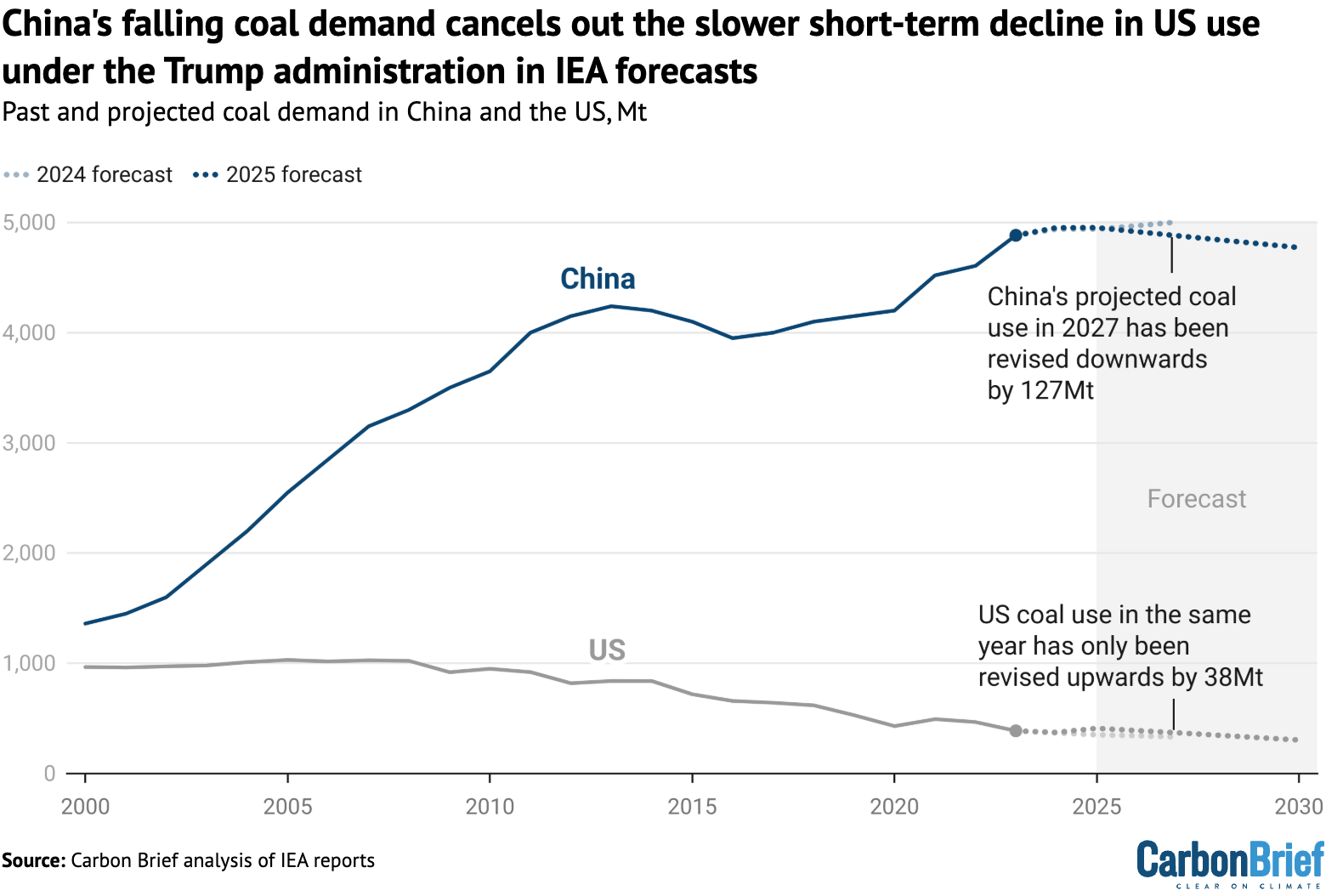
The projected dip in Chinese coal use is largely attributed to the “rapid expansion” of its renewable-energy capacity, the IEA notes. Renewables are soon set to provide a greater share of China’s electricity than coal, rising to 49% of generation by 2030, according to the report.
The Chinese government has set an ambition of peaking coal use before 2030.
While the IEA’s data suggests this goal will be met, the agency stresses that several factors “could turn the slight drop into a small increase”.
These include higher electricity demand, an increase in coal-to-chemicals projects and fluctuations in renewable-energy output due to weather conditions and other factors.
Meanwhile, India remains a “key driver of global coal demand”, but the new report also downgrades estimates for the nation’s future coal growth. The IEA forecasts that Indian coal demand will be 1,383Mt in 2027 – 39Mt (3%) lower than last year’s forecast.
This comes as a growing share of India’s electricity mix is provided by low-carbon power sources, with coal’s share set to decline from 70% in 2025 to 60% by 2030, according to the IEA.




The post IEA: Declining coal demand in China set to outweigh Trump’s pro-coal policies appeared first on Carbon Brief.
IEA: Declining coal demand in China set to outweigh Trump’s pro-coal policies

“This idea that you can invoke a national security exemption when there is no threat to national security is not only brand new, it’s ridiculous.”
From our collaborating partner Living on Earth, public radio’s environmental news magazine, an interview by Jenni Doering with Pat Parenteau, an emeritus professor and senior fellow for climate policy at Vermont Law and Graduate School.
Why Trump’s ‘God Squad’ Is Not Like the God Squads Before It
Climate Change
Virginia Republicans Want Tax Relief to Ease Gas Costs. There’s Also Electric Vehicles.
Years of debate on electric vehicles in Virginia have slowed the transition, now under full Democratic control.
Republican state lawmakers want a temporary pause on Virginia’s 32 cent per gallon gas tax to help offset rising prices at the pump resulting from President Donald Trump’s ill-defined and unpopular war in Iran.
Virginia Republicans Want Tax Relief to Ease Gas Costs. There’s Also Electric Vehicles.
Climate Change
EPA Flags Microplastics as ‘Priority’ Water Contaminants, but the Move Doesn’t Guarantee Regulation
Inclusion on the agency’s draft Contaminant Candidate List doesn’t require the EPA to monitor or set limits on microplastics in drinking water.
Citing the Trump administration’s promise to “Make America Healthy Again,” the U.S. Environmental Protection Agency placed microplastics and pharmaceuticals on a draft list of contaminants maintained by the agency.
EPA Flags Microplastics as ‘Priority’ Water Contaminants, but the Move Doesn’t Guarantee Regulation



-
Greenhouse Gases8 months ago
Guest post: Why China is still building new coal – and when it might stop
-
Climate Change8 months ago
Guest post: Why China is still building new coal – and when it might stop
-

 Greenhouse Gases2 years ago
嘉宾来稿:满足中国增长的用电需求 光伏加储能“比新建煤电更实惠”
-
Climate Change2 years ago
Bill Discounting Climate Change in Florida’s Energy Policy Awaits DeSantis’ Approval
-

 Climate Change2 years ago
嘉宾来稿:满足中国增长的用电需求 光伏加储能“比新建煤电更实惠”
-
Climate Change Videos2 years ago
The toxic gas flares fuelling Nigeria’s climate change – BBC News
-

 Renewable Energy5 months ago
Sending Progressive Philanthropist George Soros to Prison?
-

 Carbon Footprint2 years ago
US SEC’s Climate Disclosure Rules Spur Renewed Interest in Carbon Credits