Cristina Rumbaitis del Rio is a senior advisor on adaptation and resilience with the United Nations Foundation and Mattias Söderberg is global climate lead at Danish NGO DanChurchAid.
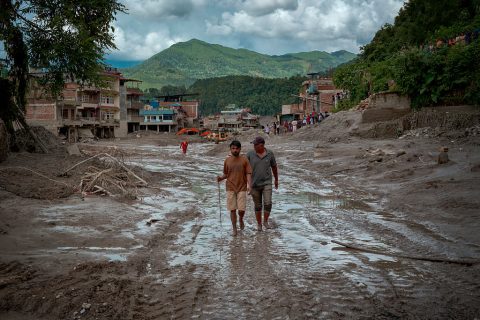
Recent extreme events – from wildfires and heatwaves in Europe to flash flooding following a glacier collapse in Nepal – have shocked and devastated communities, bringing years of warnings about such climate impacts to the doorstep of communities around the world.
One thing is certain: the new climate reality is here – and the adaptation strategies designed for yesterday’s world are no longer sufficient.
Attribution science has since shown that the hotter and more frequent heatwaves we’re experiencing around the world would have been virtually impossible without today’s high concentrations of greenhouse gases in the atmosphere. Climate shocks are now so severe that they reverberate through supply chains, food and water systems, financial markets and the movement of people.
-
Foreign minister: Nepal needs “meaningful” international support to face climate threats
Following its recent Himalayan flooding disaster, the South Asian nation is seeking urgent help from a new UN climate fund, appealing for “stronger global solidarity” -
Palestine: Israel’s bombing has left Gaza vulnerable to climate change
With homes, hospitals and water storage destroyed, Palestine’s government says that Gazans have little protection from climate impacts and sets conditional emissions targets

They must be a catalyst for a new way of thinking about adaptation and resilience, and how we finance solutions that work. A failure to invest in adaptation in one region can create costs far beyond it, which is why the concept of shared resilience is critical for leaders to grasp.
Investment not charity
At the UN General Assembly (UNGA 81) this month, leaders have an opportunity to translate today’s urgency into concrete commitments on adaptation and loss and damage finance ahead of COP31.
Those commitments are needed to underpin global stability, shared prosperity and human security. Governments should use this moment to show what a new response looks like: finance that reaches communities faster, supports locally grounded solutions, strengthens national systems, and helps countries prepare before the next shock arrives.
If we want sustained economic growth, food and water security, and resilient and prosperous societies across every region, adaptation must be at the heart of today’s development and security agenda. It cannot be just a future planning consideration or a narrow issue for climate ministries. Adaptation is now everyone’s business – and it must be financed fast and fair.
UN Secretary-General António Guterres has repeatedly framed climate finance as an investment rather than charity, warning that “a world in climate chaos cannot be a world at peace” and describing human security as freedom from the chronic and sudden disruptions that climate change multiplies.
What’s more, adaptation delivers a real return-on-investment, with researchers estimating that every dollar invested produces $10 in benefits, saving lives, protecting livelihoods, and reducing the costs of future disasters.
Hitting adaptation limits
The urgency to scale adaptation systematically is growing. The newly released “Limiting Overshoot” report from the UN Environment Programme (UNEP) confirms what scientists have long warned: exceeding global warming of 1.5C is now unavoidable under current policies. Yet, how high temperatures rise – and how long the world remains above the 1.5C threshold – will determine whether communities, economies and entire ecosystems can keep pace.
There are limits to adaptation. When we breach those limits, lives and livelihoods are lost, and people and ecosystems suffer greatly. We cannot simply build yesterday’s infrastructure a little stronger and assume it will be enough.
Nepal flood destruction shows “limits to adaptation”, scientists say
We need to fundamentally change the systems that determine how societies anticipate, absorb and recover from both immediate and evolving non-linear climate shocks. This includes transforming physical systems, such as infrastructure, and the governance systems that affect where and how we live to how we maintain our health and wellbeing.
Finance today is nowhere near the scale of the challenge.
The UNEP “Adaptation Gap Report 2025” estimates the shortfall in adaptation finance in developing countries at $284 billion–$339 billion a year – roughly 12 to 14 times current international public flows of around $26 billion. That gap is a development, economic and human security problem, especially for the most vulnerable populations who have contributed the least to causing the climate crisis.
Building resilience into financial systems
There are already signs of what a more systemic adaptation response could look like. Communities around the world are delivering practical solutions at local level, even as adaptation finance remains notoriously, and appallingly, difficult to access. Cyclone-resistant homes, local forecasting capacities, drought-resistant crops, heat insurance for pregnant informal workers and mangrove restoration are rooted in local knowledge and lived experience, while delivering benefits far beyond the communities where they originate from.
But local innovation alone is not enough; the systems around it need to be resilient too.
Jamaica offers one example. The country has built a multi-layered disaster-risk financing framework, including a catastrophe bond and contingency funds, through sustained fiscal discipline and proactive investment. Its debt-to-GDP ratio fell from around 147% in 2012 to around 62% in 202-25. That groundwork matters when disaster strikes.
Hurricane Melissa’s destruction shows need for climate resilience push
Following Hurricane Melissa, Jamaica was able to secure billions of dollars in reconstruction financing from multilateral banks – finance that might otherwise have been much harder to access. The lesson is clear: resilience can be built into the financial architecture of a country before a crisis arrives. That is the shift we now need to make at scale.
The foundations already exist – in Kingston’s fiscal reforms, in early-warning systems from the Sahel to the Pacific, and in every community that adapted before disaster struck. What is still missing is the political will, and the finance, to take what works and put it to work everywhere, at the speed our world’s new climate reality demands.
To hear more on this issue from high-level officials and experts, sign up for this event during Climate Week NYC, at 8am EDT on September 24 (in person or online), moderated by Climate Home News Editor Megan Rowling: Adapting to the New Climate Reality: Why Accelerating Impacts Demand New Responses.
The post Human security relies on adapting to the world’s new climate reality appeared first on Climate Home News.
Human security relies on adapting to the world’s new climate reality

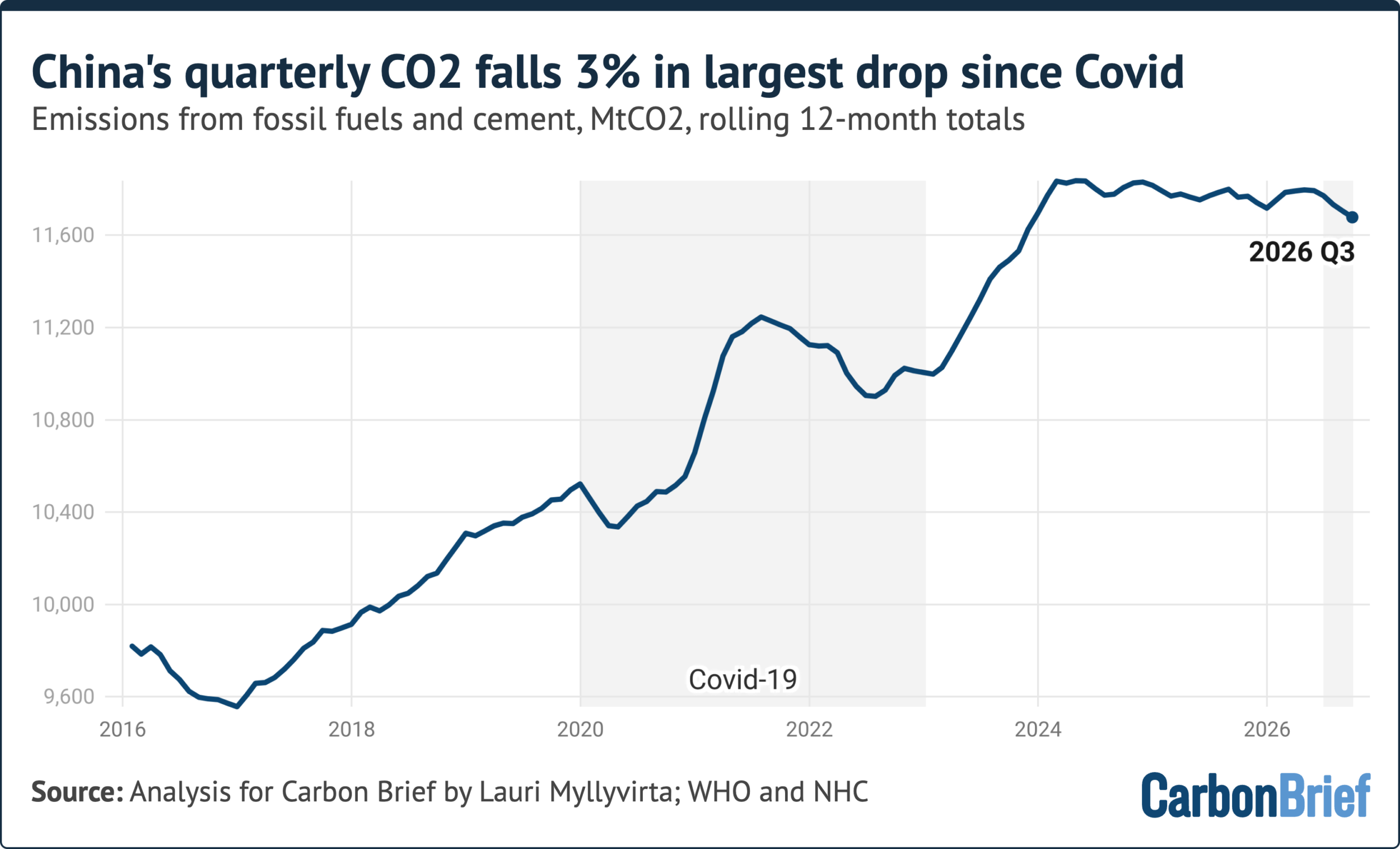
China’s carbon dioxide (CO2) emissions fell by 3.1% in the third quarter of 2026, as the Hormuz crisis continued to hit oil demand and coal use also dropped.
This guest post is by:
Lauri Myllyvirta, lead analyst at the Centre for Research on Energy and Clean Air
This was the largest quarterly reduction since the 2022 Covid lockdowns and means that China’s CO2 emissions have now fallen by an estimated 0.5% in the year to date.
The new analysis for Carbon Brief, based on official figures and commercial data, shows that coal use fell by 3% year-on-year in the third quarter of 2026, while oil was down 4%.
The main drivers were a fall in power-sector coal consumption, a continued sharp reduction in transport oil consumption and slowing growth in the coal-to-chemical industry.
The sharp decline in China’s CO2 emissions extends a “flat or falling” trend that began in March 2024 and has now lasted more than two years, as shown in the figure below.
The outlook for China’s CO2 emissions depends on the balance between rising energy demand, clean-energy growth and the government response to a GDP slowdown.
Decline drivers
Key drivers of the fall in CO2 in the third quarter of 2026 included a 3.3% drop in coal-power generation, after demand growth slowed and the amount of “wasted” wind and solar fell.
Power generation from solar, wind and nuclear increased by 110 terawatt hours (TWh) year-on-year, more than twice as much as the growth in total electricity demand. This added clean-power generation equal to Germany’s total power output in the same time period.
The fall in coal-power output and CO2 emissions came despite the fact that China continues to build new coal-power capacity at near-record rates. This means that average running hours for coal plants are falling even faster than total generation, eroding their profits.
Meanwhile, transport oil consumption continued to fall sharply, down 9% year-on-year in the third quarter of 2026. Electric vehicles (EVs) continued to gain market share, hitting a record 67% of passenger car sales and 50% of heavy trucks in September.
The amount of electricity used by EVs grew by 53%, much faster than the number of EVs on the road, showing increased usage of the existing fleet in preference to fuelled vehicles.
Elsewhere, growth in the coal-to-chemical industry continued to slow down in the third quarter of 2026. The sector has been a key source of emissions growth, but high coal prices have weakened profitability and higher output prices hurt downstream demand.
Finally, CO2 emissions from cement and steel production continued to fall in the third quarter, as the contraction in construction volumes accelerated.
Outlook for emissions
Energy consumption growth has been falling after a period of exceptionally high growth during Covid, while clean-power growth has been robust.
This makes it likely that the growth in clean-power generation will exceed total energy demand growth this year, maintaining the structural fall in fossil-fuel use.
Looking ahead, this balance also relies on progress in removing barriers to new solar and wind power being added to the grid, which result in some clean electricity being “wasted”.
The recent slowdown in energy demand growth is partly – but not fully – explained by exceptionally mild weather in the third quarter.
Another key factor is weaker GDP growth. Since reported GDP growth remains within target, however, there is reduced pressure for further stimulus policies.
The focus of the economic stimulus announced to date is “six networks”, which includes the power grid and the transportation network.
These networks are highly relevant for energy and emissions – and they are already covered by policies that emphasise “green” and zero-carbon solutions.

The post Analysis: China’s quarterly CO2 falls 3% in largest drop since Covid appeared first on Carbon Brief.
Analysis: China’s quarterly CO2 falls 3% in largest drop since Covid
Climate Change
Coles, Woolworths grilled as beef buyers receive fail grade on new deforestation scorecard
MELBOURNE, Friday 6 November 2026 — As Coles holds its Annual General Meeting today, Greenpeace Australia Pacific has branded the major supermarkets with a fail grade on their commitment to source deforestation-free beef, with an updated scorecard revealing none of the major beef buyers are following through on forest sustainability commitments.
It comes after Woolworths’s AGM last week where the board copped a grilling by environmentalists and shareholders over its failed sustainability commitments. Both Coles and Woolworths committed to eliminating deforestation in their supply chains by the end of 2025, but a year past the deadline, neither company could guarantee that their beef was not sourced from deforested pastures.
From outside the Coles AGM, Adele Chasson, Nature Policy Lead at Greenpeace Australia Pacific, said:
“This is a report card Coles and Woolworths should be ashamed to take home. While all major beef buyers had promised to take deforestation off the shelves, none of them followed through. Shareholders and the public demanded answers from Woolworths last week and from Coles today, and we will continue to hold their feet to the fire on their promises.
“Beef is the leading cause of deforestation in Australia, and Coles and Woolworths keep putting off action while koalas continue losing their homes. Aussies must be able to get their groceries without having to worry if their dinner is contributing to the bulldozing of forests or driving extinction of iconic Australian animals.
“Without strong, rapid implementation plans, these companies continue with business as usual, flying in the face of Australia’s deforestation crisis. Big beef buyers like Coles and Woolworths must stop the bulldozers now, make good on their sustainability promises and play their part in stopping Australian forest destruction.”
The scorecard assesses how eight of Australia’s largest beef buyers stack up against a conversion and deforestation-free target. It charts whether the major supermarkets, Aldi, McDonalds, Hungry Jacks, Teys, Metcash/IGA and JBS are taking proper action to end Australia’s deforestation crisis. They all failed.
-ENDS-
Media contact: Kimberley Bernard on 0407 581 404 or kbernard@greenpeace.org
Coles, Woolworths grilled as beef buyers receive fail grade on new deforestation scorecard
Özgür Özel is the leader of Turkey’s main opposition “New Party” and a member of parliament from Manisa.
The world is running out of time to deliver on the Paris Agreement. The UN Environment Programme’s latest Emissions Gap Report concludes that the chance of keeping warming below 1.5C without overshooting it is gone. Even if every country delivers its current national pledges, the planet is heading for about 2.6C of warming this century.
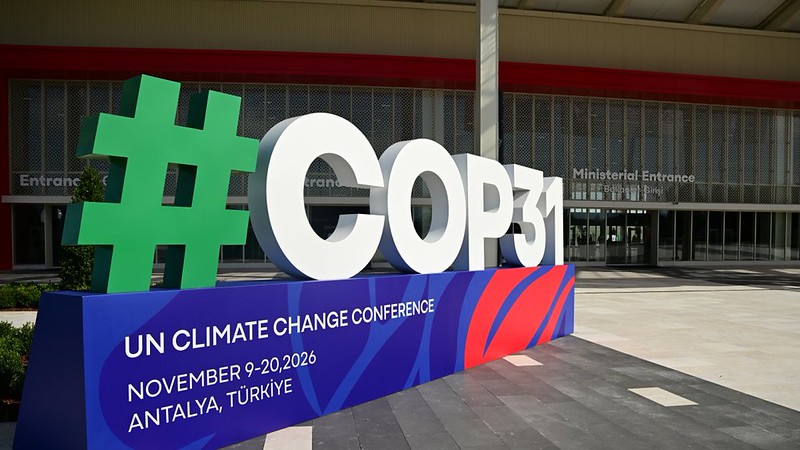
This is the backdrop as governments and their leaders gather in Antalya for COP31, ten years after the Paris Agreement took effect. Turkey lies in the Mediterranean, one of the regions most exposed to climate change, and hosting the summit is a real opportunity.
It is also a responsibility, and that responsibility begins at home. The world does not lack targets. What it has lacked – almost everywhere – is delivery. If Antalya is remembered for anything, it should be for shifting the focus from what countries promise to what they actually do.
For many people in Turkey, the climate crisis is already part of daily life. In 2021, forests in Manavgat, a district of Antalya, burned for more than a week. Last year, wildfires forced more than 50,000 people from their homes around the western coast city of Izmir. This October, Istanbul had its heaviest rainfall in more than 80 years, with the floods killing at least eight people.
COP31 Briefing: What to expect from the Antalya climate summit?
Electrification, the fossil fuel transition, adaptation to rising impacts, climate science and trade are key themes as governments gather for COP31 in TürkiyeBrazil’s fossil fuel roadmap sketches out first global timetable
The COP30 presidency’s voluntary timetable asks countries to plan first, then build up clean energy – only turning to oil and gas supplies from 2031


Measurable outcomes
Two weeks of climate negotiations cannot deliver everything that is needed to resolve the crisis, but COP31 can push for a few things that can be measured. The first is a voluntary fossil-fuel transition roadmap, with national milestones for 2030 and 2035 reported in the same format every year.
The second is a stronger commitment to protecting forests, with progress tracked over time. The third is yearly reporting on progress towards the agreed $1.3 trillion a year in climate finance by 2035, backed by a financial roadmap.
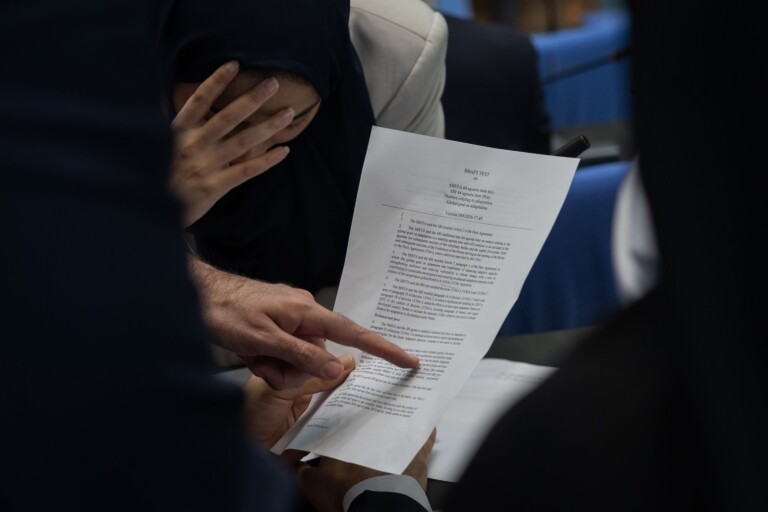
On adaptation, the indicators agreed in Belém should become funded national plans. By COP32, we should be able to see how many countries have an adaptation plan and the financial commitment behind each one.
Regional resilience partnership
The summit also has an unusual shape. Turkey hosts, Australia leads the negotiations, and the Pacific island nations play a central role. Climate diplomacy now sits at the centre of energy security, trade and development, and Turkey, which bridges developed and developing economies, is well placed to help build consensus between them. The lasting value of its presidency will depend on the practical partnerships it leaves behind.
One such partnership could connect two very different regions. On a map, the Mediterranean and the Pacific seem to have little in common, but their problems look similar: eroding coastlines, salt creeping into aquifers, failing harvests, fishing towns with fewer fish.
Turkey and Australia could launch a Mediterranean–Pacific Climate Resilience Partnership, linking coastal cities, scientists, institutions including development banks and island governments. It does not need a new bureaucracy. It can start with a few projects: shared satellite data and early-warning systems, better coastal flood defences, and trials of water-saving farming in the communities most at risk. What matters is visible results on the ground, not a ceremony.