

Article Contents

The unprecedented shifts brought on by climate change ripple far beyond rising temperatures and extreme weather; they reach deep into the minds and hearts of all living beings. Anxiety, grief, and a profound sense of loss now shadow our collective experience. This climate-related mental distress is not only felt by people but also echoed in the land, waters, plants, and animals to which we are inseparably connected. As ecosystems unravel, the mental health of humans and non-human relatives becomes a shared story of vulnerability and resilience.
Climate Change and Rising Anxiety
The reality of climate change is no longer a distant worry; it is a present and palpable force shaping the mental landscapes of countless individuals. Across ages and cultures, climate anxiety, sometimes called eco-anxiety, has emerged as a defining psychological response to the accelerating devastation of the natural world. This anxiety is not simply fear of future disasters but an existential reaction to loss, uncertainty, and powerlessness.
Signs of Climate Anxiety
People experiencing climate anxiety often report:
- Persistent worry, rumination, or panic about environmental catastrophe.
- Feelings of helplessness, hopelessness, or grief, often described as “climate grief.”
- Disturbed sleep, including insomnia or nightmares, can be linked to climate crises.
- Physical symptoms may include an elevated heart rate, stomach upset, or fatigue.
- Social withdrawal, or conversely, sudden bursts of activism.
- Existential questioning about the future, meaning, and humanity’s role in planetary degradation.
- Heightened sensitivity to environmental news and changes, sometimes leading to overwhelm or burnout.
How Climate Anxiety Shapes Worldviews
Climate anxiety is shifting how people relate to themselves and the world:
- A fractured sense of security: The predictability of seasons and natural resources, as well as the scaffolding of cultural and personal identity, is disrupted.
- Heightened interdependence: For some, anxiety strengthens awareness of interconnectedness, prompting a search for meaning beyond individualism and consumerism.
- Urgency for change: Anxiety can fuel activism and demands for systemic transformation.
- Collective trauma and grief: Climate change becomes a shared mourning for lost species, landscapes, and lifeways.
- Shifts in values: Many are turning away from materialism toward ecological stewardship, simplicity, and relationality.
Climate Anxiety in the Indigenous Context
For Indigenous peoples, climate anxiety is layered with cultural grief, the loss of land, language, ceremony, and traditional livelihoods. This grief is deepened by colonial histories that severed people’s relationships with ancestral territories and more-than-human kin.
Yet, Indigenous worldviews also carry profound resilience. Seeing humans as part of a web of life provides a relational refuge, a framework for navigating climate anxiety through connection, ceremony, and stewardship. Unlike dominant Western approaches that often treat mental health in isolation, Indigenous perspectives integrate ecological realities into healing.
Supporting Mental Well-Being Amidst Climate Anxiety
Meeting climate anxiety as both a personal and collective challenge requires approaches that nurture resilience:
Land-based healing and connection: Spending time on the land, engaging in cultural practices, and restoring bonds with ecosystems.
- Community support and dialogue: Safe spaces to share fears and grief, build solidarity, and mobilize collective hope.
- Eco-literacy and empowerment: Education in climate science, Indigenous land stewardship, and practical action to counter helplessness.
- Mindfulness and grounding practices: Techniques to calm and regulate overwhelming emotions.
- Centering Indigenous knowledge: Teachings of balance, renewal, and reciprocity enrich mental health frameworks with holistic approaches.
Indigenous Ways of Knowing: Medicine for Mind, Heart, and Spirit
Indigenous worldviews offer vital teachings for healing and well-being. Central among these is interconnectedness, the recognition that humans, earth, waters, animals, plants, and ancestors form one living web. This understanding fosters a holistic approach to mental health that weaves together mind, heart, body, and spirit.
Ceremonies, storytelling, land-based practices, and seasonal cycles cultivate balance and harmony, offering medicine for both individual and collective resilience. Reconnecting with Mother Earth is a profound step toward healing, inviting us to listen deeply to the rustle of leaves, the flow of rivers, the flight of birds and, in that listening to rediscover grounding, purpose, and hope.
Empathy for More-Than-Human Relations
Climate change also affects our non-human relatives. Plants wither, animals migrate or perish, and waters warm and recede. Indigenous teachings remind us that these beings hold life, spirit, and memory. They, too, suffer displacement and loss. Cultivating empathy for them expands our circle of care and underscores that mental and environmental health are inextricably linked.
When we engage with land, waters, and wildlife not as resources but as relatives, fractured relationships begin to heal. This relational awareness lays the foundation of stewardship rooted in respect and reciprocity, integrating the need to confront climate change.
Reconnecting with the Land
Reconnection is both sacred and practical. Land-based healing, traditional ecological knowledge, and Indigenous ceremonies are increasingly recognized within Indigenous communities and beyond as powerful supports for mental health.
Spending time on the land harvesting plants, participating in a ceremony, or simply observing seasonal rhythms nurtures awareness, patience, and resilience. It roots us in the present, affirms belonging, and reminds us that we are part of a living community. Through this reconnection, humans can find strength in relationships, solace in shared struggle, and hope in reciprocal care.
Moving Forward Together
The climate crisis compels us to rethink mental health in relational terms, recognizing that human well-being is inseparable from the well-being of the land and all its beings. Indigenous knowledge offers enduring wisdom for this path. By honouring interconnectedness, embracing land-based healing, and nurturing empathy for all relations, we can cultivate mind, heart, and spirit medicines essential for resilience.
Together, human and more-than-human kin can walk toward healing, balance, and renewed hope grounded in the living teachings of the earth we call home.
Blog by Rye Karonhiowanen Barberstock
(Image Credit: Ahmed Hossam, Unsplash)
The post Healing in the Time of Climate Change: Indigenous Ways of Knowing for Mental Health and the More-Than-Human World appeared first on Indigenous Climate Hub.
Continue Reading
An older teaching about land acknowledgement
As I have come to understand the spirit and intention of land acknowledgement, I often return to fond memories of my grandmother and her words of wisdom. She taught that the health of the places we call home comes first, because the wellbeing of the people depends on it.
In her teaching, land acknowledgement began with the land. Long before it became a paragraph read at the start of a meeting, it was a way of recognizing a homeland: its waters, its species, its seasons, and the spirit that revealed whether the place was well.
Her teaching echoes a practice found across many Indigenous Nations. Haudenosaunee gatherings, for example, have long opened with the Ohén:ton Karihwatéhkwen, the Thanksgiving Address, often translated as “the words that come before all else.” The speaker greets and gives thanks to the people, the earth, the waters, the plants, the animals, the winds, the sun, the moon and the stars. Only after everything that sustains life has been acknowledged does the gathering turn to its own business.
That order changes what an acknowledgement is for. Its purpose was to share the story of a place with neighbours and to draw them into the work of tending it. People entered the story second, as the ones responsible for what had just been named.
Understood this way, an acknowledgement does more than open a meeting. It asks us to reconsider where we stand, and what we owe the ground beneath us.
Nations among nations
In her teaching, people are one nation among many. The salmon are a nation. So are the cedars, the bison, the medicine plants, and the pollinators. Each belongs to a place, carries its own responsibilities, and offers gifts no other nation can give.
This idea of kinship runs through many Indigenous philosophies. The phrase “all my relations,” heard in ceremonies and gatherings across Turtle Island, is a reminder that family extends beyond people to the animals, plants, waters and lands that make life possible. Some Indigenous languages carry the same understanding in their grammar, speaking of many plants, animals and natural forces as living beings rather than objects.
Sovereignty, understood through this relationship, is a kind of standing more than a form of control. Each nation belongs fully to its place and carries its share of that place’s life. No nation thrives alone, and none thrives by taking over the whole.
The land is also the source of instruction. Over generations, people watched how a river valley or a stretch of prairie kept itself well: who arrived when, who fed whom, and how much could be taken before the giving stopped. In my grandmother’s telling, those observations became instructions, and those instructions helped shape law and protocol. They guided when to harvest, where to camp, how to enter a neighbour’s territory, and what was owed in return.
Indigenous legal scholars today often describe this as law that comes from the land itself, learned by watching how living systems sustain one another. A plainer name for it is knowing how to live somewhere.
The host and the guest
One of the clearest teachings in this understanding of the world is the relationship between host and guest. My grandmother invited us to recognize that relationship in the lives of plants and animals.
A host prepares the place before anyone arrives. A beaver family dams a stream, and the pond becomes a home for fish, frogs, birds and plants. A fallen tree becomes a nurse log, feeding the next generation of seedlings as it returns to the soil.
A host offers first. A flowering plant sets out nectar. A berry bush ripens fruit. These provisions come in their own season, not whenever a visitor happens to want them.
A host also makes its presence known. Birdsong, scent and the marks left along a trail tell newcomers that a place is already inhabited. The visitor does not arrive in an empty world.
The guest has responsibilities too. A guest attends to the season and to what the place can offer. A guest does not assume that everything within reach is theirs to take. A guest leaves something that helps sustain the relationship.
A bee takes nectar and carries pollen. Read through this teaching, that exchange offers an image of visiting well: receiving a gift while helping the host continue its life.
Many Indigenous harvesting protocols carry the same ethic into daily practice: ask before taking, take only what is needed, offer thanks, and leave enough for others and for the plant or animal to recover.
None of this suggests that every relationship in nature is peaceful or generous. These are ways of seeing responsibilities that people can learn to carry.
Everyone is both
No being is only a host or only a guest.
A tree makes room for other life while depending on soil, water, sunlight, fungi, and relationships beyond itself. People, too, may welcome others into their homes while remaining dependent on the larger homeland that sustains them.
The distinction between host and guest is therefore about roles, not ranks. Everyone receives. Everyone has something to give.
The question is whether the exchange sustains the place.
A visitor who takes without restraint leaves less for those who come next. A host who neglects the place has less to offer. Both have responsibilities, and neither can fulfil them alone.
This is the heart of reciprocity, a principle found across Indigenous philosophies: relationships stay healthy when gifts move in both directions. The Haudenosaunee teaching of the seventh generation extends that exchange across time, asking that decisions made today leave the place well for those not yet born.
Mutual benefit begins here, with the recognition that different beings carry different gifts and obligations.
What people carry forward
My grandmother’s teaching connects these relationships to the ways people meet their neighbours.
The host prepares a place, offers food and rest, and explains where the visitor has arrived. The guest makes themselves known, explains why they have come, listens to the terms of the visit, and brings something in return. The gift may be material. It may also be labour, knowledge, news, or a commitment to help.
Nations around the Great Lakes carried this ethic into treaty. The Dish with One Spoon, an agreement among the Haudenosaunee, Anishinaabe and allied Nations, describes shared hunting grounds as a single dish. Everyone eats from it with one spoon, takes only what they need, leaves enough for others, and keeps the dish clean. The Two Row Wampum, between the Haudenosaunee and European newcomers, shows two vessels travelling side by side on the same river, each keeping its own ways and neither steering the other.
In this understanding, acknowledgement is more than naming the people associated with a territory. It is learning enough about a homeland to behave responsibly within it.
Whose home is this? What sustains it? What laws and agreements guide our presence? What can we receive, and what must we return?
These questions make acknowledgement a relationship rather than a recital.
They also make it diplomatic. A guest who recognizes the host’s homeland recognizes that they have entered a place with its own relationships and responsibilities. A host who welcomes the guest makes room for an encounter governed by those relationships.
Neither arrives without standing. Neither arrives without obligations.
Beginning with place
I write from the shores of the Bay of Quinte. Here, the teaching asks me to begin with the water, the shoreline, and the life they sustain. Before I describe myself, I must attend to where I am.
That does not make people or history less important. It places them within the homeland that gives them meaning. The people, their laws, their agreements, and their responsibilities all belong to the place.
In a time of longer fire seasons, troubled waters, and uncertainty about what the next season will bring, this teaching asks something difficult and useful of us: pay attention before you speak.
An acknowledgement cannot tell the story of a place if the speaker has stopped noticing it.
The land came first. Beginning there again means learning to name what sustains us, and accepting that what sustains us also asks something of us.
By Rye Karonhiowanen Barberstock
Photo by Andrik Langfield on Unsplash
The post The Land Came First appeared first on Indigenous Climate Hub.
Carbon dioxide (CO2) emissions from fossil fuels and cement are projected to fall by around 0.4% in 2026 to 38.2bn tonnes of CO2 (GtCO2), according to new figures from the Global Carbon Project.
This guest post is by:
- Dr Zeke Hausfather, Carbon Brief’s climate science contributor
- Prof Pierre Friedlingstein, chair of mathematical modelling of climate systems at the University of Exeter and part of the Global Carbon Project team.
Carbon dioxide (CO2) emissions from fossil fuels and cement are projected to fall by around 0.4% in 2026 to 38.2bn tonnes of CO2 (GtCO2), according to new figures from the Global Carbon Project.
The 21st edition of the annual “global carbon budget” report, published today, says that this small decline is largely due to a 1.9% drop in emissions from oil and the energy shock triggered by the Iran conflict and the closure of the strait of Hormuz.
Emissions from coal continue to increase slightly.
The Global Carbon Project’s projections for fossil fuel and cement CO2 emissions in 2026 are preliminary, with a range that spans a fall of -1.5% to a rise of +0.6%.
This means a small increase in emissions can not be ruled out.
Emissions from land-use change, such as deforestation, are projected to rise in 2026.
This is primarily driven by peat fires and forest degradation in south-east Asia and is linked to the development of a strong El Niño event this year.
As a result, total CO2 emissions from fossil fuels and land use are projected to reach a record high of 43.3GtCO2 in 2026 – marginally above 42.8GtCO2 in 2025.
Research published alongside the report by the same team in Nature Climate Change finds that the growth in solar, wind and electric vehicles (EVs) now offsets around two-thirds of the emissions that would otherwise come from rising energy demand.
However, the deployment of these technologies is not yet enough to push global emissions into a sustained decline, according to the study.
The 2026 global carbon budget report also estimates that:
- Fossil emissions are projected to fall in China (-0.9%), the US (-1.3%) and the EU (-1.5%) in 2026, but rise by 4.4% in India.
- Oil emissions are projected to fall in every major region, with the largest drop in China (-4.6%).
- Land-use emissions averaged 4.9GtCO2 per year over 2016-25, around 21% lower than the decade before.
- Total CO2 emissions (fossil and land-use) grew by an average 0.3% per year over the past decade (2016-25), compared with 1.7% per year over the decade before.
- The remaining carbon budget to limit warming to 1.5C is 150GtCO2, or less than four years of current emissions.
- The land sink in 2025 was the highest on record, rebounding after being weakened during the 2023-24 El Niño. The current El Niño is expected to weaken the land sink in 2027.
- The concentration of CO2 in the atmosphere is set to reach 427.7 parts per million (ppm) in 2026, 54% above pre-industrial levels.
(For more on previous editions of the Global Carbon Project’s annual report, see Carbon Brief’s coverage in 2025, 2024, 2023 and 2022.)
Total emissions edge up as land-use emissions rise
Total global CO2 emissions, which combines fossil fuels and land-use change, are projected to reach a record high of 43.3GtCO2 in 2026, up from 42.8GtCO2 in 2025.
The increase in 2026 comes entirely from a projected rise in land-use emissions, which are more challenging to estimate than fossil emissions.
(The global carbon budget groups emissions from fossil fuels and cement production as “fossil emissions”. Carbon Brief follows this convention throughout this piece.)
If land-use emissions had stayed at 2025 levels, total emissions would have fallen slightly in 2026 to around 42.6GtCO2.
Each edition of the global carbon budget updates the historical record as new data and methods become available. The chart below shows total emissions in this year’s budget compared with the five previous editions.
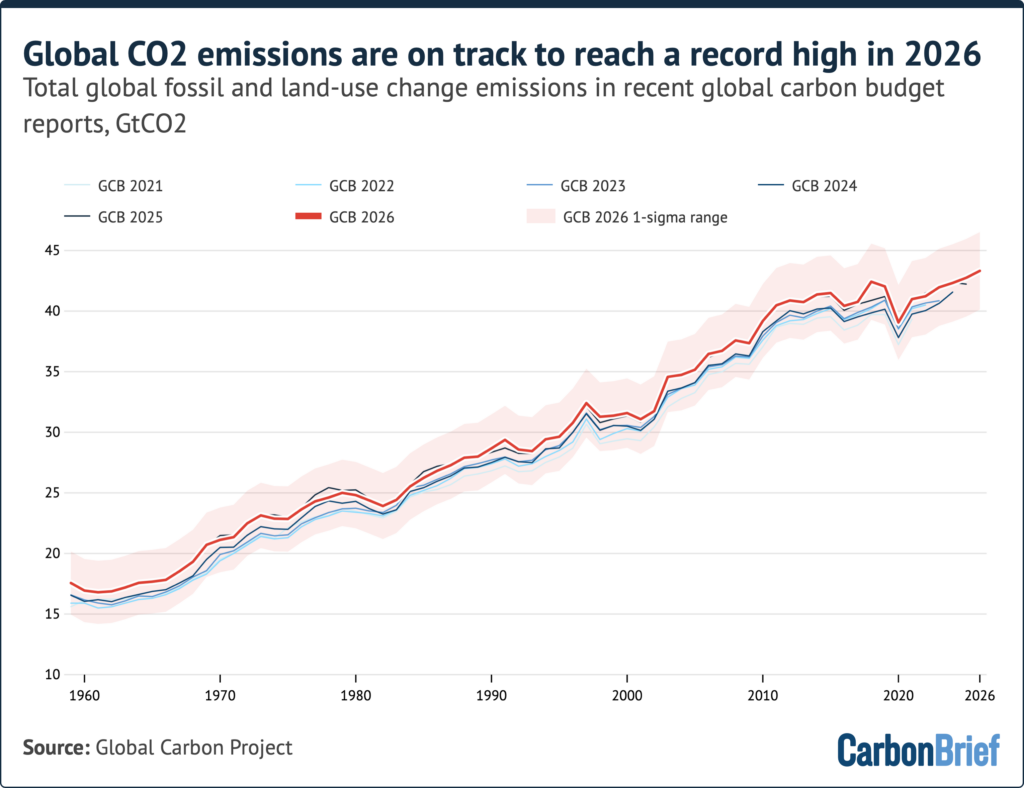
This year’s estimates of historical fossil emissions are around 0.3GtCO2 per year higher than in last year’s budget.
This is largely because the report now estimates a smaller “cement carbonation” sink in the wake of research published this year in Communications Sustainability. In other words, it estimates that cement is able to slowly reabsorb less CO2 over its lifetime than previously thought.
Estimates of land-use emissions have also been revised, including a spike in 2018 – visible in the chart above – linked to updated cropland data for Colombia.
The updated numbers show that total