



- Formal negotiations
- Finance
- Global review
- Global report
- Digital sequence information
- Harmful subsidies
- Marine biodiversity
- Planning, monitoring, reporting and review
- Article 8(j) implementation
- Biodiversity and climate change
- Links with other bodies
- Around the COP
- Armenian presidency
- Protests
- Lobbying and influence
- Carbon and biodiversity markets

Ahead of the Paris Olympic Games this summer, the organising committee was concerned about two principal diseases: Covid, which Europe is fully familiar with, and dengue fever.
Dengue, a climate-sensitive infectious disease spread by mosquitoes, is traditionally considered a “tropical” infectious disease.
But authorities closely monitored and prepared for dengue in Paris due to its potential to spread in the increasingly warm climate of the region.
A great deal of progress has been made over recent decades in the fight against some infectious diseases, such as malaria, yet this progress is at risk due to climate change.
Mosquitoes carrying the dengue virus are now a threat in France and other European countries because of warmer summers.
Extreme weather events and warming temperatures are giving many infectious diseases opportunities to expand to new regions, putting billions of people at risk.
Climate-sensitive infectious diseases
Any infectious disease whose transmission and spread are influenced by changes and variations in climate and weather is considered a climate-sensitive infectious disease (CSID).
These include diseases that are spread by air, food, water or vectors.
The CSIDs that have received most media attention are vector-borne. They are caused by pathogens that have been transmitted to a human by a vector, such as a snail, fly, tick or mosquito.
Vector-borne diseases include dengue, Zika virus, malaria, Chikungunya and yellow fever.
Ideal breeding conditions
Almost all vector-borne diseases have a climate dimension. Both pathogens – the microorganisms that cause the disease itself – and vectors are very sensitive and highly responsive to the environments they live in. Changes in temperature and rainfall can have significant impacts on their spread.
In 2024, global temperatures reached record highs. These extreme conditions have been linked to a surge in dengue fever cases worldwide and contributed to the spread of other infectious diseases.
Pathogens and vectors typically thrive in warmer climates – in part because there is a longer season in which the vectors can live, breed and pass on the disease.
Higher temperatures change the behaviour of insect vectors. Adult mosquitoes reproduce more quickly and bite more frequently in warmer weather.
Pathogens also multiply faster within the vector in warmer conditions. This means there is a higher concentration of the disease-causing pathogen transmitted within insect bites, increasing the chance of infection. In turn, this leads to quicker and more intense disease outbreaks.

Temperature is only one part of the picture. Changes in rainfall patterns contribute to creating ideal breeding conditions for mosquitoes and other vectors too.
Pakistan, for example, has had increasingly heavy monsoon seasons – linked to climate change – that result in severe flooding. When the floods recede, stagnant water pools are left creating ideal breeding sites for some mosquitos.
Flooding in 2024 has seen 1.3m cases of malaria recorded in Pakistan so far, with cases likely to continue rising. In 2021, there were 500,000 cases recorded in total.
Unequal risks
Vulnerable populations are typically at greater risk from CSIDs – including children, the elderly, pregnant women and people with weakened immune systems.
Additionally, communities with limited healthcare, inadequate housing and poor sanitation are more susceptible to outbreaks of CSIDs due to reduced capability to prevent, detect and treat infections.
Currently, lower-income countries – particularly those in tropical regions – bear the higher burden of CSIDs. Tropical regions are more exposed to vector-borne diseases for several reasons – from the warm and humid climate and the existence of disease-carrying insects to inadequate housing, infrastructure and healthcare.
This combination of factors leads to heightened risk and less resilience against the spread of such infectious diseases in many tropical countries.
However, as temperatures rise, cooler regions, such as Europe, are also becoming more vulnerable to climate-sensitive diseases.
Warmer temperatures increase the geographic range where vectors – such as mosquitoes and ticks – can survive and breed.
This pattern is exemplified by Lyme disease, an illness transmitted by ticks. Increasingly prevalent throughout the UK, it is also steadily moving into northern areas of Canada and even the Arctic – where it was previously absent as ticks could not survive the cold temperatures.

Due to climate and land-use change, ticks can now spread Lyme disease into these new areas and could lead to year-round tick seasons, which could be expected in areas of Scotland and elsewhere.
Reducing risks
While curbing the spread of CSIDs requires global action to slow climate change, there are adaptation measures that can be put in place now.
These measures are particularly important in lower-income countries, where the impacts of climate change on health are most acutely felt.
Wellcome is funding 24 research teams from both climate and health backgrounds in 12 countries to develop new digital tools to respond to the emerging threat of CSIDs.
Integrating climate data with health information can improve the prediction and management of disease outbreaks to, for example, create better early warning systems.
For example, a research team based in Vietnam is developing a new digital tool called E-DENGUE to predict dengue outbreaks as early as two months in advance. It will be tailored for the Mekong Delta region of Vietnam.
This will allow public health practitioners to be one step ahead of dengue outbreaks, giving them time to mobilise resources and concentrate interventions to the most affected areas.
Reducing the ability of mosquitoes to transmit viruses is another promising approach being used to regain control of CSIDs.
The World Mosquito Program is releasing mosquitoes infected with Wolbachia, an extremely common bacterium that occurs naturally in 50% of insect species. This bacterium was found to reduce the ability of tiger mosquitoes to transmit viruses such as dengue and Zika.
However, extreme heat can reduce the effectiveness of this method, highlighting the need for heat-resistant strains of the Wolbachia bacterium in future control programmes.
Recent advances in vaccine development also offer hope. A vaccine for dengue fever has been approved in several countries and more effective vaccines are under development.
For malaria, the vaccine Mosquirix has been recommended by the World Health Organization for use in moderate- and high-transmission areas, and a second-generation malaria vaccine, known as R21/Matrix-M, has demonstrated high efficacy in trials. This summer, Ivory Coast became the first country to roll out R21/Matrix-M.
These vaccines represent strides forward in preventing these diseases and complement other control measures.
Addressing the most acute problems
Climate change is reshaping the global landscape of infectious diseases, with vector-borne diseases at the forefront of this shift.
As temperatures rise and extreme weather becomes more severe, the risk of disease outbreaks increases – both for regions where a disease is already endemic and for those that are experiencing it anew.
Countries that have made the smallest contribution to greenhouse gas emissions are often the ones most affected by climate change’s health impacts and the least well equipped to deal with them.
Ensuring that these countries have access to tools and resources and the support needed to strengthen their health systems will help stem the spread of CSIDs. But much more will be needed to ensure that they can adapt to and mitigate the wider health effects of climate change.
The post Guest post: The growing threat of climate-sensitive infectious diseases appeared first on Carbon Brief.
Guest post: The growing threat of climate-sensitive infectious diseases
Continue Reading
Countries have completed the first “global review” of their progress towards reversing nature loss by 2030 at the COP17 biodiversity talks in Yerevan, Armenia.
The review “notes with deep concern” that, unless action is “rapidly accelerated”, the goal to reverse nature loss and meet a set of 23 targets by 2030 “will not be achieved”.
It “urges” countries to accelerate action, including by “increased ambition in addressing the gaps”.
Much of the discussions in Yerevan focused on how to raise the necessary funds to help developing countries protect nature.
Some major economies pushed to expand the range of nations that are expected to provide finance, with countries agreeing at the end of the two weeks of talks that non-donors that want to contribute can “signal interest” before COP18.
This came after developed countries failed to meet a target to significantly ramp up nature finance over the last few years.
It also came as a landmark fund agreed at COP16 in Colombia to pay communities for the genetic resources derived from nature stands nearly empty two years on.
The Yerevan talks marked the halfway point of the “Kunming-Montreal Global Biodiversity Framework” (GBF), the “Paris Agreement for nature” first made in 2022 and due to be achieved by 2030.
During the nearly 12-hour-long final plenary, countries voted for Quito, Ecuador, to host the COP18 nature talks, which will be held in 2028.
Countries managed to sign off on all the major negotiation texts, marking a stark contrast to COP16, which ran so far over time that the Colombian presidency lost “quorum”, forcing talks to resume in Rome months later.
Below, Carbon Brief has detailed analysis of all of the key outcomes from COP17.
Formal negotiations
Finance
Finance, predictably, was at the heart of the discord and deadlock at the Yerevan talks.
At COP17, discussions on finance had to achieve several outcomes.
The first part – to take stock of biodiversity finance mobilised so far to meet the nature deal’s goals – fell under the global review.
As the global report noted, developed countries failed to meet their commitments to raise “at least $20bn a year by 2025” for nature. Delegates pointed to falling aid levels and a sharp 27% decline in environmental funding for the 2026-30 period.
The second part was to agree on how to mobilise resources for the next four years, to meet the GBF’s goals and targets.
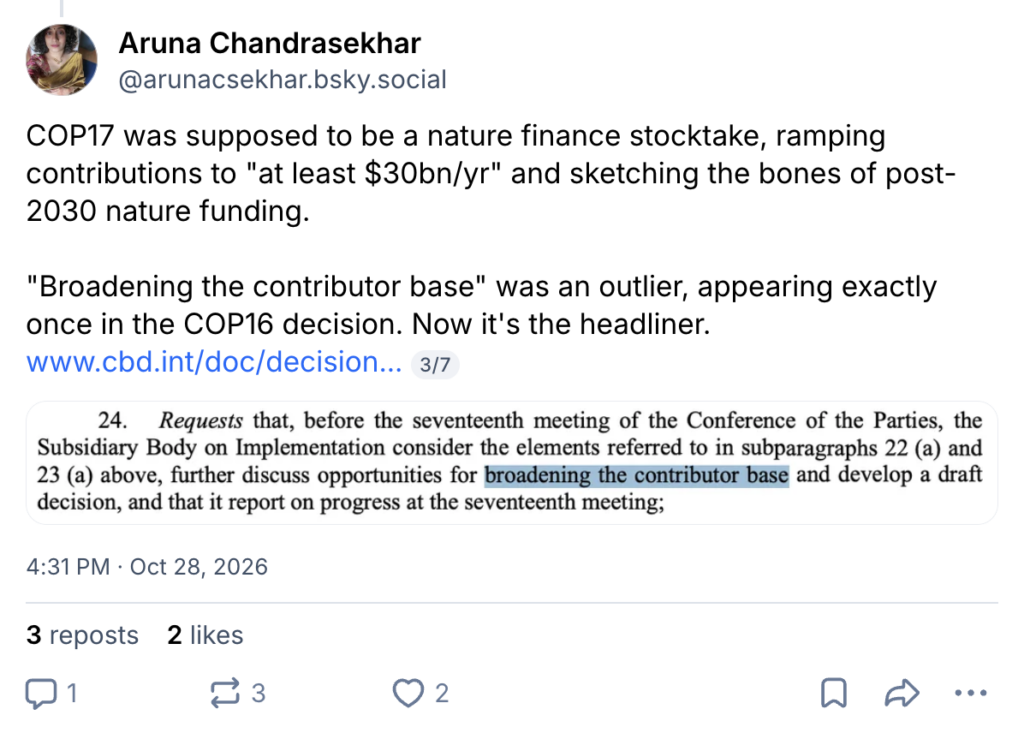
Calls to “broaden the contributor base” of who pays to protect nature – and whether that should include emerging economies – became the most fraught element of the talks.
Eventually, countries agreed on what Switzerland described as a “super, mega-delicate” text. It hinged on major “political compromises”, with “no major winner or loser”, according to Kenya.
Per the decision, countries that want to be included on a list of developed country donors can “signal interest” through bilateral, confidential consultations before COP18 and every alternate COP after.
Finally, countries also agreed on criteria to shape and resource a new, permanent financial mechanism to protect nature after 2030.
However, this did not immediately take the form of a new fund under the COP that biodiverse countries have demanded since 2022, deferring the mechanism’s institutional structure to COP18.
Resource mobilisation discussions at the GBF’s halfway mark were supposed to agree on how to close the “biodiversity finance gap” and to “increase resources from all sources” to “at least” $200bn per year by 2030, as set out in target 19 of the GBF.
The talks were largely dominated by a push, led by the JUSCANZ bloc of developed countries, to “broaden the contributor base”. This could see emerging economies, such as Qatar, China, Saudi Arabia and India, being added to the list of countries that pay to protect nature.
Article 20 of the UN Convention on Biological Diversity (CBD) states that developed countries “shall provide new and additional financial resources” to developing countries to meet the costs of implementing measures to protect nature.
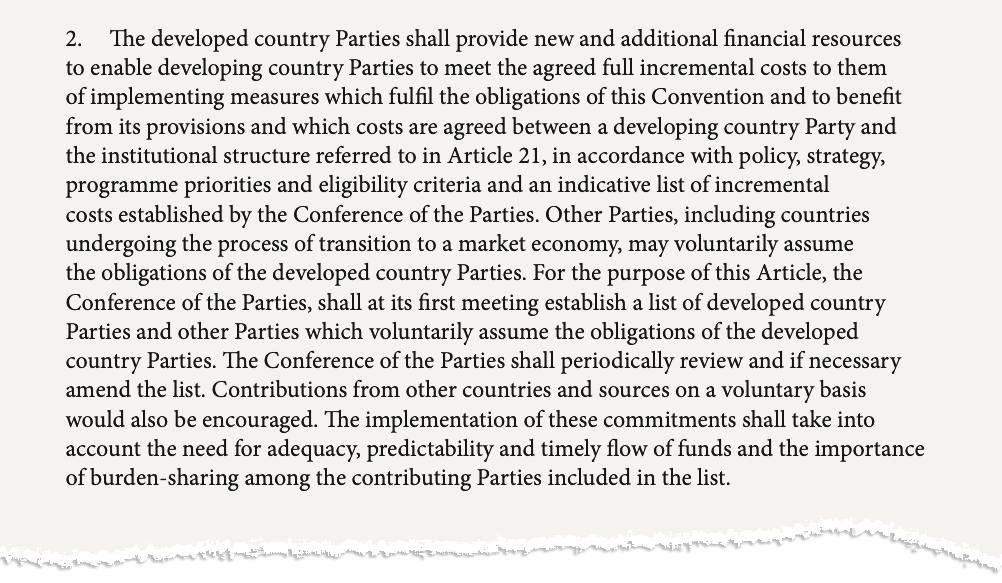
The text states that other countries – including emerging economies – may “voluntarily assume” these obligations to pay. However, it adds that this list of developed countries “shall” be reviewed periodically and amended “if necessary”.
The list was last amended in 2006.
(See this “jargon buster” which explains the specific meaning and legal weight of various terms and verbs used in UN formal documents.)
Discussions around this fraught subject had reached a dead end at intersessional talks this year, but resurfaced in Yerevan.
The first “non-paper” had four different options for expanding the contributor base. These ranged from using the World Bank’s country income groups “as a proxy” to identify high-income countries, to commissioning a study on the impacts of being included on the list.
By 21 October, the number of options swelled to eight, including two from Saudi Arabia and one from Peru.
Some countries “expressed concern” that certain options were based on a CBD secretariat study on “what constitutes a developed country”, Earth Negotiations Bulletin reported.
By the end of the first week, it was clear that the finance deadlock would have to go into informal ministerial consultations for any consensus to emerge.
At a press conference on 28 October, Christopher O’Sullivan, Ireland’s nature minister and representing the EU delegation, told Carbon Brief:
“Our position isn’t that we want to pull back in terms of contributing…but it’s been 20 years since that list was added to, times have changed and there are new realities. We just simply want those new realities reflected. I don’t fully understand why there’s so much opposition to that.”
The EU chose not to comment on which countries it would like to see on that list.
Lim Li Ching from the Third World Network, meanwhile, called the push for others to “assume the obligations” of developed countries “sheer hypocrisy”, adding that any country could make a voluntary contribution. She told Carbon Brief:
“At a forum like the CBD, this linking of income status with finance does not take into account where historical and current responsibilities lie. If you want to generate more funding for biodiversity, let’s look at sovereign debt burdens and rules, which are inequitable for developing countries. But if you can fund wars, and provide resources for your defence industry, then you know where the priorities are.”
On 29 October – at a plenary meant to adopt final texts for the most contentious subjects – Norway’s Gaute Hanssen announced that resource-mobilisation discussions would go into a smaller “friends of the chair” meeting.
Facilitated by Carolina Caceres from Canada and Imèn Meliane from Tunisia, the meeting would discuss the most contentious elements of a draft decision that had swelled to 112 brackets, denoting areas of disagreement on specific details in the text.
While the meeting was open to all, countries that were called to be present included Brazil, Canada, Chile, China, the EU, Fiji, Norway, Russia, Switzerland, Saudi Arabia, South Africa and the UK.
At the same time, a “non-paper” text by finance and environment ministers laid out countries’ red lines and compromises.