KOROR, PALAU, Wednesday 2 September 2026 — The new global heating projection by the United Nations Environment Programme (UNEP) has laid bare the dire realities of inevitable climate disaster, loss and damage for the Pacific and Australia in a 1.8°C world, with Greenpeace warning ‘we are now in bloody dangerous territory’, and must do everything possible to return warming to 1.5°C.
The report, Limiting Overshoot – Navigating exceedance of 1.5°C and pathways towards return, released as world leaders meet at this year’s Pacific Islands Forum in Palau, highlights the urgency of the climate crisis, the greatest security threat facing the Pacific. It comes as fracked gas from the Beetaloo Basin, one of Australia’s biggest climate bombs, began flowing for the first time.
Australia is the biggest polluter of all Pacific Islands Forum member states, far exceeding all other forum members combined. Greenpeace is calling on Prime Minister Anthony Albanese to centre Pacific priorities at the Forum, and walk the talk on climate solutions as a genuine family member of the Pacific.
Speaking from Palau, Shiva Gounden, Head of Pacific at Greenpeace Australia Pacific, said: “The latest UNEP report has printed in black and white that fossil fuel-hungry nations have overstepped, overshot and overindulged at the expense of Pacific lives, livelihoods, cultures and communities. This year’s Pacific Islands Forum has made it more apparent than ever that climate change is the region’s greatest security threat, and we cannot waste time on geopolitical power games when our world is sinking beneath our feet.
“As a person from the Pacific, I know our communities will not quietly accept these dire warnings of climate overshoot as our fate; we are already living and fiercely resisting this reality every single day. With every increment of warming, our lands, our livelihoods, and our island homes are threatened, but the Pacific’s resolve only grows stronger. We draw strength from our ocean and those who walked before us; our people are the protectors of the frontlines of climate change and the beacons of climate justice.
“By harnessing the natural power of our sun, winds, and seas through a rapid transition to renewable energy, and uniting in true global collaboration, we can steer back to 1.5°C – this is our moral, legal, and scientific imperative. A Fossil Fuel Free Pacific can breathe life back into the lungs of our islands.”
Also in Palau, Dr Simon Bradshaw, COP31 Lead and climate expert at Greenpeace Australia Pacific, said: “The UN report is warning that we are now in bloody dangerous territory. It lays bare the deadly consequences of reckless fossil fuel expansion, and a failure to listen to Pacific voices and to the decades of emphatic scientific warnings.
“It is a damning indictment of government climate inaction and negligence, coming just days after fracked gas from the Beetaloo Basin started flowing and Woodside’s disastrous Browse gas mega project undergoes Federal decision — two carbon bombs that would lock in decades of dangerous climate pollution and push us past the point of no return.
“Every new fossil fuel project pushes us closer to dangerous and irreversible tipping points in the climate system, with almost unimaginable consequences for the safety and security of communities in the Pacific, Australia and around the world.
“The task now is to minimise the magnitude, duration and consequences of any temperature overshoot. A pathway back to 1.5°C is possible but this pathway cannot be paved by fossil fuels.
“Accelerating the shift from fossil fuels to renewable energy, and working with our big energy partners across Asia to decarbonise together, is not only the path back from the climate brink, but also the key to our energy security and our future prosperity.”
Also in Palau, Vishal Prasad, Director of Pacific Islands Students Fighting Climate Change, said: “This report is terrifying for the young people of the Pacific. We know what 1.5, and what anything beyond it, means for our future, our families, our culture and our environment. 1.5 to stay alive has never been just slogan. It is our reality.
“The International Court of Justice has made it clear: keeping to 1.5 is not a choice, it is a legal obligation. Every new fossil fuel project drives us further from it. So we are not asking for your goodwill. We are not begging you. We are telling you what international law requires of you: end fossil fuel expansion. No new coal, no new oil, no new gas. Your corporate profits cannot be allowed to extinguish our future.”
—ENDS—
Greenpeace Australia Pacific has delegates from the Pacific and Australia at the PIFLM in Palau available for interview
Headshots can be found here
Media contact: Kimberley Bernard in Palau on +61407 581 404 or kbernard@greenpeace.org
‘Bloody dangerous territory’: UN report an indictment of govt climate inaction

For the first time, new-energy vehicles (NEVs) made up 67% of new car sales in China in September, according to the latest data from the China Passenger Car Association (CPCA).
The figures show that NEVs, which include battery electric cars and plug-in hybrids, captured a record share of sales, even though fewer were sold than last year.
This is because sales of combustion-engine cars are falling steeply, a trend that the CPCA has attributed to rising petrol prices following the start of the Hormuz crisis.
Indeed, sales of fuel-only cars were down 31% year-on-year in the first nine months of 2026, with plug-in hybrid sales down 26% – whereas battery EV sales were only down 4%.
One analyst tells Carbon Brief that China’s rapidly growing EV fleet has offset demand for 143m barrels of oil since the start of the Hormuz crisis.
Another says that the crisis is “reinforcing China’s electrification of road transport”.
Meanwhile, amid slowing domestic sales, Chinese carmakers’ exports of NEVs more than doubled [in 2026 to date / in September] from a year earlier.
NEV record
A record two out of every three cars sold in September in China were NEVs, according to CPCA data, as shown in the figure below.
(NEVs predominantly include battery electric vehicles – BEVs – and plug-in hybrids – PHEVs. BEVs only run on electricity, whereas PHEVs also have a combustion engine.)
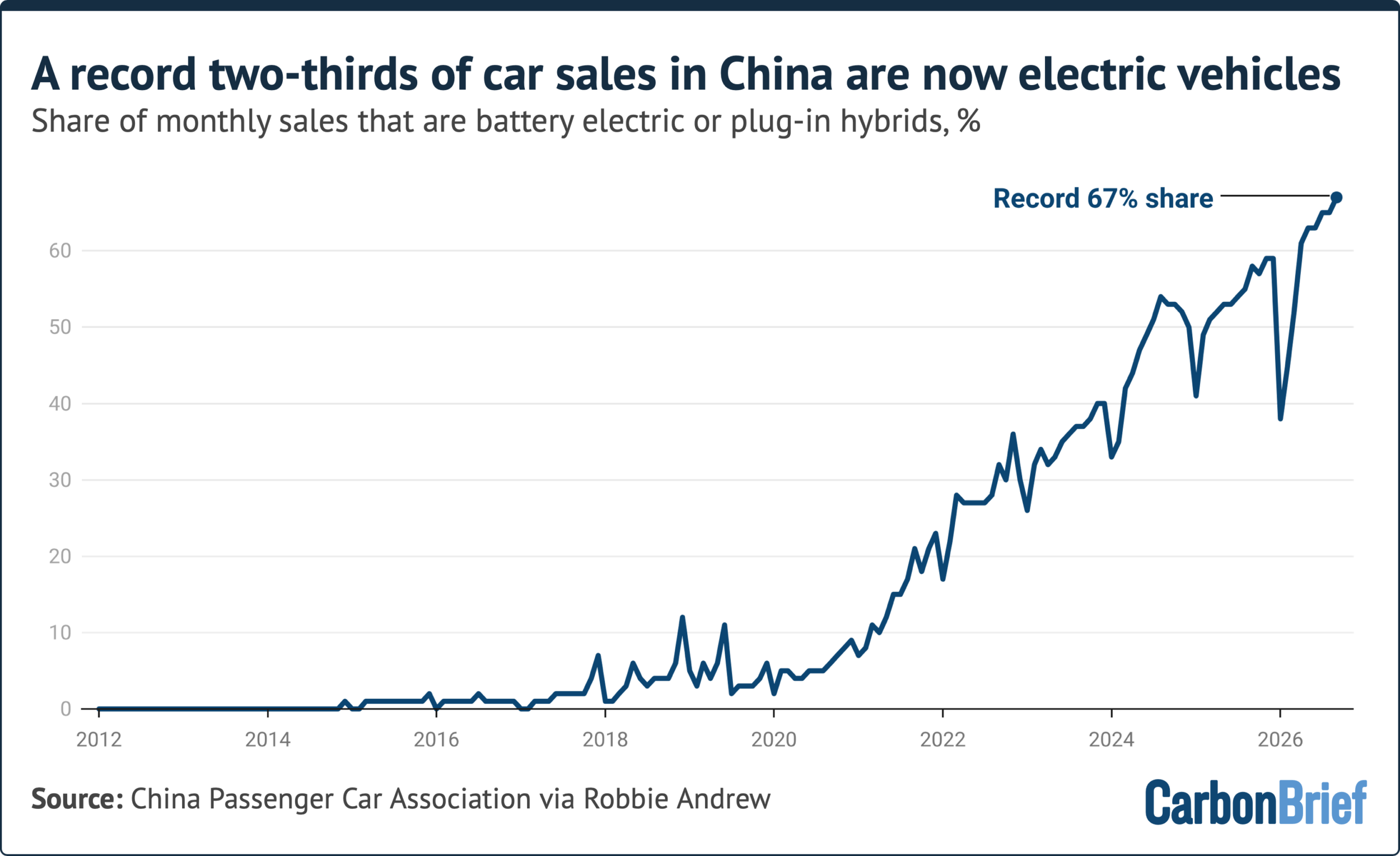
This marks a rapid rise for NEVs from just 6% of new car sales in 2020 up to 58% in 2026 to date – and a record 67% in the month of September.
This year, NEVs’ share of sales has also bounced back from a low of 39% in January, after the full purchase tax exemption that had been in place for more than a decade came to an end in December 2025.
The gain in NEV share in 2026 has come amid a slowdown across the wider domestic passenger-car market, which has hit sales of combustion-engine vehicles particularly hard.
This September, passenger-car retail sales across all categories declined, with overall sales volumes falling 28% year-on-year.
The contraction was led by combustion-engine vehicles, which saw sales fall 43% year-on-year in September and 31% in 2026 to date.
However, sales of PHEVs also fell by 36% year-on-year in September and by 26% in 2026 to date. By comparison, BEVs performed better, although sales still declined 8.5% from a year earlier in September and 4% in 2026 to date.
As a result, NEV sales overall fell by 17% in September and 13% in 2026 to date.
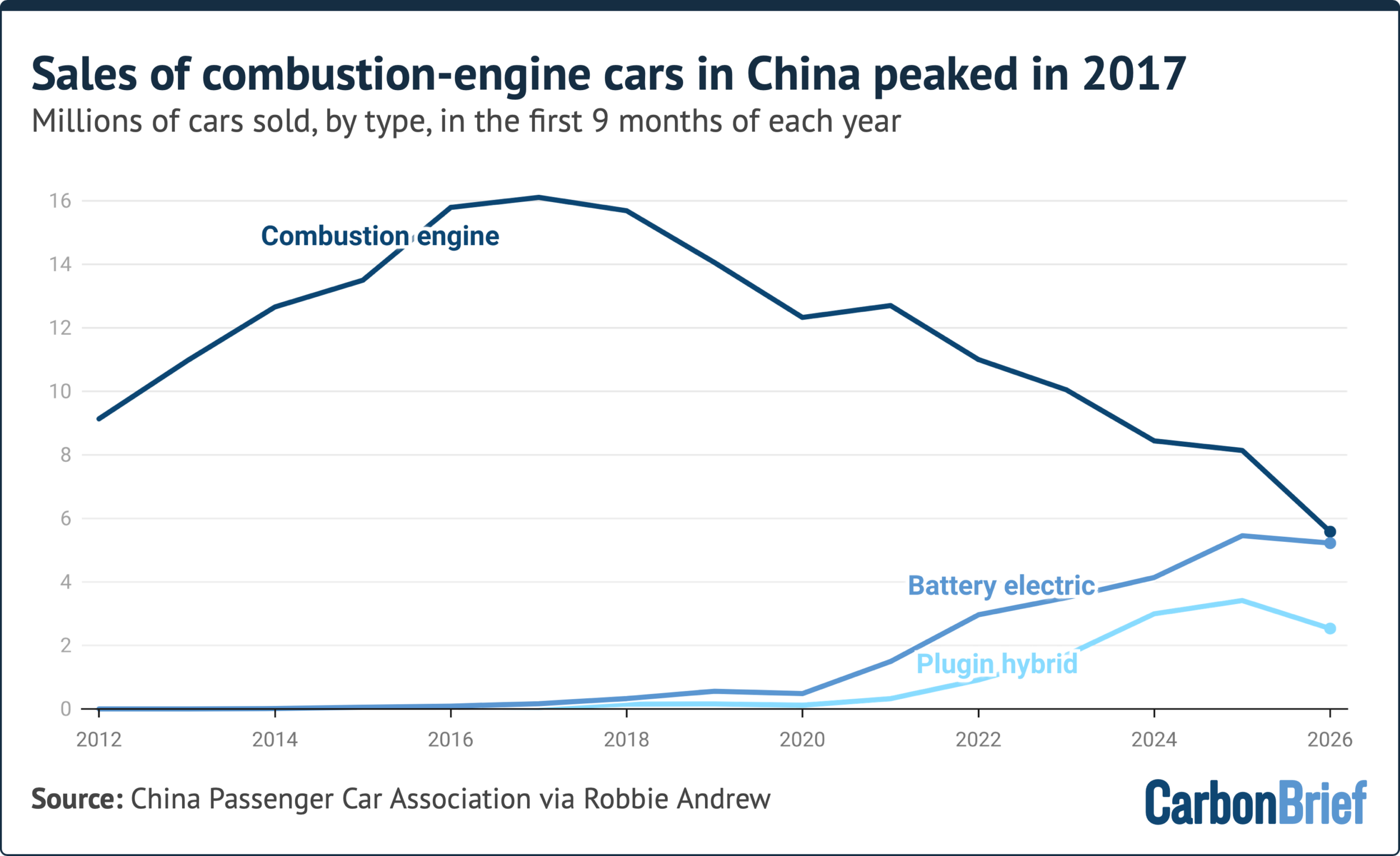
While the market changes in 2026 to date were particularly dramatic, they reflect a broad continuation of trends seen over the past decade.
Indeed, sales of combustion-engine cars in China peaked in 2017 and they have been declining ever since, shown in the figure below.
Impact of Hormuz
Part of the reason for the advance of NEVs in 2026, said Chinese technology news outlet OFweek, was petrol cars “giving up market share” as they were outperformed by electric alternatives.
Cui Dongshu, secretary-general of the CPCA, cited higher petrol prices as an explanation for September’s weak combustion-car sales, in comments to financial news outlet National Business Daily.
Imports of oil into China in January-September have fallen 15% compared to 2025, equivalent to 470m barrels, as ongoing conflict tightened supply and drove up prices.
China’s passenger-car NEV fleet has displaced 143m barrels of oil so far during the strait of Hormuz crisis, Euan Graham, senior energy analyst at thinktank Ember, tells Carbon Brief.
EVs “accounted for 12% of the decrease in China’s oil use post-Hormuz”, according to an estimate provided to thinktank the Brookings Institute by an unnamed analyst.
Erica Downs, a senior research scholar at Columbia University’s Center on Global Energy Policy, tells Carbon Brief that the strait of Hormuz crisis and higher oil prices are “reinforcing China’s electrification of road transport”.
She says the “world’s largest oil supply disruption” vindicates China’s early bet on EVs, which was partly driven by concerns about oil-supply security.
NEV demand down
Nevertheless, NEV sales have fallen year-on-year, albeit at a slower rate than overall car sales. The growth in NEV market share has also been decelerating.
Zhang Yichao, a partner at consulting firm AlixPartners, tells Carbon Brief that NEVs benefit from government trade-in policies and a “strong pipeline” of new models, particularly those involving innovation.
He says these factors help explain why NEVs sales have fallen at a slower rate to their combustion-car counterparts.
Cui told the state-run China National Radio that the fall for NEVs and for cars overall in September 2026, is also due to a high baseline of sales from the same month in 2025, as well as changes to trade-in policies and disruptions from the holiday period.
Other factors, says consulting firm Wood Mackenzie, are the weakened demand due to “demand pull-forward” in 2025 caused by the end of subsidies, as well as “tighter financing conditions”.
Zhang tells Carbon Brief he does not “see much more room ahead” for further growth in NEVs’ market share.
He adds that, in his view, their share in China is unlikely to exceed 80%, as some premium-market segments and specific use cases will continue to require combustion-engine vehicles.
Exports surge
Meanwhile, while domestic NEV retail sales fell 17% in September 2026, exports more than doubled, increasing 164% year-on-year, according to the CPCA.
This extends the decline in domestic sales and very strong growth in exports seen across 2026 to date, as shown in the figure below.
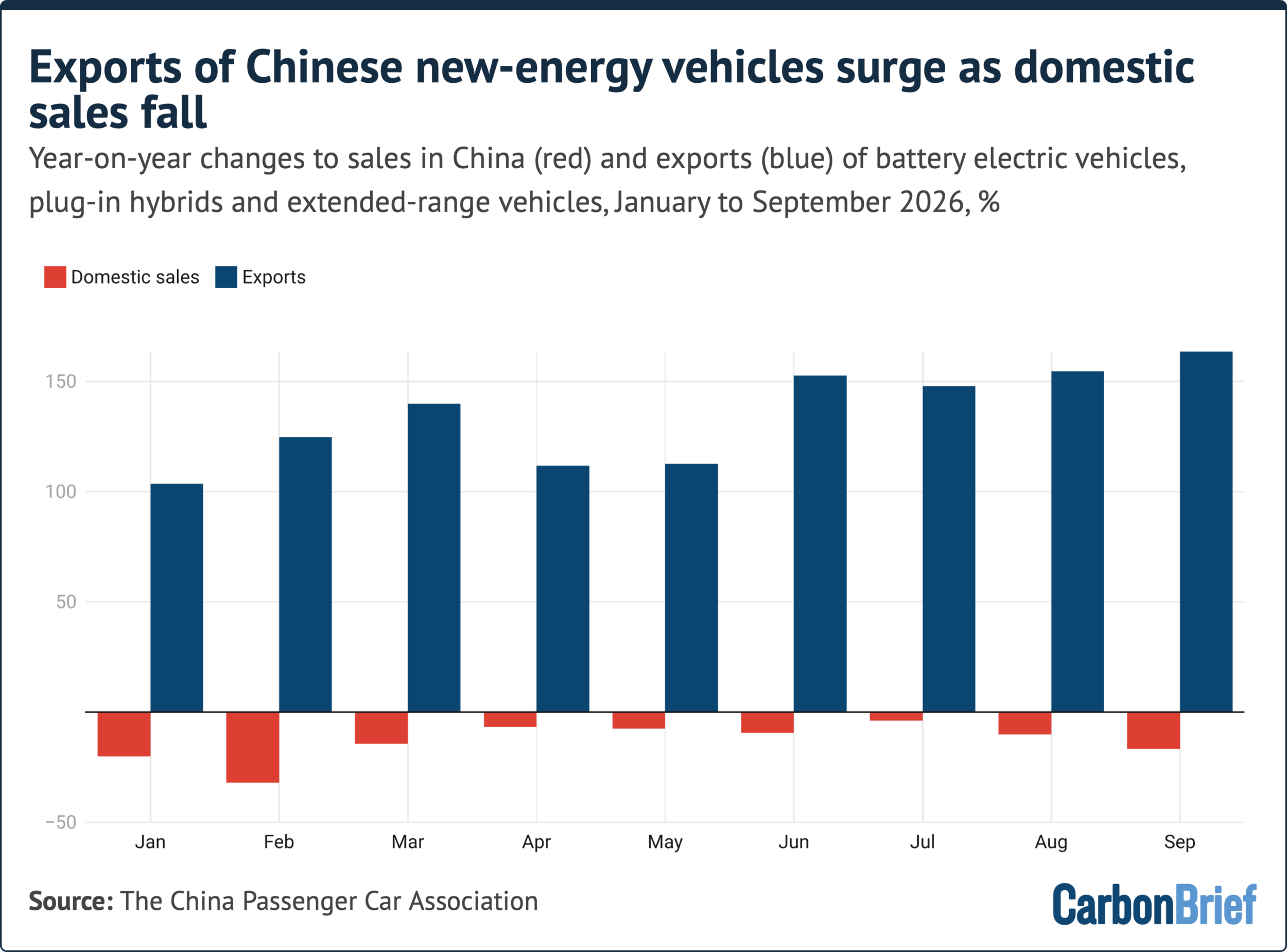
In September, 1,084,000 NEVs were sold domestically in China, while 558,000 NEVs were exported.
Exports are becoming increasingly important to Chinese carmakers, in the face of weaker domestic demand and cut-throat industrial competition.
The CPCA says exports have become “a core priority” for some carmakers.
However, the surge in exports from China has created concern in the EU, which has placed tariffs on imports of EVs from China and recently agreed plans to cut imports of hybrids.
Countries including Mexico and Turkey have also placed tariffs on Chinese EV imports.
At the same time, the Chinese government is putting policies in place that might be expected to disincentivise exports, such as cutting VAT export rebates.
Analysts differ on what impact this policy shift will have, with some saying it will be limited, while others believe it could cause the price of exported cars to rise.