



- Formal negotiations
- Finance
- Global review
- Global report
- Digital sequence information
- Harmful subsidies
- Marine biodiversity
- Planning, monitoring, reporting and review
- Article 8(j) implementation
- Biodiversity and climate change
- Links with other bodies
- Around the COP
- Armenian presidency
- Protests
- Lobbying and influence
- Carbon and biodiversity markets

China’s effort to build large solar power “bases” in and around the desert is a major part of its current renewable plan.
What is less known is that the initiative – which has expanded rapidly in the country’s arid north and northwest – is also a part of China’s campaign to combat desertification, an issue increasingly exacerbated by climate change.
For more than four decades, Beijing has been trying to prevent sand from degrading its land and forming dust storms with an afforestation programme called the “Three-North Shelterbelt” (三北防护林).
Over the past two years, the programme – described as China’s “war on sand” by the media – has been boosted by the development of large-scale solar bases in far-flung regions, such as Xinjiang and Inner Mongolia.
Installing solar panels in the desert can not only generate power, but also help prevent sand dunes from moving, according to Dr He Jijiang, executive deputy director of the Research Center for Energy Transition and Social Development at Tsinghua University, Beijing.
Energy companies’ investments also provide financial support to many regions’ sand-control campaigns – an apparent obstacle in the past – Dr He tells Carbon Brief at a side event in the China pavilion at the ongoing 16th session of the conference of parties (COP16) of the United Nations Convention to Combat Desertification (UNCCD) in Riyadh, Saudi Arabia.
Taming of the sand
China is one of the worst-hit countries by desertification, which essentially means land degradation in dry lands. When land degrades, it becomes less healthy and productive.
Nearly 18% of China’s landmass – roughly seven times the size of the UK – is affected by the issue, according to statistics reported by Guan Zhi’ou, director of China’s National Forestry and Grassland Administration and the head of the Chinese delegation to COP16, in November.
China’s effort to combat desertification has a strong link with its – and the world’s – climate actions.
Soil is the second largest natural carbon sink on Earth after oceans and stores a large amount of carbon. When land degrades, not only does it lose the ability to store as much carbon, it can also release carbon into the atmosphere, driving further climate change.
On the other hand, climate change accelerates land degradation and China is on the front line. The country has seen the largest total area shift from non-dryland into drylands over the past three decades, according to a major scientific report published by the UNCCD at COP16. This means more parts of China are now prone to land degradation.
Since the introduction of the Three-North Shelterbelt programme in 1978, China has adopted a series of measures to fight desertification, from planting sand-blocking vegetation to laying straw on the ground in the shape of checkerboards to prevent its vast deserts from expanding. These solutions have enabled the country to protect about 360,000km2 of desertified land and to rehabilitate 79,000km2 of it, Guan said.
The ancient Chinese people built the Great Wall and Beijing now intends to build a “Green Great Wall”. According to the plan, the Three-North programme will see a total of 350,000km2 of trees planted in northern regions over the space of 73 years – until 2050 – to block out dust storms, stabilise the soil and improve land fertility.
Research by the Chinese Academy of Sciences showed that emissions averaging 213m tonnes of carbon dioxide equivalent were absorbed by forest, land and the environment every year between 1980 and 2015, due to the Three-North Shelterbelt programme, according to a release published by the National Forestry and Grassland Administration.
Solar solution
China’s plan for renewable energy from 2021 to 2025 calls for the “large-scale development” of its sand-plus-solar anti-desertification method, a concept Beijing started promoting around two years ago.
The concept centres around managing arid areas via building and maintaining solar farms. It stems from years of experience accumulated by Chinese solar developers, which have built solar farms in the desert for more than a decade – with varying degrees of success.
“Building solar farms needs a lot of space. China has vast deserts, so [companies] wanted to take advantage of it,” Dr He explains.
But to operate solar farms in such harsh conditions, these companies must first take various protective measures – and these measures helped combat desertification, too.
For example, companies need to put up fences around their solar farms to stop animals from entering, install anti-dust nets to prevent sand from gathering on equipment and make straw checkerboards around their bases to prevent nearby sand dunes from shifting, Dr He says.

Solar panels also bring benefits to the ground underneath. For example, they can reduce water evaporation by blocking out direct sunshine, according to Dr Chen Siyu, a professor at the college of atmospheric sciences at Lanzhou University in Lanzhou, a city situated on the edge of the Gobi desert in China.
Solar panels can “significantly increase” the soil moisture of dry regions and, therefore, help plants to grow, Dr Chen tells Carbon Brief. A 2021 study conducted in northwest China projected that the soil moisture would increase by up to 113.6% when it is sheltered.
“Solar panels can also form a natural barrier, helping to shed wind speed and prevent dust storms from occurring and spreading,” she says.
Ramping up transition
The construction of solar farms also injects financial support to many regions’ sand-control campaigns, providing incentives for them to carry on, Dr He notes.
“In the past, planting trees only brought ecological benefits, not economic returns,” he says. “Now, if a company wants to build a solar power station, it needs to cover all related costs, from hiring equipment to growing plants.”
Ramping up the solar-plus-sand method can scale up China’s renewable deployment, as well as improving soil conditions by bringing greenery, vegetable plots and livestock to the desert and barren land. Because of this, dryland has become “a type of resource”, Dr He says.
The Chinese government has been pushing the concept as a way to upscale the development of desert-based solar.
But there are concerns over whether the country’s grid is ready to transport such a large amount of solar power from remote areas to big cities on the eastern coast thousands of kilometres away.
Dr He recognises the challenge. “We don’t have enough long-distance transmission lines, but we are building many,” he says.
A shorter version of this article appeared in Carbon Brief’s China Briefing newsletter on 12 December 2024.
The post Explainer: How China’s renewables rollout boosts its ‘war on sand’ appeared first on Carbon Brief.
Explainer: How China’s renewables rollout boosts its ‘war on sand’
Continue Reading
Countries have completed the first “global review” of their progress towards reversing nature loss by 2030 at the COP17 biodiversity talks in Yerevan, Armenia.
The review “notes with deep concern” that, unless action is “rapidly accelerated”, the goal to reverse nature loss and meet a set of 23 targets by 2030 “will not be achieved”.
It “urges” countries to accelerate action, including by “increased ambition in addressing the gaps”.
Much of the discussions in Yerevan focused on how to raise the necessary funds to help developing countries protect nature.
Some major economies pushed to expand the range of nations that are expected to provide finance, with countries agreeing at the end of the two weeks of talks that non-donors that want to contribute can “signal interest” before COP18.
This came after developed countries failed to meet a target to significantly ramp up nature finance over the last few years.
It also came as a landmark fund agreed at COP16 in Colombia to pay communities for the genetic resources derived from nature stands nearly empty two years on.
The Yerevan talks marked the halfway point of the “Kunming-Montreal Global Biodiversity Framework” (GBF), the “Paris Agreement for nature” first made in 2022 and due to be achieved by 2030.
During the nearly 12-hour-long final plenary, countries voted for Quito, Ecuador, to host the COP18 nature talks, which will be held in 2028.
Countries managed to sign off on all the major negotiation texts, marking a stark contrast to COP16, which ran so far over time that the Colombian presidency lost “quorum”, forcing talks to resume in Rome months later.
Below, Carbon Brief has detailed analysis of all of the key outcomes from COP17.
Formal negotiations
Finance
Finance, predictably, was at the heart of the discord and deadlock at the Yerevan talks.
At COP17, discussions on finance had to achieve several outcomes.
The first part – to take stock of biodiversity finance mobilised so far to meet the nature deal’s goals – fell under the global review.
As the global report noted, developed countries failed to meet their commitments to raise “at least $20bn a year by 2025” for nature. Delegates pointed to falling aid levels and a sharp 27% decline in environmental funding for the 2026-30 period.
The second part was to agree on how to mobilise resources for the next four years, to meet the GBF’s goals and targets.
Calls to “broaden the contributor base” of who pays to protect nature – and whether that should include emerging economies – became the most fraught element of the talks.
Eventually, countries agreed on what Switzerland described as a “super, mega-delicate” text. It hinged on major “political compromises”, with “no major winner or loser”, according to Kenya.
Per the decision, countries that want to be included on a list of developed country donors can “signal interest” through bilateral, confidential consultations before COP18 and every alternate COP after.
Finally, countries also agreed on criteria to shape and resource a new, permanent financial mechanism to protect nature after 2030.
However, this did not immediately take the form of a new fund under the COP that biodiverse countries have demanded since 2022, deferring the mechanism’s institutional structure to COP18.
Resource mobilisation discussions at the GBF’s halfway mark were supposed to agree on how to close the “biodiversity finance gap” and to “increase resources from all sources” to “at least” $200bn per year by 2030, as set out in target 19 of the GBF.
The talks were largely dominated by a push, led by the JUSCANZ bloc of developed countries, to “broaden the contributor base”. This could see emerging economies, such as Qatar, China, Saudi Arabia and India, being added to the list of countries that pay to protect nature.
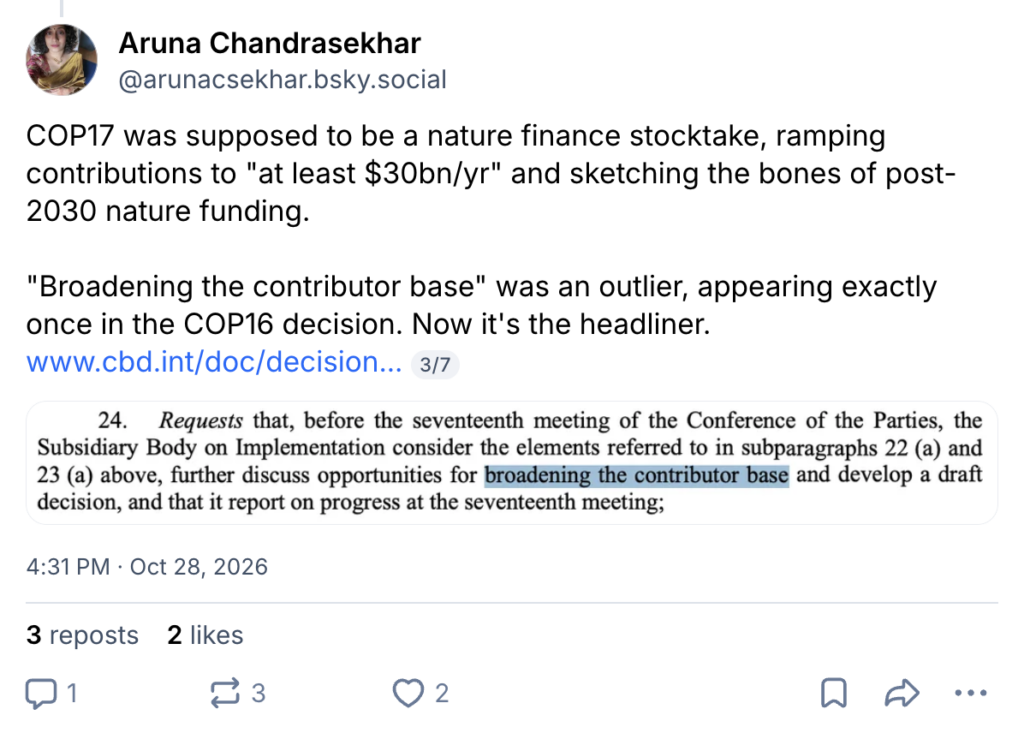
Article 20 of the UN Convention on Biological Diversity (CBD) states that developed countries “shall provide new and additional financial resources” to developing countries to meet the costs of implementing measures to protect nature.
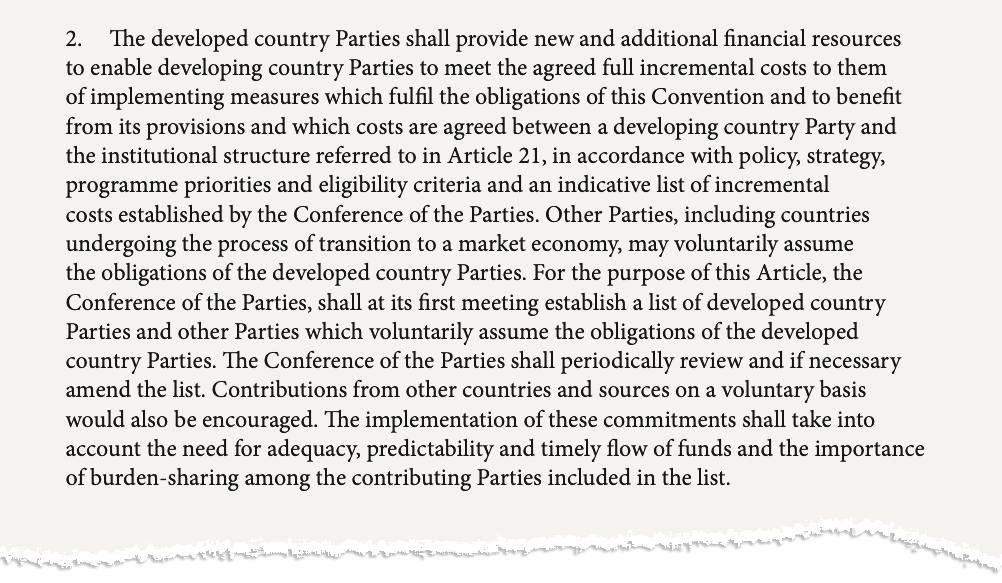
The text states that other countries – including emerging economies – may “voluntarily assume” these obligations to pay. However, it adds that this list of developed countries “shall” be reviewed periodically and amended “if necessary”.
The list was last amended in 2006.
(See this “jargon buster” which explains the specific meaning and legal weight of various terms and verbs used in UN formal documents.)
Discussions around this fraught subject had reached a dead end at intersessional talks this year, but resurfaced in Yerevan.
The first “non-paper” had four different options for expanding the contributor base. These ranged from using the World Bank’s country income groups “as a proxy” to identify high-income countries, to commissioning a study on the impacts of being included on the list.
By 21 October, the number of options swelled to eight, including two from Saudi Arabia and one from Peru.
Some countries “expressed concern” that certain options were based on a CBD secretariat study on “what constitutes a developed country”, Earth Negotiations Bulletin reported.
By the end of the first week, it was clear that the finance deadlock would have to go into informal ministerial consultations for any consensus to emerge.
At a press conference on 28 October, Christopher O’Sullivan, Ireland’s nature minister and representing the EU delegation, told Carbon Brief:
“Our position isn’t that we want to pull back in terms of contributing…but it’s been 20 years since that list was added to, times have changed and there are new realities. We just simply want those new realities reflected. I don’t fully understand why there’s so much opposition to that.”
The EU chose not to comment on which countries it would like to see on that list.
Lim Li Ching from the Third World Network, meanwhile, called the push for others to “assume the obligations” of developed countries “sheer hypocrisy”, adding that any country could make a voluntary contribution. She told Carbon Brief:
“At a forum like the CBD, this linking of income status with finance does not take into account where historical and current responsibilities lie. If you want to generate more funding for biodiversity, let’s look at sovereign debt burdens and rules, which are inequitable for developing countries. But if you can fund wars, and provide resources for your defence industry, then you know where the priorities are.”
On 29 October – at a plenary meant to adopt final texts for the most contentious subjects – Norway’s Gaute Hanssen announced that resource-mobilisation discussions would go into a smaller “friends of the chair” meeting.
Facilitated by Carolina Caceres from Canada and Imèn Meliane from Tunisia, the meeting would discuss the most contentious elements of a draft decision that had swelled to 112 brackets, denoting areas of disagreement on specific details in the text.
While the meeting was open to all, countries that were called to be present included Brazil, Canada, Chile, China, the EU, Fiji, Norway, Russia, Switzerland, Saudi Arabia, South Africa and the UK.
At the same time, a “