The European Central Bank (ECB) is standing in the way of a plan by African and Latin American development banks to mobilise large amounts of finance to tackle climate change.
The Frankfurt-based ECB sets rules for the 20 European countries that use the Euro currency, and has told their national central banks not to re-channel a type of financial asset known as special drawing rights (SDRs) to multilateral development banks (MDBs).
This has scuppered an attempt by the African Development Bank (AfDB) and Inter-American Development Bank (IDB) to persuade rich nations to give their SDRs to them – where they argue the money can go further – rather than back to the International Monetary Fund (IMF).
SDRs are issued by the IMF as a way of supplementing its member countries’ foreign exchange reserves, allowing them to reduce their reliance on more expensive domestic or external debt for building reserves. They can be held and used by member countries, the IMF and designated official entities called “prescribed holders”, which include some central banks and regional development banks. Governments will discuss how they are used at the IMF’s annual meeting in Washington DC this week.
Pepukaye Bardouille, special adviser on climate resilience to the Barbados prime minister, told Climate Home in a press briefing last week that Eurozone countries “have struggled” to give their SDRs to the AfDB and IDB “because of restrictions of the [ECB] that hinder their ability to re-channel”.
Laurence Tubiana, CEO of the European Climate Foundation, said during the same briefing that the ECB’s rules are a “problem”, noting that central banks “are very averse to risk”. “All this money sitting in central banks doesn’t really work for development and for all the big issues we have to face,” she said. This is a moment where we “have to open all the boxes” of finance, she added.

Laurence Tubiana as a UN high level climate champion in 2016 (Pic: UNFCCC/Flickr)
Explaining the ECB’s reluctance in a recent online article for the Center for Global Development, leading economists Vera Songwe and Mark Plant wrote that central banks use their reserves to ensure the smooth flow of trade and to support their currencies.
“They loathe using them to pay for current spending or investments in their own countries, much less others,” they explained. “Lending to MDBs is seen as chipping away at high-income countries’ financial safety margins to help bail out developing countries that are a world away.”
Pandemic bail-out cash
When the COVID-19 pandemic hit the global economy, cash-strapped developing countries and small island states that cannot borrow easily because of low credit ratings asked the IMF for financial support.
The IMF responded by issuing $650 billion worth of SDRs. By default, these are allocated to countries according to the size of their economy which meant that the bigger, richer nations got the most, despite needing the least.
At the time, IMF Managing Director Kristalina Georgieva urged rich nations to re-allocate their SDRs to smaller, poorer nations. The IMF set up two funds called the Resilience and Sustainability Trust (RST) and the Poverty Reduction and Growth Trust (PRGT) – and rich nations re-allocated some of their SDRs to those.
In March 2023, the RST approved its first batch of loans, including $764 million for Jamaica to invest in renewables and energy efficiency.
Parametric triggers: How small islands can escape climate-poverty trap
But critics pointed out that the RST adds to national debt burdens and only countries with an existing IMF programme can access it, excluding many in need.
The AfDB and the IDB argued that channeling the money to them – instead of to the RST – would allow them to “leverage SDRs by up to four times their value in the form of loans to finance social and climate projects”. As the RST is not a bank, its ability to leverage is limited.
AfDB President Akinwumi Adesina said in May that the proposal was “an innovative approach through which development financing can be mobilized with a multiplier effect and at no cost to taxpayers. These are the types of solutions we need to help us tackle Africa’s growing development challenges.”
ECB’s cold water
But the proposal has received little interest. According to Songwe and Plant, no countries have taken the AfDB and IDB up on their proposal.
While the IMF gave it the green light in May, the ECB president Christine Lagarde said in 2022 that it “would not be compatible with the EU’s legal framework” for Eurozone nations to take part.
Since then, the ECB has continued to encourage Eurozone countries to channel their SDRs into the IMF’s two funds, but considers redirecting them outside of the IMF to be incompatible with the EU constitution’s ban on monetary financing.
The European Council has made a formal exception for rechannelling SDRs to the IMF because it considers them still to be reserve assets.
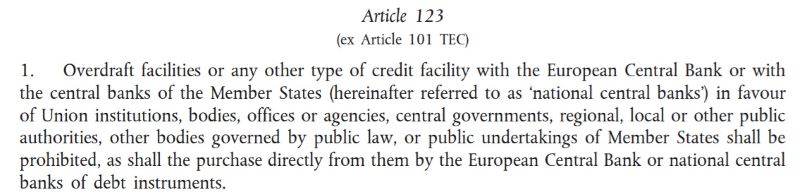
The ECB believes the proposal is incompatible with Article 123(1) of the Treaty on the Functioning of the European Union
While France and Italy have supported re-allocating SDRs to MDBs, the German central bank has opposed re-allocating SDRs, even to the IMF.
Tubiana said reform of the ECB to allow re-allocating SDRs to MDBs “seems very, very far away”, adding that if Germany and the rest of the Eurozone states feel unable to do this, they could issue their own bonds to offer cheaper capital for climate finance.
Songwe and Plant argue that, to avoid the same hurdle next time SDRs are dished out, MDBs should be given them directly rather than asking wealthy governments to re-allocate them. This would, however, require agreement from 85% of the IMF’s executive board, which is “no small feat in today’s politically fractured world”, the economists warned.
(Reporting by Joe Lo; editing by Megan Rowling)
The post European Central Bank holds back plan to boost climate finance for Africa, Latam appeared first on Climate Home News.
European Central Bank holds back plan to boost climate finance for Africa, Latam
Climate Change
IMO head: Shipping decarbonisation “has started” despite green deal delay
The head of the United Nations body governing the global shipping industry has said that greenhouse gases from the global shipping industry will fall, whether or not the sector’s “Net Zero Framework” to cut emissions is adopted in October.
Arsenio Dominguez, secretary-general of the International Maritime Organization, told a new year’s press conference in London on Friday that, even if governments don’t sign up to the framework later this year as planned, the clean-up of the industry responsible for 3% of global emissions will continue.
“I reiterate my call to industry that the decarbonisation has started. There’s lots of research and development that is ongoing. There’s new plans on alternative fuels like methanol and ammonia that continue to evolve,” he told journalists.
He said he has not heard any government dispute a set of decarbonisation goals agreed in 2023. These include targets to reduce emissions 20-30% on 2008 levels by 2030 and then to reach net zero emissions “by or around, i.e. close to 2050”.
Dominguez said the 2030 emissions reduction target could be reached, although a goal for shipping to use at least 5% clean fuels by 2030 would be difficult to meet because their cost will remain high until at least the 2030s. The goals agreed in 2023 also included cutting emissions by 70-80% by 2040.
In October 2025, a decision on a proposed framework of practical measures to achieve the goals, which aims to incentivise shipowners to go green by taxing polluting ships and subsidising cleaner ones, was postponed by a year after a narrow vote by governments.
Ahead of that vote, the US threatened governments and their officials with sanctions, tariffs and visa restrictions – and President Donald Trump called the framework a “Green New Scam Tax on Shipping”.
Dominguez said at Friday’s press conference that he had not received any official complaints about the US’s behaviour at last October’s meeting but – without naming names – he called on nations to be “more respectful” at the IMO. He added that he did not think the US would leave the IMO, saying Washington had engaged constructively on the organisation’s budget and plans.
EU urged to clarify ETS position
The European Union – along with Brazil and Pacific island nations – pushed hard for the framework to be adopted in October. Some developing countries were concerned that the EU would retain its charges for polluting ships under its emissions trading scheme (ETS), even if the Net Zero Framework was passed, leading to ships travelling to and from the EU being charged twice.
This was an uncertainty that the US and Saudi Arabia exploited at the meeting to try and win over wavering developing countries. Most African, Asian and Caribbean nations voted for a delay.
On Friday, Dominguez called on the EU “to clarify their position on the review of the ETS, in order that as we move forward, we actually don’t have two systems that are going to be basically looking for the same the same goal, the same objective.”
He said he would continue to speak to EU member states, “to maintain the conversations in here, rather than move forward into fragmentation, because that will have a very detrimental effect in shipping”. “That would really create difficulties for operators, that would increase the cost, and everybody’s going to suffer from it,” he added.
The IMO’s marine environment protection committee, in which governments discuss climate strategy, will meet in April although the Net Zero Framework is not scheduled to be officially discussed until October.
The post IMO head: Shipping decarbonisation “has started” despite green deal delay appeared first on Climate Home News.
IMO head: Shipping decarbonisation “has started” despite green deal delay
Climate Change
DeBriefed 23 January 2026: Trump’s Davos tirade; EU wind and solar milestone; High seas hope
Welcome to Carbon Brief’s DeBriefed.
An essential guide to the week’s key developments relating to climate change.
This week
Trump vs world
TILTING AT ‘WINDMILLS’: At the World Economic Forum meeting in Davos, Switzerland, Donald Trump was quoted by Reuters as saying – falsely – that China makes almost all of the world’s “windmills”, but he had not “been able to find any windfarms in China”, calling China’s buyers “stupid”. The newswire added that China “defended its wind power development” at Davos, with spokesperson Guo Jiakun saying the country’s efforts to tackle climate change and promote renewable energy in the world are “obvious to all”.
SPEECH FACTCHECKED: The Guardian factchecked Trump’s speech, noting China has more wind capacity than any other country, with 40% of global wind generation in 2024 in China. See Carbon Brief’s chart on this topic, posted on BlueSky by Dr Simon Evans.
GREENLAND GRAB: Trump “abruptly stepped back” from threats to seize Greenland with the use of force or leveraging tariffs, downplaying the dispute as a “small ask” for a “piece of ice”, reported Reuters. The Washington Post noted that, while Trump calls climate change “a hoax”, Greenland’s described value is partly due to Arctic environmental shifts opening up new sea routes. French president Macron slammed the White House’s “new colonial approach”, emphasising that climate and energy security remain European “top priorities”, according to BusinessGreen.
Around the world
- EU MILESTONE: For the first time, wind and solar generated more electricity than fossil fuels in the EU last year, reported Reuters. Wind and solar generated 30% of the EU’s electricity in 2025, just above 29% from plants running on coal, gas and oil, according to data from the thinktank Ember covered by the newswire.
- WARM HOMES: The UK government announced a £15bn plan for rolling out low-carbon technology in homes, such as rooftop solar and heat pumps. Carbon Brief’s newly published analysis has all the details.
- BIG THAW: Braving weather delays that nearly “derail[ed] their mission”, scientists finally set up camp on Antarctica’s thawing Thwaites glacier, reported the New York Times. Over the next few weeks, they will deploy equipment to understand “how this gargantuan glacier is being corroded” by warming ocean waters.
- EVS WELCOME: Germany re-introduced electric vehicle subsidies, open to all manufacturers, including those in China, reported the Financial Times. Tesla and Volvo could be the first to benefit from Canada’s “move to slash import tariffs on made-in-China” EVs, said Bloomberg.
- SOUTHERN AFRICA FLOODS: The death toll from floods in Mozambique went up to 112, reported the African Press Agency on Thursday. Officials cited the “scale of rainfall” – 250mm in 24 hours – as a key driver, it added. Frontline quoted South African president Cyril Ramaphosa, who linked the crisis to climate change.
$307bn
The amount of drought-related damages worldwide per year – intensified by land degradation, groundwater depletion and climate change – according to a new UN “water bankruptcy” report.
Latest climate research
- A researcher examined whether the “ultra rich” could and should pay for climate finance | Climatic Change
- Global deforestation-driven surface warming increased by the “size of Spain” between 1988 and 2016 | One Earth
- Increasing per-capita meat consumption by just one kilogram a year is “linked” to a nearly 2% increase in embedded deforestation elsewhere | Environmental Research Letters
(For more, see Carbon Brief’s in-depth daily summaries of the top climate news stories on Monday, Tuesday, Wednesday, Thursday and Friday.)
Captured

For the first time since monitoring began 15 years ago, there were more UK newspaper editorials published in 2025 opposing climate action than those supporting it, Carbon Brief analysis found. The chart shows the number of editorials arguing for more (blue) and less (red) climate action between 2011-2025. Editorials that took a “balanced” view are not represented in the chart. All 98 editorials opposing climate action were in right-leaning outlets, while nearly all 46 in support were in left-leaning and centrist publications. The trend reveals the scale of the net-zero backlash in the UK’s right-leaning press, highlighting the rapid shift away from a political consensus.
Spotlight
Do the oceans hold hope for international law?
This week, Carbon Brief unpacks what a landmark oceans treaty “entering into force” means and, at a time of backtracking and breach, speaks to experts on the future of international law.
As the world tries to digest the US retreat from international environmental law, historic new protections for the ocean were quietly passed without the US on Saturday.
With little fanfare besides a video message from UN chief Antonio Guterres, a binding UN treaty to protect biodiversity in two-thirds of the Earth’s oceans “entered into force”.
What does the treaty mean and do?
The High Seas Treaty – formally known as the “biodiversity beyond national jurisdiction”, or “BBNJ” agreement – obliges countries to act in the “common heritage of humankind”, setting aside self-interest to protect biodiversity in international waters. (See Carbon Brief’s in-depth explainer on what the treaty means for climate change).
Agreed in 2023, it requires states to undertake rigorous impact assessments to rein in pollution and share benefits from marine genetic resources with coastal communities and countries. States can also propose marine protected areas to help the ocean – and life within it – become more resilient to “stressors”, such as climate change and ocean acidification.
“It’s a beacon of hope in a very dark place,” Dr Siva Thambisetty, an intellectual property expert at the London School of Economics and an adviser to developing countries at UN environmental negotiations, told Carbon Brief.
Who has signed the agreement?
Buoyed by a wave of commitments at last year’s UN Oceans conference in France, the High Seas treaty has been signed by 145 states, with 84 nations ratifying it into domestic law.
“The speed at which [BBNJ] went from treaty adoption to entering into force is remarkable for an agreement of its scope and impact,” said Nichola Clark, from the NGO Pew Trusts, when ratification crossed the 60-country threshold for it to enter into force last September.
For a legally binding treaty, two years to enter into force is quick. The 1997 Kyoto Protocol – which the US rejected in 2001 – took eight years.
While many operative parts of the BBNJ underline respect for “national sovereignty”, experts say it applies to an area outside national borders, giving territorial states a reason to get on board, even if it has implications for the rest of the oceans.
What is US involvement with the treaty?
The US is not a party to the BBNJ’s parent Law of the Sea, or a member of the International Seabed Authority (ISA) overseeing deep-sea mining.
This has meant that it cannot bid for permits to scour the ocean floor for critical minerals. China and Russia still lead the world in the number of deep-sea exploration contracts. (See Carbon Brief’s explainer on deep-sea mining).
In April 2025, the Biden administration issued an executive order to “unleash America’s offshore critical minerals and resources”, drawing a warning from the ISA.
This Tuesday, the Trump administration published a new rule to “fast-track deep-sea mining” outside its territorial waters without “environmental oversight”, reported Agence France-Presse.
Prof Lavanya Rajamani, an expert in international environmental law at the University of Oxford, told Carbon Brief that, while dealing with US unilateralism and “self-interest” is not new to the environmental movement, the way “in which they’re pursuing that self-interest – this time on their own, without any legal justification” has changed. She continued:
“We have to see this not as a remaking of international law, but as a flagrant breach of international law.”
While this is a “testing moment”, Rajamani believes that other states contending with a “powerful, idiosyncratic and unpredictable actor” are not “giving up on decades of multilateralism…they just asking how they might address this moment without fundamentally destabilising” the international legal order.
What next for the treaty?
Last Friday, China announced its bid to host the BBNJ treaty’s secretariat in Xiamen – “a coastal hub that sits on the Taiwan Strait”, reported the South China Morning Post.
China and Brussels currently vie as the strongest contenders for the seat of global ocean governance, given that Chile made its hosting offer days before the country elected a far-right president.
To Thambisetty, preparatory BBNJ meetings in March can serve as an important “pocket of sanity” in a turbulent world. She concluded:
“The rest of us have to find a way to navigate the international order. We have to work towards better times.”
Watch, read, listen
OWN GOAL: For Backchannel, Zimbabwean climate campaigner Trust Chikodzo called for Total Energies to end its “image laundering” at the Africa Cup of Nations.
MATERIAL WORLD: In a book review for the Baffler, Thea Riofrancos followed the “unexpected genealogy” of the “energy transition” outlined in Jean-Baptiste Fressoz’s More and More and More: An All-Consuming History.
REALTY BITES: Inside Climate News profiled Californian climate policy expert Neil Matouka, who built a plugin to display climate risk data that real-estate site Zillow removed from home listings.
Coming up
- 26 January: International day of clean energy
- 27 January: India-EU summit, New Delhi
- 31 January: Submit inputs on food systems and climate change for a report by the UN special rapporteur on climate change
- 1 February: Costa Rica elections
Pick of the jobs
- British Antarctic Survey, boating officer | Salary: £31,183. Location: UK and Antarctica
- National Centre for Climate Research at the Danish Meteorological Institute, climate science leader | Salary: NA. Location: Copenhagen, with possible travel to Skrydstrup, Karup and Nuuk
- Mongabay, journalism fellows | Stipend: $500 per month for 6 months. Location: Remote
- Climate Change Committee, carbon budgets analyst | Salary: £47,007-£51,642. Location: London
DeBriefed is edited by Daisy Dunne. Please send any tips or feedback to debriefed@carbonbrief.org.
This is an online version of Carbon Brief’s weekly DeBriefed email newsletter. Subscribe for free here.
The post DeBriefed 23 January 2026: Trump’s Davos tirade; EU wind and solar milestone; High seas hope appeared first on Carbon Brief.
DeBriefed 23 January 2026: Trump’s Davos tirade; EU wind and solar milestone; High seas hope
Climate Change
Q&A: What UK’s ‘warm homes plan’ means for climate change and energy bills
The UK government has released its long-awaited “warm homes plan”, detailing support to help people install electric heat pumps, rooftop solar panels and insulation in their homes.
It says up to 5m households could benefit from £15bn of grants and loans earmarked by the government for these upgrades by 2030.
Electrified heating and energy-efficient homes are vital for the UK’s net-zero goals, but the plan also stresses that these measures will cut people’s bills by “hundreds of pounds” a year.
The plan shifts efforts to tackle fuel poverty away from a “fabric-first” approach that starts with insulation, towards the use of electric technologies to lower bills and emissions.
Much of the funding will support people buying heat pumps, but the government has still significantly scaled back its expectations for heat-pump installations in the coming years.
Beyond new funding, there are also new efficiency standards for landlords that could result in nearly 3m rental properties being upgraded over the next four years.
In addition, the government has set out its ambition for scaling up “heat networks”, where many homes and offices are served by communal heating systems.
Carbon Brief has identified the key policies laid out in the warm homes plan, as well as what they mean for the UK’s climate targets and energy bills.
- Why do homes matter for UK climate goals?
- What is the warm homes plan?
- What is included in the warm homes plan?
- What does the warm homes plan mean for energy bills?
- What has been the reaction to the plan?
Why do homes matter for UK climate goals?
Buildings are the second-largest source of emissions in the UK, after transport. This is largely due to the gas boilers that keep around 85% of UK homes warm.
Residential buildings produced 52.8m tonnes of carbon dioxide equivalent (MtCO2e) in 2024, around 14% of the nation’s total, according to the latest government figures.
Fossil-fuel heating is by far the largest contributor to building emissions. There are roughly 24m gas boilers and 1.4m oil boilers on the island of Great Britain, according to the National Energy System Operator (NESO).
This has left the UK particularly exposed – along with its gas-reliant power system – to the impact of the global energy crisis, which caused gas prices – and energy bills – to soar.
At the same time, the UK’s old housing stock is often described as among the least energy efficient in Europe. A third of UK households live in “poorly insulated homes” and cannot afford to make improvements, according to University College London research.
This situation leads to more energy being wasted, meaning higher bills and more emissions.
Given their contribution to UK emissions, buildings are “expected to be central” in the nation’s near-term climate goals, delivering 20% of the cuts required to achieve the UK’s 2030 target, according to government adviser the Climate Change Committee (CCC).
(Residential buildings account for roughly 70% of the emissions in the buildings sector, with the rest coming from commercial and public-sector buildings.)
Over recent years, Conservative and Labour governments have announced various measures to cut emissions from homes, including schemes to support people buying electric heat pumps and retrofitting their homes.
However, implementation has been slow. While heat-pump installations have increased, they are not on track to meet the target set by the previous government of 600,000 a year by 2028.
Meanwhile, successive schemes to help households install loft and wall insulation have been launched and then abandoned, meaning installation rates have been slow.
At the same time, the main government-backed scheme designed to lift homes out of fuel poverty, the “energy company obligation” (ECO), has been mired in controversy over low standards, botched installations and – according to a parliamentary inquiry – even fraud.
(The government announced at the latest budget that it was scrapping ECO.)
The CCC noted in its most recent progress report to parliament that “falling behind on buildings decarbonisation will have severe implications for longer-term decarbonisation”.
What is the warm homes plan?
The warm homes plan was part of the Labour party’s election-winning manifesto in 2024, sold at the time as a way to “cut bills for families” through insulation, solar and heat pumps, while creating “tens of thousands of good jobs” and lifting “millions out of fuel poverty”.
It replaces ECO, introduces new support for clean technologies and wraps together various other ongoing policies, such as the “boiler upgrade scheme” (BUS) grants for heat pumps.
The warm homes plan was officially announced by the government in November 2024, stating that up to 300,000 households would benefit from home upgrades in the coming year. However, the plan itself was repeatedly delayed.
In the spending review in June 2025, the government confirmed the £13.2bn in funding for the scheme pledged in the Labour manifesto, covering spending between 2025-26 and 2029-30.
The government said this investment would help cut bills by up to £600 per household through efficiency measures and clean technologies such as heat pumps, solar panels and batteries.
After scrapping ECO at the 2025 budget, the treasury earmarked an extra £1.5bn of funding for the warm homes plan over five years. This is less than the £1bn annual budget for ECO, which was funded via energy bills, but is expected to have lower administrative overheads.
In the foreword to the new plan, secretary of state Ed Miliband says that it will deliver the “biggest public investment in home upgrades in British history”. He adds:
“The warm homes plan [will]…cut bills, tackle fuel poverty, create good jobs and get us off the rollercoaster of international fossil fuel markets.”
Miliband argues in his foreword that the plan will “spread the benefits” of technologies such as solar to households that would otherwise be unable to afford them. He writes: “This historic investment will help millions seize the benefits of electrification.” Miliband concludes:
“This is a landmark plan to make the British people better off, secure our energy independence and tackle the climate crisis.”
What is included in the warm homes plan?
The warm homes plan sets out £15bn of investment over the course of the current parliament to drive uptake of low-carbon technologies and upgrade “up to” 5m homes.
A key focus of the plan is energy security and cost savings for UK households.
The government says its plan will “prioritise” investment in electrification measures, such as heat pumps, solar panels and battery storage. This is where most of the funding is targeted.
However, it also includes new energy-efficiency standards to encourage landlords to improve conditions for renters.
Some policies were notable due to their absence, such as the lack of a target to end gas boiler sales. The plan also states that, while it will consult on the use of hydrogen in heating homes, this is “not yet a proven technology” and therefore any future role would be “limited”.
New funding
Technologies such as heat pumps and rooftop solar panels are essential for the UK to achieve its net-zero goals, but they carry significant up-front costs for households. Plans for expanding their uptake therefore rely on government support.
Following the end of ECO in March, the warm homes plan will help fill the gap in funding for energy-efficiency measures that it is expected to leave.
As the chart below shows, a range of new measures under the warm homes plan – including a mix of grants and loans – as well as more funding for existing schemes, leads to an increase in support out to 2030.

One third of the total funding – £5bn in total – is aimed at low-income households, including social housing tenants. This money will be delivered in the form of grants that could cover the full cost of upgrades.
The plan highlights solar panels, batteries and “cost-effective insulation” for the least energy-efficient homes as priority measures for this funding, with a view to lowering bills.
There is also £2.7bn for the existing boiler upgrade scheme, which will see its annual allocation increase gradually from £295m in 2025-26 to £709m in 2029-30.
This is the government’s measure to encourage better-off “able to pay” households to buy heat pumps, with grants of £7,500 towards the cost of replacing a gas or oil-fired boiler. For the first time, there will also be new £2,500 grants from the scheme for air-to-air heat pumps (See: Heat pumps.)
A key new measure in the plan is £2bn for low- and zero-interest consumer loans, to help with the cost of various home upgrades, including solar panels, batteries and heat pumps.
Previous efforts to support home upgrades with loans have not been successful. However, innovation agency Nesta says the government’s new scheme could play a central role, with the potential for households buying heat pumps to save hundreds of pounds a year, compared to purchases made using regular loans.
The remaining funding over the next four years includes money assigned to heat networks and devolved administrations in Scotland, Wales and Northern Ireland, which are responsible for their own plans to tackle fuel poverty and household emissions.
Heat pumps
Heat pumps are described in the plan as the “best and cheapest form of electrified heating for the majority of our homes”.
The government’s goal is for heat pumps to “increasingly become the desirable and natural choice” for those replacing old boilers. At the same time, it says that new home standards will ensure that new-build homes have low-carbon heating systems installed by default.
Despite this, the warm homes plan scales back the previous government’s target for heat-pump installations in the coming years, reflecting the relatively slow increase in heat-pump sales. It also does not include a set date to end the sale of gas boilers.
The plan’s central target is for 450,000 heat pumps to be installed annually by 2030, including 200,000 in new-build homes and 250,000 in existing homes.
This is significantly lower than the previous target – originally set in 2021 under Boris Johnson’s Conservative government – to install 600,000 heat pumps annually by 2028.
Meeting that target would have meant installations increasing seven-fold in just four years, between 2024 and 2028. Now, installations only need to increase five-fold in six years.
As the chart below shows, the new target is also considerably lower than the heat-pump installation rate set out in the CCC’s central net-zero pathway. That involved 450,000 installations in existing homes alone by 2030 – excluding new-build properties.

Some experts and campaigners questioned how the UK would remain on track for its legally binding climate goals given this scaled-back rate of heat-pump installations.
Additionally, Adam Bell, policy director at the thinktank Stonehaven, writes on LinkedIn that the “headline numbers for heat pump installs do not stack up”.
Heat pumps in existing homes are set to be supported primarily via the boiler upgrade scheme and – according to Bell – there is not enough funding for the 250,000 installations that are planned, despite an increased budget.
The government’s plan relies in part on the up-front costs of heat pump installation “fall[ing] significantly”. According to Bell, it may be that the government will reduce the size of boiler upgrade scheme grants in the future, hoping that costs will fall sufficiently.
Alternatively, the government may rely on driving uptake through its planned low-cost loans and the clean heat market mechanism, which requires heating-system suppliers to sell a growing share of heat pumps.
Rooftop solar
Rooftop solar panels are highlighted in the plan as “central to cutting energy bills”, by allowing households to generate their own electricity to power their homes and sell it back to the grid.
At the same time, rooftop solar is expected to make a “significant contribution” to the government’s target of hitting 45-47 gigawatts (GW) of solar capacity by 2030.
As it stands, there is roughly 5.2GW of solar capacity on residential rooftops.
Taken together, the government says the grants and loans set out in the warm homes plan could triple the number of homes with rooftop solar from 1.6m to 4.6m by 2030.
It says that this is “in addition” to homes that decide to install rooftop solar independently.
Efficiency standards
The warm homes plan says that the government will publish its “future homes standard” for new-build properties, alongside necessary regulations, in the first quarter of 2026.
On the same day, the government also published its intention to reform “energy performance certificates” (EPCs), the ratings that are supposed to inform prospective buyers and renters about how much their new homes will cost to keep warm.
The current approach to measuring performance for EPCs is “unreliable” and thought to inadvertently discourage heat pumps. It has faced long-standing calls for reform.
As well as funding low-carbon technologies, the warm homes plan says it is “standing up for renters” with new energy-efficiency standards for privately and socially rented homes.
Currently, private renters – who rely on landlords to invest in home improvements – are the most likely to experience fuel poverty and to live in cold, damp homes.
Landlords will now need to upgrade their properties to meet EPC ratings B and C across two new-style EPC metrics by October 2030. There are “reasonable exemptions” to this rule that will limit the amount landlords have to spend per property to £10,000.
In total, the government expects “up to” 1.6m homes in the private-rental sector to benefit from these improvements and “up to” 1.3m social-rent homes.
These new efficiency standards therefore cover three-fifths of the “up to” 5m homes helped by the plan.
The government also published a separate fuel poverty strategy for England.
Heat networks
The warm homes plan sets out a new target to more than double the amount of heating provided using low-carbon heat networks – up to 7% of England’s heating demand by 2035 and a fifth by 2050.
This involves an injection of £1.1bn for heat networks, including £195m per year out to 2030 via the green heat network fund, as well as “mobilising” the National Wealth Fund.
The plan explains that this will primarily benefit urban centres, noting that heat networks are “well suited” to serving large, multi-occupancy buildings and those with limited space.
Alongside the plan, the government published a series of technical standards for heat networks, including for consumer protection.
What does the warm homes plan mean for energy bills?
The warm homes plan could save households “hundreds on energy bills” for those whose homes are upgraded, according to the UK government.
This is in addition to two changes announced in the budget in 2025, which are expected to cut energy bills for all homes by an average of £150 a year.
This included the decisions to bring ECO to an end when the current programme of work wraps up at the end of the financial year and for the treasury to cover three-quarters of the cost of the “renewables obligation” (RO) for three years from April 2026.
Beyond this, households that take advantage of the measures outlined in the plan can expect their energy bills to fall by varying amounts, the government says.
The warm homes plan includes a number of case studies that detail how upgrades could impact energy bills for a range of households. For example, it notes that a social-rented two-bedroom semi-detached home that got insulation and solar panels could save £350 annually.
An owner-occupier three-bedroom home could save £450 annually if it gets solar panels and a battery through consumer loans offered under the warm homes plan, it adds.
Similar analysis published by Nesta says that a typical household that invests in home upgrades under the plan could save £1,000 a year on its energy bill.
It finds that a household with a heat pump, solar panels and a battery, which uses a solar and “time of use tariff”, could see its annual energy bill fall by as much as £1,000 compared with continuing to use a gas boiler, from around £1,670 per year to £670, as shown in the chart below.

Ahead of the plan being published, there were rumours of further “rebalancing” energy bills to bring down the cost of electricity relative to gas. However, this idea failed to come to fruition in the warm homes plan.
This would have involved reducing or removing some or all of the policy costs currently funded via electricity bills, by shifting them onto gas bills or into general taxation.
This would have made it relatively cheaper to use electric technologies such as heat pumps, acting as a further incentive to adopt them.
Nesta highlights that in the absence of further action with regard to policy costs, the electricity-to-gas price ratio is likely to stay at around 4.1 from April 2026.
What has been the reaction to the plan?
Many of the commitments in the warm homes plan were welcomed by a broad range of energy industry experts, union representatives and thinktanks.
Greg Jackson, the founder of Octopus Energy, described it as a “really important step forward”, adding:
“Electrifying homes is the best way to cut bills for good and escape the yoyo of fossil fuel costs.”
Dhara Vyas, chief executive of the trade body Energy UK, said the government’s commitment to spend £15bn on upgrading home heating was “substantial” and would “provide certainty to investors and businesses in the energy market”.
On LinkedIn, Camilla Born, head of the campaign group Electrify Britain, said the plan was a “good step towards backing electrification as the future of Britain, but it must go hand in hand with bringing down the costs of electricity”.
However, right-leaning publications and politicians were critical of the plan, focusing on how a proportion of solar panels sold in the UK are manufactured in China.
According to BBC News, two-thirds (68%) of the solar panels imported to the UK came from China in 2024.
In an analysis of the plan, the Guardian’s environment editor Fiona Harvey and energy correspondent Jillian Ambrose argued that the strategy is “all carrot and no stick”, given that the “longstanding proposal” to ban the installation of gas boilers beyond 2035 has been “quietly dropped”.
Christopher Hammond, chief executive of UK100, a cross-party network of more than 120 local authorities, welcomed the plan, but urged the government to extend it to include public buildings.
The government’s £3.5bn public sector decarbonisation scheme, which aimed to electrify schools, hospitals and council buildings, ended in June 2025 and no replacement has been announced, according to the network.
The post Q&A: What UK’s ‘warm homes plan’ means for climate change and energy bills appeared first on Carbon Brief.
Q&A: What UK’s ‘warm homes plan’ means for climate change and energy bills
-
Climate Change5 months ago
Guest post: Why China is still building new coal – and when it might stop
-
Greenhouse Gases5 months ago
Guest post: Why China is still building new coal – and when it might stop
-
Greenhouse Gases2 years ago嘉宾来稿:满足中国增长的用电需求 光伏加储能“比新建煤电更实惠”
-
Climate Change2 years ago
Spanish-language misinformation on renewable energy spreads online, report shows
-
Climate Change2 years ago
Bill Discounting Climate Change in Florida’s Energy Policy Awaits DeSantis’ Approval
-
Climate Change Videos2 years ago
The toxic gas flares fuelling Nigeria’s climate change – BBC News
-

Climate Change2 years ago嘉宾来稿:满足中国增长的用电需求 光伏加储能“比新建煤电更实惠”
-
Carbon Footprint2 years agoUS SEC’s Climate Disclosure Rules Spur Renewed Interest in Carbon Credits


