

Developing countries want rich nations to give them hundreds of billions of dollars for climate action, suggesting this could be raised by taxing defence, technology and fashion companies, as well as financial transactions.
At UN talks on a new post-2025 climate finance goal in the German city of Bonn, the umbrella group for 134 developing countries said wealthy governments could raise $1.1 trillion a year, needed by poorer nations to curb emissions, adapt to climate change and deal with the damage it causes.
An unpublished position paper by the G77+China, seen by Climate Home, maintains that rich countries would “only” need to spend 0.8% of their GDP per year to raise $441 billion. That would mobilise enough private finance to reach $1.1 trillion a year, it adds.
It notes that 0.8% of GDP is much less than the 6.9% of GDP developing countries currently spend paying interest on their debt.
The paper says developed countries can raise $441 billion “without compromising spending on other priorities entirely by adopting targeted domestic measures” such as a “financial transaction tax”, a defence company tax, a fashion tax and a “Big Tech Monopoly Tax”.
It argues that “the matter in question is not whether the resources exist, it is whether there is political will to prioritise climate change”.

Bolivian negotiator Diego Pacheco, who often speaks for the influential Like-Minded Developing Countries group, told Climate Home that rich countries were trying to pass their responsibility to provide climate finance onto the private sector and development banks that mainly offer loans.
“The [argument of a] lack of public finance is not true,” he said. “There is a lot of finance available and political will is lacking.”
He suggested that developed countries should shift military budgets towards tackling climate change or tax luxury products “because luxurious patterns of consumption are also a driver of the climate crisis”.
Innovative sources
Referring to the document in talks on the new finance goal yesterday, Saudi Arabia’s negotiator justified a tax on arms manufacturers by saying that military emissions of planet-heating gases represent 5% of global historical emissions.
“One… potential idea is to have a tax on defence companies in developed countries,” he said, suggesting it could be put forward. “We also realise that a financial transaction tax can actually generate a lot of revenue as well.”
At the COP28 climate summit last November, France and Kenya launched a taskforce to look into innovative levies that could raise money for climate action. They said they planned to examine taxes on international shipping – which has already agreed to introduce one – aviation, fossil fuels and financial transactions but did not refer to fashion, technology or defence companies.
Global brands targeted
According to the document, a financial transaction tax would raise about $240 billion a year over a decade through a 0.5% tax on trades, 0.1% on bonds and 0.005% on derivatives “only for Wall Street”.
About $57 billion a year could be raised from a 5% tax on the annual sales of the top seven technology firms, it says. Those would include Amazon, Apple and Google. “The ‘Big Tech’ firms hold a global monopoly on technologies, upon which developing countries have been reliant,” the paper argues.
About $34 billion a year could come from a 5% tax on the annual sales of the roughly 80 top fashion firms in developed countries, it says. This would hit brands like Louis Vuitton, Dior and Nike.
The G77+China group adds that the fashion sector comes behind only fossil fuels and agriculture in the size of its emissions – “however, unlike fossil fuels and agriculture, high-end brands are not critical for food and energy security”.
Around $21 billion a year could come from a 5% tax on the annual sales of the top 80 defense firms in developed countries, the paper says. This would include US firms like Lockheed Martin, Northrop Grumman and Boeing, the UK’s BAE Systems and France’s Thales.
All these measures would result in finance flows mainly from developed to developing countries, the document notes, except for the technology tax where “flows would be mixed as consumer[s] would shoulder the cost”.
Quality – not just quantity – matters in the new climate finance goal
Pacheco said the proposals originated within the Arab Group, before winning support from the wider G77+China group. Developed countries have yet to publicly respond to the ideas.
Under the UN climate change process, the group of developed countries defined back in 1992 have so far had the sole responsibility to provide climate finance to developing nations.
Developed-country governments are now pushing hard to change this, so that wealthier and high-emitting developing countries like Saudi Arabia would also contribute towards the new post-2025 finance goal.
This is one of the divisive issues government negotiators will wrangle over this week and next in Bonn to prepare the ground for an expected agreement on the finance goal at COP29 in Baku in November.
(Reporting by Joe Lo; editing by Megan Rowling)
The post Developing countries suggest rich nations tax arms, fashion and tech firms for climate appeared first on Climate Home News.
Developing countries suggest rich nations tax arms, fashion and tech firms for climate

The conference is one of the largest aimed at preparing for hurricane season, which begins June 1. A task force report on potential reforms to the agency also remains on hold.
ORLANDO, Fla.—A major conference to help communities prepare for hurricane season kicked off Monday without the agency that coordinates federal disaster response.
Right now, Greenpeace activists are standing up to Big Gas at a major gas conference in Sydney.
Inside the Sheraton Grand Hotel, executives from fossil fuel companies have gathered alongside lobbyists, investors and political allies to plan the future of gas in Australia – and how to maximise their profits.
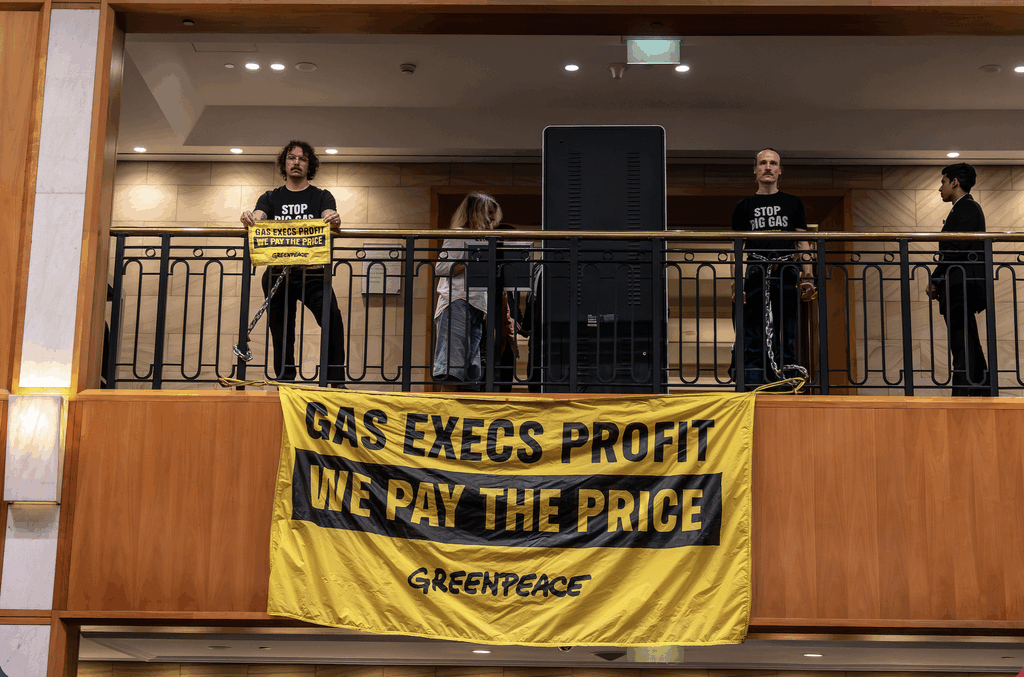
So Greenpeace has stepped in to call it out. Activists have dropped a banner inside the venue with a clear message: Gas Execs Profit. We Pay The Price.
We need your help to spread the message that we won’t stand by and let this happen.
What’s really going on
Gas corporations are making billions in windfall profits from global conflicts – from Ukraine to Iran – while Australians pay the price with higher energy bills and climate damage.
And they want more.
More drilling. More exports. More profit.
Why Greenpeace took action today
This conference is where it all comes together. Behind closed doors, gas executives, lobbyists, investors and political allies are meeting to push for more gas expansion, no doubt using global instability as their justification.
That’s why Greenpeace couldn’t let this gathering go uninterrupted.
Big Gas is counting on people not paying attention. Let’s prove them wrong.
Share the video to call out Big Gas.
What needs to happen now
Gas is expensive. It’s volatile. And it ties our energy system to global instability.
But there is a better way. Renewable energy is already cheaper, more reliable, and made right here in Australia. It’s the fastest path to lower bills, real energy security and a safer climate.
To get there, we need to:
- properly tax the gas industry and its exports
- stop expanding gas
- and speed up the transition to homegrown renewable energy.
Share this video far and wide to show just how much support there is to tax Big Gas properly and speed up the transition to renewable energy.
This is just the beginning
This action is part of a growing movement to stand up to Big Gas and challenge the power it holds over our government and society. The Federal Government has a role to play – starting by taxing gas corporations properly and then accelerating the transition to homegrown renewable energy.
Together, we can show just how much support there is for change and make it impossible for decision-makers to ignore.
What you can do
- Follow along on our social channels.
- Share the video far and wide to show how much support there is.
- Sign the petition to tell Albo to stand up to Big Gas – because if we can, he can.
BREAKING: Greenpeace activists disrupt major gas conference in Sydney
SYDNEY, Tuesday 31 March 2026 — Two Greenpeace Australia Pacific activists have been arrested following a peaceful protest at the Australian Domestic Gas Outlook conference in Sydney, where they dropped a banner that said — “Gas Execs Profit. We Pay The Price” and held banners saying “Tax Gas Profits”.
Photos and B Roll video of the protest and arrests are available here
Live updates on Greenpeace Instagram
The two activists were arrested by police around 9:00am AEDT and taken to Day Street Police Station. Information on this morning’s gas conference disruption can be found here.
Solaye Snider, Campaigner at Greenpeace Australia Pacific, said: “Greenpeace activists have taken a strong stand today against profit hungry gas corporations and lobbyists, who see horrific global wars as an opportunity to price gouge and profiteer, while everyday people pay the price.
“Australians have had enough of gas corporations like Santos and ConocoPhillips ripping us off, leaving us with nothing but empty pockets and climate damage. The gas industry is aggressively lobbying against being fairly taxed and pushing to drill for more gas. Change requires showing up and speaking out, and that’s what these activists have done today.
“Greenpeace Australia Pacific stands by our activists, and stands with all communities who are peacefully fighting for a safe and clean energy future. The right to peaceful protest is a fundamental pillar of a healthy democracy and a basic right of all Australians.”
-ENDS-
Media contacts:
Lucy Keller: +61 491 135 308 or lkeller@greenpeace.org or Kate O’Callaghan: +61 406 231 892 or kate.ocallaghan@greenpeace.org
Greenpeace activists arrested after disrupting major gas conference in Sydney



-
Climate Change8 months ago
Guest post: Why China is still building new coal – and when it might stop
-
Greenhouse Gases8 months ago
Guest post: Why China is still building new coal – and when it might stop
-

 Greenhouse Gases2 years ago
嘉宾来稿:满足中国增长的用电需求 光伏加储能“比新建煤电更实惠”
-
Climate Change2 years ago
Bill Discounting Climate Change in Florida’s Energy Policy Awaits DeSantis’ Approval
-

 Climate Change2 years ago
嘉宾来稿:满足中国增长的用电需求 光伏加储能“比新建煤电更实惠”
-
Climate Change Videos2 years ago
The toxic gas flares fuelling Nigeria’s climate change – BBC News
-

 Renewable Energy5 months ago
Sending Progressive Philanthropist George Soros to Prison?
-

 Carbon Footprint2 years ago
US SEC’s Climate Disclosure Rules Spur Renewed Interest in Carbon Credits