

Welcome to Carbon Brief’s DeBriefed.
An essential guide to the week’s key developments relating to climate change.
This week
Record floods across the globe
IVORY COAST: Floods and landslides killed at least 24 people in Ivory Coast’s largest city of Abidjan after a week of heavy rains that was “four times the usual volume in some cases”, the Associated Press reported. The newswire added that the city’s disadvantaged communities are “particularly vulnerable” because of poor storm drainage in informal settlements.
CHINA ‘SWAMPED’: Landslides killed eight people in their homes in southern China’s Hunan province, said the South China Morning Post, with Taoyuan county receiving 39.5cm of rain in a day. Record rains “swamped” Hunan’s capital of Changsha, “turning roads into rivers and submerging subway tunnels”, Reuters wrote. By Monday, 33 rivers had “exceeded warning levels”, Xinhua reported. Associated Press also reported that flooding killed two people in the “deluged” US midwest.
BANGLADESH INUNDATED: Widespread flooding has stranded nearly two million people in north-east Bangladesh, CNN reported. It added that “large swathes” of Sylhet and Sunamganj provinces were underwater after a second wave of flooding hit the region in less than a month, with 772,000 children “in urgent need of assistance”. Camps in Cox’s Bazaar that accommodate “almost [one million] documented [Rohingya] refugees have been overrun by the incoming floodwaters”, Down to Earth reported, with at least 10 Rohingya fatalities out of the total 31 deaths in the Bangladesh floods this year.
Heat deaths: tolls apart
PAKISTAN’S FATAL HEAT: Doctors in Karachi “treated thousands of victims of heatstroke at various hospitals” after a “days-long heatwave” scorched southern Pakistan, the Associated Press reported. While local media reported that the heatwave “killed more than two dozen people” in Karachi alone, AP added that “no government spokesman was available to confirm the number of heatstroke-related deaths”. However, the Edhi ambulance service told BBC News it had taken around 568 people’s bodies to the Karachi city morgue in Pakistan over the past six days – up from its usual rate of 30-40 bodies a day.
‘TOLLS APART’: In neighbouring India, the country’s health ministry said 143 people across the country had died of heatstroke from the start of summer until 20 June, far lower than 209 confirmed and 448 suspected deaths tallied by Times of India. Meanwhile, a non-profit report estimated that “192 homeless individuals died from the heat in just nine days” in the national capital region alone, experts in India Development Review Online wrote, “highlighting the significant underreporting of heat-related deaths” in the country.
CULPABLE HEAT: In the US, the Boston Globe reported that New England experienced the “highest rate of heat-related emergency department visits” in the country, with temperatures in the region crossing 32C. Meanwhile, prosecutors in Arizona could “reasonably press homicide charges against big oil” for heat deaths in the state last year, the Guardian reported. Finally, Reuters wrote that the “sweltering summer” is worsening conditions in Gaza, where “nearly all the 2.3 million inhabitants have been driven from their homes by Israel’s military campaign” with almost no access to electricity and little clean water.
Around the world
- COW TAX: Denmark is set to introduce the world’s first carbon tax on agriculture after a historic agreement on Monday, Politico reported. Farmers will be charged “almost €100 a year” per cow once the levy rolls out in 2030, Financial Times said.
- PARLEY VOUS: In a “new and surprising” move, South China Morning Post reported that China agreed to talks with the EU over its plans to raise tariffs on electric vehicle imports by 48%.
- MAI KUHIHEWA: Youth in the US state of Hawaii who sued transport authorities for their use of fossil fuels reached a “first-of-its-kind” settlement that recognised their “constitutional rights to a life-sustaining climate”, Teen Vogue reported.
- OILSTRUCK: Financial Times reported on ExxonMobil’s development of “one of the largest offshore oil developments in history” and what it could mean for Guyana.
- BP U-TURN: Oil and gas giant BP has imposed a hiring freeze and paused new offshore wind projects to place a greater emphasis on oil and gas rather than renewables amid investor discontent, sources at the company told Reuters.
- PIPELINE PROTESTS: 37 activists in Uganda were arrested for protesting the East African Crude Oil Pipeline (EACOP), calling on China to “reject financial support” to the project, All Africa reported.
£116bn £30bn £2.8tn
Some of the “scary-sounding” numbers being used to mislead the public about the “cost” of net-zero in the UK general-election campaign. Carbon Brief’s Dr Simon Evans has factchecked them.
Latest climate research
- A new study in Nature Ecology and Evolution found that Earth’s most extreme wildfires increased 2.2-fold in the past 20 years, with the last seven years seeing the six most extreme fires on record.
- According to new research in Nature Climate Change, a 1C rise in average temperatures would mean four extra minutes every day spent collecting water for women. By 2050, women could spend 30% and 100% more time – globally and regionally – collecting water, “undermining” their welfare.
- New research on grounding zones – where ice transitions from land to water – suggests that sea-level rise projections could be substantially underestimated, according to a Carbon Brief guest post.
(For more, see Carbon Brief’s in-depth daily summaries of the top climate news stories on Monday, Tuesday, Wednesday, Thursday and Friday.)
Captured

New Carbon Brief analysis found that UK governments in England, Scotland, Wales and Northern Ireland have missed their tree-planting targets set in 2020 and failed to plant an area of forest nearly the size of Birmingham. Tree-planting is a “significant” part of the UK’s net-zero strategy to compensate for other polluting sectors. By 2050, the unplanted trees would have removed some 8.5m tonnes of CO2 from the atmosphere, roughly 2% of the UK’s annual emissions in 2023. This shortfall will need to be made up for with stronger efforts elsewhere if the UK’s net-zero by 2050 target is to be met.
Spotlight
Monsoon mixtape
As the UK gears up for Glastonbury, Carbon Brief interviews pioneering Indian hip-hop and folk artists about protest music and the role of artists in an era of climate change.
When Carbon Brief spoke to the Marathi-language rapper MC Mawali from the hip-hop collective Swadesi, Mumbai was under an orange alert for extremely heavy rains, after stalling for most of the month.
The monsoon has changed along with the mega-city most defined by it. Massive infrastructure projects have cost the island city its flood buffers, including the much-diminished Aarey forest, home to the Indigenous Warli tribe and the only urban leopard population in the world.
In 2019, Mawali, along with fellow Swadesi rappers and Warli bard Prakash Bhoir, gave Mumbai’s #SaveAarey movement its protest anthem, The Warli Revolt – its chorus warning of a dystopian climate future to come.
“I used to go to Aarey to swim in the Vihar lake as a kid, but I didn’t know about [Warli] culture, their instruments, their songs going extinct that are not on the internet,” said Mawali.
When the chainsaws came for the forest, Mawali says he “felt helpless”, but he’s happy to hear that Warli Revolt has become a go-to anti-deforestation anthem across the country since. He added:
“Today’s music business is about labels pouring in music and splashing their artists all over platforms that censor messages like ours, but, through hip-hop, we’ve learned to hijack that same system to keep folk, tribal and conscious music alive.”
To anti-caste singer-poet Dhammarakshit Randive from the Yalgaar Sanskrutik Manch collective, the word “green” has turned into “its own kind of propaganda” that justifies “ask-no-questions development”, with high displacement of people and a large emissions footprint.
“‘Green’ often becomes propaganda, telling us you can offset 100 trees in a biodiverse forest that Adivasis (Indigenous peoples) depend on by planting another 1,000 somewhere else,” he told Carbon Brief.
Randive sees climate change, anti-caste and “movements to centre democracy” as interlinked, “affecting all our lives, everywhere”. To him, the main role of musicians and artists in responding to climate change is to establish that intersectionality. He told Carbon Brief:
“Otherwise, those fighting for forests are dying unheard in those same forests, sanitation workers are dying in the same sewers, factory workers are dying in the heat and there’s no one to widen peoples’ perspectives to say ‘this is all part of the same struggle’.”
Taru Dalmia, also known as Delhi Sultanate, was among the earliest pioneers to fuse dub and dancehall with protest anthems penned by Indigenous singers, such as Bhagaban Majhi, protesting mining projects in central India. Blood Earth, the album Dalmia made with producer Chris McGuiness, is now 12-years-old, but remains just as relevant.
“At that time we made it, I felt that there was a kind of hidden violence and not as much discourse about a war-like situation in [mineral-rich Indian states],” said Dalmia, speaking to Carbon Brief. He feels that, since then, “there’s definitely more awareness and politicisation which has to do with how much more repressive things have gotten and [environmental and other] issues staring at us in the face”.
While hip-hop has “blown up” over the past half-decade, he feels that little has changed as far as mining companies are concerned, since “profit margins remain huge”. Dalmia added:
“This awareness of how fundamentally our way of life is based on extraction, extractive industries and destruction and how that’s a direct continuation of the colonial project…sure, there’s more politicisation, but the depth of it is still missing.”
While extreme weather has not quite made its way to the airwaves, aside from boilerplate Bollywood songs invoking heat and rain, mercury levels were the subject of one of India’s earliest environmental campaign songs.

In 2015, a young Sofia Ashraf dropped the single Kodaikanal Won’t, a rap parody of Nicki Minaj’s Anaconda, demanding that Unilever clean up toxic waste from its thermometer factory dumped in the rainforest and compensate its workers for mercury poisoning. It drew over 2m views, praise from Minaj and a public apology and settlement from Unilever. Speaking to Carbon Brief, Ashraf said:
“Since Kodaikanal Won’t, there has been a whole gamut of songs around climate change, from general awareness-building to pointed information-sharing, music has been used effectively to express the dread a lot of us live under. The downside is that greenwashing is constantly on the rise and there is too much onus on the audience to parse this content for the truth.”
But she remains optimistic, telling Carbon Brief:
“As long as art still strives to build conscious narratives, I feel we are headed in the right direction.”
Watch, read, listen
PETROCENTRIC: Adam Hanieh, author and professor of political economy at the University of Exeter, spoke to the Break Down about all the ways in which oil came to “permeate” our lives.
MIC TEST: Vox tuned in to how scientists are listening to Puerto Rico’s frogs to understand how climate change is altering life on the rainforest island.
NON-ALIGNED: A piece in Drilled unpacked new research prompting questions of what “Paris-aligned” means and whether “climate pledges…need a terminology overhaul”.
Coming up
- 22-30 June: London climate action week
- 30 June: France national assembly elections, first round
- 4 July: UK general election
Pick of the jobs
- International Institute for Environment and Development (IIED), head of global climate law, policy and governance programme (maternity cover) | Salary: £64,814-£80,654. Location: UK (hybrid) with access to London office
- Sustainable Futures Collaborative, senior research associate, climate policy | Salary: Unknown. Location: New Delhi
- Climate and Community Project, data communications manager | Salary: $105,000. Location: US (fully remote), one week of travel every two months
- Global Campaign to Demand Climate Justice (DCJ), communications coordinator. Salary: $38,400. Location: Remote. Preference for candidates from the global south
- Chr. Michelsen Institute (CMI), global fellowships for scholars from non-OECD countries | Stipend: NOK 15,000 per month, plus travel, accommodation and insurance coverage. Location: Bergen, Norway
- Climate News Tracker, managing editor | Salary: £70,000-£80,000. Location: Remote, with occasional UK travel for meetings
DeBriefed is edited by Daisy Dunne. Please send any tips or feedback to debriefed@carbonbrief.org.
This is an online version of Carbon Brief’s weekly DeBriefed email newsletter. Subscribe for free here.


The post DeBriefed 28 June 2024: Global floods; Heat deaths uncertainty; India’s climate protest music appeared first on Carbon Brief.
DeBriefed 28 June 2024: Global floods; Heat deaths uncertainty; India’s climate protest music

Drought and heatwaves occurring together – known as “compound” events – have “surged” across the world since the early 2000s, a new study shows.
Compound drought and heat events (CDHEs) can have devastating effects, creating the ideal conditions for intense wildfires, such as Australia’s “Black Summer” of 2019-20 where bushfires burned 24m hectares and killed 33 people.
The research, published in Science Advances, finds that the increase in CDHEs is predominantly being driven by events that start with a heatwave.
The global area affected by such “heatwave-led” compound events has more than doubled between 1980-2001 and 2002-23, the study says.
The rapid increase in these events over the last 23 years cannot be explained solely by global warming, the authors note.
Since the late 1990s, feedbacks between the land and the atmosphere have become stronger, making heatwaves more likely to trigger drought conditions, they explain.
One of the study authors tells Carbon Brief that societies must pay greater attention to compound events, which can “cause severe impacts on ecosystems, agriculture and society”.
Compound events
CDHEs are extreme weather events where drought and heatwave conditions occur simultaneously – or shortly after each other – in the same region.
These events are often triggered by large-scale weather patterns, such as “blocking” highs, which can produce “prolonged” hot and dry conditions, according to the study.
Prof Sang-Wook Yeh is one of the study authors and a professor at the Ewha Womans University in South Korea. He tells Carbon Brief:
“When heatwaves and droughts occur together, the two hazards reinforce each other through land-atmosphere interactions. This amplifies surface heating and soil moisture deficits, making compound events more intense and damaging than single hazards.”
CDHEs can begin with either a heatwave or a drought.
The sequence of these extremes is important, the study says, as they have different drivers and impacts.
For example, in a CDHE where the heatwave was the precursor, increased direct sunshine causes more moisture loss from soils and plants, leading to a drought.
Conversely, in an event where the drought was the precursor, the lack of soil moisture means that less of the sun’s energy goes into evaporation and more goes into warming the Earth’s surface. This produces favourable conditions for heatwaves.
The study shows that the majority of CDHEs globally start out as a drought.
In recent years, there has been increasing focus on these events due to the devastating impact they have on agriculture, ecosystems and public health.
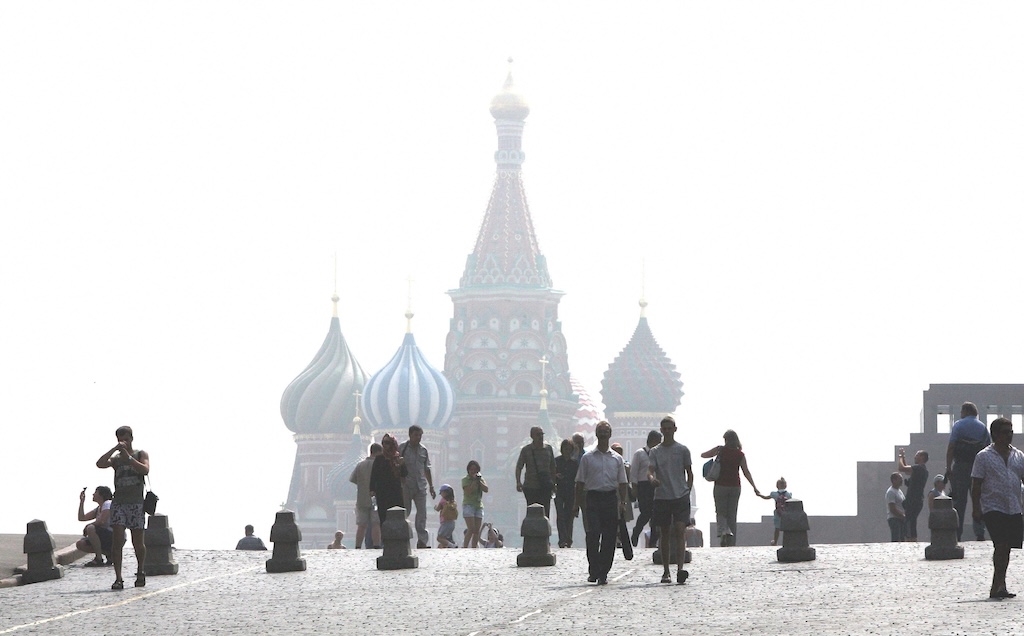
In Russia in the summer of 2010, a compound drought-heatwave event – and the associated wildfires – caused the death of nearly 55,000 people, the study notes.
The record-breaking Pacific north-west “heat dome” in 2021 triggered extreme drought conditions that caused “significant declines” in wheat yields, as well as in barley, canola and fruit production in British Columbia and Alberta, Canada, says the study.
Increasing events
To assess how CDHEs are changing, the researchers use daily reanalysis data to identify droughts and heatwaves events. (Reanalysis data combines past observations with climate models to create a historical climate record.) Then, using an algorithm, they analyse how these events overlap in both time and space.
The study covers the period from 1980 to 2023 and the world’s land surface, excluding polar regions where CDHEs are rare.
The research finds that the area of land affected by CDHEs has “increased substantially” since the early 2000s.
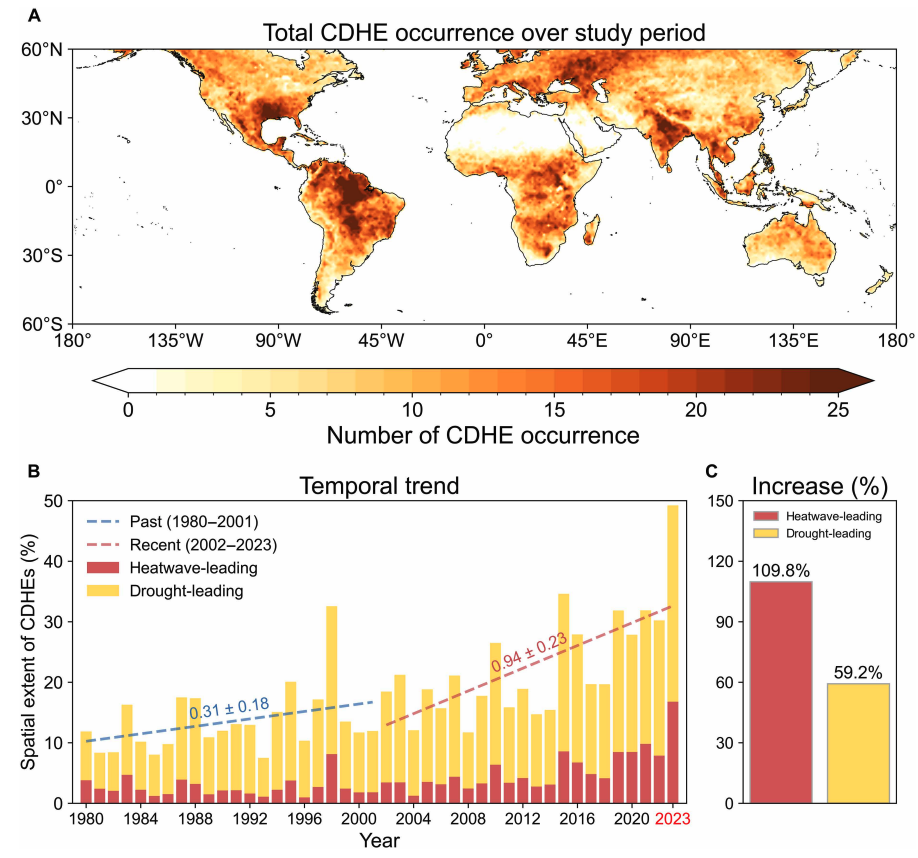
Heatwave-led events have been the main contributor to this increase, the study says, with their spatial extent rising 110% between 1980-2001 and 2002-23, compared to a 59% increase for drought-led events.
The map below shows the global distribution of CDHEs over 1980-2023. The charts show the percentage of the land surface affected by a heatwave-led CDHE (red) or a drought-led CDHE (yellow) in a given year (left) and relative increase in each CDHE type (right).
The study finds that CDHEs have occurred most frequently in northern South America, the southern US, eastern Europe, central Africa and south Asia.
Threshold passed
The authors explain that the increase in heatwave-led CDHEs is related to rising global temperatures, but that this does not tell the whole story.
In the earlier 22-year period of 1980-2001, the study finds that the spatial extent of heatwave-led CDHEs rises by 1.6% per 1C of global temperature rise. For the more-recent period of 2022-23, this increases “nearly eightfold” to 13.1%.
The change suggests that the rapid increase in the heatwave-led CDHEs occurred after the global average temperature “surpasse[d] a certain temperature threshold”, the paper says.
This threshold is an absolute global average temperature of 14.3C, the authors estimate (based on an 11-year average), which the world passed around the year 2000.
Investigating the recent surge in heatwave-leading CDHEs further, the researchers find a “regime shift” in land-atmosphere dynamics “toward a persistently intensified state after the late 1990s”.
In other words, the way that drier soils drive higher surface temperatures, and vice versa, is becoming stronger, resulting in more heatwave-led compound events.
Daily data
The research has some advantages over other previous studies, Yeh says. For instance, the new work uses daily estimations of CDHEs, compared to monthly data used in past research. This is “important for capturing the detailed occurrence” of these events, says Yeh.
He adds that another advantage of their study is that it distinguishes the sequence of droughts and heatwaves, which allows them to “better understand the differences” in the characteristics of CDHEs.
Dr Meryem Tanarhte is a climate scientist at the University Hassan II in Morocco, and Dr Ruth Cerezo Mota is a climatologist and a researcher at the National Autonomous University of Mexico. Both scientists, who were not involved in the study, agree that the daily estimations give a clearer picture of how CDHEs are changing.
Cerezo-Mota adds that another major contribution of the study is its global focus. She tells Carbon Brief that in some regions, such as Mexico and Africa, there is a lack of studies on CDHEs:
“Not because the events do not occur, but perhaps because [these regions] do not have all the data or the expertise to do so.”
However, she notes that the reanalysis data used by the study does have limitations with how it represents rainfall in some parts of the world.
Compound impacts
The study notes that if CDHEs continue to intensify – particularly events where heatwaves are the precursors – they could drive declining crop productivity, increased wildfire frequency and severe public health crises.
These impacts could be “much more rapid and severe as global warming continues”, Yeh tells Carbon Brief.
Tanarhte notes that these events can be forecasted up to 10 days ahead in many regions. Furthermore, she says, the strongest impacts can be prevented “through preparedness and adaptation”, including through “water management for agriculture, heatwave mitigation measures and wildfire mitigation”.
The study recommends reassessing current risk management strategies for these compound events. It also suggests incorporating the sequences of drought and heatwaves into compound event analysis frameworks “to enhance climate risk management”.
Cerezo-Mota says that it is clear that the world needs to be prepared for the increased occurrence of these events. She tells Carbon Brief:
“These [risk assessments and strategies] need to be carried out at the local level to understand the complexities of each region.”



The post Heatwaves driving recent ‘surge’ in compound drought and heat extremes appeared first on Carbon Brief.
Heatwaves driving recent ‘surge’ in compound drought and heat extremes
Greenhouse Gases
DeBriefed 6 March 2026: Iran energy crisis | China climate plan | Bristol’s ‘pioneering’ wind turbine
Welcome to Carbon Brief’s DeBriefed.
An essential guide to the week’s key developments relating to climate change.
This week
Energy crisis
ENERGY SPIKE: US-Israeli attacks on Iran and subsequent counterattacks across the Middle East have sent energy prices “soaring”, according to Reuters. The newswire reported that the region “accounts for just under a third of global oil production and almost a fifth of gas”. The Guardian noted that shipping traffic thr