

Welcome to Carbon Brief’s DeBriefed.
An essential guide to the week’s key developments relating to climate change.
This week
Germany’s €100bn climate funding
BILLIONS IN FUNDING: Germany’s parliament on Tuesday voted to create a €500bn defence and infrastructure fund and relax “constitutionally-protected debt rules”, the Guardian reported, with “the last-minute backing of the Greens” in return for “guarantees that €100bn of the funds destined for infrastructure would be allocated for climate and economic transformation investments”. The deal came following “clumsy” initial negotiations from Germany’s chancellor-in-waiting, Friedrich Merz, Bloomberg said. It reported that the Greens “finally came around” after Merz’s negotiators “conceded to their key demands”, which also included adding Germany’s 2045 climate-neutrality target into the constitution.
TAKING CLIMATE ‘SERIOUSLY’: The Greens said in a statement on social media that the agreement “finally takes the challenges of the future seriously”, according to the New York Times. Paula Piechotta, a member of the Greens in the German Bundestag, told the German newspaper Tagesspiegel that the deal was a “great success for democracy in our country, for sustainability and intergenerational justice”. The newspaper added that the far-right Alternative for Germany (AfD) and the Left party, “unsurprisingly”, criticised the agreement.
UK opposition breaks cross-party climate consensus
BREAKING AWAY: In a speech, Kemi Badenoch, leader of the UK opposition Conservative party, said it was “impossible” for the UK to meet its net-zero target by 2050, marking a “sharp break from years of political consensus”, BBC News reported. She did not offer an alternative target for the goal, the broadcaster said, quoting her telling reporters that if the Conservatives “do find a target is necessary, then yes we will have one”. Badenoch “failed to cite any evidence in support” of her arguments, according to a factcheck published by Carbon Brief, which concluded that much of the existing evidence “contradicts” her claims.
TORY BACKLASH: In response, Conservative former prime minister Theresa May, who was responsible for passing the 2050 target into law, warned the move “will hurt future generations and cost Britons”, the Times reported. The Confederation of British Industry (CBI) also criticised the speech, warning that “now is not the time to step back from the opportunities of the green economy”, according to the i newspaper. In the Daily Telegraph, Ambrose Evans-Pritchard said Badenoch’s “rant comes close to political tragedy”.
Around the world
- CARNEY CUTS: New Canadian prime minister Mark Carney removed the country’s “consumer carbon tax”, CBC News reported, adding that the policy had been a “potent point of attack” for his political opponents.
- GREENPEACE BILL: Greenpeace has been ordered to pay $660m in damages over its protests against the Dakota Access pipeline in 2016, which could “bankrupt its US operations” if upheld, the Financial Times said.
- UK-CHINA FORUM: The UK and China agreed to establish an “annual climate dialogue”, with the first meeting to be held in London later this year, the Times reported.
- CHEQUES AND BALANCES: A US judge has “temporarily barred” attempts by the Trump administration to recoup at least $14bn in “grants issued by the Biden administration for climate and clean-energy projects”, the Washington Post said.
- EXTREME HEAT: “Severe heatwave conditions” have begun affecting several areas across India “unusually early in the season”, the Hindustan Times reported.
- SOUTH AFRICAN SUPPORT: The EU will fill a “$1bn hole” in South African’s “just energy transition partnership” left by the US, the Financial Times reported. The US is also “stalling” $2.6bn of climate finance for South Africa, Bloomberg said.
152
The number of “unprecedented” extreme weather events that occurred in 2024, according to the World Meteorological Organization’s State of the Climate 2024 report. Heatwaves were the most common type of unprecedented events – defined as events “worse than any ever recorded in the region” – followed by “rain or wet spells” and floods.
Latest climate research
- New research in Climate and Development explored how environmental justice featured in the climate action plans of rust-belt cities in the US, finding that few “provided enough details” to determine if it was a priority.
- A new Science Advances study identified “increasing storminess” in the south-western Caribbean, which was attributed to “industrial-age warming”.
- Marine heatwaves are now 5.1 times more frequent and 4.7 times more intense since records began, new research in Communications Earth & Environment found.
(For more, see Carbon Brief’s in-depth daily summaries of the top climate news stories on Monday, Tuesday, Wednesday, Thursday and Friday.)
Captured
The UK’s high electricity prices are primarily driven by gas prices, according to an analysis published by Carbon Brief, with the UK typically seeing gas set electricity prices 98% of the time – compared to an average in the EU of 40%.
Spotlight
Chatham House talks climate and resilience
Carbon Brief outlines key takeaways from Chatham House’s climate and energy summit.
Chatham House, the UK’s leading international affairs thinktank, held its annual summit on climate and energy on 18-19 March. This year’s theme was: “Securing a resilient future.”
Carbon Brief attended the conference, where speakers including COP30 CEO Ana Toni, UK climate envoy Rachel Kyte and Moroccan minister for energy transition and sustainable development Leila Benali shared their thoughts on encouraging and enacting climate action.
Climate backlash
A sense of urgency permeated discussions at the summit, underpinned by concerns over growing anti-climate narratives.
Toni argued climate scepticism proves climate action is on the right track.
She said: “First people ignore you, then they laugh at you, then they fight you – and this is where we are – then we win.”

Other speakers said that increasing support for climate action by building new norms and creating overlapping interests could also be effective strategies.
Former US climate envoy Todd Stern pointed to increasing adoption of electric vehicles, while ClientEarth CEO Laura Clarke raised the example of community-owned renewable power.
Fretting over finance
Clean Earth Gambia founder Fatou Jeng warned that climate finance, as ever likely to be an important issue at COP30, has “not progressed much”.
“Blended finance” – using public money to leverage private funds – was heavily criticised in several panels. Ben Parsons, a partner at consultancy firm Oaklin, noted that only 72 such deals were agreed in 2024.
Speakers agreed that innovative mechanisms to derisk climate finance were needed, with Morocco’s Benali critiquing “exclusive” and inflexible private financing options.
Ndongo Samba Sylla, head of research and policy at International Development Economics Associates, argued that using local currencies would significantly boost climate finance.
Resilience through renewables
A key benefit of the UK’s “climate leadership”, Kyte argued, is that the energy transition will “make British people more secure”.
Parsons said the argument – recently deployed by Conservative leader Badenoch – that the energy transition replaced reliance on Russian fossil fuels with reliance on Chinese technology was incorrect.
“Fossil fuels are fuel – they require constant replenishment. Renewables are infrastructure,” he said, adding that arguably the UK should be accelerating its deployment of clean-energy technology.
On cybersecurity challenges in renewable power systems, Alex Schoch, vice president and group director of flexibility and electrification at Octopus Energy, argued that the key issue is how renewable energy “hardware” is managed, rather than where it is sourced from.
Parsons agreed, noting that the UK’s current power system has “plenty of cybersecurity vulnerabilities in it today”.
He said: “We have to make sure we’re putting [cybersecurity strategies] in place…But I don’t think that goes hand in hand with thinking we should avoid buying renewables from certain parts of the world.”
In a session on energy security in war-time Ukraine, held under the Chatham House rule, participants noted that the country was a case study for the importance of energy security.
Speakers said that since Russia’s invasion of Ukraine, attacks on thermal power plants have seen growing use of low-carbon energy – particularly distributed solar.
Watch, read, listen
ELEPHANT IN THE ROOM: The Columbia Energy Exchange podcast explored how the new Trump government underpinned discussions at the energy industry event CERAWeek.
‘CONFLICT BLINDSPOT’: A new report by ODI found that “less than 10% of international climate finance” in 2022 went to fragile and conflict-affected countries.
METHANE INACTION: Leading supermarkets in the global north are “failing to address the methane pollution in their supply chains”, according to a study covered by Desmog.
Coming up
- 24-26 March: 16th Petersberg Climate Dialogue, Berlin, Germany
- 24-26 March: IPCC lead author meeting for methodology report on inventories for short-lived climate forcers, Bilbao, Spain
- 24-28 March: 20th session of the UN FAO commission on genetic resources for food and agriculture, Rome, Italy
- 25 – 28 March:First G20 climate and environment sustainability working group meeting, online
Pick of the jobs
- ClientEarth, lawyer or legal consultant, energy systems, Asia | Salary: 455m-585m Indonesian rupiah. Location: Jakarta
- European External Action Service, policy officer for green diplomacy | Salary: Unknown. Location: Brussels
- Bloomberg, climate reporter | Salary: Unknown. Location: Hong Kong
- The Grantham Research Institute on Climate Change and the Environment, project manager | Salary: £42,679-£51,000. Location: London
DeBriefed is edited by Daisy Dunne. Please send any tips or feedback to debriefed@carbonbrief.org.
This is an online version of Carbon Brief’s weekly DeBriefed email newsletter. Subscribe for free here.

The post DeBriefed 21 March 2025: Germany’s climate win; Conservatives’ net-zero row-back; Key messages from major UK climate conference appeared first on Carbon Brief.

Drought and heatwaves occurring together – known as “compound” events – have “surged” across the world since the early 2000s, a new study shows.
Compound drought and heat events (CDHEs) can have devastating effects, creating the ideal conditions for intense wildfires, such as Australia’s “Black Summer” of 2019-20 where bushfires burned 24m hectares and killed 33 people.
The research, published in Science Advances, finds that the increase in CDHEs is predominantly being driven by events that start with a heatwave.
The global area affected by such “heatwave-led” compound events has more than doubled between 1980-2001 and 2002-23, the study says.
The rapid increase in these events over the last 23 years cannot be explained solely by global warming, the authors note.
Since the late 1990s, feedbacks between the land and the atmosphere have become stronger, making heatwaves more likely to trigger drought conditions, they explain.
One of the study authors tells Carbon Brief that societies must pay greater attention to compound events, which can “cause severe impacts on ecosystems, agriculture and society”.
Compound events
CDHEs are extreme weather events where drought and heatwave conditions occur simultaneously – or shortly after each other – in the same region.
These events are often triggered by large-scale weather patterns, such as “blocking” highs, which can produce “prolonged” hot and dry conditions, according to the study.
Prof Sang-Wook Yeh is one of the study authors and a professor at the Ewha Womans University in South Korea. He tells Carbon Brief:
“When heatwaves and droughts occur together, the two hazards reinforce each other through land-atmosphere interactions. This amplifies surface heating and soil moisture deficits, making compound events more intense and damaging than single hazards.”
CDHEs can begin with either a heatwave or a drought.
The sequence of these extremes is important, the study says, as they have different drivers and impacts.
For example, in a CDHE where the heatwave was the precursor, increased direct sunshine causes more moisture loss from soils and plants, leading to a drought.
Conversely, in an event where the drought was the precursor, the lack of soil moisture means that less of the sun’s energy goes into evaporation and more goes into warming the Earth’s surface. This produces favourable conditions for heatwaves.
The study shows that the majority of CDHEs globally start out as a drought.
In recent years, there has been increasing focus on these events due to the devastating impact they have on agriculture, ecosystems and public health.
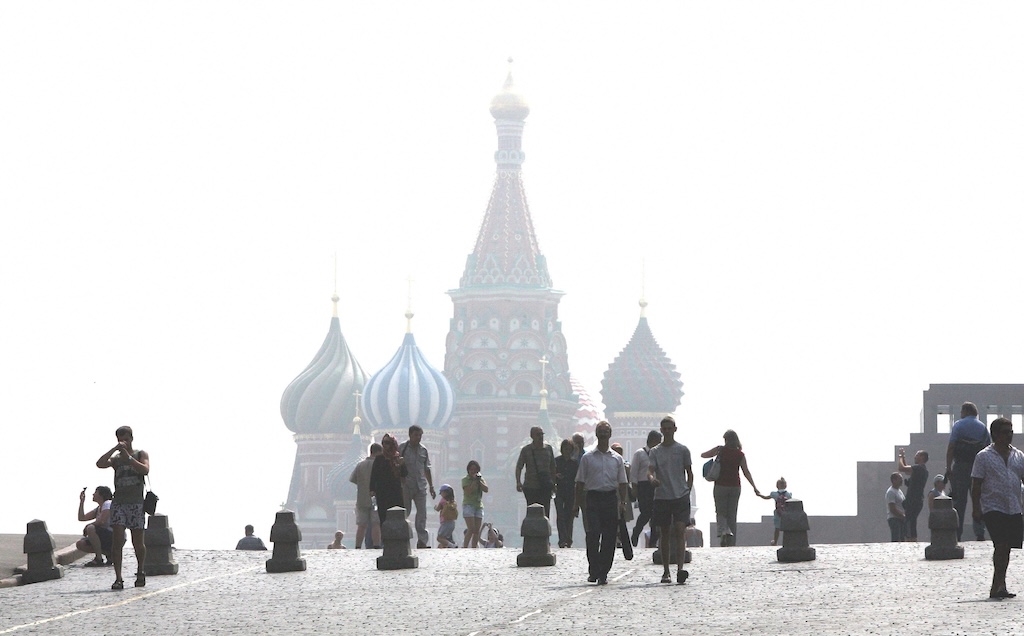
In Russia in the summer of 2010, a compound drought-heatwave event – and the associated wildfires – caused the death of nearly 55,000 people, the study notes.
The record-breaking Pacific north-west “heat dome” in 2021 triggered extreme drought conditions that caused “significant declines” in wheat yields, as well as in barley, canola and fruit production in British Columbia and Alberta, Canada, says the study.
Increasing events
To assess how CDHEs are changing, the researchers use daily reanalysis data to identify droughts and heatwaves events. (Reanalysis data combines past observations with climate models to create a historical climate record.) Then, using an algorithm, they analyse how these events overlap in both time and space.
The study covers the period from 1980 to 2023 and the world’s land surface, excluding polar regions where CDHEs are rare.
The research finds that the area of land affected by CDHEs has “increased substantially” since the early 2000s.
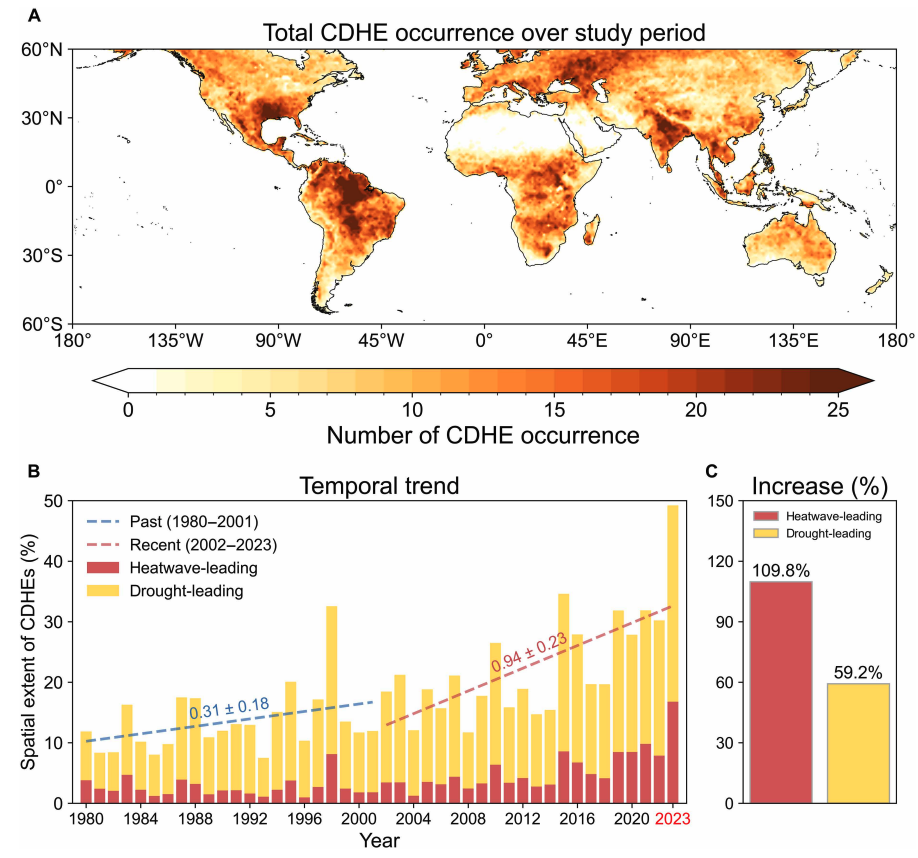
Heatwave-led events have been the main contributor to this increase, the study says, with their spatial extent rising 110% between 1980-2001 and 2002-23, compared to a 59% increase for drought-led events.
The map below shows the global distribution of CDHEs over 1980-2023. The charts show the percentage of the land surface affected by a heatwave-led CDHE (red) or a drought-led CDHE (yellow) in a given year (left) and relative increase in each CDHE type (right).
The study finds that CDHEs have occurred most frequently in northern South America, the southern US, eastern Europe, central Africa and south Asia.
Threshold passed
The authors explain that the increase in heatwave-led CDHEs is related to rising global temperatures, but that this does not tell the whole story.
In the earlier 22-year period of 1980-2001, the study finds that the spatial extent of heatwave-led CDHEs rises by 1.6% per 1C of global temperature rise. For the more-recent period of 2022-23, this increases “nearly eightfold” to 13.1%.
The change suggests that the rapid increase in the heatwave-led CDHEs occurred after the global average temperature “surpasse[d] a certain temperature threshold”, the paper says.
This threshold is an absolute global average temperature of 14.3C, the authors estimate (based on an 11-year average), which the world passed around the year 2000.
Investigating the recent surge in heatwave-leading CDHEs further, the researchers find a “regime shift” in land-atmosphere dynamics “toward a persistently intensified state after the late 1990s”.
In other words, the way that drier soils drive higher surface temperatures, and vice versa, is becoming stronger, resulting in more heatwave-led compound events.
Daily data
The research has some advantages over other previous studies, Yeh says. For instance, the new work uses daily estimations of CDHEs, compared to monthly data used in past research. This is “important for capturing the detailed occurrence” of these events, says Yeh.
He adds that another advantage of their study is that it distinguishes the sequence of droughts and heatwaves, which allows them to “better understand the differences” in the characteristics of CDHEs.
Dr Meryem Tanarhte is a climate scientist at the University Hassan II in Morocco, and Dr Ruth Cerezo Mota is a climatologist and a researcher at the National Autonomous University of Mexico. Both scientists, who were not involved in the study, agree that the daily estimations give a clearer picture of how CDHEs are changing.
Cerezo-Mota adds that another major contribution of the study is its global focus. She tells Carbon Brief that in some regions, such as Mexico and Africa, there is a lack of studies on CDHEs:
“Not because the events do not occur, but perhaps because [these regions] do not have all the data or the expertise to do so.”
However, she notes that the reanalysis data used by the study does have limitations with how it represents rainfall in some parts of the world.
Compound impacts
The study notes that if CDHEs continue to intensify – particularly events where heatwaves are the precursors – they could drive declining crop productivity, increased wildfire frequency and severe public health crises.
These impacts could be “much more rapid and severe as global warming continues”, Yeh tells Carbon Brief.
Tanarhte notes that these events can be forecasted up to 10 days ahead in many regions. Furthermore, she says, the strongest impacts can be prevented “through preparedness and adaptation”, including through “water management for agriculture, heatwave mitigation measures and wildfire mitigation”.
The study recommends reassessing current risk management strategies for these compound events. It also suggests incorporating the sequences of drought and heatwaves into compound event analysis frameworks “to enhance climate risk management”.
Cerezo-Mota says that it is clear that the world needs to be prepared for the increased occurrence of these events. She tells Carbon Brief:
“These [risk assessments and strategies] need to be carried out at the local level to understand the complexities of each region.”



The post Heatwaves driving recent ‘surge’ in compound drought and heat extremes appeared first on Carbon Brief.
Heatwaves driving recent ‘surge’ in compound drought and heat extremes
Greenhouse Gases
DeBriefed 6 March 2026: Iran energy crisis | China climate plan | Bristol’s ‘pioneering’ wind turbine
Welcome to Carbon Brief’s DeBriefed.
An essential guide to the week’s key developments relating to climate change.
This week
Energy crisis
ENERGY SPIKE: US-Israeli attacks on Iran and subsequent counterattacks across the Middle East have sent energy prices “soaring”, according to Reuters. The newswire reported that the region “accounts for just under a third of global oil production and almost a fifth of gas”. The Guardian noted that shipping traffic through the strait of Hormuz, which normally ferries 20% of the world’s oil, “all but ground to a halt”. The Financial Times reported that attacks by Iran on Middle East energy facilities – notably in Qatar – triggered the “biggest rise in gas prices since Russia’s full-scale invasion of Ukraine”.
‘RISK’ AND ‘BENEFITS’: Bloomberg reported on increases in diesel prices in Europe and the US, speculating that rising fuel costs could be “a risk for president Donald Trump”. US gas producers are “poised to benefit from the big disruption in global supply”, according to CNBC. Indian government sources told the Economic Times that Russia is prepared to “fulfil India’s energy demands”. China Daily quoted experts who said “China’s energy security remains fundamentally unshaken”, thanks to “emergency stockpiles and a wide array of import channels”.
‘ESSENTIAL’ RENEWABLES: Energy analysts said governments should cut their fossil-fuel reliance by investing in renewables, “rather than just seeking non-Gulf oil and gas suppliers”, reported