

Welcome to Carbon Brief’s Cropped.
We handpick and explain the most important stories at the intersection of climate, land, food and nature over the past fortnight.
This is an online version of Carbon Brief’s fortnightly Cropped email newsletter. Subscribe for free here.
Key developments
COP16 kicks off in Cali
COLOMBIA CALLING: Representatives from 175 countries are meeting in Cali, Colombia from 21 October to 1 November for the COP16 biodiversity summit, with “life on Earth on the agenda”, the New York Times reported. At the talks, countries will grapple with how to put the Kunming-Montreal Global Biodiversity Framework – often described as the “Paris Agreement for nature” – into action, alongside debates on finance for developing countries and how to best share the benefits from genetic information, the newspaper said. Carbon Brief has produced an interactive grid of where each party stands on the key negotiating issues and a live tracker of the texts under negotiation. On Tuesday, Carbon Brief’s team of five journalists on the ground in Cali held an online webinar on the key issues up for discussion at the summit. A recording is available.
HIGH-LEVEL PRESENCE: Mongabay reported that around 23,000 delegates are attending COP16, with presidents or heads of state from Brazil, Guatemala, Guinea-Bissau, Haiti, Mozambique, Peru and Suriname expected to be present. (The Earth Negotiations Bulletin noted that the summit “is the largest UN biodiversity conference to date”.) The outlet added that the conference also aims to adopt a work programme for Indigenous peoples and local communities. El Espectador reported that the Development Bank of Latin America (CAF) will invest $300m in the protection of important ecosystems across the region, including the Amazon, the Antarctic and Patagonia. The president of CAF, Sergio Díaz-Granados, said they will deliver a tool for identifying high-quality projects to be funded.
PLANS AND PLEDGES: A joint investigation by Carbon Brief and the Guardian found that 85% of countries had failed to meet a UN request to publish new pledges on how they plan to tackle biodiversity decline before COP16. Just 25 nations and the EU released new national biodiversity strategies and action plans (NBSAPs) ahead of the summit. Since then, a further 10 countries have come forward with NBSAPS, including COP16 host Colombia. Colombia’s NBSAP pledges to extend protected areas from 24 to 34% of national territory and increase the bioeconomy’s contribution to national GDP from 0.8 to 3%. Carbon Brief will be updating its NBSAP tracker later this week.
Water woes
STRESSED OUT: New analysis from the US-based thinktank the World Resources Institute found that “one-quarter of the world’s crops are grown in areas where the water supply is highly stressed, highly unreliable or both”. Three staple crops that together provide more than half of the world’s calories – rice, wheat and corn – are “particularly vulnerable”, according to the analysis. It added that both rainfed and irrigated crops “face growing threats”, with the former imperilled by “erratic weather patterns” and the latter facing “increasing competition over shared water supplies”. According to the report, “demand for water to irrigate crops is projected to rise by 16% by 2050, compared to 2019”.
TRAGEDY OF THE COMMONS: Covering the report, Grist wrote that water stress “stems partly from a common tendency to take water for granted and treat it like an endlessly renewable, on-demand resource”. Sam Kuzma, one of the authors of the report, told the publication: “Because we don’t put a value on water, you can irrigate and not pay much at all for the water that you’re using…That means we can be pretty reckless with how we’re growing and in what environments.” The analysis “spells trouble for global food security”, Grist wrote, noting that major agricultural exporters, including India, are among the countries most at risk of increasing water stress.
ROME DECLARATION: At the World Food Forum last week, hosted by the UN Food and Agriculture Organization in Rome, member states adopted the Rome Declaration on Water Scarcity in Agriculture. According to Down to Earth, “the countries committed to mobilise greater political support in terms of policies, legal and institutional frameworks, access to financing and responsible water governance”. FAO director general Dr Qu Dongyu told the plenary session: “The solutions we develop must reflect the interconnected nature of water security, agrifood systems and climate resilience.” According to the FAO press release, “by 2050, more than half the global population will live in areas at risk of water scarcity at least one month a year”.
Spotlight
‘The planet doesn’t have time to lose’
Carbon Brief’s entire food, land and nature team is on the ground in Cali, Colombia to report on the UN biodiversity talks. In this spotlight, Carbon Brief outlines what has happened so far at COP16.
Hola from Cali, where the UN biodiversity summit COP16 has kicked off this week.
Thousands of negotiators, observers, activists and journalists have descended on the city – the country’s “salsa capital” – for detailed nature discussions over the coming two weeks.
Far from the harsh lighting and long corridors of other COPs, Cali delegates are treated to mountain views in the distance and large overhead fans staving off the October heat in one of the world’s most biodiverse countries.

It has not all been smooth sailing so far, however, with packed buses transporting sweating delegates, congested roads, poor internet connections and winding security queues on the first day of the summit.
COP16 comes two years after countries signed off on a global biodiversity deal aiming to halt and reverse nature loss by the end of this decade.
Since this agreement, countries have been figuring out how to put in place these goals on a national level.
Hot topics
Negotiators are discussing a wide range of issues, including the implementation of biodiversity goals and how to scale up nature finance.
Bernadette Fischler Hooper, the head of global advocacy at WWF, told a press briefing on 21 October that resource mobilisation was hotly debated at the pre-COP16 implementation talks last week.
For example, countries are split on whether to develop a new global fund for biodiversity – to be controlled by the COP – or stick with the current fund. Negotiators are trying to break the “deadlock” on this issue over the next two weeks, she noted.
Other discussions centre around agreeing rules around digital access to genetic information, Indigenous peoples’ rights and monitoring for the Global Biodiversity Framework.
“The planet doesn’t have time to lose,” Colombian environment minister and COP16 president Susana Muhamad said at the summit’s opening ceremony.
Speaking via telecast, UN chief António Guterres also urged countries to “make peace with nature” – referencing the COP16 theme.
Security fears
More than 10,000 police officers are in place across the city amid threats from a rebel group to disrupt COP16.
Speaking at a press conference on 21 October, Cali’s mayor, Alejandro Eder, said that security was the first issue tackled when the city was selected to host COP16.
Eder assured the safety of COP16 attendees, but Colombian president Gustavo Petro last week said he was “nervous” that “something bad” could happen at the start of the summit, according to Colombia’s El Heraldo newspaper.
Eder noted that COP16 was organised in “record time”, given that cities usually have two years to prepare. (Turkey withdrew as COP16 host last year after severe earthquakes killed more than 40,000 people. Cali was confirmed as the new host in February 2024.)
Elsewhere, nearly 2,000 Indigenous peoples from Colombia took to the streets of Cali on 21 October calling for nature to be respected. More protests are expected throughout the summit.
Carbon Brief’s team of five nature journalists will be closely tracking the negotiations on the ground in Cali over the next two weeks.
News and views
REEF IT AND WEEP: The mass bleaching of coral reefs worldwide since early 2023 “is now the most extensive on record”, the US National Oceanic and Atmospheric Administration (NOAA) told Reuters. Satellite data showed a “staggering 77%” of global reefs so far have “been subjected to bleaching-level heat stress…as climate change fuels record and near-record ocean temperatures across the world”, the newswire added. “We’ve eclipsed the previous record by 11.3% and…in half the amount of time,” Dr Derek Manzello, coordinator of NOAA’s Coral Reef Watch, told Axios. CNN said that scientists have called for an emergency session on coral reefs at COP16 “in response to the bleaching record”.
‘NATURE-POSITIVE’: A record number of companies are expected to be at COP16, and they are “increasingly touting their ambitions to be ‘nature-positive’ alongside their net zero targets”, the Financial Times wrote. According to the newspaper, which looked at the rapid proliferation of the term “nature-positive” since COP15 in 2022, it implies “halting and reversing biodiversity loss, targeting an overall increase in nature…by 2030, relative to a 2020 baseline”. However, it adds that scientists and environmentalists are worried that states and firms “are starting to brandish the term as a buzzword” before a comprehensive and credible definition of nature-positive and its metrics exists.
GLOBAL ECOSYSTEM ATLAS: At COP16, the Group on Earth Observations (GEO) launched the proof-of-concept of the Global Ecosystems Atlas, a tool for mapping and monitoring the world’s ecosystems. According to a GEO press release, the atlas provides information on ecosystem extent, condition and potential risks, drawing on inputs from high-quality maps and new maps based on field data and AI. The atlas aims to support “tracking [progress on] the Global Biodiversity Framework, develop national ecosystem maps…and inform private sector reporting on nature-related risks”, the press release added.
THE ROOF IS ON FIRE: Forest fires have intensified and become more widespread “amid global heating, particularly in the high northern latitudes such as Canada and Siberia”, researchers wrote in the Conversation. Their new study found that global carbon emissions from forest fires have grown by 60% over the past two decades, with the “largest contributions com[ing] from fires in Siberia and western North America”, the authors added. “We had to check the calculations because it’s such a big number,” lead author Dr Matthew Jones told the New York Times. Elsewhere, research covered by Carbon Brief revealed that a long-term decline in area burned globally by wildfires due to land-use change has almost entirely been offset by increases caused by warming.
DYING PLANET: Wildlife populations worldwide have “plunged” by an average of 73% in the last 50 years according to the latest Living Planet report, the Guardian reported. However, it adds that the Living Planet index is “weighted in favour of data from Africa and Latin America” and the metric has faced criticism for “potentially overestimating wildlife declines”. Vox, covering the report, wrote that it “underscores [that] we are living in a time of profound biodiversity loss” and that “calculating a single figure to encompass all of this loss isn’t easy”. At the same time, scientists not involved in the report called its metrics “misleading”, the story added. A ZSL scientist quoted by Vox said that “it’s also possible that the [Living Planet Index] actually underestimates the scale of declines”. Our World In Data published a guide to understanding the index and “what it does and doesn’t mean”.
Watch, read, listen
FOREST LOSS: Mongabay looked at how Indonesia’s plan to boost renewable energy could lead to Indigenous communities losing “huge swathes of their forests to biomass plantations”.
EYES ON SOUTH AMERICA: Analysis in the Guardian discussed how Colombia and Brazil “have the chance of a lifetime to save the Amazon” in hosting key upcoming global events.
SNAIL’S PACE: Ahead of COP16, NPR’s All Things Considered radio show spoke to wildlife biologist Dr David Sischo about what it’s like to work with Hawaii’s endangered tree snails.
COUNTING MOTHS: Sundance award-winning documentary “Nocturnes” followed ecologist Dr Mansi Mungee counting hawk moths in the lush forests of north-eastern India.
New science
- A new study found that nearly half of the proposed indicators for measuring progress on the Kunming-Montreal Global Biodiversity Framework could involve community-based monitoring programmes. Researchers in Nature Sustainability wrote that greater involvement of citizens could “enhance local to national decision-making”.
- A 1% increase in deforestation in the Brazilian Amazon was linked with a 6.3% rise in malaria cases the following month, a new study in Proceedings of the National Academy of Sciences found. Using sub-annual data, researchers showed that deforestation increases malaria transmission, especially in areas with high amounts of forest cover.
- Increasingly dry conditions under a changing climate will pose a significant threat to frogs and other water-sensitive animals, according to new research in Nature Climate Change. Researchers combined maps of drought risk and frog and toad habitats to find that nearly 7% of frog and toad habitats will become “arid-like” by the end of the century.
In the diary
- 21 October-1 November: COP16 UN biodiversity conference | Cali, Colombia
- 25 October: Kiribati presidential election
- 4-5 November: UN Water meeting | New York
- 5 November: US election
- 11-22 November: COP29 UNFCCC climate conference | Baku, Azerbaijan
Cropped is researched and written by Dr Giuliana Viglione, Aruna Chandrasekhar, Daisy Dunne, Orla Dwyer and Yanine Quiroz. Please send tips and feedback to cropped@carbonbrief.org.

The post Cropped 23 October 2024: COP16 kicks off; Water woes; Coral bleaching ‘worst ever’ appeared first on Carbon Brief.
Cropped 23 October 2024: COP16 kicks off; Water woes; Coral bleaching ‘worst ever’

Continue Reading
Prepared by a coalition of nine Western Australian union, industry, conservation, and community organisations—including UnionsWA, the Conservation Council WA, and the Smart Energy Council—the WA Clean Energy, Jobs & Industry Plan provides a practical roadmap to transform Western Australia into a clean energy powerhouse while creating thousands of secure local jobs.
Western Australia stands at a pivotal crossroads: lead the global clean energy economy or watch investment, future industries, and secure jobs go elsewhere. The WA Clean Energy, Jobs & Industry Plan outlines a transformative blueprint to harness the state’s world-class solar and wind resources. Discover how legislated renewable targets, green iron manufacturing, and a dedicated regional training strategy can generate tens of thousands of local jobs, lower household bills, and build a resilient, net-zero future for all Western Australians.

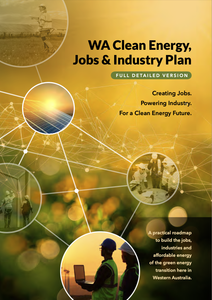
WA needs a clear and forward-thinking plan if it is going to become a competitive renewable energy powerhouse and maintain its economic strength through the energy transition.
“Western Australians know a faster renewable energy transition will lower their household expenses and prevent harmful climate pollution. But the community also needs clear direction to ensure this transition will create jobs, lower costs and not cause undue environmental harm.
“Here, sectors representing a broad range of interests have laid the groundwork for those outcomes, clearly outlining what is needed to create a future for WA that is good for the environment, for the climate, for workers and for the economy.
Summary
The WA Clean Energy, Jobs & Industry Plan sets out a strategic roadmap to position Western Australia as a global clean energy superpower while creating thousands of secure local jobs.
The report establishes three overarching goals:
- Creating local employment.
- Maintaining industrial competitiveness.
- Lowering household energy costs
To realize this vision, the framework details actionable measures to follow on from the recent WA Government announcement of a 75% Renewable Energy Target by 2031 for the South West Interconnected System. This includes developing a statewide Renewable Energy Target, coordinating statewide workforce and training pipelines, strategically planning regional infrastructure to safeguard high-value biodiversity and cultural heritage, and ensuring equitable benefit-sharing through household electrification incentives and First Nations equity partnerships. Ultimately, the plan highlights that establishing clear policy and regulatory certainty will unlock lower energy bills, boost power reliability, and secure the state’s global competitiveness in emerging green commodity export markets.

Key Findings
- Statewide Renewable Energy Target and Emissions Reduction Targets: The report calls for a statewide RET and 1.5°C aligned emission reduction targets to remove policy risk, lower capital costs, and attract clean energy investment.
- Transformative Job Creation: Accelerating the transition offers massive employment prospects, including up to 8,800 solar and battery jobs by 2050, as well as 24,000 ongoing and 11,000 construction jobs in a commercial green iron industry.
- Industrial Electrification & Competitiveness: Requiring large gas users to adopt binding electrification timetables and providing concessional financing will protect existing energy-intensive manufacturers from rising energy costs and impending domestic gas shortfalls.
- Green Commodity Export Leadership: Western Australia can build new export markets in green iron, green ammonia, and offshore oil/gas decommissioning by constructing shared common-user infrastructure and setting dedicated Green Commodity Export Targets.
- Coordinated Workforce & Training Pipeline: To address critical skill shortages the plan recommends establishing a WA Clean Energy Jobs Plan 2050, three regional training hubs, and dedicated pathways for female and under-represented apprentices.
- Environmental Safeguards & Community Benefits: Fast-tracked development must be paired with State Planning Policies that avoid high-biodiversity and cultural heritage lands, mandate new data centres to run on additional renewable power, and deliver household electrification rebates and First Nations equity partnerships.

What you can do
WA has an opportunity to lead on sustainable, clean energy and associated industries. You can help by:
- Sending an email to Environment Minister Murray Watt and Prime Minister Anthony Albanese, calling on them to reject Browse.
- Sharing this story to help more Australians understand what’s at stake.
- Encouraging your friends and family to take action.