

Welcome to Carbon Brief’s Cropped. We handpick and explain the most important stories at the intersection of climate, land, food and nature over the past fortnight.
This is an online version of Carbon Brief’s fortnightly Cropped email newsletter. Subscribe for free here.
Key developments
Migratory species in peril
EXTINCTION THREAT: A new UN-backed report, the “State of the World’s Migratory Species” found that one in five of the species listed under the Convention on the Conservation of Migratory Species of Wild Animals (CMS) is “threatened with extinction”, with nearly half experiencing population declines. The report examined the status of nearly 1,200 species protected under the CMS, concluding: “The impacts of climate change are already being felt by many migratory species, and these impacts are expected to increase considerably over the coming decades, not just as a direct threat to species but also as an amplifier of other threats.” Conserving these species “is extremely difficult because they cross nations, continents, even hemispheres”, Dr Amanda Rodwald, the director of the Center for Avian Population Studies at the Cornell Lab of Ornithology, told Grist.
A RAY OF HOPE: Several news outlets covered the report. Yale Environment 360 noted that the report “is the first comprehensive assessment” of migratory species. It added that “marine life is particularly at risk” due to overfishing, with 97% of marine migratory species “facing extinction”, including sharks, rays and sturgeons. According to Inside Climate News, “the numbers could be even more dire because the CMS treaty…covers only about a quarter of the world’s known migratory species”. But, it added, “the authors emphasise that further species declines and habitat destruction are not inevitable”, highlighting success stories, such as that of the humpback whale. Yale E360 quoted Inger Andersen, head of the UN Environment Programme, who said: “The global community has an opportunity to translate this latest science of the pressures facing migratory species into concrete conservation action.”
CARNIVORE CONSERVATION: The report was released on 12 February at the 14th Conference of the Parties to the CMS, being held this week in Samarkand, Uzbekistan. The next day, the CMS signed a memorandum of understanding with the International Union for Conservation of Nature (IUCN) that “formalise[d] a commitment for IUCN and CMS to work together to protect threatened African carnivores”, according to the IUCN. The organisation said that its partnership would “raise funds and facilitate frontline conservation action targeted at protecting and recovering” lions, cheetahs, leopards and African wild dogs. Dr Grethel Aguilar, director-general of the IUCN, highlighted that those four are “species that are vital to healthy ecosystems and on which many other species depend”.
Farmers’ protests across the EU
WAVE OF PROTESTS: Carbon Brief reported that farmers across the EU, including in Belgium, France, Germany and Greece, have taken to the streets in protest over the past weeks due to a “series of concerns, including competition from cheaper imports, rising costs of energy and fertiliser and environmental rules”. Carbon Brief analysed the main demands from farmer groups in seven EU countries and found that many – but not all – were related to climate change and biodiversity conservation. Several points of contention were related to policies that have not yet been implemented, such as the EU’s upcoming nature restoration law and a pending trade agreement with several South American countries. The EU is working on other climate and biodiversity regulations ahead of parliamentary elections in June this year.
COORDINATED CONCERNS: Truckers, beekeepers and foresters joined the farmers in protest in Poland, Euractiv reported. According to a Polish apple grower, these groups are opposed to impositions that would result from the European Green Deal as well as “the influx of low-quality Ukrainian food to Poland under the liberalised EU trade rules”. In an interview with the outlet, Jacek Zarzecki of the Federation of Agricultural Producers Union said that regulations aimed at reducing agricultural emissions and enhancing animal welfare were not sufficiently supporting farmers. Meanwhile, there have also been protests in India, with Al Jazeera reporting that Indian security forces fired tear gas and authorities suspended internet services in a bid to stop thousands of farmers marching on New Delhi. Their demands “include higher support, guaranteed prices for their produce, and forgiveness for loans, as well as a clutch of other concessions”, the outlet said.
REGULATION ROLLBACK: Earlier this month, protests were “brought to the doorstep of the European parliament” in Brussels as farmers pushed the body “to abandon its most demanding emissions targets”, the Times wrote. It reported that “Brussels has struggled to contain the fightback” against agricultural regulation and that, in response, the European Commission has decided to “scrap” a plan to reduce emissions of methane, nitrogen and other gases from agriculture by 30%. Bloomberg added that the EU has also abandoned its plan to reduce the use of pesticides by half by 2030 under farmers’ pressure. It quoted European Commission president Ursula von der Leyen, who said the regulation had become a “symbol of polarisation”. She added that a new proposal drafted with the input of more stakeholders “may be put forward”, Bloomberg wrote.
GENE-EDITED AFFAIRS: Meanwhile, Politico reported that the European parliament passed “a tight plenary vote” that would put gene-edited seeds – marketed as a way to reduce climate impacts on agriculture – on the market. The outlet said the patentable so-called “supercrops” could pave the way for half a dozen big suppliers to strengthen their market domination. Member states are currently “deadlocked” in negotiating the proposal, Politico added. Science explained that part of the controversy arises from whether gene-edited seeds will be protected intellectual property as “conventionally bred plants in Europe cannot be patented”.
Spotlight
New nature fund takes its first steps
On 9 February, the governing body of a “game-changing” new fund for biodiversity met for the first time in Washington DC. Carbon Brief unpacks the highlights and major decisions made at that meeting. (For more, see Carbon Brief’s detailed Q&A on progress since COP15.)
Conceived at the 2022 UN COP15 biodiversity summit in a last-minute compromise amid calls by many developing countries for a distinct fund, a landmark new nature fund is now on the verge of becoming real.
Meant to finance a tall order of conservation targets for this decade, the Global Biodiversity Framework (GBF) Fund is housed under the Global Environment Facility (GEF), a multilateral fund with 186 member governments. The GEF is entrusted with supporting a wide range of global environmental action. At the GEF council’s 66th meeting this week, countries agreed to invest a cumulative $1.1bn in biodiversity, climate change, restoration and pollution control.
Dr Dawda Badgie, the elected chairperson of the GBF Fund council, who hails from the Gambia, said:
“These decisions can change peoples’ lives for years to come…We have to act collectively about the challenges we are facing. They do not spare anybody.”
Members from different countries met for the first time as the GBF Fund council to approve policies framing how multilateral finance for nature in this decade will flow. The GBF Fund’s initial work programme to lay out its funding agenda is expected in June this year and financing is to follow before the end of 2024.
Funding flows
Of the decisions approved in Washington DC, the most crucial was one on how the fund’s resources will be allocated. It empowers the GEF chief executive to approve projects up to $5m and calls for a mid-term review of all projects over $2m.
The council committed to prioritising 20% of its funds to support Indigenous and local community-led conservation projects, and at least 36% to small island states and least-developed countries.
According to the Earth Negotiations Bulletin (ENB), calls for a written policy on the participation of Indigenous peoples in deciding what these projects should look like were also taken on board by the GEF, which agreed to develop a draft methodology by June. “Projects should engage with Indigenous peoples and local communities as partners and co-designers rather than just beneficiaries,” said the International Indigenous Forum on Biodiversity (IIFB).
Youth groups advocated for a similar, but additional, direct funding line for women and youth, ENB added. Council members pointed to sparse funding available to many countries and suggested that organising projects in regional clusters, such as the Amazon, would ensure funding would be meaningful and impactful.
The council also decided how projects under the fund will be designed and approved, with funding priorities guided by the Convention on Biological Diversity’s (CBD) Conference of the Parties, or COP.
The council also approved the fund’s budget and administrative costs, including World Bank levies – even though they are still being negotiated – and staffing decisions. The IIFB urged the council to recruit staff who have experience working with Indigenous communities.
Seed capital shortage
At the meeting, Spain’s secretary of state for the environment, Hugo Morán Fernández, announced a contribution of €10m to the GBF Fund, joining Canada, Germany, the UK and Japan in pledging seed capital to kickstart the fund.
However, the World Bank’s representative at the meeting said that of these countries’ total $219.2m in pledges, only $54.6m has actually been paid into the fund so far (by Germany and Spain). This, observers warned, brings the fund’s actual capital into question and sits in sharp contrast to the yawning $700bn biodiversity finance gap.
Dr David Cooper, acting CBD chief, said in a statement:
“If we’re honest, we need an order of magnitude more in the coming few years, if we are going to meet that COP request of…scaling up finance commensurate with the targets of the GBF.
“We need this frontloading. We need this support for actions on the ground right away if we are going to have any chance of achieving those ambitious targets by 2030.”
News and views
INDONESIAN ELECTION: “More than 100 million people” were expected to cast their votes in the Indonesian election today, according to the New York Times. It continued: “As one of the world’s biggest exporters of coal, nickel and palm oil, Indonesia has a large role to play in the climate change crisis.” The vote “is widely seen as a referendum on the legacy” of two-term president Joko Widodo, the newspaper added. Early results, or “quick counts”, after the polls closed showed a “commanding lead” for current defence minister Prabowo Subianto, who has “presented himself as an heir to [the] immensely popular sitting president”, the Associated Press reported.
STRIKE FOR SAFETY: A partial strike within Brazil’s environmental agencies is “threatening” the country’s climate goals, according to a news article in Nature. Since early January, staffers at several agencies have stopped their field visits, “where they conduct deforestation surveillance and help to shut down illegal mining operations”. Nature added that “if their demands aren’t met, they could soon turn up the heat on the government and stop working altogether”. The workers contend that they are overworked and underpaid and that their safety is at risk when they are out in the field. The country is already feeling the impacts of the strike, Nature reported: “Inspectors issued 93% fewer environmental fines in the Amazon during the first two weeks of January than in the same period last year.”
AVOCADO CONFLICT: The organisation Climate Rights International said in a press release that “the Biden administration should act on a call by US senators to work with the Mexican government to prevent avocados grown on illegally deforested lands from reaching US markets”. A 2023 Climate Rights International investigation pointed out that avocado exports to major markets such as the US and EU contribute to illegal deforestation, water theft, and “dire consequences for the rights of local residents” in Mexico. Indigenous leaders and residents in two central Mexican states defending their territories from avocados’ expansion have been victims of violence, attacks and murders over the past decade, the report added.
AGRARIAN COURTS: In December, Colombian president Gustavo Petro announced a new court system that would help resolve land ownership conflicts between peasant farmers, or campesinos, and large companies, Mongabay reported. The system will eventually encompass 70 agrarian courts, with the first five set to begin operating by 2 May. According to Mongabay, “peasant farmers have long struggled for recognition by the state”. It added that while some advocates of farmers’ rights welcomed the announcement, others have voiced concerns about the lack of specialisation of judges and the risk of not having Indigenous participation in implementing the court system.
MULTITUDE OF MANGROVES: Pakistan expanded its mangroves nearly threefold over the past 30 years, according to an analysis of satellite data, Mongabay reported. Mangroves covered 48,331 hectares in 1986 and grew to 143,930 hectares in 2020. The analysis attributed the expansion to government and NGO efforts to boost the conservation of mangroves through restoration, research and awareness-raising campaigns, Mongabay explained. The study also acknowledged the role of fisher communities in planting and protecting such ecosystems, as well as “massive tree-planting projects” carried out bynational and provincial governments since 2008.
Watch, read, listen
SALT SHOCKS: A long-read in Scroll.in examined how changes in the Indian monsoon are disrupting salt production, threatening the livelihoods of traditional saltmakers.
DELTA DECIMATED: Shrimp farming in the Mekong Delta – touted as a step towards climate and economic resilience – is “ultimately unsustainable”, the Diplomat wrote.
ANTARCTIC OBSERVATIONS: National Public Radio interviewed a team of scientists testing a drone that will help map the terrain in Antarctica.
CONSERVING CORALS: PBS News Hour explored how scientists are trying to conserve and preserve the remaining coral reefs in Florida.
New science
Arctic marine heatwaves forced by greenhouse gases and triggered by abrupt sea-ice melt
Communications Earth and Environment
A new attribution study revealed that marine heatwaves in the Arctic are being triggered by a combination of greenhouse-gas-induced warming and “abrupt” melting of sea ice. The research found that the most intense Arctic marine heatwave on record, which occurred in 2020, had temperatures up to 4C higher than normal and lasted for 103 days, “would be exceptionally unlikely in the absence of greenhouse gas forcing in terms of both intensity and duration”. According to the paper, marine heatwaves in the Arctic can impact fish stocks and marine food chains, thus affecting Indigenous communities and fisheries. The study concluded that if greenhouse gas emissions continue to rise, “moderate marine heatwaves in the Arctic will very likely persistently reoccur”.
Widespread temporal and spatial variability in net ecosystem productivity under climate change
One Earth
A new study found that future net ecosystem productivity – the difference between the amount of carbon taken out of the air through photosynthesis and the amount respired by plants – is more variable than previously thought. Using a combination of data and models, researchers explored how ecosystem productivity might vary in space and time under different emissions scenarios. They found that under a “very low” emissions scenario, carbon storage in the Amazon is “projected to decline considerably” by 2100. Under higher emissions scenarios, carbon storage “will likely increase” due to the CO2 fertilisation effect, the study said – although it did not take into account disturbances such as drought and fire. The result, the researchers wrote, “highlight[s] the need for effective actions to maintain [the Amazon’s] carbon storage capacity under climate change”.
Projected changes in mean and extreme precipitation over northern Mexico
Journal of Climate
The frequency of extreme rainfall events in northern Mexico would likely double by the end of the century under a scenario of very high emissions, “exacerbating the flood risk for vulnerable communities”, according to new research. The study found that by the end of the century, average and extreme rainfall would decrease west of the Sierra Madre highlands and increase to the east, with “implications for the agricultural sector, economy and infrastructure”. The region is home to 32 million people, yet, the study says, few studies have analysed future trends in mean or extreme rainfall there.
In the diary
- 11-17 February: 14th meeting of the Conference of the Parties to the Convention on Migratory Species of Wild Animals | Samarkand, Uzbekistan
- 26-29 February: World Trade Organization ministerial conference | Abu Dhabi
- 26 February-1 March: Sixth session of the UN environment assembly | Nairobi
Cropped is researched and written by Dr Giuliana Viglione, Aruna Chandrasekhar, Daisy Dunne, Orla Dwyer and Yanine Quiroz. Please send tips and feedback to cropped@carbonbrief.org
The post Cropped 14 February 2024: Nature fund gets real; Migratory species in peril; EU rolls back regulations appeared first on Carbon Brief.

The conference is one of the largest aimed at preparing for hurricane season, which begins June 1. A task force report on potential reforms to the agency also remains on hold.
ORLANDO, Fla.—A major conference to help communities prepare for hurricane season kicked off Monday without the agency that coordinates federal disaster response.
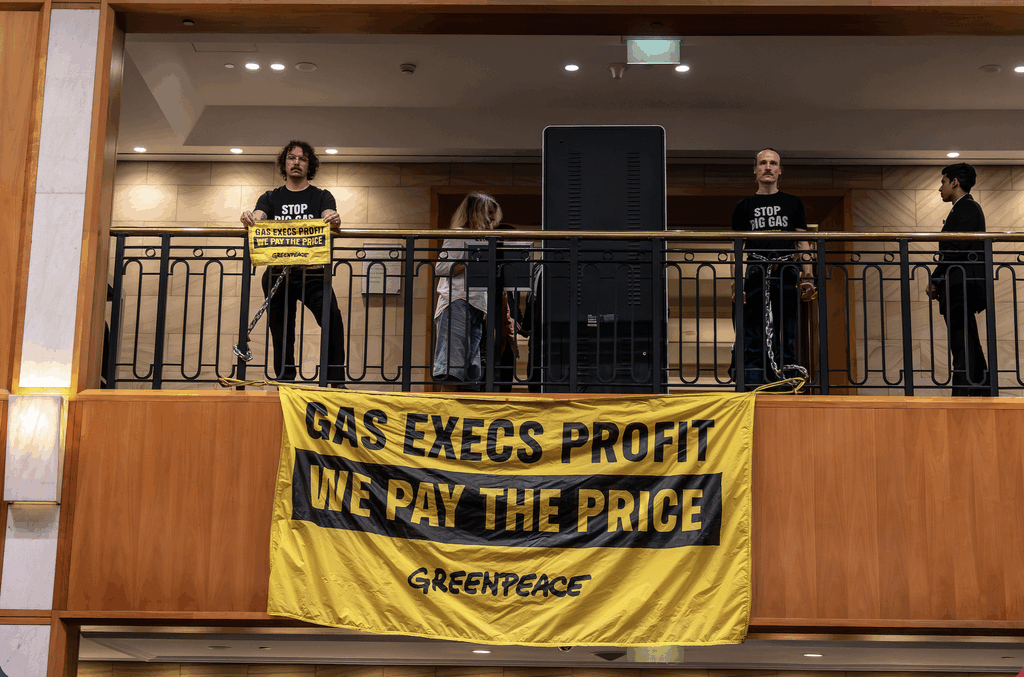
Right now, Greenpeace activists are standing up to Big Gas at a major gas conference in Sydney.
Inside the Sheraton Grand Hotel, executives from fossil fuel companies have gathered alongside lobbyists, investors and political allies to plan the future of gas in Australia – and how to maximise their profits.
So Greenpeace has stepped in to call it out. Activists have dropped a banner inside the venue with a clear message: Gas Execs Profit. We Pay The Price.
We need your help to spread the message that we won’t stand by and let this happen.
What’s really going on
Gas corporations are making billions in windfall profits from global conflicts – from Ukraine to Iran – while Australians pay the price with higher energy bills and climate damage.
And they want more.
More drilling. More exports. More profit.
Why Greenpeace took action today
This conference is where it all comes together. Behind closed doors, gas executives, lobbyists, investors and political allies are meeting to push for more gas expansion, no doubt using global instability as their justification.
That’s why Greenpeace couldn’t let this gathering go uninterrupted.
Big Gas is counting on people not paying attention. Let’s prove them wrong.
Share the video to call out Big Gas.
What needs to happen now
Gas is expensive. It’s volatile. And it ties our energy system to global instability.
But there is a better way. Renewable energy is already cheaper, more reliable, and made right here in Australia. It’s the fastest path to lower bills, real energy security and a safer climate.
To get there, we need to:
- properly tax the gas industry and its exports
- stop expanding gas
- and speed up the transition to homegrown renewable energy.
Share this video far and wide to show just how much support there is to tax Big Gas properly and speed up the transition to renewable energy.
This is just the beginning
This action is part of a growing movement to stand up to Big Gas and challenge the power it holds over our government and society. The Federal Government has a role to play – starting by taxing gas corporations properly and then accelerating the transition to homegrown renewable energy.
Together, we can show just how much support there is for change and make it impossible for decision-makers to ignore.
What you can do
- Follow along on our social channels.
- Share the video far and wide to show how much support there is.
- Sign the petition to tell Albo to stand up to Big Gas – because if we can, he can.
BREAKING: Greenpeace activists disrupt major gas conference in Sydney
SYDNEY, Tuesday 31 March 2026 — Two Greenpeace Australia Pacific activists have been arrested following a peaceful protest at the Australian Domestic Gas Outlook conference in Sydney, where they dropped a banner that said — “Gas Execs Profit. We Pay The Price” and held banners saying “Tax Gas Profits”.
Photos and B Roll video of the protest and arrests are available here
Live updates on Greenpeace Instagram
The two activists were arrested by police around 9:00am AEDT and taken to Day Street Police Station. Information on this morning’s gas conference disruption can be found here.
Solaye Snider, Campaigner at Greenpeace Australia Pacific, said: “Greenpeace activists have taken a strong stand today against profit hungry gas corporations and lobbyists, who see horrific global wars as an opportunity to price gouge and profiteer, while everyday people pay the price.
“Australians have had enough of gas corporations like Santos and ConocoPhillips ripping us off, leaving us with nothing but empty pockets and climate damage. The gas industry is aggressively lobbying against being fairly taxed and pushing to drill for more gas. Change requires showing up and speaking out, and that’s what these activists have done today.
“Greenpeace Australia Pacific stands by our activists, and stands with all communities who are peacefully fighting for a safe and clean energy future. The right to peaceful protest is a fundamental pillar of a healthy democracy and a basic right of all Australians.”
-ENDS-
Media contacts:
Lucy Keller: +61 491 135 308 or lkeller@greenpeace.org or Kate O’Callaghan: +61 406 231 892 or kate.ocallaghan@greenpeace.org
Greenpeace activists arrested after disrupting major gas conference in Sydney



-
Climate Change8 months ago
Guest post: Why China is still building new coal – and when it might stop
-
Greenhouse Gases8 months ago
Guest post: Why China is still building new coal – and when it might stop
-

 Greenhouse Gases2 years ago
嘉宾来稿:满足中国增长的用电需求 光伏加储能“比新建煤电更实惠”
-
Climate Change2 years ago
Bill Discounting Climate Change in Florida’s Energy Policy Awaits DeSantis’ Approval
-

 Climate Change2 years ago
嘉宾来稿:满足中国增长的用电需求 光伏加储能“比新建煤电更实惠”
-
Climate Change Videos2 years ago
The toxic gas flares fuelling Nigeria’s climate change – BBC News
-

 Renewable Energy5 months ago
Sending Progressive Philanthropist George Soros to Prison?
-

 Carbon Footprint2 years ago
US SEC’s Climate Disclosure Rules Spur Renewed Interest in Carbon Credits