

Dr Sivendra Michael is Fiji’s permanent secretary for environment and climate change.
In Fiji, the ocean is our connection to one another, our source of food, our livelihood and an inheritance passed down through generations. It shapes where we live, how we travel and the traditions we carry forward.
Our land may appear small on a world map, but our ocean territory stretches across approximately 1.3 million square kilometres – larger than France, Germany and the UK combined.
For island nations across the Pacific, Caribbean and Indian Ocean, the ocean is not a distant environmental concern. It is the foundation of our communities and our economies. That is why the growing threats to the ocean concern us so deeply. The consequences of decades of pressure are becoming impossible to ignore.
Warming hits coral reefs hard
Consider what is happening to our coral reefs. The most extensive global bleaching event on record exposed more than 80% of the world’s coral reef area to high-level heat stress between 2023 and 2025.
For island nations, the consequences extend far beyond the reefs themselves. A damaged reef can mean a coastline more exposed to storms, fewer fish for families who depend on them and lost income for communities already facing enormous economic pressures.
-
COP31 Bulletin Day 7: Incoming ministers set to battle over cover text
A first draft of the Antalya summit’s main political outcome includes a wide range of asks from 160 countries and must be whittled down amid divisions over science, finance and energy transition -
Scientists defend UN overshoot report after Saudi-led push to sideline it at COP31
In response to critics who have questioned the report’s scientific legitimacy, its authors say the review matches IPCC standards -
Pacific leaves empty handed from COP31 “pledging event” for new fund
With developed countries only re-announcing old pledges, the facility remains $300 million away from meeting its 2026 target of $500m for resilience projects
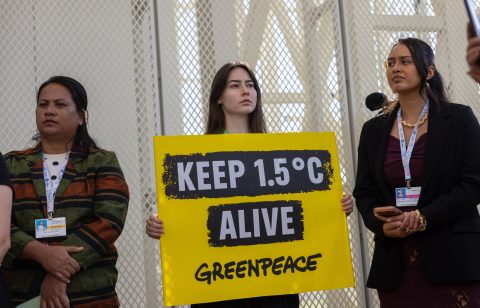

The world is now on course to overshoot 1.5°C of warming, the temperature threshold island nations fought so hard to secure under the Paris Agreement. How far temperatures rise beyond that threshold, and whether and how quickly they can be brought back below it, will help determine whether our reefs have a chance to recover.
For island nations, the stakes extend to whether communities can continue adapting or whether some of the places we call home become increasingly difficult to inhabit.
We cannot afford to treat this as an inevitable loss. The future of our reefs, and the communities that depend on them, must not be determined by the world’s willingness to accept continued warming.
Healthy ocean vital to keep warming in check
As international climate negotiators today prepare to discuss oceans, island nations have three interconnected priorities they want to make clear: keeping the 1.5°C limit within reach, improving access to climate finance and ensuring that the ocean is recognised as central to tackling the climate crisis.
We owe the ocean more than we acknowledge. For decades, it has absorbed most of the excess heat trapped by greenhouse gases and a substantial share of our carbon dioxide emissions, shielding the planet from far greater warming. But that protection has come at an enormous cost.

The bleaching of our coral reefs is one of the most visible consequences of that burden, but the damage does not end there. Rising ocean temperatures are disrupting marine ecosystems. Increasing acidity makes it harder for corals and shell-forming organisms to build and maintain their skeletons and shells, while declining oxygen levels threaten marine life and the habitats on which fisheries depend. Continued warming will intensify these pressures.
Governments must deliver deeper emissions reductions this decade, backed by credible plans for implementation. Limiting the extent and duration of any overshoot of 1.5°C must be a central measure of climate ambition.
Climate solutions being put into practice
That ambition must also extend to the ocean. We no longer need to make the case that the ocean is part of the climate solution. That case has been made. What we need now is action that reflects its importance.
Coastal ecosystems such as mangroves and seagrass meadows store carbon while protecting shorelines and supporting marine biodiversity. Offshore renewable energy and cleaner maritime transport offer further opportunities to reduce dependence on fossil fuels.
Pre-COP draws attention to Pacific’s climate plight and 1.5C goal
Across the Pacific, island nations are already putting solutions into practice. In the Marshall Islands, the SV Juren Ae, a modern sailing cargo vessel, is reducing reliance on fossil fuels for inter-island transport. Its success offers a model for the Pacific Blue Shipping Partnership, a regional initiative co-led by Fiji and the Marshall Islands to transform maritime transport.
For communities separated by vast stretches of ocean, reliable and affordable shipping is essential. Cleaner vessels offer an opportunity to reduce fuel consumption and emissions while improving transport services. With the right support, initiatives such as these can be expanded across the region.
But putting solutions into practice requires finance.
Island states struggle to access finance
Island nations are already paying for the consequences of a crisis they have contributed little to creating. We are protecting coastlines, adapting infrastructure to rising seas and working to safeguard communities threatened by climate change. Yet too many of these efforts are held back, not by a lack of ideas or expertise, but by the difficulty of securing the finance needed to carry them forward.
For small island governments, accessing international climate finance can become an exhausting exercise in navigating complex requirements, often with limited staff and resources to manage the process.
Climate funds should align their application and accreditation procedures wherever possible, reducing unnecessary duplication. They should also make better use of existing national systems and capacities rather than requiring governments to establish new structures to satisfy different funding arrangements.
Critically, support for countries already bearing the costs of climate change must not come at the expense of burdening them with greater debt.
Pacific nations want higher emissions charges if shipping talks reopen
The Pacific Blue Shipping Partnership illustrates what is at stake. Island nations have come together around a practical plan to transform maritime transport. Scaling up that ambition will require a financing system capable of supporting it. COP31 must deliver concrete progress on access to climate finance, particularly for small island developing states and least developed countries.
Earlier this year, Fiji welcomed climate leaders to the Pacific for Pre-COP31, organised in partnership with Tuvalu and Australia. It brought international climate decision-makers to a region where the consequences of climate change, and the solutions being developed in response, could be seen firsthand.
COP31 and beyond
But the message from the Pacific should not stay in the Pacific.
The world cannot continue to acknowledge the ocean’s importance in speeches while treating it as an afterthought in climate policy. That recognition must now shape national climate commitments, the Global Stocktake of climate plans in 2028 and the allocation of climate finance.
The COP31 leadership has identified the ocean as a priority.
The measure of the summit’s success will not be how prominently the ocean features in its discussions, but how firmly it is reflected in its outcomes.
The post COP31 can’t deliver for islands without delivering for the ocean appeared first on Climate Home News.
COP31 can’t deliver for islands without delivering for the ocean

Russia, Saudi Arabia and COP31 co-president Australia are the largest exporters of carbon dioxide (CO2) emissions in history, reveals Carbon Brief analysis.
Since 1850, the three nations – and other major fossil-fuel exporters – have exported hundreds of billions of tonnes of CO2 in the form of gas, oil and coal that has been burned in other countries.
Carbon Brief’s analysis of extraction-based CO2 emissions is based on figures compiled by Robbie Andrew, a senior researcher at Norwegian climate institute CICERO.
It shows that Australia is responsible for more than twice as much global warming when including emissions from its fossil-fuel exports, while Saudi Arabia has caused more than four times as much.
Australia has been under pressure for continuing to expand its fossil-fuel production ahead of the UN climate summit in Antalya, where it is co-president with host nation Turkey.

In contrast, nations that are heavily reliant on energy imports – such as Japan or Germany – have are responsible for far lower shares of planet-warming emissions, if responsibility passes to fossil-fuel producers.
There are many different ways to assign historical responsibility for current global warming.
Carbon Brief has previously published analysis based on territorial emissions, the consumption of imported goods, according to colonial rule or based on historical emissions per capita.
Historical responsibility
This year is expected to be around 1.5C hotter than pre-industrial temperatures. Next year is forecast to be the hottest on record, at around 1.7C of warming.
This year-to-year variation is due to natural variability, such as El Niño. However, approximately 100% of global warming to date is the result of human-caused greenhouse gas emissions.
The burning of fossil fuels since the industrial revolution is the largest contributor to this.
Since there is a direct link between each tonne of CO2 and each fraction of a degree of warming, historical fossil-fuel emissions can be tied to responsibility for current climate change.
This is typically calculated on the basis of historical territorial CO2 emissions, according to where in the world the fossil fuels are burned. It is also possible to assign historical responsibility on a “consumption” basis, according to where goods are used.
Historical emissions are often counted by country, but this puts the focus on populous nations. Alternatively, responsibility can be assigned per capita, based on today’s populations.
A less-familiar way to look at the question of historical responsibility is to consider where fossil fuels are extracted. This puts the spotlight on major fossil-fuel exporters.
The figure below shows that Russia, Saudi Arabia and Australia are the largest CO2 exporters of all time, based on emissions from exported fossil fuels since 1850.
(The allocation is based on extraction taking place within current national borders. Emissions under the former USSR, Czechoslovakia and Yugoslavia are allocated among constituent countries, based on their share of emissions at the time of separation.)
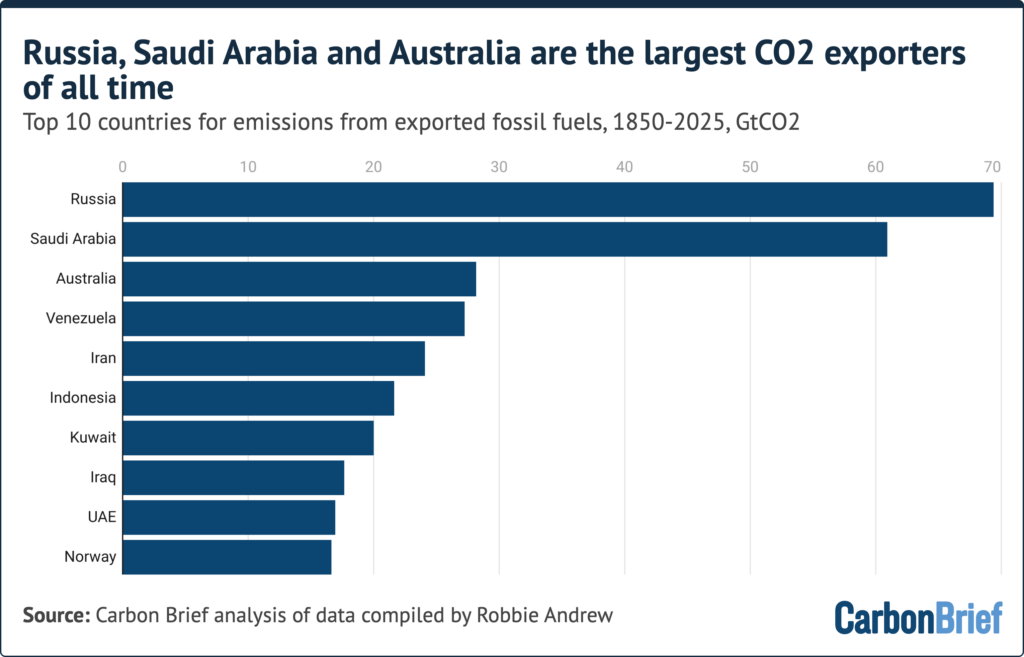
Other major CO2 exporters, based on their overseas sales of fossil fuels since 1850, include Venezuela, Iran, Norway, the United Arab Emirates and Canada.
Between them, these major coal, oil and gas producers have exported hundreds of billions of tonnes of CO2 over the past 175 years, according to Carbon Brief’s analysis.
Extraction-based accounting
The analysis shows that overall, the US and China retain the largest responsibility for historical warming under extraction-based accounting, despite having been net CO2 importers since 1850.
The US has large resources of coal, oil and gas, but was nevertheless a major oil importer until after the shale revolution in the early 2000s.
China remains a major oil and gas importer, describing itself as “rich in coal, lacking oil and gas”.
Russia remains in third place, as shown in the figure below, despite gaining responsibility for an extra 69bn tonnes of CO2 from exported fossil fuels.
The UK becomes the fourth-largest historical emitter, climbing above Germany due to the latter’s reliance on fossil-fuel imports.
Saudi Arabia becomes responsible for the world’s fifth-largest share of historical warming when including its fossil-fuel exports, which increase its cumulative emissions more than fourfold.
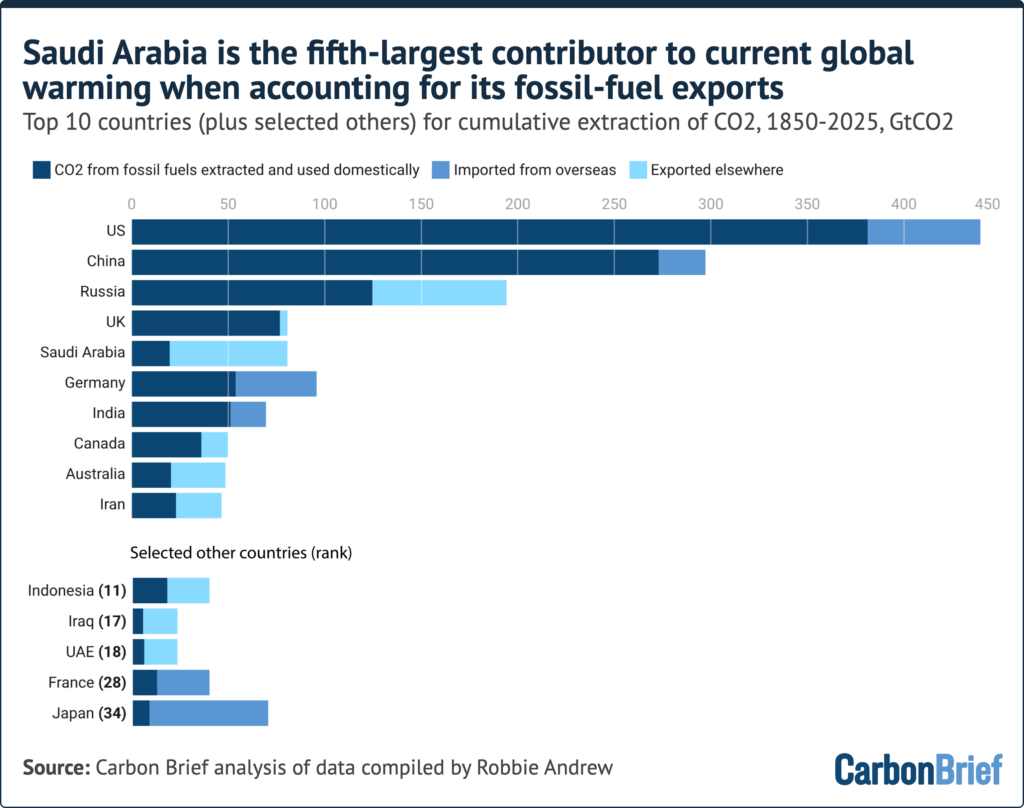
Australia also climbs up the rankings, becoming one of the top-ten largest emitters when including its fossil-fuel exports. This more than doubles its share of historical emissions.
Nations that drop down the rankings under extraction-based accounting, due to their reliance on fossil-fuel imports, include Germany, India, France and COP31 host Turkey.
Japan is a particularly notable example, as it is almost completely reliant on fossil-fuel imports. The nation is the sixth-largest emitter on a territorial basis and the 34th-largest on an extraction basis.
Per-capita accounting
When considering population sizes, major fossil-fuel exporters have the highest extraction-based CO2 emissions since 1850, as shown in the figure below.
Small nations that export large amounts of oil and gas are particularly prominent on this list, including Brunei, Kuwait, Qatar, Norway and Trinidad and Tobago.
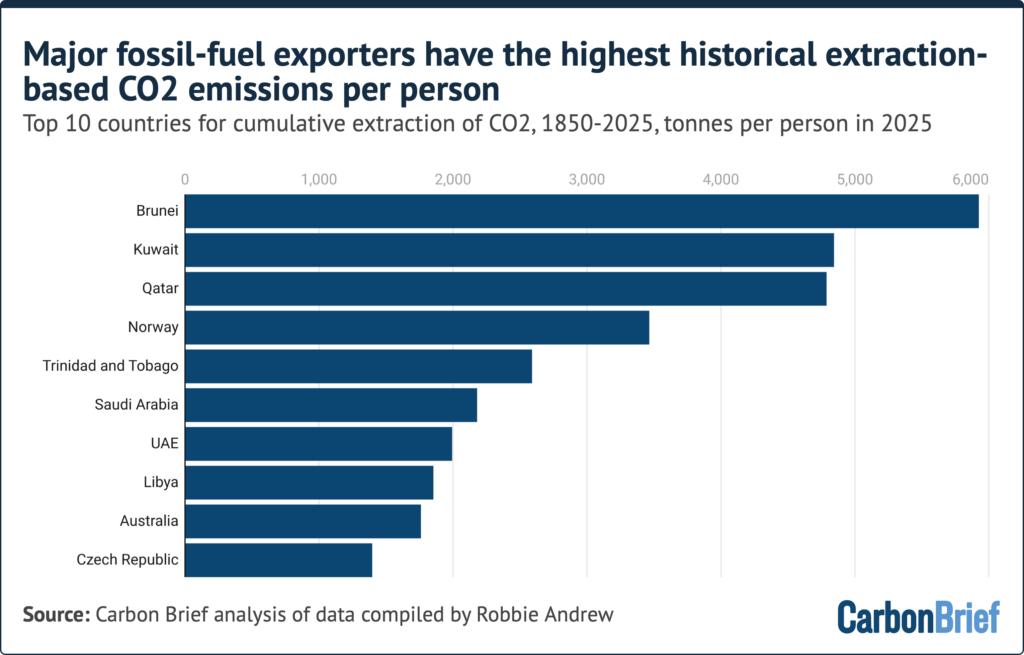
Andrew tells Carbon Brief that while the extraction-based accounting offers an alternative perspective on historical responsibility for warming, it also raises complex questions. He explains:
“At the end of the day, it’s not solely the responsibility of extracting countries that fuels are combusted; it’s joint responsibility between extractors, producers and consumers.”
He adds that responsibility for past decisions is shared by many actors. For example, he notes that oil production in the Middle East was historically “developed by and for western powers”.