

The Tropical Forest Forever Facility (TFFF) – a major new rainforest protection fund launched by Brazil at COP30 – is unlikely to make payments to rainforest countries until at least 2028, experts said, while it raises funds in financial markets.
The proposed new mechanism aims to pay rainforest countries for achieving low deforestation rates. Rather than depending on grants, the TFFF would seek to raise public and private capital to make investments in financial markets, and then use part of the returns to reward countries which protect their rainforests.
But raising the US$125 billion of public and private investment needed to make meaningful payments could take years, according to Andrew Deutz, managing director of Global Policy and Partnerships at WWF, one of the organisations involved in the fund’s design.
He said it will likely take two or three years for the fund to raise private capital by issuing bonds, invest the money and generate enough returns to make significant payments. “So I don’t think we’re going to see payments to rainforest countries until 2028 or 2029,” Deutz said.
-
UK cuts support for climate action abroad to fund military instead
The UK’s foreign minister said the cuts to the aid budget would “deliver the biggest increase in defence spending since the Cold War” -
Roadmap launched to restart deadlocked UN plastics treaty talks
The chair of the negotiations proposes informal meetings through 2026 to bridge deep divisions among countries, following the collapse of talks in Geneva last year


Norway’s climate minister Andreas Bjelland Eriksen, another of the fund’s early backers, told Climate Home News that “the TFFF requires scale, which will take some time”, but added that it “is a historic opportunity” to finance the protection of tropical forests “for generations”.
The delay is not necessarily bad, according to Deutz, as it will allow communities to build capabilities and legal structures to handle the new flow of funds. “There needs to be a capacity-building process over the next couple of years with Indigenous organisations and local communities to be able to manage the flow of funds at that level,” he added.
At the COP26 climate summit in 2021, over 140 countries – covering 85% of the world’s forests – pledged to end deforestation by 2030. At last year’s COP30, the Brazilian government promised to create a roadmap towards ending deforestation by that same date.
But governments are far off track, with a yearly review showing that deforestation rates are currently 63% higher than what they should be to reach this goal. An estimated $570 billion funding gap for nature protection has contributed to the deficient results.
First step: raising $10 billion
While the TFFF has a long-term goal of raising $125bn in public and private capital, its proponents say the key goal for the fund in 2026 will be to raise the total amount of public investment to $10bn so that it can start to scale up.
The fund has already raised $6.7bn, but Norway’s $3bn pledge requires that the TFFF raises about $10bn mostly from other funders by the end of 2026 or they will not invest.
Before scaling up to the long-term $125bn goal – of which $25bn is public and $100bn private – the TFFF will have to prove that it can be successful in paying back investors and channeling funds for rainforest protection. The whole process can take years, Deutz said.
If this $10bn target is reached, the fund could begin raising private finance – up to an estimated $40bn, Deutz said. This initial $50bn tranche would serve to start making investments and show that the model works and can generate returns.
Bjelland Eriksen also said that reaching the $10bn target will be “an important priority” this year. “Only a handful of countries had the opportunities to assess it in detail before the [COP30] Belém summit – now is the time for more countries to do so,” the Norwegian minister said.
Public finance from governments is key for the TFFF model because it would act as a guarantee to lower risk for private investors, something very common in the financial sector, said Charlotte Hamill, partner at hedge fund Bracebridge Capital and one of the fund’s financial advisors, at an event earlier in January in Davos.
“Being able to do this at scale is actually really important, not only to be able to make the payments that are necessary for rainforest preservation but also, in a funny way, it allows you to buy slightly less risky assets because you’re gonna have a much larger pool to buy them off of,” she added.
New contributions?
João Paulo de Resende, TFFF Leader at Brazil’s Ministry of Finance, told Climate Home News that the country will continue fundraising efforts throughout this year, and said he has recently concluded a tour in East Asia speaking with government officials from Japan, South Korea and China.
Conversations with the Chinese government have become “a lot more serious”, said Felix Finkbeiner, founder of the non-profit Plant-for-the-Planet, which operates the online tracking platform TFFF Watch. He added that a Chinese investment would likely be similar in size to the French or German contributions, which would grant the country a seat on the TFFF board. France has pledged a €500m ($578m) investment while Germany has promised €1bn ($1.17bn).
While China is categorised as a developing country at UN climate talks, and thus has no legal responsibility to grant climate finance, the TFFF has been seen as an opportunity for the Asian country to contribute because it’s not an official mechanism within the UN. Deutz said that, for the Chinese government to contribute, they will need reassurance that the funds will not be counted as formal climate finance.
The UK is another of the countries expected to announce a contribution in the coming months, both Finkbeiner and Deutz said. The country announced cuts to climate finance this week as it ramps up defense spending, but Deutz noted that it could still contribute with funds to the TFFF.
“I’m still somewhat optimistic that [the $10bn goal] can happen despite the geopolitical turmoil because the TFFF does not require grant money. We’re not competing with humanitarian assistance,” Deutz explained. “Because governments are being asked to make a loan that would be paid back with interest, this comes out of a different pile of money”.
Multilateral banks such as the European Bank for Reconstruction and Development (EBRD) and the Asian Infrastructure Investment Bank (AIIB) also reportedly considered contributions.
Brazil sharing leadership
Despite having led the official launch of the fund and spearheading its fundraising efforts, Brazil is now aiming to “share leadership” as other countries join the TFFF’s steering committee and establish a new board.
De Resende told Climate Home News that “the project no longer belongs solely to Brazil”, and added that the group of countries that have pledged contributions to the TFFF are also now playing a larger role in “finding ways to jointly promote sponsor outreach”.
Deutz said that Brazil wants to move towards a “shared leadership model”. “They are now asking the European countries to have one of them set up to be the co-chairs so that this is not seen as a Brazilian initiative but is rather seen as owned by all of them,” he added.
The fund will now have to form a steering committee, likely chaired by Brazil and one European country, which will instruct the World Bank on setting up the formal structures of the fund.
Bjelland Eriksen said there is “important work” ongoing to formally establish the fund’s investment arm (known as the TFIF), while de Resende said he expects to “have the fund incorporated in some European jurisdiction by the beginning of the second semester.”
The post COP30 rainforest fund unlikely to make first payments until 2028 appeared first on Climate Home News.
COP30 rainforest fund unlikely to make first payments until 2028

In the shadow of Ankara’s new international football stadium, a group of visiting journalists – including Climate Home News – perched on tiny chairs watched over by mannequins dressed in old mobile phones, newspapers and bottle tops.
As they sipped Turkish tea in a room meant to educate visitors – mostly schoolchildren – about recycling, they were addressed by Ekrem Yıldırım, lead on zero waste at Türkiye’s environment ministry.
After Yıldırım spoke of Türkiye’s plans to pursue “zero waste”, one journalist asked why the sugar cubes for the tea were individually wrapped in plastic and why water had been served in single-use plastic pots.
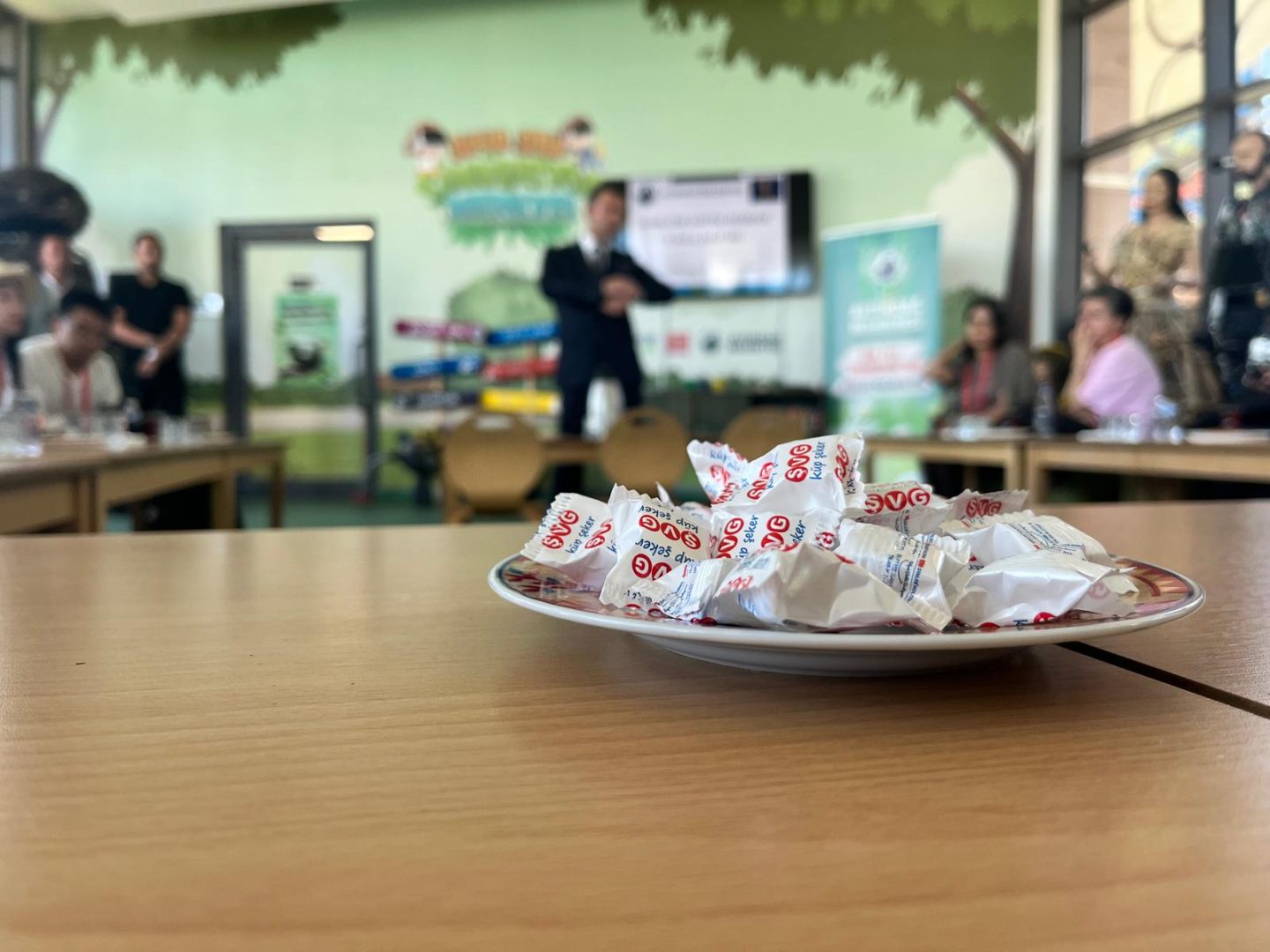
Yıldırım accepted that this kind of packaging is a problem and glass or porcelain is preferable. He added that legislation to ban single-use packaging has been introduced to parliament, but is not yet finalised.
The situation symbolised what Turkish experts and environmental campaigners flag as a contradiction between the “zero waste” image that the government – represented by First Lady Emine Erdoğan – presents to the world and the reality of rising Turkish waste generation, significant climate-wrecking methane emissions from landfills and a politically influential industry producing plastics from oil and gas.
International campaign lacks domestic punch
Türkiye’s Zero Waste initiative – which is a vague plan to reduce waste generation and increase recycling, rather than a specific goal to reach zero waste by any specific date – was launched in 2017.
It came at a time when the Turkish government was under fire for its coal mines, its refusal to ratify the Paris Agreement and its brutal response to protests against plans to turn Gezi Park in Istanbul into a barracks and shopping mall.
Ümit Şahin, climate lead at Sabancı University’s Istanbul Policy Center, said the Turkish government saw then, and still sees, the initiative as “a way to build its international reputation on environmental issues”.
“Recycling gives the government something visible to point to,” he said. “It can promote the campaign without taking on powerful fossil fuel interests or changing its development priorities in mining and energy.”
The campaign has been led by Emine Erdoğan, the wife of Türkiye’s long-time president, Recep Tayyip Erdoğan. In 2022, she convinced countries at the UN General Assembly to create an annual International Day of Zero Waste on March 30.

COP31 President Murat Kurum has picked up on the theme, saying that zero waste is “one of the main pillars” of Türkiye’s COP31 presidency. In September, he reminisced at a press briefing in the northern city of Trabzon about old-fashioned Turkish rural life where food waste would be given to animals, ripped clothes would be mended, and new attire was only for religious festivals.
President Erdoğan told leaders at September’s UN General Assembly in New York that an “incredible desire for consumption” was fuelling a “culture of waste”. “We cannot speak of justice in a world where tonnes of food are thrown into the garbage on one side while hundreds of millions of people collect food from garbage containers on the other,” he railed.
Sedat Gündoğdu, a marine biologist and environmental researcher at Türkiye’s Çukurova University, told Climate Home News that zero waste is a worthy concept. But when it comes to putting words into action at home, he said, the government has failed. Official statistics show the amount of waste each person in Türkiye generates has remained broadly unchanged since 2010 and the total annual amount has increased by 15%.
Single-use plastics ban
To help fix this, an European Union-style ban on single-use plastics – like plastic cutlery, cups and stirrers – was reported by state media in March to be working its way through parliament and expected to come into effect on September 1.
But PAGEV, a Turkish plastics industry trade association, argued that such “restrictive” policies had failed in the EU and would damage the Turkish economy and take away jobs.
Despite COP31 shining an international spotlight on the Turkish waste sector, the ban has yet to be approved by President Erdoğan. Gündoğdu and Greenpeace Türkiye campaigner Berk Butan fear that, if it is approved, it will be watered down so that Turkish companies can make single-use plastics in Türkiye even if they can no longer sell them in the country.
The latter restriction, Gündoğdu argued, would be “meaningless” because it cannot be enforced. Similar measures in Germany and Italy have failed, he said, because manufacturers just relabelled single-use products like plastic straws as multiple-use straws.
To close these loopholes, he said, strict definitions and design criteria are needed, which the Turkish legislation does not have. Butan added that single-use plastics could still be made in Türkiye, and then exported, used and dumped abroad, causing the same environmental damage somewhere else.
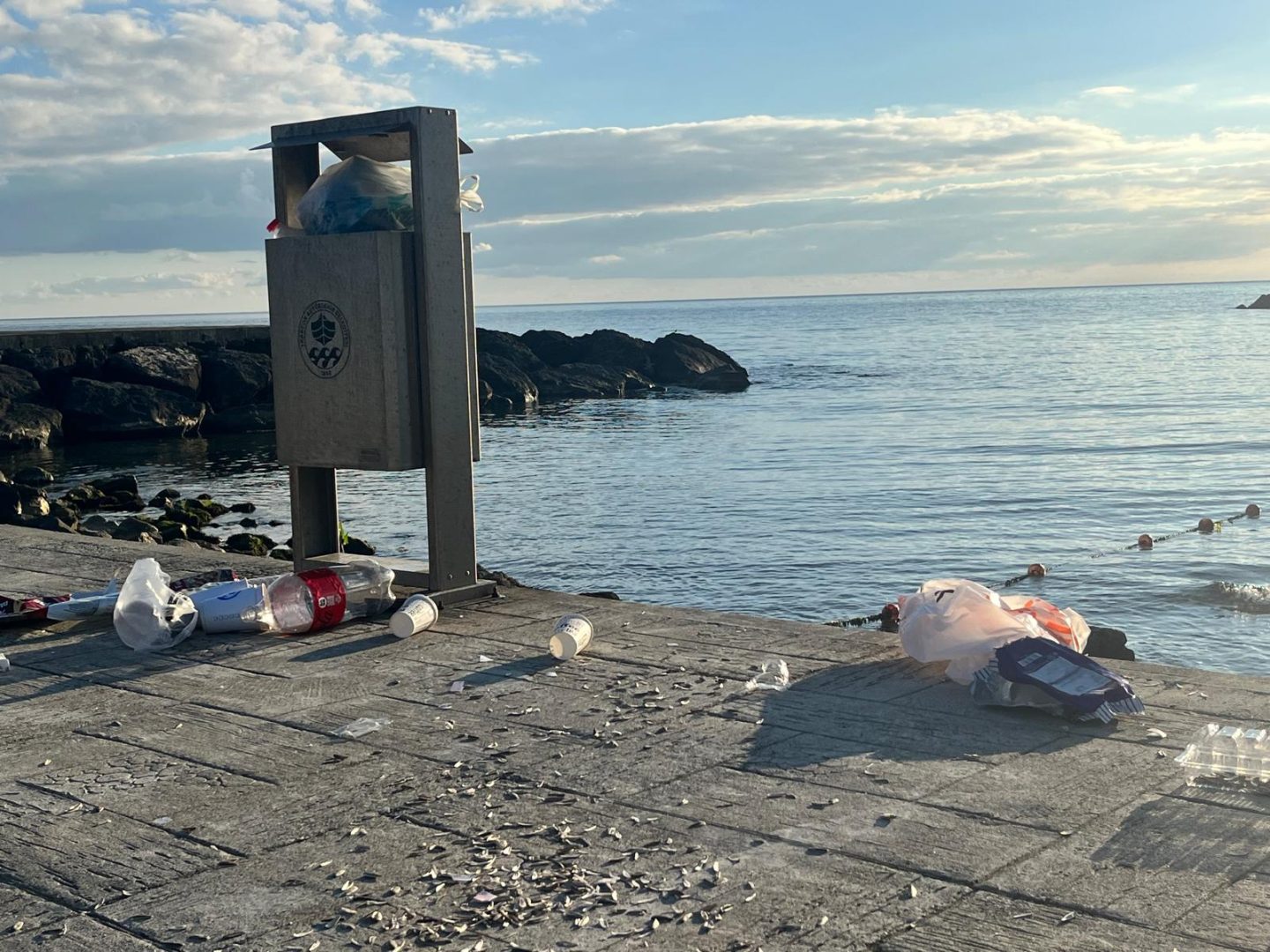
Türkiye’s other flagship waste prevention measure is a tax on plastic bags, which led to an immediate drop in usage when introduced in 2019. But, despite rampant inflation, the tax has risen from 0.25TL in 2019 to just 1TL ($0.02), meaning it’s several times less in real terms than in 2019.
“You can’t even buy chewing gum with one lira,” said Gündoğdu. “If you see one lira on the ground, you will not take it. So that’s why it’s meaningless.” Butan added that the government did not invest in creating behavioural changes among the public, such as encouraging them to shop with reusable textile tote bags. “They just put in the tax and they didn’t do the rest,” he said.
Landfills tidied up but still leaking methane
While the amount of waste generated keeps rising, there has been progress in dealing with the waste so that it is at least out of sight. Official statistics suggest more and more of it is being collected and, while the vast majority is still sent to landfill rather than recycled, those landfills are now covered and more advanced than they used to be.
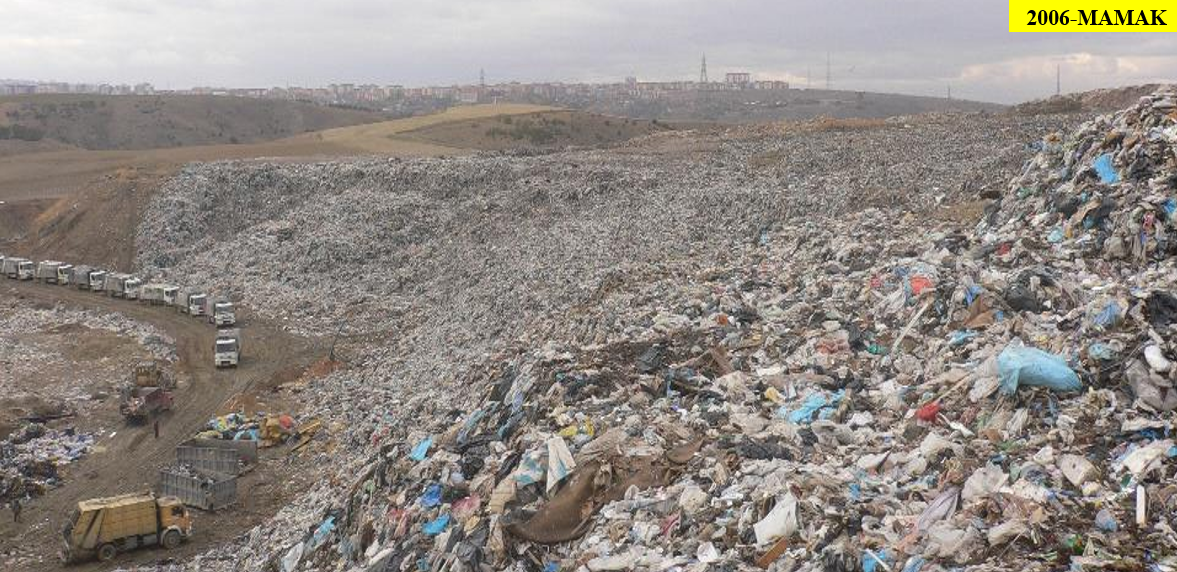
On the outskirts of Ankara, waste management company ITC gave Climate Home News a presentation showing one such transformation. A before image shows what the nearby Mamak landfill looked like in 2006 – a huge open pile of garbage known in Türkiye as a “wild landfill”.
Another image shows what the site looks like now with the rubbish covered up with soil. ITC says that Ankara’s garbage is brought to them on trucks, and sorted into recyclables and biodegradable waste, which is then turned into compost or burned for energy. Waste heat is used to grow blueberries, tomatoes and lavender or to warm shoppers in a nearby branch of the Swedish furniture giant Ikea.
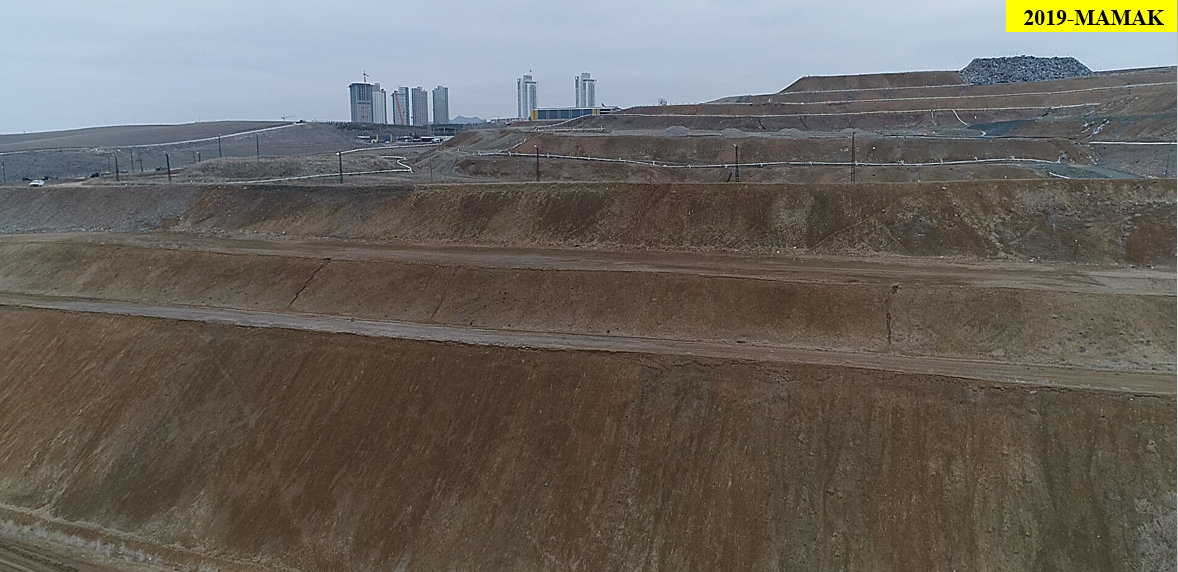
But despite this progress, satellite observations from Carbon Mapper shows the site is still leaking methane – a particularly potent greenhouse gas – into the atmosphere. Exactly how much is unclear from Carbon Mapper’s limited observations but the nearby Sincan landfill leaks about 1,200 kilogrammes of methane an hour into the atmosphere. Climate Home News analysis suggests this does similar damage to the climate as 73,000 petrol cars. ITC did not respond to a request for comment.
In October, a Guardian investigation showed these methane leaks were happening at landfills across Türkiye and are some of the worst in the world. Researchers from the University of California (UCLA) said they were “mind-boggingly large”. Aside from the climate damage, local residents near one Istanbul landfill report a smell so bad they told the Guardian they have to sleep with their windows closed even on hot summer nights.
Waste imports from Europe
Dealing with its own growing waste is difficult enough, but Türkiye also imports mountains of plastic from its European neighbours too. Ever since China restricted waste imports, the European Union has exported more plastic waste to Türkiye than to any other nation by far.
Despite European Commission concerns about how well Türkiye deals with the waste, the trade is expected to grow as an EU ban on exports to non-OECD countries – a category that does not include Türkiye – comes into force on November 21.
The export of waste to Türkiye has seen European countries accused of waste imperialism. Butan and Gündoğdu said Türkiye should ban waste imports. But COP31 President and Turkish environment minister Kurum pushed back on this during a press conference in Trabzon in September.

“You called it waste imperialism,” he said through a translator, but “nobody is forcing anyone” to import waste. He added that handling the waste creates jobs in Türkiye and that it doesn’t matter to the environment where the waste is recycled as long as it is.
But most of Türkiye’s municipal waste is currently not recycled. Turkish official Yıldırım said that the country’s recovery rate is currently around 30%. The most recent statistics available from the EU suggest Türkiye in 2020 had a recycling rate of 12%. The EU country average in 2024 was about 50%.
At the zero waste centre in Ankara, Yıldırım said Türkiye is improving its recycling rate and wants to do even more. The aim, he said, is to reach a rate of 70% by an unspecified date, up there with global frontrunners like Germany.
To achieve that, he said Türkiye is raising awareness of the importance of recycling including through cartoons for children and initiatives for football supporters to collect and redistribute unwanted toys.

As he spoke to journalists, a portrait of the ‘Girl with a Pearl Earring’ made from buttons, a sultan made from old plastic straws and a horse and wolf made from metal cogs and screws looked on. “The world is something that has been entrusted to us, and waste is something you steal from the future,” said Yıldırım.
Climate Home News’ travel and accommodation for the trip on which much of this article was reported was funded by the Turkish government.
The post Türkiye pushes “zero waste” at COP31, but is it delivering at home? appeared first on Climate Home News.
https://www.climatechangenews.com/2026/11/11/turkiye-pushes-zero-waste-at-cop31-but-is-it-delivering-at-home/
More than 92,000 people have registered to attend the COP31 climate summit in Antalya, Turkey, potentially making it the largest COP in history.
Carbon Brief analysis of the provisional lists of delegates, published by the United Nations Framework Convention on Climate Change (UNFCCC), reveals that more than 14,000 delegates have been registered as “host country guests”.
For comparison, the provisional list for COP30 in Belém, Brazil, last year included only around 1,000 delegates in this category.
As with COP30, Donald Trump’s US government has not sent a delegation. Other no-shows include Israel and Myanmar.
It was reported ahead of the summit that Taliban officials from Afghanistan had been registered for the event as observers; however, there are no delegates from observer states in the provisional lists.
With more than 3,000 “virtual” delegates signed up to attend the summit online, the total number of people registered for the event surpasses 95,000.
Further analysis of the participant lists will be added to this article in due course.
Party delegates
With 92,934 participants registered, COP31 is provisionally the largest COP in history – topping COP28 in Dubai, which was attended by more than 80,000 people.
This total is based on the delegates that have registered to be at the summit in person. The UNFCCC releases the final figures – based on participants collecting a physical badge at the venue – after the summit has ended.
The chart below shows how the provisional figures for COP31 compare to the final totals in previous COPs – going back to COP1 in Berlin in 1995.
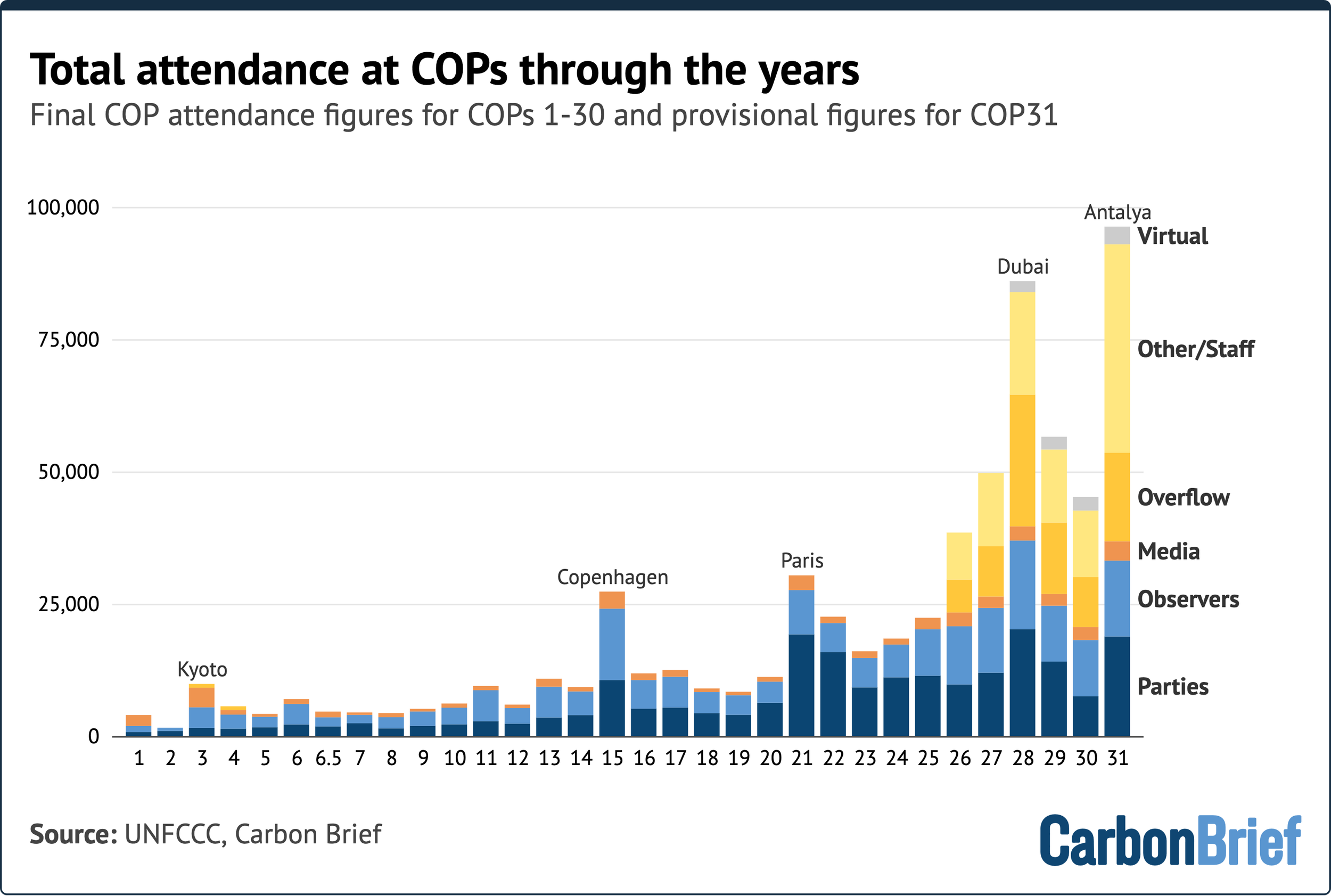
The participant lists provided by the UNFCCC are divided between the different types of groups and organisations attending the summit. The largest group at COP31 is for delegates representing parties. These are nation-states, plus the European Union, that have ratified the convention and play a full part in negotiations.
This group adds up to 18,812 delegates – the second largest after COP28.

Membership
Support award-winning climate journalism
(In keeping with recent COPs, the UNFCCC has published spreadsheets that name every single person that has registered for the summit – excluding support staff. Previously, COPs have typically included thousands of “overflow” participants in which countries and UN agencies could nominate delegates without their names appearing on their official lists.)
For consistency with Carbon Brief’s analysis of previous COPs, the above chart includes overflow delegates as a single group. However, the participant lists do divide the overflow delegates between parties and observer groups. Including the overflow numbers takes the total for party representatives to more than 34,000.
Nations
The map and table below present the delegation size – split between party and overflow badges – for all the countries registered for COP31. The darker the shading, the more delegates that country has signed up. Use the search box to find the data for a specific party.
Unsurprisingly, host nation Turkey has registered the largest delegation for COP31 – with 2,950 people.
Following behind are Brazil (1,994 people), Nigeria (1,506), China (1,021) and Indonesia (978).
The rest of the top 10 is made up of Austral