

Doubling down on fossil fuels in response to the spikes in oil and gas prices unleashed by the Iran war would be “completely delusional”, the UN climate chief is expected to warn on Monday, in one of his strongest attacks yet on planet-heating fossil fuels.
Addressing political and business leaders in Brussels, Simon Stiell will argue that dependence on oil and gas is “ripping away national security and sovereignty” and will urge them not to use the crisis as a pretext to slow the clean energy transition.
“Fossil fuels that supercharge disasters rake in trillions in taxpayer-funded subsidies globally,” he will say. “Money that could be far better spent”.
Climate Home News understands Stiell views the current crisis as a crucial moment to ramp up pressure against fossil fuels, as it lays bare the economic irrationality of new oil and gas investments compared with the benefits of renewable energy.
Stiell’s warning comes at the start of a pivotal week for energy policy in Brussels. Energy ministers meet on Monday to discuss soaring energy costs before environment ministers gather on Tuesday to debate climate targets and a proposal to dilute carbon dioxide emissions standards for cars. Energy security will also feature high on the agenda of the European leaders’ summit on Thursday and Friday.
Oil and gas prices surging
Oil and gas prices have surged after key Gulf producers halted output following Iran’s attacks on regional infrastructure and the closure of the Strait of Hormuz, through which a fifth of the world’s oil supplies pass.
The disruption is hitting Asia hardest. Nearly 90% of the region’s oil and gas flows east, and fuel shortages have already forced Bangladesh to shut universities early and the Philippines to cut civil servants’ working hours. Across the continent, import-dependent countries have scrambled to lock in supplies, driving up prices as they compete for the same cargoes.
-
New summit in Colombia seeks to revive stalled UN talks on fossil fuel transition
Colombia will host the first conference on transitioning away from fossil fuels, after more than 80 countries pushed at COP30 for an end to coal, oil and gas -
South African rare earths project aims to rival Chinese with low-cost model
The EU-backed Zandkopsdrift project plans to offset the high cost of rare earths production with another mineral in hot demand for use in batteries -
Paris Agreement watchdog weighs action against countries missing climate plan
With more than 60 countries – including India, Argentina and Vietnam – still failing to submit updated NDCs, the oversight committee will discuss this month how to respond


Europe has little direct exposure to the Strait of Hormuz disruption, but integrated global energy markets mean the continent will still pay more for its oil and gas imports.
European Commission President Ursula von der Leyen said last week that the Iran war had already cost European citizens an additional three billion euros ($3.4 billion) in fossil fuel imports. “That is the price of our dependency,” she added.
‘Renewables turn the tables’
But right-wing politicians have seized on the Middle East crisis to attack the bloc’s green policies, blaming them for rising energy prices and weakening competitiveness.
Some governments, including Italy, have called for the suspension of the Emissions Trading System (ETS), the continent’s main climate policy, which incentivises companies to invest in lower-carbon production by putting a price on pollution. Eight other governments have urged the EU not to weaken its carbon market.
Von der Leyen said abandoning the EU’s long-term strategy, focused on investment in renewables and nuclear, would be a “strategic blunder”.
Gulf oil and gas crisis sparks calls for renewables investment
Echoing her message, Simon Stiell is expected to tell leaders that “meek dependence on fossil fuel imports will leave Europe forever lurching from crisis to crisis”.
“This fossil fuel crisis will happen again and again in this new world disorder where some major powers do as they please,” the UN climate chief will say.
“Renewables turn the tables,” Stiell is expected to add. “Sunlight doesn’t depend on narrow and vulnerable shipping straits. Wind blows without massive taxpayer-funded naval escorts”.
The rollout of new wind and solar power capacity across Europe since the introduction of the Green Deal in 2019 has saved 59 billion euros ($67bn) that would have been spent on additional fossil fuel imports, according to analysis by think-tank Ember.
The post ‘Completely delusional’: UN climate chief warns against fossil fuel push after Iran crisis appeared first on Climate Home News.
‘Completely delusional’: UN climate chief warns against fossil fuel push after Iran crisis

Climate Change
‘COP-out’: COP31 fails to deliver the ambition needed to phase out fossil fuels and address climate breakdown
Antalya, Türkiye, Sunday 22 November 2026 — The COP31 climate summit in Antalya has ended in disappointment and anger, as the final COP31 outcome failed to deliver on critical issues like overshooting the 1.5°C limit, fossil fuel phase out and climate finance. Greenpeace Australia Pacific says that Australia did not deliver the deal that the world needed in a time of escalating climate breakdown.
In Antalya, Dr Susie Byers, Head of Advocacy at Greenpeace Australia Pacific, said: “We need to call this COP outcome what it is: a COP-out that has failed to deliver what the world urgently needs given the scale of the crisis we’re facing. It’s a colossal lost opportunity, and one that the world won’t easily forget.
“Coming out of Belém there was momentum to phase out fossil fuels, but COP31 wasn’t able to harness that energy and drive the world forward. The failure to adopt the Cover Decision means there’s now no acknowledgement of, let alone response to, 1.5°C overshoot — the survival line for Pacific nations. Electrification, defence of science, protection for the oceans, and advances on climate finance were all casualties of cynical attempts to derail climate action with dangerous distractions like CCUS.
“Australia knew how hard this task would be and put their hand up anyway. In the end, they didn’t get it done. This outcome validates exactly why so many countries are looking towards parallel tracks like the International Court of Justice Advisory Opinion and national transition roadmaps, where we’ve seen microdiplomacy and Pacific leadership again lead the way. This spirit of multilateralism and collaboration is how we will move beyond rhetoric to concrete actions, and end the fossil fuel chokehold.”
Also in Antalya, Shiva Gounden, Head of Pacific at Greenpeace Australia Pacific, said: “They called this an ‘implementation’ COP, but implementation means nothing when the foundation is broken. The frontline communities leading this fight came to Antalya demanding the urgent, definitive action required to confront the sickening realities of 1.5°C overshoot. Instead, developed countries turned their backs on their historical responsibilities, held climate finance hostage, and treated the debt they owe as a cheap bargaining chip.
“At the exact same time, Parties and negotiating blocs deliberately blocked the bold action the world needed on mitigation, peddled toxic distractions like CCUS, and intentionally scrubbed the words ‘fossil fuels’ from the final text. A strong Presidency that understood the urgency of the situation would not have let this happen; Australia failed to deliver what it promised the Pacific.
“Billions of people across the world are fiercely defending their lives, their homes, their cultures, and their livelihoods, and we came here with their voices demanding real action. By choking off the money and refusing to name the root cause of this collapse, polluting nations made a calculated choice to protect their own interests over our shared future. The Pacific will increasingly look towards parallel paths like the ICJ climate advisory opinion, and the Santa Marta process, to continue finding solutions because that is what our people need.”
ENDS
COP31 images and video available here in Greenpeace Media Library
Media contact: Kate O’Callaghan in Antalya (GMT+3) on +61 406 231 892 (Whatsapp/Signal)
Climate Change
COP31 Bulletin Day 13: New draft retains electrification goal but delays adaptation finance and science decisions
After an evening of tense discussions, a new version of the cover text was finally released at around 2am on Sunday morning. But, with many delegates flying home, it is unclear if – and for how long – there will be the two-thirds of governments present needed to legally adopt a decision.
The latest draft, which is – as of 9.30 – scheduled to be put to a plenary session for approval at 10am – retains a goal to boost electrification and links it more strongly with clean energy and storage. It does not, however, include language on transitioning away from fossil fuels as many countries had called for.
It ditches a specific numerical target for carbon capture, use and storage (CCUS), a controversial technology that is favoured by fossil fuel producers, which is now only an aim “to achieve gigatonne scale globally by 2035 as a collective global aspiration”. The previous version had two alternative targets, a weaker one of 0.5Gt “working towards” 1.3-2.5Gt and a stronger one of 2.5Gt.
The draft cover decision has strong language on responding to an almost certain overshoot of the 1.5C warming limit, recognising that it will increase loss and damage and result “in increasingly adverse, and in some cases irreversible, impacts and risks to human and natural systems”. As President of Negotiations Chris Bowen has repeatedly drawn attention to, this is the first COP held since the UN acknowledged that overshoot is inevitable.
In pursuing efforts to limit any overshoot, the decision recognises the need for “deep, rapid and sustained reductions in greenhouse gas emissions in line with 1.5 °C pathways” – which is a push towards greater ambition.
The text also resolves to close adaptation gaps and boost action and support to help countries and communities to better cope with adverse climate impacts. But it does not put a figure to a goal agreed at COP30 last year to triple adaptation finance by 2035.
The goal did not specify a baseline year and African nations, least-developed countries and small island states had pushed for it to be a later and higher baseline and therefore a larger target number of $120 bn a year. Instead, the text launches a “roadmap” on adaptation finance to be considered at COP32.
Loss and damage finance has been cut from the roadmap’s scope, as have references to about half the money pledged to the loss and damage fund having yet to be sent to the fund’s bank account and the gap between the $2.8 billion of loss and damage funding requested by developing countries in the fund’s start-up stage and the $0.342 billion allocated to fund these projects. “Erasing the shortfall doesn’t make it disappear for families who have lost everything”, said Harjeet Singh, global convenor of Fill the Fund.
The new text drops its invitation to the Intergovernmental Panel on Climate Change (IPCC) to publish all of its next three reports in time for the 2028 global stocktake of climate progress. Instead, it just invites them to “continue to provide policy-relevant information as input to the UNFCCC processes, including outputs from the seventh assessment cycle to the next global stocktake”. It no longer specifies that all their reports, including the third on reducing emissions, are published. The IPCC will have an online meeting in December to discuss this issue but COP31 guidance will be influential in its decision.
As Climate Home News entered the venue around 7.30am, tired-looking negotiators from Saudi Arabia and from the Alliance of Small Island Developing States were seen entering the area which houses the Presidency’s offices, as others dozed on sofas. A source close to the German delegation said that negotiations had been intense and were not necessarily resolved.
If the Presidency does not think it can get agreement on a cover text, then it can withdraw it or it can issue it a Presidency declaration, which does not have much weight. Some of its provisions could be added into other agenda items and adopted seperately. Governments could also decide to reconvene COP31 at a later date – known as a bis – as happened at COP6.
The post COP31 Bulletin Day 13: New draft retains electrification goal but delays adaptation finance and science decisions appeared first on Climate Home News.
COP31 Bulletin Day 13: Germany rejects text moments before plenary meeting
On Friday night, COP31 approved a series of less controversial agenda items and then COP President Murat Kurum told governments to hang around the venue until midnight in case his team wanted to consult them on the cover text, which is still Thursday’s version.
If you don’t hear from us, Kurum said, go home and get some rest and don’t bother coming in before 9am. Governments appear to have taken his advice. Around 10am, the conference centre was ghostly and there was still no sign of a new draft cover text.
COP31 Bulletin Day 11: Countries decry cover text for omitting fossil fuels
Friday night’s plenary did offer a few moments of drama. An activist was ushered out of the room by security after holding a rope around his neck and shouting “you keep doing nothing, nothing at all” and “you are killing the future, just kill me now” to a smattering of applause.
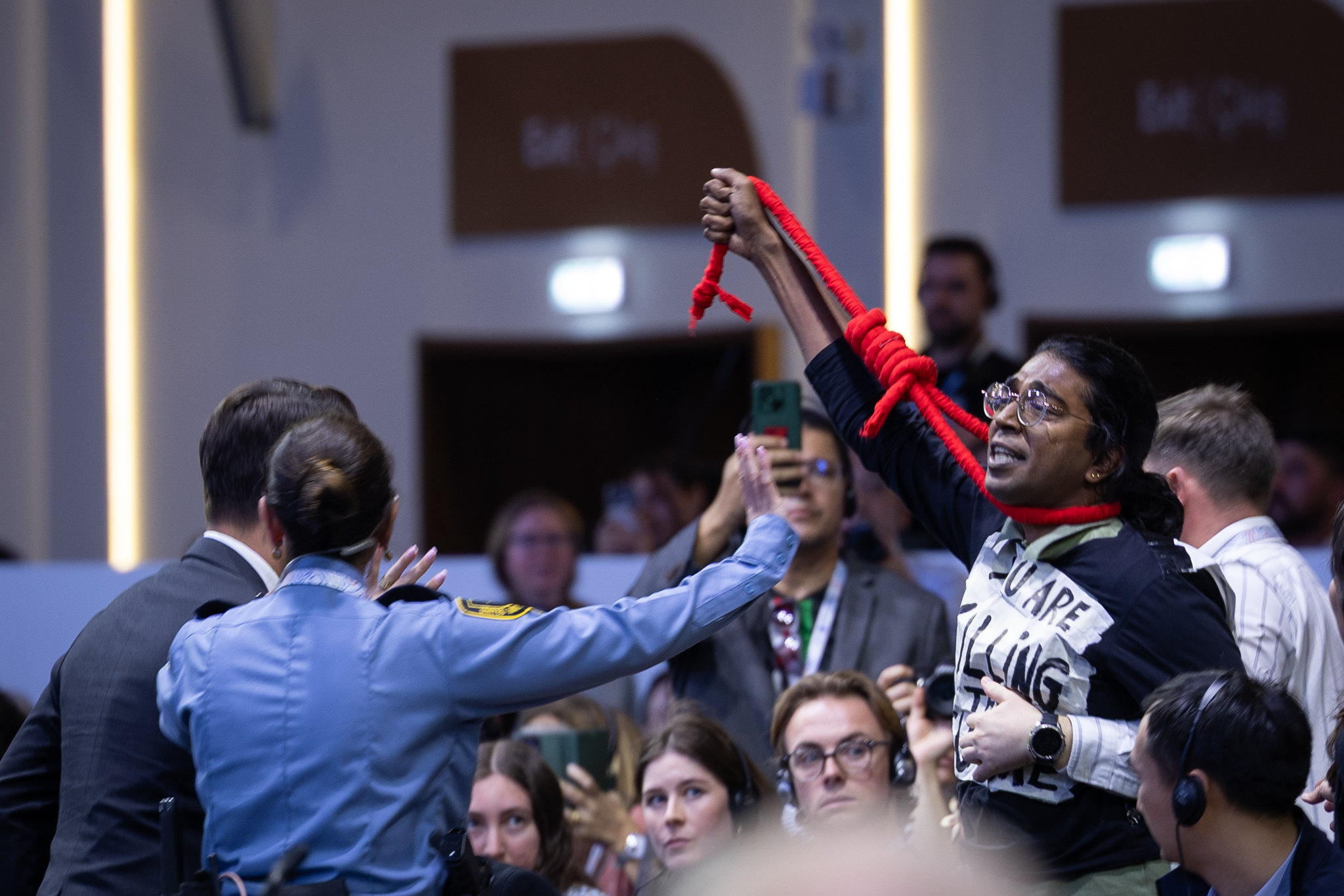
Panama’s environment minister Juan Carlos Navarro urged Kurum to ensure full respect of the rules of procedure when gavelling decisions through this weekend. Given he has led threats to object to the cover text if it is not ambitious enough, this sounded like a warning to Kurum not to ignore objections, as previous COP presidents have been accused of doing.
Another significant development on Friday night was a joint statement from Australia and China which, among other things, expressed China’s backing for the 35×35 electrification goal. More on that here.
The post COP31 Bulletin Day 12: ‘Don’t ignore us,’ Panama warns as COP31 runs into overtime appeared first on Climate Home News.
COP31 Bulletin Day 12: ‘Don’t ignore us,’ Panama warns as COP31 runs into overtime

‘COP-out’: COP31 fails to deliver the ambition needed to phase out fossil fuels and address climate breakdown
COP31 Bulletin Day 13: New draft retains electrification goal but delays adaptation finance and science decisions

How “Marie Antoinnete” Can We Get?

-
Climate Change1 year ago
Guest post: Why China is still building new coal – and when it might stop
-
Greenhouse Gases1 year ago
Guest post: Why China is still building new coal – and when it might stop
-

 Renewable Energy1 year ago
Sending Progressive Philanthropist George Soros to Prison?
-
Greenhouse Gases1 year ago
嘉宾来稿:探究火山喷发如何影响气候预测
-

 Climate Change2 years a