

Catherine Abreu is the Director of the International Climate Politics Hub
In a move straight out of the movies, the UN Secretary-General’s High Level Climate Event in September put the two prospective hosts for the 2026 global climate talks, Türkiye and Australia, back-to-back in the speaking order.
Both President Erdogan and Prime Minister Albanese confidently welcomed the world to their countries for COP31. Here at COP30, the drama continues, with the Australian and Turkish Pavilions sitting side-by-side while neither country seems prepared to step back from their bid. Get your popcorn.
Except this isn’t the movies, it’s the UN-led, multilateral process charged with helping us save ourselves from runaway climate change. And, thus far, what has been conspicuously missing from the pseudo-dramatic showdown between these two potential hosts is any meaningful discussion about how either country would aim to use its presidency of the climate talks to accelerate action on climate change, in their own country or globally. The drama, it would seem, has been misplaced.
-
COP30 Bulletin Day 1: Host nation Brazil averts agenda row at opening
In a compromise solution, the COP30 presidency will hold consultations on four contentious issues – climate finance, trade measures, 1.5C ambition and transparency of national data -
After climate memo row, Gates gives $1.4bn to help farmers cope with a hotter world
The announcement follows Gates’ call for a “strategic pivot” in global climate efforts from focusing on emissions, with new investments aimed at helping smallholder farmers access climate-resilient technologies


Any country wanting to host the annual UN summit on climate change should be making the case for doing so based on their climate credentials – and their climate ambition.
While some past COPs may have made us forget this, the energy and intent of current COP President Brazil, and the conversation Brazil’s COP presidency has generated at home about the country’s climate action, serve as useful reminders of what we should be striving for in the host of the climate talks.
It would be disappointing not to have a solid plan in place for COP31 and risk losing the momentum Brazil will hopefully have generated by the end of COP30.
COP host criteria
So, what should we be looking for in a COP host? First, we need a prospective presidency to be clear about the conversations they envisage mediating in the run-up to and during their summit and how those will help us advance a just and equitable transition away from fossil fuels toward renewable energy and energy efficiency, within the framework of the Paris Agreement.
We need a COP presidency focused on the question of how they can use their platform to help improve countries’ abilities to respond to the impacts of climate change and address the losses and damages they are experiencing.
We need a presidency fully engaged with using their platform to secure commitments to provide the finance countries need to take climate action and respond to climate impacts, while advancing the need to transform global financial systems so that we are tackling the problem of climate change at its core, rather than deepening it.
Finally, and perhaps most importantly, we need a host ready to commit their COP to being an effective space for negotiating, deliberation and decision making that is free from the undue influence of actors who are there to slow us down.
In other words, is the potential host ready to commit to a COP led by science and traditional and Indigenous knowledge? Are they prepared to ensure transparent accreditation processes that will expose conflicts of interest? And are they prepared and competent to facilitate an effective COP structure so that parties are given the opportunity to have the conversations they need to have, and to land the outcomes they need to achieve, without the influence of anticlimate lobbyists in their midst? If the answers to all of these questions are not a resounding yes, this is not the Presidency we need.
-
What do African countries want from COP30?
At the UN climate summit, African negotiators are seeking more “debt-free” financing that would allow them to implement climate solutions – from adaptation to just transition -
Not another COP-out: We must rewrite the rules of the UN climate talks
Reforming the talks is not procedural housekeeping – it is a crucial pillar of climate action needed to accelerate a fossil fuel phase-out and ramp up finance


Moreover, a potential COP host should be prepared to use their global platform to substantially advance climate action on the domestic level.
In the case of Australia, that should involve being steered by the wider Pacific leadership on just and equitable transitions away from fossil fuels. As the second largest coal exporter in the world and with a domestic energy mix that includes both fossil fuels and booming renewable energy growth, Australia can and should be aiming to credibly lead conversations on export market transformation and power system transitions to ethical renewable energy and improving energy efficiency.
For Türkiye, affirming a direction of travel away from coal dependency is key. So far Türkiye has been opposed to this both domestically and internationally; indeed, it did not sign up to the tripling renewables pledge at COP28, even though that target was aligned with Türkiye’s own renewable targets, because the text referred to “coal phase-down”. Türkiye moving past its opposition and opening up to a dialogue on a just transition away from coal would be a significant victory for the climate.
There are many reasons a country may want to host the UN climate summit. Foremost among those reasons, and at the heart of the UN process that decides COP hosts, should be the drive to lead national and global conversations that make a real difference in tackling the climate crisis.
The post Climate is MIA in Australia and Turkiye’s bids to host COP31 appeared first on Climate Home News.
Climate is MIA in Australia and Türkiye’s bids to host COP31

Next week, diplomats from around the world will descend on Yerevan, Armenia, to negotiate a series of decisions under the UN Convention on Biological Diversity (CBD).
Between 19 and 30 October, 196 parties will gather to hammer out the precise wording of the dozens of legal texts that make up the decisions under the Conference of the Parties (COP) to the CBD.
This year’s summit is particularly significant, as it marks the halfway point between the agreement of the Kunming-Montreal Global Biodiversity Framework and the deadline for achieving its targets.
The CBD has found that countries are currently not on track to meet 22 out of the framework’s 23 targets.
During the fortnight, delegates will also be negotiating decisions relating to the two supplemental protocols to the CBD: the Cartagena Protocol, which covers biosafety; and the Nagoya Protocol, which covers access and benefit-sharing for the use of genetic resources.
(The Cartagena and Nagoya Protocols, which are each governed by a “meeting of the parties”, or “MOP”, have fewer parties than the CBD as a whole, with 173 and 141, respectively.)
Carbon Brief is tracking the progress of countries towards consensus on dozens of negotiating texts using the interactive table below.
The tracker includes texts from the COP, as well as the MOPs for the Cartagena and Nagoya protocols. It also includes draft decisions from the most recent subsidiary body meetings, as these form the starting point for the negotiations in Yerevan.
The CBD has three subsidiary bodies: the subsidiary body on scientific, technical and technological advice (SBSTTA), the subsidiary body on implementation (SBI) and the subsidiary body on article 8(j) and other provisions (SB8J).
SB8J focuses on issues related to the Indigenous peoples and local communities. It was established at COP16 in Cali, Colombia, in 2024.
The first two columns of the interactive tracker list the topic of each agenda item and the relevant body, with subsequent columns including dates, page counts and links to the original documents.
The table is searchable and can be sorted using the arrows in the header.
Areas of disagreement in UN draft texts are denoted by square brackets. Counting the brackets in a particular iteration of a text therefore gives a sense of how far parties are from reaching consensus.
The bracket column is colour-coded, with dark green indicating a low number of brackets and red indicating a high number of brackets remaining.
Texts can also present parties with choices using “options” or alternatives (“alt”), which are counted together in the sixth column of the table.
The key discussions in Yerevan will centre around two agenda items in particular. The first is the global review, which will assess progress towards the GBF and make recommendations for accelerating action.
The second is finance, which can be separated into two parts: resource mobilisation and the financial mechanism. On resource mobilisation, biodiverse global south countries are likely to push for an increased amount of international finance for conservation.
Disagreement over the creation of the financial mechanism led to the suspension of COP16 in Cali in October 2024, as parties failed to find agreement on the mobilisation of finance before the end of the summit.
Global south countries want the establishment of a separate financial mechanism under the control of the CBD; global north countries largely prefer to maintain the existing mechanism, which sits under the Global Environment Facility.
At the resumed session of COP16 in Rome in early 2025, countries agreed on a roadmap that would lead to the establishment of a permanent mechanism.
related
Analysis: Lula presidency saved at least 20,000km2 of Brazilian Amazon since 2022
Why land-use emissions have fallen by a third this century – in six charts

Analysis: 84% of nations miss deadline to identify ‘nature-harming’ subsidies by 2025
UK withdraws millions in funding from world’s second-largest rainforest in Congo
The post Interactive: Tracking negotiating texts at the COP17 biodiversity summit appeared first on Carbon Brief.
Interactive: Tracking negotiating texts at the COP17 biodiversity summit
A beacon of love
On an outer island of Fiji, two thousand nautical miles from Sydney, is a shining light of hope and resilience for our troubled world.
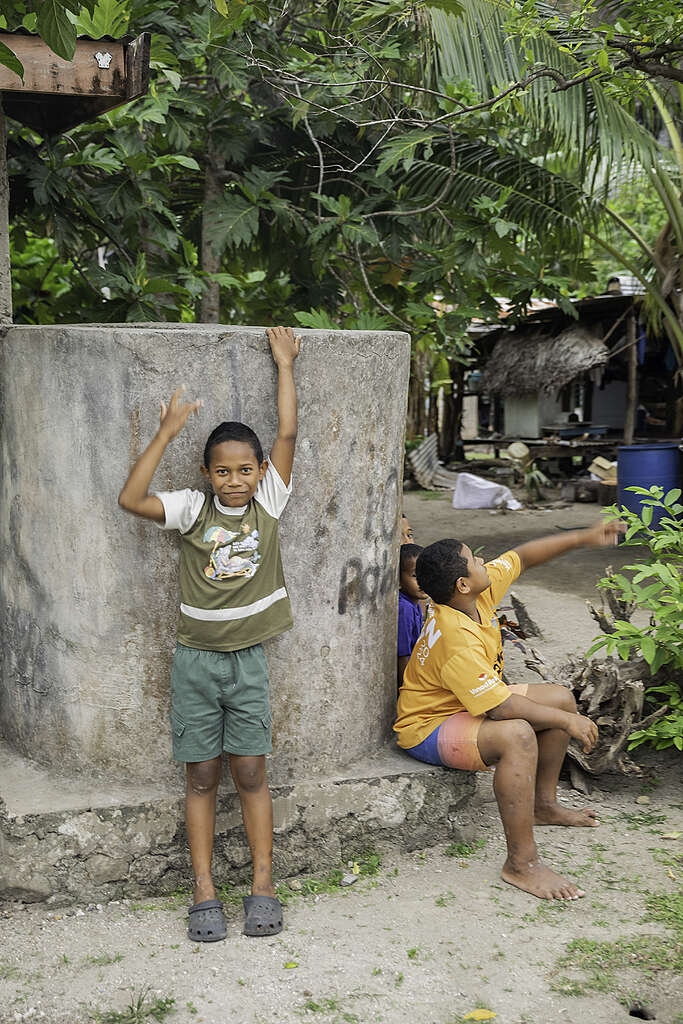
The island of Kioa is home to a Tuvaluan community who migrated from their atoll of Vaitupu in the late 1940s. It is a land of warm hearts, big smiles, and deep cultural roots; a place where the sound of a conch still summons the island together, where islanders paddle out to fish in carved outrigger canoes, and healthy happy children walk barefoot to school.
Here, culture is life. Kioans live sustainably through their traditional knowledge and practices. The island is alive with song, dance and the rhythms of a life tied to the tides, the winds, and the seasons.
Facing the future
Greenpeace has been lucky to have a relationship with Kioa for a number of years now, and we are continually learning from this remarkable community.
Last week, as part of our Voyaging Oceania project, we returned to the island. Our purpose was twofold —- to carry messages from the island to leaders gathering in Nadi this week for the Pacific Pre-COP, and to support the Kioa community in their efforts to improve water security for the island.
Unlike Tuvalu itself, with its eight atolls, Kioa is a mountainous, forested and richly fertile island. It will remain habitable far into the future. Kioans did not initially migrate from Vaitupu due to climate change, but the move was prophetic. They now have a lifeboat.
However, even Kioa faces challenges on our rapidly warming planet, in particular when it comes to water. Climate change is shifting once reliable rainfall patterns. On top of this, the island is already feeling the effect of this year’s intensifying El Niño event, which for Fiji means reduced rainfall and prolonged dry spells.
Right now, fresh water has to be carefully rationed, and is only available for a few hours a day. During last week’s visit aboard our campaigning ship Oceania, Greenpeace was privileged to work with the Kioa community on a new solar-powered water distribution project for the island.
Designed and led by the island, the project involves using a solar pump to move water from a reliable source to a storage tank and then using gravity to distribute the water around the village.
It was a lesson in how local knowledge and ingenuity can be the backbone of today’s climate solutions. To build a dam around the source, the local community knew the exact spot where they could gather gravel at low tide to mix with the cement. They took only what was needed, knowing that all resources must be carefully conserved. Kioa has no roads and no machinery, and it was an all-of-island effort to carry the materials up to the project site, including many heavy bags of sand and rock.
Such projects truly bring to life the vision of a resilient, locally-led, fossil fuel free Pacific.