

Welcome to Carbon Brief’s China Briefing.
China Briefing handpicks and explains the most important climate and energy stories from China over the past fortnight. Subscribe for free here.
Key developments
100% tariffs imposed on Chinese EVs following climate envoy meetings
FIRST MEETING: The recently appointed Chinese and US climate envoys Liu Zhenmin and John Podesta met in Washington last week with an aim to build on the “Sunnylands statement” that had restored engagement between presidents Xi Jinping and Joe Biden at their summit last year, the Hong Kong-based South China Morning Post reported. At the meeting, Podesta raised issues with Liu including “Chinese overcapacity in solar and battery manufacturing, steel production and coal power”, according to Reuters, adding that “the tone of the talks continued to be cordial”. State-run newspaper China Youth Daily reported comments from Chinese foreign ministry spokesperson Wang Wenbin saying that the US “expresses willingness to strengthen cooperation with China in addressing climate change”.
100% TARIFFS: Just after Liu’s US visit concluded, Biden announced significant new tariffs on a range of Chinese imports, reported Bloomberg. The outlet quoted Biden saying: “When you [China] make tactics like this, you’re not competing, it’s not competition, it’s cheating. And we’ve seen damage here in America.” According to a breakdown published by Reuters, tariffs on Chinese electric vehicles (EVs) will quadruple to 100% (plus a separate 2.5% tariff), while solar cell tariffs will double to 50%, lithium-ion EV battery tariffs will increase from 7.5% to 25% and tariffs on critical minerals rise from nothing to 25% this year.
MEDIA REACTION: New York Times’ columnist Paul Krugman supported the increased tariffs, saying: “Why not just buy cheap Chinese batteries? Political economy…The Biden administration was able to get large subsidies for renewable energy only by tying those subsidies to the creation of domestic manufacturing jobs. If those subsidies are seen as creating jobs in China instead, our last, best hope of avoiding climate catastrophe will be lost.” However, another New York Times’ comment article by economists Gernot Wagner and Conor Walsh asked the US to not “slam the door on inexpensive Chinese electric vehicles”. Bloomberg columnist David Fickling commented that “Chinese clean tech is not the enemy”, adding “from all the talk of Chinese ‘overcapacity’ coming out of Washington, you might think that the problem of addressing climate change had already been solved…We’ll need all [western nations’] industrial might – plus that of China, and a whole host of countries besides – to get there.” An editorial in the Economist called the tariffs a “bad policy, worse leadership”, saying they “will bring underappreciated economic harms to America and the world”.
CHINA REACTION: The Chinese foreign minister Wang Yi said that the tariffs are the “most typical form of bullying in the world today”, adding “it shows that some people in the US have reached the point of losing their minds in order to maintain their unipolar hegemony”, Reuters reported. State-run newspaper China Daily quoted foreign ministry spokesperson Wang Wenbin saying that the US is “making double standards by justifying its own subsidies and exports, while accusing other countries’ subsidies and exports as ‘unfair’ and ‘overcapacity’”. State broadcaster CCTV reposted a statement by the Ministry of Commerce which says that the US move is “a clear example of political manipulation”.
State-backed media disputes US ‘overcapacity’ argument
PEOPLE’S DAILY: The Communist party-affiliated People’s Daily published comments under the nom-de-plume “Zhong Caiwen”, which is likely linked to the party’s Central Financial and Economic Affairs Commission, on 7, 8, 9, 10, 12 and 13 May about China’s manufacturing production capacity under the background of “the US trying its best to exaggerate the so-called ‘overcapacity’ of China’s new energy resources”. The articles claimed that the “overcapacity arguments are designed to ‘curb and suppress China’s superior industries’”, “ignore[ing] the benefits that Chinese products bring to global consumers”, while stressing the contributions China made to tackling climate change.
ECONOMIC DAILY: Meanwhile, state-run media outlets Xinhua, Guangming Daily and Economic Daily carried similar opinions. The Economic Daily, which according to its own introduction, plays an “important role for the communist party’s Central Committee and the State Council in guiding the public opinion towards economy”, ran the headline, “Refuting ‘the theory of overcapacity in new energy’”, on its 6 May frontpage and, “Refuting ‘the theory of overcapacity in new energy’ again”, on the frontpage of 13 May. The two articles argued that the rapid growth in China is “not blind expansion”, but is based on the “urgent need to reduce global carbon emissions” and that the US uses it as “an excuse for more trade barriers”.
DOMESTIC FACTORS: Founder of H&S Capital and former news editor of BBC News Chinese Howard Zhang told Carbon Brief that this “sudden media storm” came “at a time of rising discontent over economic downturn and huge youth unemployment [in China]”. He added that “these anti-West reports help to divert public opinions and reinforce the government’s conspiracy theory that the West, led by the US, is trying to ‘stop China from rising up’ and is trying to ‘choke China off’”. Zhang acknowledged that China “does have a point”, but added it was “worth noting that these reports do not really report on Western concerns objectively and these reports are still mainly targeting the domestic audience”.
INTERNATIONAL OUTLOOK: Isabel Hilton, founder of London-based NGO Dialogue Earth (formerly China Dialogue) told Carbon Brief that the reason behind China arguing its “predominance in key industrial areas was not the result of unfair subsidies”, but because “it is unlikely that either the EU or the US will allow important industrial sectors to be undermined in what they see as unfair completion, with all the political and economic damage that would follow. Hence, the Chinese need to argue that it is not unfair.” Hilton, a visiting professor at King’s College London, added that a key point made by the Chinese media commentary was “China’s model of industrial development is no different from that of Western industrialised countries and that, further, they obey WTO rules and do not restrict or protect their own market…we can debate quite a lot of this, especially the market access point”.
Xi rebuts overcapacity and endorses climate cooperation during visiting Europe
OVERCAPACITY TENSIONS: On 5 May, president Xi commenced a five-day visit to Europe, which he began by meeting French president Emmanuel Macron and European Commission president Ursula von der Leyen, Agence France-Presse reported. The newswire quoted von der Leyen saying the EU “cannot absorb massive over-production of Chinese industrial goods”. In comments covered by the People’s Daily, Xi responded that “there is no such thing as ‘China’s overcapacity problem’”. Meanwhile, China and France signed the “Sino-French joint declaration on strengthening cooperation on biodiversity and the oceans: Kunming-Montreal to Nice”, to deepen cooperation on biodiversity protection, People’s Daily reported.
PRE-READ: Le Figaro published an article by Xi ahead of his arrival in France, in which he noted that Sino-French cooperation “spearheaded cooperation in aviation and nuclear energy”. He added: “Our two countries can deepen cooperation on innovation and jointly promote green development…The Chinese government supports more Chinese companies in investing in France. And we hope that France will ensure that they operate in a fair and equitable business environment.” State newswire Xinhua published an official English translation of the piece.
OTHER COUNTRIES: Meanwhile, Xi also visited Serbia and Hungary, where the South China Morning Post said he “upgraded relations with China’s two closest allies in Europe”. German chancellor Olaf Scholz did not meet Xi in person, but told journalists at a press conference that there are “many overlaps” between China and western automotive manufacturers, Reuters reported. State-run outlet Reference News quoted the German federal minister for digital affairs and transport saying “we don’t want to close off markets” to Chinese EVs.
EU SOLAR PROBE: Following the EU’s launching of a probe into Chinese solar companies last month, Longi and Shanghai Electric withdrew tenders to supply a Romanian solar park in “the latest sign that the EU’s new anti-subsidy powers are having a deterrent effect” on companies suspected of receiving Chinese subsidies, the Financial Times said. It quoted the EU internal markets commissioner saying the regulation ensures “foreign companies which participate in the European economy do so by abiding [by] our rules”.
China’s low-carbon energy boost
NEW DATA: China’s state broadcaster CCTV reported that China’s electricity generation from wind and solar increased 25% year-on-year in the first quarter of 2024. In the same period, electricity generated from coal declined. According to data from National Energy Administration (NEA), the total solar capacity in the first quarter of 2024 reached 45.7 gigawatts (GW), China Energy Net reported. In addition, China’s low-carbon electricity capacity will be enlarged with the State Council approving the construction of a 2GW offshore solar project at Lianyungang city, economic newswire Jiemian reports. Once being constructed, it will connect with eight existing nuclear power plants and become a 10GW “mega” renewable energy project, added the outlet.
NEW RESEARCH: A new paper covered by Carbon Brief found that China’s rising electricity demand can be met more cheaply through a combination of solar plus battery storage than by building new coal capacity. Carbon Brief also covered a study by the China Energy Transformation Program, a project under China’s Energy Research Institute, that finds electrification, greater energy efficiency and a low-carbon power system could help China develop a net-zero emissions energy system by 2055, five years earlier than its “dual carbon” goal planned.
Spotlight
Interview: China’s renewables ‘pave the way to rapidly reduce coal reliance’
A new report by Australia-based thinktank Climate Energy Finance argues that China could reach its “dual carbon” climate goals earlier than planned.
Carbon Brief interviews the author of the report to find out more. The questions and their answers are edited for length and clarity. The whole interview is available on Carbon Brief’s website.
Carbon Brief: Your report concluded that China’s coal power output will soon peak and decline – despite rising coal capacity – thanks to the rapid rise of clean energy sources. How widely do you think that potential tipping point is understood, both within China and internationally?
Xuyang Dong: This potential is not being understood or acknowledged enough both within China and internationally. China is prioritising energy security over the need to reduce coal-use…Concurrently, China is increasing renewable energy capacity at a staggering pace that far outstrips every other nation on the planet.
Internationally, news headlines continue to emphasise that China is building new coal-fired power plants, leading to a lack of confidence about China’s commitment to decarbonising its national electricity grid…However, the picture is more positive when we look at installed capacity. At the end of March this year, 53% of China’s installed capacity was zero-emissions.
CB: If China is to announce more ambitious climate goals and expand renewable energy like you suggested in the report, in your opinion, what are the barriers?
XD: We are aware there are concerns over China’s land use as a major constraint for building more wind and solar farms. We have run a case study on a 1.5GW solar project being built in the Tengger Desert in Ningxia Province. The project has 3.5 million solar modules installed, and only took up 0.1% of the total desert. In our model, we estimate that China needs to install a total of 5,405GW of new solar capacity to reach its dual-carbon targets and that may require only 11% of a total land area of the Gobi Desert, a neighbouring desert to Tengger.
The real challenge is that… more transmission lines are needed to maximise the renewable energy generation potential of China’s desert areas, and to resolve China’s land use constraints in the east coast.
CB: What do you think about policy support?
XD: I think being more ambitious in the overall climate target would be a good start… Considering its political system is “top-down”, a more ambitious target could help the central government to give out more mandates, build better transmission lines and distribute the generated power into the areas that are needed.
Internationally, China needs to align with other developed countries to take its responsibilities as the leading renewable superpower, and the carbon price would be an important policy lever… A further driver would be for other nations to also catch up with China’s staggering renewable expansion, and start to emulate its speed and scale, so there will be no excuse left for China to do less.
CB: What do you think about China’s “new three” – solar, batteries and EV – and how they help China in energy transition and economy?
XD: The “new three” has played a very huge part in China’s economic growth [in 2023]…I know there are a lot of concerns about this overcapacity in the industry, such as in the EU and the US, and I think for China to address the concerns over industrial overcapacity, it needs to, first, stimulate domestic demand and deployment of solar and wind farms, energy storage systems buildout and EV sales. Secondly, China could use its cheap renewable exports to help emerging markets and developing economies to build more renewable energy capacity, boosting and accelerating the global energy transition. Finally, it should be collaborating on joint ventures with European and US investors to build local factories.
Watch, read, listen
ENVIRONMENT ‘SPY’: The South China Morning Post reported that China’s top spy agency claimed two foreign NGOs and foundations had stolen “environmental data” from China.
FLOODING AI: A new artificial intelligence (AI) model was developed by Chinese scientists to forecast flood risks and monitor hydrological conditions even in basins lacking hydrological records, another South China Morning Post article reported.
NEA COMMENT: The Communist party-affiliated magazine Current Affairs Report published an article written by the head of China’s National Energy Administration (NEA), Zhang Jianhua, about “high-quality development of new energy”.
G7’S STRATEGIES: EU-China environmental cooperation specialist Arvea Marieni wrote a comment on G7’s climate strategies for China’s state broadcaster CGTN.

In April 2024, nearly half of cars sold in China were electric vehicles (EVs) or plug-in hybrids (PHEVs), which are known collectively as “new-energy vehicles” (NEVs). According to figures from the China Passenger Car Association (CPCA), NEVs made up 44% of sales in April, up from 34% a year earlier and just 4% during the same month in 2020.
New science
Impact of flowering temperature on lychee yield under climate change: a case study in Taiwan
Climate Services
A decline in the number of cooler days as a result of climate change could make existing varieties of lychee “unsuitable for cultivation in production areas in southern Taiwan”, a new study says. With some lychee farmers in Taiwan already experiencing economic losses as the climate warms, the researchers project a decline in lychee yields per hectare of 12-35% by the end of the century.
China Briefing is compiled by Wanyuan Song and Anika Patel. It is edited by Wanyuan Song and Dr Simon Evans. Please send tips and feedback to china@carbonbrief.org

The post China Briefing 16 May 2024: Biden’s 100% tariffs on Chinese EV; State media pushback; Xi’s Europe trip appeared first on Carbon Brief.

Three countries have been named by the Paris Agreement’s compliance committee for failing to submit a nationally determined contribution (NDC) and repeatedly snubbing offers of help with their climate plans.
After months of internal debate over whether to identify serial non-responders, the Paris Agreement’s Implementation and Compliance Committee (PAICC) named the three countries which have failed to engage with it over their NDCs on Friday.
It named Democratic Republic of Congo, Senegal and North Korea in a footnote of its annual report, adding that it decided to name them “with a view to facilitating engagement”, adding that representatives of the three nations had been invited to its meeting in early 2027 “with the purpose of identifying any challenges and constraints”.
“The Committee noted the importance of Parties engaging with the Committee in a timely manner, while noting that some delays may be due to the national capabilities and circumstances of the Parties”, the report said.
-
Under US pressure, World Bank says it will back gas “where appropriate”
The US wants the World Bank to expand its gas support while climate campaigners are pushing for it to end – its head spoke this week of limited backing for the fossil fuel -
IPCC scientists vow to press on with climate reports despite political deadlock
After governments again failed to agree a timeline, nearly 120 IPCC authors pledged to complete their assessment on time and with full scientific rigour -
Paris Agreement committee snubbed over missing NDC climate plans
Many governments have still not submitted a nationally determined contribution to the UN, breaching a key requirement of the Paris Agreement

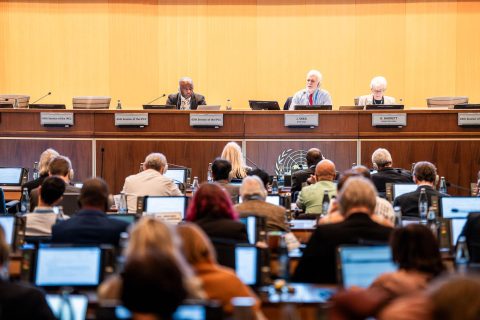

In July, PAICC said 12 countries had ignored its repeated attempts to discuss why they had not published an NDC as required every five years under the 2015 Paris accord.
Members of the committee had been divided over whether to name them, but at a September meeting decided to do so in their annual report to the annual climate COP summit.
By the time the report was published on Friday, only Congo, Senegal and North Korea “had not communicated an NDC or submitted a [Biennial Transparency Report] and had not yet responded to any of the Committee’s notifications, despite several reminders issued by the Committee in this regard”.
Rainforest and renewable energy ambitions
The silence from Congo and Senegal is notable because the former is home to much of the Congo Basin rainforest while the latter has sought billions of dollars in climate finance to support its renewable energy ambitions.
After Brazil, Congo has more rainforest than any country in the world. This forest, and the country’s peatlands, absorb huge amounts of greenhouse gas but are fast being lost to expanding farmland, charcoal production, logging and mining.
Senegal signed a Just Energy Transition Partnership with Canada and wealthy European nations in 2023, to help it meet its renewable energy targets under the-then government of Macky Sall. It was chair of the Least Developed Countries group between January 2022 and December 2023.

Tejas Rao, who is researching the PAICC as part of a doctoral thesis at Cambridge University, said the governments of the three countries should engage with the committee.
“Engagement costs these governments very little and the committee has shown it will listen,” he said.
“Silence leaves the committee with no basis to help, and it leaves the [governments] exposed to the narrative that they are simply disengaged,” he told Climate Home News.
Paris Agreement requirement
The 2015 Paris Agreement requires all parties to publish an NDC every five years outlining their emissions reduction targets, with each plan meant to be more ambitious than the country’s last NDC.
The latest set – the third round of plans, with new targets for 2035 – was due in February 2025. While most countries missed this deadline, all but around 30 – mostly small emitters but including Egypt, Vietnam and Argentina – have now submitted them.
Over the year, the PAICC – which is made up of government climate officials from developed and developing countries – has been communicating with governments that have not submitted NDCs and trying to overcome barriers to them doing so.
Some nations have cited exceptional circumstances as the reason for not submitting an NDC, a process that requires a significant amount of work in tracking emissions and consulting on how to curb them across the economy. For example, a letter from a Sudanese official to the PAICC, seen by Climate Home News, said that the country’s civil war had led to the suspension of its NDC preparation.
-
IPCC scientists vow to press on with climate reports despite political deadlock
After governments again failed to agree a timeline, nearly 120 IPCC authors pledged to complete their assessment on time and with full scientific rigour