

Sunsets are like blazing bonfires guiding us towards darkness – whether we’re ready or not.
Dodging chaotic shade thrown jaggedly like daggers, I constantly rebuilt myself like a phoenix in the midst of smoldering midnight melancholy. The swirling backroads of Virginia’s majestic mountains both tore apart and transformed my identity, teaching me early on that transformation is unavoidable. Essentially, my climate has always been changing.
Despite its magnificent beauty, Forge Road (also known as Route 608) has always been quilted with lies, broken promises, and deception. Isolated and forgotten, older generations have sometimes referred to it as God’s landscape. It’s more like a concrete pathway to hell. In the past few decades, steadfast gentrification has blanketed the hillside, forcing farmers whose livelihoods depended on the land to completely rebuild from the bottom again. For miles, pastures were emptied and fields were plowed for the last time to make way for cumbersome suburban castles, their gates still spiking up into the sun’s raging horizon like needles in my eyes. The whittling away of those gorgeous hills once spotted with grazing cattle has covered hundreds of acres in gaudy communities. As a result, this manifested a cataclysmic split that echoed my perpetual pain. Forced tranquility seamlessly manipulated thru-travelers from denser populations as they searched for a paradise less paved.
But at five years old, I couldn’t yet tell the difference. I would have still called it an oasis.
Commonly known by locals as a racetrack for rednecks and rebels in southern Rockbridge County, Virginia, commuters typically travel Forge Road as an alternative route between Buena Vista (BV) and Glasgow. Until I was four years old, we lived in a trailer park in BV, but my mom feared my sister and I would be labeled as “trailer trash” when we started kindergarten. So, we left our well-insulated bedrooms for a drafty and cramped two-bedroom cottage at least 20 minutes from any of the neighboring towns: Buena Vista (population: 6k), Glasgow (population: 1k), and Lexington (population: 7k). My dad grew up in Lexington and Granny Elsie, his mother, maintained their family homeplace for decades. Despite the distance, Granny visited us as often as she could and helped us settle into our new home.
My mom was raised in Roanoke, the largest city in our part of Virginia. She would often tell us stories about how she’d watched farmland get sold and paved over to build a mall, parking lots, and other buildings. Joni Mitchell said it best: they’d paved paradise. But I never imagined anything like that would happen to us.
It was the summer of 1995. I had just moved into the tucked-away countryside with my mom, dad, and younger sister Sarah. Our new house, a 1930s farmette, was being freshly painted in a coat of ivory by my mom and Granny.
“Come quick!” I shrieked as the majestic fireball fiercely burned in the distance. Terrified, my Granny Elsie came running.
“What’s wrong, my dear?” she inquired, convinced of danger.
“Look,” I whispered and pointed at the screaming sky. After a moment, Granny’s face softened into a gentle smile. Wrapping our arms around each other, we fixed our gaze on the vibrant neon pink and burnt orange horizon.
I may not have been in any physical harm at that moment, but Granny saved me that day.
From that day on, it became vital for me to not only admire the world’s natural beauty, but to advocate for its existence. Years down the road, we’d sip her freshly brewed Southernly sweet tea and reflect on that evening while playing cards. Granny taught me that life is full of challenges, but she also showed me how to embrace the internalized rhythm of the natural world that pulses through my heart, spirit, and soul. For years to come, we spent countless hours celebrating our joyful adoration of the outdoors no matter the season.
Later on, Dad mirrored this sentiment. He had reluctantly left our family in 1997, but we reconnected when I was an adult. “No matter how you say it, it’s going to be a song,” he told me as we improvised a myriad of funky tunes (me on piano and vocals and him on bass or drums). And he was right.
My parents met in a rock band. Mom taught music, and Dad was a self-employed rockstar, so music was a non-negotiable part of our life. I often felt out of place around my peers. “Most likely to dig through the trash and recycle” was my so-called unofficial superlative, but it was true. In my bright stripes and funky hair, I punked my way through school, focusing more on how to save the planet than myself. I realize now those two go hand in hand.
When I was younger, I spent hours reading under the willow tree, swimming in Buffalo Creek, or writing furiously in a composition notebook. I’d wave and grin from the backseat in my mom’s car at old farmers on their rusty tractors. But, sheltered from modern culture, my sister and I also became socially awkward and immensely lonely. We spent most of our time exploring the natural world and I perfected hopping barbed wire fences and walking past grazing cows. Avoiding patties and thorny vines with finesse, we frequently hiked to Buffalo Creek to wade into the gently flowing water.
For my sister and I, our daily life over the years was a performance, and we were not allowed to opt out of that mindset under our mom’s watch. We were constantly putting on a show, from parades and summer theater performances to those infamous beauty pageants. Traveling to these much more densely populated locations allowed us spotty exposure to blissful modern culture, only to return reluctantly (and often begrudgingly) to our isolated home.
We had no well or city water, only an outdated cistern. It wasn’t potable, so we refilled jugs from Food Lion. When it was time to shower, we stood in tubs to collect gray water, then used it to flush (otherwise, we left the yellow to mellow). Mom would not let us keep the heat over 65 degrees in winter because of the price of propane, so I learned at a young age that fossil fuels were not sustainable. Our household’s avid reusing, reducing, and recycling led me to being intensely mindful of my habits and routines.
Our house was built on top of what used to be Mount Lydia Church. Formerly a place of worship for slaves, it transformed in later years into our homeplace. Located just down the road was Bunker Hill Mill, a plantation built on Buffalo Creek over 200 years before I learned to swim in it. And in our front yard, down the hill, is an overgrown cemetery. I would spend hours there quietly reflecting amidst the sunken, unlabeled graves. It often felt like more of a refuge than my dysfunctional home life.

Warning: this paragraph contains mention of abuse. If you find this content upsetting or disturbing, please skip ahead to the following paragraph. Like a frog in boiling water, the abuse began slowly. No one could hear the desperate screams as the cruelty intensified, nor did anyone seem to care. Like melting ice caps, I barely recognized what was happening until it was a prevalent part of who I had become: damaged. After multiple failed attempts to advocate for myself, I became overwhelmed with hopelessness. I wanted to experience what I naively believed was real: a safe world where I mattered. Stress and screams preoccupied my mind. As the violence continued to escalate, I became extremely anxious. Wandering into the woods became the only way for me to process the horrendous intensity at home. Whenever it was finally over or I found a way out, I exited however I could. Often it was through my bedroom window.
Countless nights, I slinked into the plutonium night where the ebony sky would sparkle above me. In school, I learned about constellations like Orion, Casseopoia, and the North Star from local Native American tribes such as the Monacans. I would lay outside for hours letting my imagination run away with ideas about what else existed outside of my painful reality. As I ventured down to Bunker Hill, tiptoeing carefully along fragile riparian buffers of the shimmering creek, I burrowed deeper into my mind looking for solace from the trauma and poverty that engulfed my life. In these moments, the dense shadows of piney woodland allowed me to gradually tap back into the present. I didn’t realize it then, but I had discovered a way to heal myself.
It was around this time that I first noticed the farmland shrinking away. Before long, several beloved pastures and fields were replaced with endless rows of suburban mansions. It was a stark contrast to my life in poverty. Agricultural fatigue had infected my neighborhood, and I stopped seeing as many tractors puckering down Forge Road. The myriad of rolling hills eroded into posh cul-de-sacs. New classmates on our bus made fun of my sister and I constantly for our secondhand clothing. As a result, I developed a problem with stealing in a desperate effort to fit in and feel normal.
Eventually, I began to accept my identity by embracing my passion for nature. I had been one of the first to attend a field trip to Boxerwood Nature Center, a local nonprofit that ran environmental education opportunities for young students. For the first time, I learned about the impacts of water pollution on the Chesapeake Bay. Boxerwood created an opportunity that changed my life forever, one that led me to discovering what my purpose was: to help make the planet a better place.
Ultimately, school became my safe zone. In high school, I started significantly investigating climate change. At 16, I completed a governor’s school summer program about issues affecting the Chesapeake Bay. My senior independent project “Conservation for a Better World” included organizing a solo litter pickup along Buffalo Creek. I even proudly sang a recycle rap on Earth Day with my sister to advocate for waste conservation.
Basically, I set my eyes on a career path that related to helping the environment and climate change. In the process, I slowly started learning how to take better care of myself, too. It wasn’t until decades later during adulthood that I finally learned that I didn’t have to always perform. On the contrary, I could advocate authentically for both myself and my world.
My Granny understood more than anyone else. She helped when she could. “You don’t like to let grass grow under your feet,” she later remarked with a chuckle about my road-runner lifestyle. As I matured, I spent incalculable numbers of miles driving all over tarnation, as she likes to say. Meanwhile, my mom and sister faded out of my world.

Eventually I started to live with Granny in Lexington. So many times rather than staying home with her, I’d say, “Granny, I need to get out.” I’d drive down to the Maury River to spend a few hours basking in the sun or wading away from the world. But what was I darting away from, anyway? Why didn’t I stay in one place more often? I later figured it out: my untreated mental health struggles (CPTSD, depression, anxiety, ADHD) were slowly poisoning me inside, so the whole time I was trying to run away from myself. Perhaps it wasn’t about letting the grass grow under my feet after all, but planting a garden to pollinate my future.
Granny’s incessant loyalty is and will always be as rare as a hopeful blue jewel. With her soft, calming eyes, she would watch me with the most honest admiration I have ever seen. From an observant young girl to a reckless teenager, I was a rose that grew from the cracked backroads of my broken childhood. Granny never stopped being my hero, showing up when I needed rides to appointments more times than I can count. Later, she would arrive with barely an inquisition when I needed to be picked up at night in dubious neighborhoods after a slew of poor choices. I grappled with my mental health for decades and it took a long time to get help that worked. Years of complex trauma eventually led to severe impulsivity and self-induced escapism.
Agricultural fatigue is a lot like compassion fatigue. I cared so much, so deeply, for so long, about the world around me as I simultaneously watched it crumble. Disheartened, I wanted someone to care about me like that too. In a way, my battles with not ever seeming to be able to get away from putting out fires in my life’s conveyor belt of relentlessly abrasive friction were a lot like the world today in perpetual crisis with the climate. Just like Greta, I sometimes felt like I was drowning in stress. I tiptoed around others and stopped advocating for myself for too long. But, my experiences also taught me grit.
Once I found the strength to get up again, my survival instincts brought me to develop a sense of agency for compassionate activism.
In this way, justice became a rainbow of healing in the warm sky that wrapped around me like a blanket. By focusing on who I can and have become rather than the obstacles that hindered me, I found a way to genuinely improve the sustainability of my own life and my impact on the global community. With newfound hope, I now know that I will survive if I choose love and peace.
Eventually, I moved away and started college. I studied Sociology and English (ELA), served my country as a Peace Corps Volunteer in Moldova, then established my career as an educator. I returned to academia a few years later and got my Master’s in Education (M.Ed.) with a focus in nature-based learning (NBL) in order to amplify my global impact. To this day, my pedagogy revolves around advocating and communicating for evidence-based practices and environmental education (EE). Not only that, but I have embraced my musicianship by performing on various instruments at local venues and composing albums with my father.
Ultimately, my experiences healing my trauma through nature have revealed that if I don’t share what’s important and how I need help, people won’t care or know why it matters to be supportive. Especially in rural areas like mine where mental health resources are often scarce, I have had to play an active role that took more than resilience; it took determination and self-control alongside pain, grief, and despair.
As I have watched my climate change around me, I see now that I too am the damaged wilderness on a mountain of chaos.
Like a tree branching out towards sunlight, I am continuing to reach towards brighter moments despite my twisted roots. It’s as if those pathways of agony and revolution are symbolically identical. As if without struggle, I could not have grown, nor healed alongside the transformations happening across the globe without repairing the damages present in my own environments.
In this way, my crisis and rebirth are the same. Like a phoenix, I’ve learned how to release and revitalize, then let go and fly, reaching up to rip down the barriers that have kept me apart from my needs and goals ahead. Despite being stigmatized, I’ve transformed and am taking back control, adding back what I wish to gain so I can find fresh clarity. May I continue to evolve. May my optimized self forgive my former selves who didn’t have the skills or knowledge to do so. And, may my past selves be forever proud of who I’ve become today. Growing up on chaos mountain taught me to sing my heart out. Like my dad once said, “It doesn’t matter how you say it. To me, it’s going to be a song.” And I will not be silenced.
As I move into my 33rd year on this planet, I see clearly how interconnected my mental health is with the natural world. This interconnection has taught me both why and how to actively stop climate change, as well as how to be more mindful of what I already have rather than be wasteful or inefficient. My dedication to global justice is an essential part of my wild, incorrigible spirit. Returning to Buffalo Creek whenever I can is a necessity for my mental health due to its deeply embedded sacrality in my soul. An essential part of my spirituality is optimized every time I lead myself down the hidden metal stairs with the loosely tied rope to keep me stable.
As I dip my toes in the clear fresh water, I am reminded of how brief our lives really are. Like the water, I keep moving forward, rejuvenated and empowered by the ecosystem to protect nature. Although depression and trauma still penetrate elements of my world, I’ve allowed my transformation to fuel my fire to fight for the future of our planet. My childhood escapism, which once led to a myriad of crises, eventually allowed me to find myself. I am just visiting this planet briefly, a small speck in time, but I’m still here. And the creek still flows.
Namaste.

Katrina Broughman (pronounced “Bruff-man”), a rural native from Rockbridge County, Virginia (VA), has a background in nonprofit leadership, networking/outreach, fundraising, and both English language Arts and environmental education and is an active changemaker in her communities. Katrina currently teaches in Amherst County, holds a B.A. ‘13 in English and Sociology with an emphasis in the environment from Mary Baldwin College (MBU), received her M.Ed.-EBL from MBU with additional M.A. (Sociology) coursework from Morehead State University (KY) in 2021, and has been a certified Virginia Master Naturalist with the Central Blue Ridge Chapter in Lovingston since 2018.
The post Chaos Mountain appeared first on Climate Generation.

Continue Reading
Three countries have been named by the Paris Agreement’s compliance committee for failing to submit a nationally determined contribution (NDC) and repeatedly snubbing offers of help with their climate plans.
After months of internal debate over whether to identify serial non-responders, the Paris Agreement’s Implementation and Compliance Committee (PAICC) named the three countries which have failed to engage with it over their NDCs on Friday.
It named Democratic Republic of Congo, Senegal and North Korea in a footnote of its annual report, adding that it decided to name them “with a view to facilitating engagement”, adding that representatives of the three nations had been invited to its meeting in early 2027 “with the purpose of identifying any challenges and constraints”.
“The Committee noted the importance of Parties engaging with the Committee in a timely manner, while noting that some delays may be due to the national capabilities and circumstances of the Parties”, the report said.
-
Under US pressure, World Bank says it will back gas “where appropriate”
The US wants the World Bank to expand its gas support while climate campaigners are pushing for it to end – its head spoke this week of limited backing for the fossil fuel -
IPCC scientists vow to press on with climate reports despite political deadlock
After governments again failed to agree a timeline, nearly 120 IPCC authors pledged to complete their assessment on time and with full scientific rigour -
Paris Agreement committee snubbed over missing NDC climate plans
Many governments have still not submitted a nationally determined contribution to the UN, breaching a key requirement of the Paris Agreement

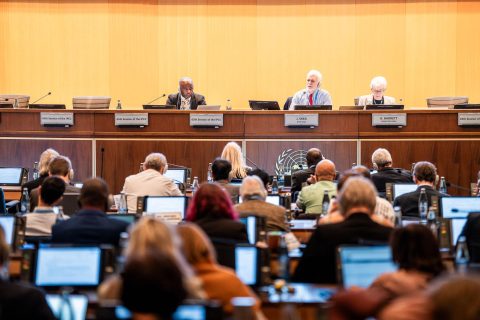

In July, PAICC said 12 countries had ignored its repeated attempts to discuss why they had not published an NDC as required every five years under the 2015 Paris accord.
Members of the committee had been divided over whether to name them, but at a September meeting decided to do so in their annual report to the annual climate COP summit.
By the time the report was published on Friday, only Congo, Senegal and North Korea “had not communicated an NDC or submitted a [Biennial Transparency Report] and had not yet responded to any of the Committee’s notifications, despite several reminders issued by the Committee in this regard”.
Rainforest and renewable energy ambitions
The silence from Congo and Senegal is notable because the former is home to much of the Congo Basin rainforest while the latter has sought billions of dollars in climate finance to support its renewable energy ambitions.
After Brazil, Congo has more rainforest than any country in the world. This forest, and the country’s peatlands, absorb huge amounts of greenhouse gas but are fast being lost to expanding farmland, charcoal production, logging and mining.
Senegal signed a Just Energy Transition Partnership with Canada and wealthy European nations in 2023, to help it meet its renewable energy targets under the-then government of Macky Sall. It was chair of the Least Developed Countries group between January 2022 and December 2023.

Tejas Rao, who is researching the PAICC as part of a doctoral thesis at Cambridge University, said the governments of the three countries should engage with the committee.
“Engagement costs these governments very little and the committee has shown it will listen,” he said.
“Silence leaves the committee with no basis to help, and it leaves the [governments] exposed to the narrative that they are simply disengaged,” he told Climate Home News.
Paris Agreement requirement
The 2015 Paris Agreement requires all parties to publish an NDC every five years outlining their emissions reduction targets, with each plan meant to be more ambitious than the country’s last NDC.
The latest set – the third round of plans, with new targets for 2035 – was due in February 2025. While most countries missed this deadline, all but around 30 – mostly small emitters but including Egypt, Vietnam and Argentina – have now submitted them.
Over the year, the PAICC – which is made up of government climate officials from developed and developing countries – has been communicating with governments that have not submitted NDCs and trying to overcome barriers to them doing so.
Some nations have cited exceptional circumstances as the reason for not submitting an NDC, a process that requires a significant amount of work in tracking emissions and consulting on how to curb them across the economy. For example, a letter from a Sudanese official to the PAICC, seen by Climate Home News, said that the country’s civil war had led to the suspension of its NDC preparation.
-
IPCC scientists vow to press on with climate reports despite political deadlock
After governments again failed to agree a timeline, nearly 120 IPCC authors pledged to complete their assessment on time and with full scientific rigour -
Under US pressure, World Bank says it will back gas “where appropriate”
The US wants the World Bank to expand its gas support while climate campaigners are pushing for it to end – its head spoke this week of limited backing for the fossil fuel -
Who shapes climate science? The equity question facing the IPCC
Early completion of the next global climate science assessment reports risks excluding research from the Global South, which is key to ensuring the findings are fair
The US and Iran are not signed up to the Paris Agreement and so do not have active NDCs, nor does Taiwan, which is not a UN member state.
Rao said that because the PAICC is “facilitative and non-punitive”, naming the countries “is meant to open a door, not close one – the invited consultation is the point”.
“In recent months, governments that explained their constraints, whether capacity, finance or domestic process, have been met with follow-up and support rather than sanction, and the number of silent governments has fallen sharply,” Rao said.
The post Paris Agreement committee names three countries snubbing it over NDCs appeared first on Climate Home News.
Paris Agreement committee names three countries snubbing it over NDCs