

The “cost” of cutting UK emissions to net-zero is less than the cost of a single fossil-fuel price shock, according to a new report from the Climate Change Committee (CCC).
Moreover, a net-zero economy would be almost completely protected from fossil-fuel price spikes in the future, says the government’s climate advisory body.
The report is being published amid surging oil and gas prices after the US and Israel attacked Iran, which has triggered chaos on international energy markets.
It builds on the CCC’s earlier advice on the seventh “carbon budget”, which found that it would cost the UK less than 0.2% of GDP per year to reach its net-zero target.
In the new report, the CCC sets out for the first time a full cost-benefit analysis of the UK’s net-zero target, including the cost of clean-energy investments, lower fossil-fuel bills, the health benefits of cleaner air and the avoided climate damages from cutting emissions.
It finds that the country’s legally binding target to reach “net-zero emissions” by 2050 will bring benefits worth an average of £110bn per year to the UK from 2025-2050, with a total “net present value” of £1,580bn.
The CCC states that its new report responds to requests from parliamentarians and government officials seeking to better understand its cost assumptions, amid the ongoing cost-of-living crisis in the UK.
The report also pushes back on “misinformation” about the cost of net-zero, with CCC chair Nigel Topping saying in a statement that it is “important that decision-makers and commentators are using accurate information to inform debates”.
Co-benefits outweigh costs
The CCC’s new report is the first to compare the overall cost of decarbonising with the wider benefits of avoiding dangerous climate change, as well as other “co-benefits”, such as cleaner air and healthier diets.
It sets the CCC’s previous estimate of the net cost of net-zero – some £4bn per year on average out to 2050 – against the value of avoided damages and other co-benefits.
These “co-benefits” are estimated to provide £2bn to £8bn per year in net benefit by the middle of the century, according to the report.
The CCC notes that this approach allowed it to “fully appraise the value of the net-zero transition”.
It concludes that the net benefits of reaching net-zero emissions by 2050 are an average of £110bn per year from 2025 to 2050.
These benefits to the UK amount to more than £1.5tn in total and start to outweigh costs as soon as 2029, says the CCC, as shown in the figure below.
In addition, the CCC says that every pound spent on net-zero will bring benefits worth 2.2-4.1 times as much.
This updated analysis includes the value of benefits from improved air quality being 20% higher in 2050 than previously suggested by the CCC.
However, the “most significant” benefit of the transition is the avoidance of climate damages, with an estimated value of £40-130bn in 2050. The report states:
“Climate change is here, now. Until the world reaches net-zero CO2 [carbon dioxide] emissions, with deep reductions in other greenhouse gases, global temperatures will continue to rise. That will inevitably lead to increasingly extreme weather, including in the UK.”
The CCC’s conclusion is in line with findings from the Office for Budget Responsibility (OBR) in 2025, which suggested that the economic damages of unmitigated climate change would be far more severe than the cost of reaching net-zero.
The CCC notes that its approach to the cost-benefit analysis of the net-zero target is in line with the Treasury’s “green book”, which is used to guide the valuation of policy choices across UK government.
It says that one of the key drivers of overall economic benefit is a more efficient energy system, with losses halved compared with today’s economy.
It says that the UK currently loses £60bn a year through energy waste. For example, it says nearly half of the energy in gas is lost during combustion to generate electricity.
In a net-zero energy system, such energy waste would be halved to £30bn per year, says the CCC, thanks to electrified solutions, such as electric vehicles (EVs) and heat pumps.
For example, it notes that EVs are around four times more efficient than a typical petrol car and so require roughly a quarter of the energy to travel a given distance.
Collectively, these efficiencies are expected to halve energy losses, saving the equivalent of around £1,000 per household, according to the CCC.
Net-zero protects against price spikes
The CCC tests its seventh carbon budget analysis against a range of “sensitivities” that reflect the uncertainties in modelling methodologies and assumptions for key technologies. This includes testing the impact of a fossil-fuel price spike between now and 2050.
In the original analysis, the committee had assumed that the cost of fossil fuels would remain largely flat after 2030.
However, the report notes that, in reality, fossil-fuel prices are “highly volatile”. It adds:
“Fossil-fuel prices are…driven by international commodity markets that can fluctuate sharply in response to geopolitical events, supply constraints, and global demand shifts. A system that relies heavily on fossil fuels is, therefore, exposed to significant price shocks and heightened risk to energy security.”
It draws on previous OBR modelling of the impact of a gas price spike. This suggested that future price spikes would cost the UK government between 2-3% of GDP in each year the spike occurs, assuming similar levels of support to households and businesses as was provided in 2022-23.
The CCC adapts this approach to test a gas-price spike during the seventh carbon budget period, which runs from 2038 to 2042.
It finds that, if a similar energy crisis occurred in 2040 and no further action had been taken to cut UK emissions, then average household energy bills would increase by 59%. In contrast, bills would only rise by 4%, if the UK was on the path to net-zero by 2050.
The committee says that when considering the impact on households, businesses and the government, a single fossil-fuel price shock of this nature would cost the country more than the total estimated cost of reaching.
The finding is particularly relevant in the context of rising oil and gas prices following conflict in the Middle East, which has prompted some politicians and commentators to call for the UK to slow down its efforts to cut emissions.
In his statement, Topping said that it was “more important than ever for the UK to move away from being reliant on volatile foreign fossil fuels, to clean, domestic, less wasteful energy”.
Angharad Hopkinson, political campaigner for Greenpeace UK, welcomed this finding, saying in a statement:
“Each time this happens it gets harder and harder to swallow the cost. The best thing the UK can do for the climate is also the best thing for the cost of living crisis – get off the uncontrollable oil and gas rollercoaster that drags us into wars we didn’t want but still have to pay for. Inaction on climate is unaffordable.”
Benefits remain even if key technologies are more expensive
In addition to testing the impact of more volatile fossil-fuel prices, the CCC also tests the implications if key low-carbon technologies are cheaper – or more expensive – than thought.
It concludes that the upfront investments in net-zero yield significant overall benefits under all of the “sensitivities” it tested. As such, it offers a rebuttal to the common narrative that net-zero will cost the UK trillions of pounds.
The net cost of net-zero comes out at between 0% and 0.5% of GDP between 2025 and 2050, says the CCC, under the various sensitivities it tested.
“This sensitivity analysis shows that an electrified energy system is both a more efficient and a more secure energy system,” adds the CCC.
Finally, the report takes into account the costs of the alternative to net-zero. It looks at what would need to be spent in an economy where net-zero was not pursued any further.
The CCC says that the gross system cost of the balanced pathway falls below the baseline cost from 2041, which is consistent with its previous seventh carbon budget advice.
As shown in the chart below, costs fall under a net-zero pathway between 2025 to 2050, whereas they rise in the baseline of no further action.
Moreover, the total costs of the alternatives are broadly similar, with the relatively small difference shown by the solid line.
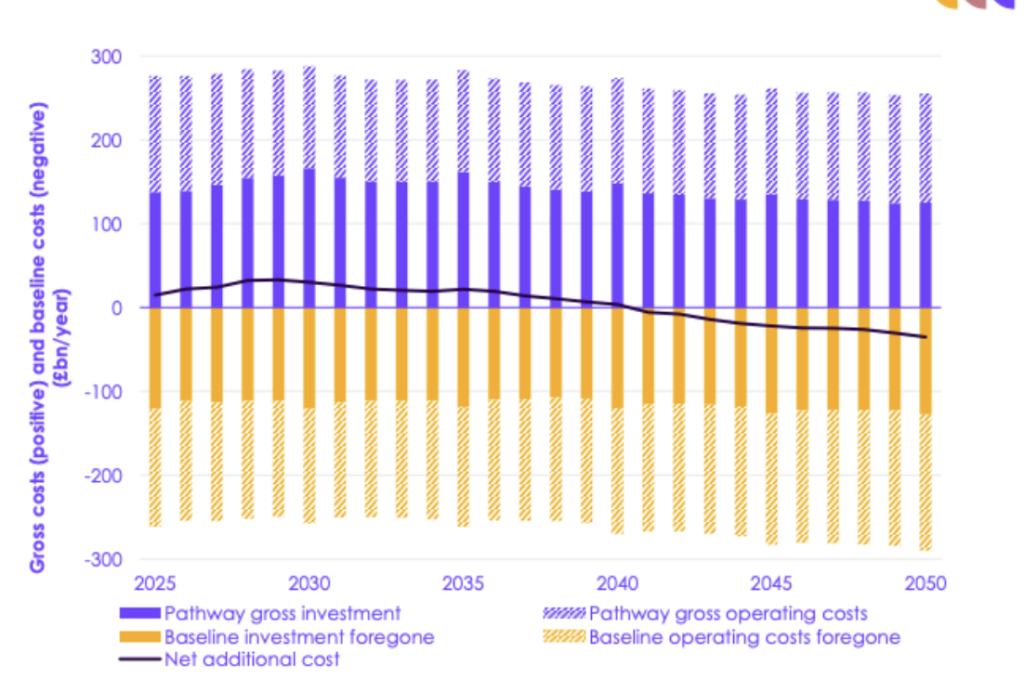
The decline in energy system costs shown in the figure above is broadly driven by more efficient low-carbon technologies, says the CCC, helping costs to fall from 12% of GDP today to 7% by the middle of the century.
The CCC’s new analysis comes ahead of the UK parliament voting on and legislating for the seventh carbon budget, which it must do before 30 June 2026.



The post CCC: Net-zero will protect UK from fossil-fuel price shocks appeared first on Carbon Brief.

The conference is one of the largest aimed at preparing for hurricane season, which begins June 1. A task force report on potential reforms to the agency also remains on hold.
ORLANDO, Fla.—A major conference to help communities prepare for hurricane season kicked off Monday without the agency that coordinates federal disaster response.
Right now, Greenpeace activists are standing up to Big Gas at a major gas conference in Sydney.
Inside the Sheraton Grand Hotel, executives from fossil fuel companies have gathered alongside lobbyists, investors and political allies to plan the future of gas in Australia – and how to maximise their profits.
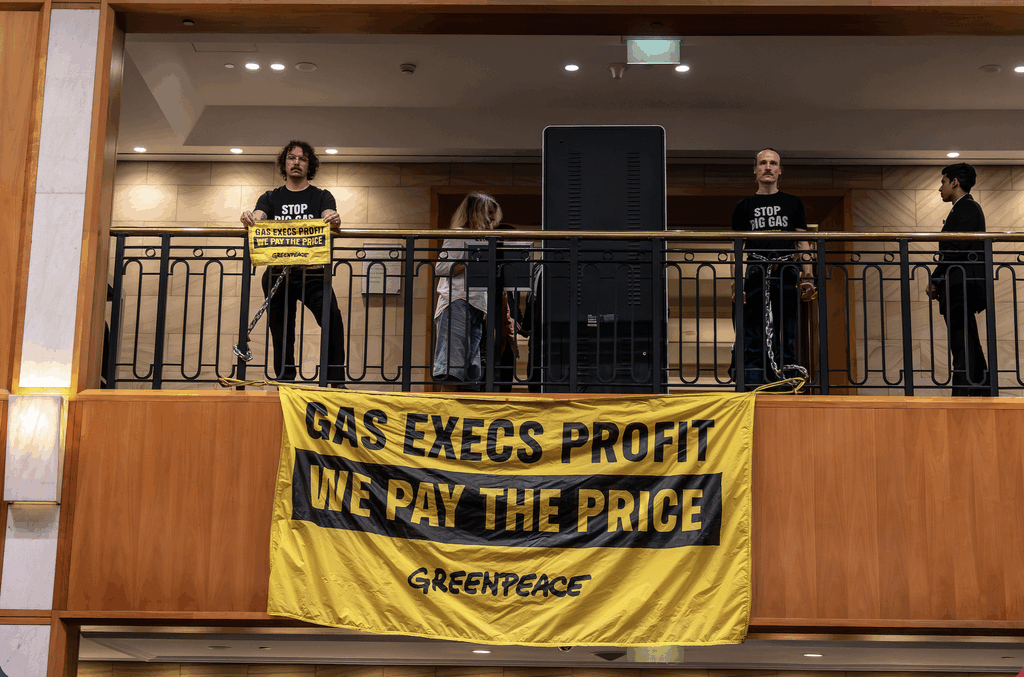
So Greenpeace has stepped in to call it out. Activists have dropped a banner inside the venue with a clear message: Gas Execs Profit. We Pay The Price.
We need your help to spread the message that we won’t stand by and let this happen.
What’s really going on
Gas corporations are making billions in windfall profits from global conflicts – from Ukraine to Iran – while Australians pay the price with higher energy bills and climate damage.
And they want more.
More drilling. More exports. More profit.
Why Greenpeace took action today
This conference is where it all comes together. Behind closed doors, gas executives, lobbyists, investors and political allies are meeting to push for more gas expansion, no doubt using global instability as their justification.
That’s why Greenpeace couldn’t let this gathering go uninterrupted.
Big Gas is counting on people not paying attention. Let’s prove them wrong.
Share the video to call out Big Gas.
What needs to happen now
Gas is expensive. It’s volatile. And it ties our energy system to global instability.
But there is a better way. Renewable energy is already cheaper, more reliable, and made right here in Australia. It’s the fastest path to lower bills, real energy security and a safer climate.
To get there, we need to:
- properly tax the gas industry and its exports
- stop expanding gas
- and speed up the transition to homegrown renewable energy.
Share this video far and wide to show just how much support there is to tax Big Gas properly and speed up the transition to renewable energy.
This is just the beginning
This action is part of a growing movement to stand up to Big Gas and challenge the power it holds over our government and society. The Federal Government has a role to play – starting by taxing gas corporations properly and then accelerating the transition to homegrown renewable energy.
Together, we can show just how much support there is for change and make it impossible for decision-makers to ignore.
What you can do
- Follow along on our social channels.
- Share the video far and wide to show how much support there is.
- Sign the petition to tell Albo to stand up to Big Gas – because if we can, he can.
BREAKING: Greenpeace activists disrupt major gas conference in Sydney
SYDNEY, Tuesday 31 March 2026 — Two Greenpeace Australia Pacific activists have been arrested following a peaceful protest at the Australian Domestic Gas Outlook conference in Sydney, where they dropped a banner that said — “Gas Execs Profit. We Pay The Price” and held banners saying “Tax Gas Profits”.
Photos and B Roll video of the protest and arrests are available here
Live updates on Greenpeace Instagram
The two activists were arrested by police around 9:00am AEDT and taken to Day Street Police Station. Information on this morning’s gas conference disruption can be found here.
Solaye Snider, Campaigner at Greenpeace Australia Pacific, said: “Greenpeace activists have taken a strong stand today against profit hungry gas corporations and lobbyists, who see horrific global wars as an opportunity to price gouge and profiteer, while everyday people pay the price.
“Australians have had enough of gas corporations like Santos and ConocoPhillips ripping us off, leaving us with nothing but empty pockets and climate damage. The gas industry is aggressively lobbying against being fairly taxed and pushing to drill for more gas. Change requires showing up and speaking out, and that’s what these activists have done today.
“Greenpeace Australia Pacific stands by our activists, and stands with all communities who are peacefully fighting for a safe and clean energy future. The right to peaceful protest is a fundamental pillar of a healthy democracy and a basic right of all Australians.”
-ENDS-
Media contacts:
Lucy Keller: +61 491 135 308 or lkeller@greenpeace.org or Kate O’Callaghan: +61 406 231 892 or kate.ocallaghan@greenpeace.org
Greenpeace activists arrested after disrupting major gas conference in Sydney



-
Climate Change8 months ago
Guest post: Why China is still building new coal – and when it might stop
-
Greenhouse Gases8 months ago
Guest post: Why China is still building new coal – and when it might stop
-

 Greenhouse Gases2 years ago
嘉宾来稿:满足中国增长的用电需求 光伏加储能“比新建煤电更实惠”
-
Climate Change2 years ago
Bill Discounting Climate Change in Florida’s Energy Policy Awaits DeSantis’ Approval
-

 Climate Change2 years ago
嘉宾来稿:满足中国增长的用电需求 光伏加储能“比新建煤电更实惠”
-
Climate Change Videos2 years ago
The toxic gas flares fuelling Nigeria’s climate change – BBC News
-

 Renewable Energy5 months ago
Sending Progressive Philanthropist George Soros to Prison?
-

 Carbon Footprint2 years ago
US SEC’s Climate Disclosure Rules Spur Renewed Interest in Carbon Credits