

Canadians chose Mark Carney, a former central banker and UN climate envoy who leads the ruling Liberal Party, as their prime minister in Monday’s election, rejecting the anti-climate action Conservative Party of Pierre Poilievre.
The election result means that the climate policies of the world’s 12th-biggest emitter will be broadly unchanged, as the Liberals – under Justin Trudeau and now Carney – have governed the North American nation since 2015. At the time of publication, it was still unclear whether the centre-left party had won a majority of seats in Canada’s parliament.
Poilievre’s Conservative Party had promised to scrap climate polices like a carbon tax on industry and to boost oil and gas production and exports.
Meghan Fandrich, who survived a devastating wildfire driven by climate change in her village of Lytton, said there was “some comfort in knowing that Canada has rejected the Conservative leader – someone who voted against climate policies over 400 times, planned to accelerate fossil fuel production, and whose platform would have driven emissions higher, fuelling even more climate disasters”.
Canada’s new leader culls carbon tax seen as burden on voters
A Carbon Brief analysis suggests that a Conservative victory would have led to a rise in Canada’s emissions, whereas a Liberal government would keep emissions falling – although not fast enough to meet its own climate targets.
Trump drives Carney comeback
Climate change did not play a major role in the election, particularly as Carney scrapped an unpopular carbon tax on consumers soon after taking over from Trudeau in March.
Polls had suggested that the Conservatives were on course for a huge victory until January, when Trudeau resigned and US President Donald Trump charged big tariffs on Canadian exports and threatened to annex the country, causing many voters to back Carney over Poilievre, who is more ideologically aligned with Trump.

Carney is an ex-banker with a long history of climate action. As governor of the Bank of England, he called on investors to take their money out of fossil fuel companies.
After leaving the bank, he promoted carbon offsets through the Taskforce on Scaling Voluntary Carbon Markets and helped launch a coalition of financial institutions trying to reduce emissions called the Glasgow Financial Alliance for Net Zero.
Ana Toni, the Brazilian CEO of this year’s COP30 UN climate summit, said it was “very positive to have Mark Carney who has a deep knowledge of climate change and economics at the helm in Canada, and knows that the best path ahead is through the energy transition”.
After Trudeau announced in January that he would resign, Carney won the Liberal Party contest to take over from him as prime minister in March and has now won a general election, giving him a mandate to rule the country for up to four years.
Pick a lane on energy
Caroline Brouillette, head of Climate Action Network Canada, said Carney now had the chance to prove his climate credentials as Canada’s leader: “With the election over, Prime Minister Carney has the opportunity to practice what he has preached for years, and kickstart a green transformation that will build our country’s resilience for decades to come.”
But, she said, that means “picking a lane with regard to energy: no more flirting with fossil fuel expansion and new pipelines, which would come with staggering costs to our wallets and our planet”.
Trump throws lifeline to Canadian deep-sea miner, setting scene for international clash
Under pressure from Conservatives labelling him “Carbon Tax Carney”, the prime minister scrapped the controversial tax on consumers – which had been his party’s signature climate policy since 2019 – this March.
The tax, which a March poll showed two-thirds of Canadians wanted to get rid of, was paid by some drivers filling up their cars with gasoline or diesel and by people buying heating oil for their homes.
Carney said he would replace the tax with measures to retrofit homes for energy efficiency and install heat pumps, saying the changes “will make a difference to hard-pressed Canadians” and “ensure that we fight against climate change”.
Carbon tax on industry stays
But he did maintain the carbon price on big industries, which the Conservatives had promised to scrap. Analysis from the Canadian Climate Institute suggested that, while the consumer carbon price grabbed the headlines, the industrial price was expected to drive three times more emissions reductions by 2030.
At energy security talks, US pushes gas and derides renewables
Carney’s election manifesto also promises to boost electric vehicle production and use, as well as infrastructure to transmit electricity across the country and carbon removal and storage technology.
The Conservative manifesto pledged to “unleash Canadian resources”, by scrapping the emissions cap on oil and gas production, enabling construction of gas export terminals on Canada’s west coast and approving oil exports from Arctic ports.
Canada this year holds the G7 presidency and will host a leaders summit for the group of big, wealthy countries in the oil-rich province of Alberta in June.
Harjeet Singh, director of the Satat Sampada Climate Foundation in India, said that, as the G7 chair, Carney “must summon the political courage to champion bold global climate action – starting at home by rejecting new oil and gas projects and urging other G7 nations to dramatically scale up public climate finance to support developing countries in deploying renewable energy and addressing escalating climate impacts”.
The post Canada votes to keep Carney as leader, over anti-climate Conservatives appeared first on Climate Home News.
Canada votes to keep Carney as leader, over anti-climate Conservatives

The conference is one of the largest aimed at preparing for hurricane season, which begins June 1. A task force report on potential reforms to the agency also remains on hold.
ORLANDO, Fla.—A major conference to help communities prepare for hurricane season kicked off Monday without the agency that coordinates federal disaster response.
Right now, Greenpeace activists are standing up to Big Gas at a major gas conference in Sydney.
Inside the Sheraton Grand Hotel, executives from fossil fuel companies have gathered alongside lobbyists, investors and political allies to plan the future of gas in Australia – and how to maximise their profits.
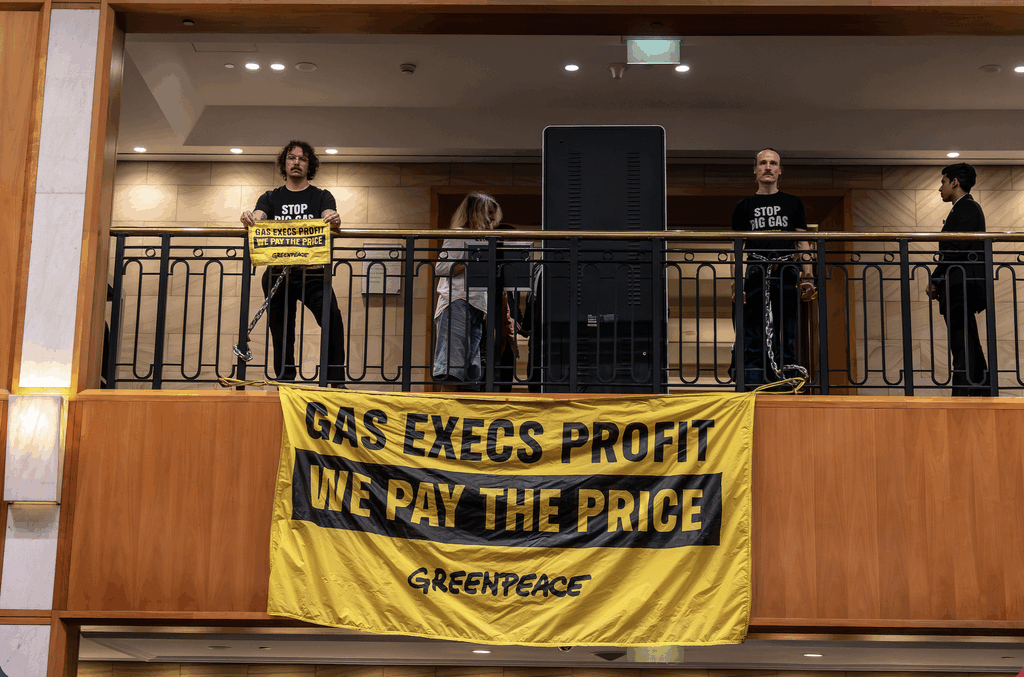
So Greenpeace has stepped in to call it out. Activists have dropped a banner inside the venue with a clear message: Gas Execs Profit. We Pay The Price.
We need your help to spread the message that we won’t stand by and let this happen.
What’s really going on
Gas corporations are making billions in windfall profits from global conflicts – from Ukraine to Iran – while Australians pay the price with higher energy bills and climate damage.
And they want more.
More drilling. More exports. More profit.
Why Greenpeace took action today
This conference is where it all comes together. Behind closed doors, gas executives, lobbyists, investors and political allies are meeting to push for more gas expansion, no doubt using global instability as their justification.
That’s why Greenpeace couldn’t let this gathering go uninterrupted.
Big Gas is counting on people not paying attention. Let’s prove them wrong.
Share the video to call out Big Gas.
What needs to happen now
Gas is expensive. It’s volatile. And it ties our energy system to global instability.
But there is a better way. Renewable energy is already cheaper, more reliable, and made right here in Australia. It’s the fastest path to lower bills, real energy security and a safer climate.
To get there, we need to:
- properly tax the gas industry and its exports
- stop expanding gas
- and speed up the transition to homegrown renewable energy.
Share this video far and wide to show just how much support there is to tax Big Gas properly and speed up the transition to renewable energy.
This is just the beginning
This action is part of a growing movement to stand up to Big Gas and challenge the power it holds over our government and society. The Federal Government has a role to play – starting by taxing gas corporations properly and then accelerating the transition to homegrown renewable energy.
Together, we can show just how much support there is for change and make it impossible for decision-makers to ignore.
What you can do
- Follow along on our social channels.
- Share the video far and wide to show how much support there is.
- Sign the petition to tell Albo to stand up to Big Gas – because if we can, he can.
BREAKING: Greenpeace activists disrupt major gas conference in Sydney
SYDNEY, Tuesday 31 March 2026 — Two Greenpeace Australia Pacific activists have been arrested following a peaceful protest at the Australian Domestic Gas Outlook conference in Sydney, where they dropped a banner that said — “Gas Execs Profit. We Pay The Price” and held banners saying “Tax Gas Profits”.
Photos and B Roll video of the protest and arrests are available here
Live updates on Greenpeace Instagram
The two activists were arrested by police around 9:00am AEDT and taken to Day Street Police Station. Information on this morning’s gas conference disruption can be found here.
Solaye Snider, Campaigner at Greenpeace Australia Pacific, said: “Greenpeace activists have taken a strong stand today against profit hungry gas corporations and lobbyists, who see horrific global wars as an opportunity to price gouge and profiteer, while everyday people pay the price.
“Australians have had enough of gas corporations like Santos and ConocoPhillips ripping us off, leaving us with nothing but empty pockets and climate damage. The gas industry is aggressively lobbying against being fairly taxed and pushing to drill for more gas. Change requires showing up and speaking out, and that’s what these activists have done today.
“Greenpeace Australia Pacific stands by our activists, and stands with all communities who are peacefully fighting for a safe and clean energy future. The right to peaceful protest is a fundamental pillar of a healthy democracy and a basic right of all Australians.”
-ENDS-
Media contacts:
Lucy Keller: +61 491 135 308 or lkeller@greenpeace.org or Kate O’Callaghan: +61 406 231 892 or kate.ocallaghan@greenpeace.org
Greenpeace activists arrested after disrupting major gas conference in Sydney



-
Climate Change8 months ago
Guest post: Why China is still building new coal – and when it might stop
-
Greenhouse Gases8 months ago
Guest post: Why China is still building new coal – and when it might stop
-

 Greenhouse Gases2 years ago
嘉宾来稿:满足中国增长的用电需求 光伏加储能“比新建煤电更实惠”
-
Climate Change2 years ago
Bill Discounting Climate Change in Florida’s Energy Policy Awaits DeSantis’ Approval
-

 Climate Change2 years ago
嘉宾来稿:满足中国增长的用电需求 光伏加储能“比新建煤电更实惠”
-
Climate Change Videos2 years ago
The toxic gas flares fuelling Nigeria’s climate change – BBC News
-

 Renewable Energy5 months ago
Sending Progressive Philanthropist George Soros to Prison?
-

 Carbon Footprint2 years ago
US SEC’s Climate Disclosure Rules Spur Renewed Interest in Carbon Credits