

As the rapid deployment of clean energy technologies fuels demand for their components, human rights abuses linked to the supply of critical minerals show no sign of letting up.
New data from a Transition Minerals Tracker compiled by the Business & Human Rights Resource Centre (BHRRC) shows that more than 630 allegations of human rights violations have been associated with minerals mining since 2010. Of those, 91 were made in the last year alone.
The tracker monitors human rights abuses associated with the extraction of seven minerals including copper, lithium and bauxite, which is new in this year’s update. These elements are essential for the production of solar panels, wind turbines, electric vehicles and electrification more broadly.
The latest BHRRC data points to widespread violations of Indigenous peoples’ rights – such as forced relocation, water pollution and denial of access to traditional land – as well as attacks on human rights defenders and workers’ rights abuses.
BHRRC also registered 53 allegations of work-related deaths since 2010, with 30 percent of those newly reported in 2023.
Supply chain FAQ: What you need to know about critical minerals
Caroline Avan, BHRRC’s head of natural resources and just transition, said the situation is not improving. “The sector is blatantly failing at protecting those who generate its profits, and this is only the tip of the iceberg,” she said.
“We are probably only capturing a fraction of abuses because we rely on public data and so many issues don’t get reported,” she added. The BHRRC gives companies an opportunity to respond to the allegations it documents.
Just ten companies are associated with more than half of all allegations registered since 2010 – including China Minmetals, Glencore, Grupo Mexico, First Quantum Minerals and Solway Group – while 46% of the total originated in South America.
Allegations of human rights abuses linked to transition minerals by category

Avan explained that many abuses follow a pattern that begins with environmental violations – such as water or soil pollution – compounded by inadequate consultation with local communities, which then leads to protracted conflict.
This has been the case at the Las Bambas copper mine in Peru, now owned by MMG Ltd, whose major shareholder is China Minmetals Corporation (CNC), and formerly controlled by Glencore. It received the most allegations of rights abuses not only in 2023, but across the tracker’s full 13-year monitoring period.
The mine’s infrastructure, activities and expansion plans have led to a series of social and environmental impacts, provoking protests and blockades by Indigenous communities. Most recently, last November, 1,500 workers went on strike to ask for a larger share of profits.
CNC, MMG and Las Bambas have not responded to the BHRCC over the reported allegations.
New global principles
The persistence of human rights abuses in mineral mining is set to attract more attention, with the International Energy Agency estimating that mineral demand for clean energy applications is set to grow by three and a half times by 2030.
The BHRRC’s report notes that the mining sector is under pressure from civil society, Indigenous peoples and global policymakers alike to strengthen human rights protections.
For example, the new EU Batteries Regulation, adopted last July, obliges end users of battery minerals to carry out thorough supply chain due diligence.
“We are seeing the automotive industry asking more of the upstream mining sector, and that is good news,” said Avan. “But we are not seeing enough from the renewable energy sector in terms of asking mineral suppliers to ensure their operations are not linked with abuses.”
Days after climate talks, US slaps tariffs on Chinese EVs and solar panels
Last month, UN Secretary-General Antonio Guterres launched a high-level Panel on Critical Energy Transition Minerals tasked with developing a set of global principles to “safeguard environmental and social standards and embed justice in the energy transition”.
Guterres said supply chains must be “managed properly” to ensure that developing countries get a fair share of benefits and that the environment and human rights are protected.
“Too often, production of these minerals leaves a toxic cloud in its wake: pollution; wounded communities, childhoods lost to labour and sometimes dying in their work. And developing countries and communities have not reaped the benefits of their production and trade,” the UN chief said in comments at the launch.
“This must change… The race to net zero cannot trample over the poor,” he added. The panel is expected to deliver initial recommendations ahead of the UN General Assembly in September.
In Nagorno-Karabakh, Azerbaijan’s net zero vision clashes with legacy of war
The BHRRC’s Avan told Climate Home it was “concerning that countries in the Global North are rushing to sign strategic partnerships with resource-rich countries in the Global South because they want to secure their mineral supply chains, but the companies who will be involved in delivering those minerals are not asked much in terms of requirements for human rights protections”.
For companies, recommendations from the centre’s new report include adopting human rights policies and giving affected communities access to the benefits and governance of projects.
Avan said government regulation and better business practices are essential “to ensure that the global energy transition is a just one, centred on respect for human rights, fair negotiations and shared prosperity”.
“The alternative is rising resistance, conflict, and distrust – all threatening to slow the pace of the transition,” she added.
(Reporting by Daisy Clague, editing by Megan Rowling)
The post Calls for responsible mining fail to stem rights abuses linked to transition minerals appeared first on Climate Home News.
Calls for responsible mining fail to stem rights abuses linked to transition minerals

The conference is one of the largest aimed at preparing for hurricane season, which begins June 1. A task force report on potential reforms to the agency also remains on hold.
ORLANDO, Fla.—A major conference to help communities prepare for hurricane season kicked off Monday without the agency that coordinates federal disaster response.
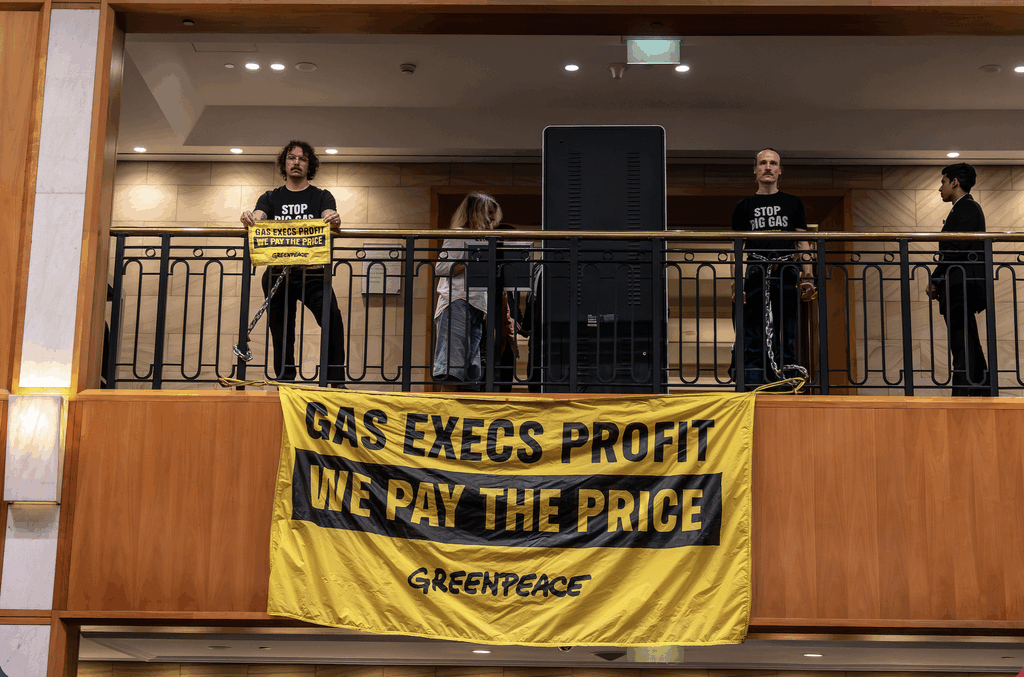
Right now, Greenpeace activists are standing up to Big Gas at a major gas conference in Sydney.
Inside the Sheraton Grand Hotel, executives from fossil fuel companies have gathered alongside lobbyists, investors and political allies to plan the future of gas in Australia – and how to maximise their profits.
So Greenpeace has stepped in to call it out. Activists have dropped a banner inside the venue with a clear message: Gas Execs Profit. We Pay The Price.
We need your help to spread the message that we won’t stand by and let this happen.
What’s really going on
Gas corporations are making billions in windfall profits from global conflicts – from Ukraine to Iran – while Australians pay the price with higher energy bills and climate damage.
And they want more.
More drilling. More exports. More profit.
Why Greenpeace took action today
This conference is where it all comes together. Behind closed doors, gas executives, lobbyists, investors and political allies are meeting to push for more gas expansion, no doubt using global instability as their justification.
That’s why Greenpeace couldn’t let this gathering go uninterrupted.
Big Gas is counting on people not paying attention. Let’s prove them wrong.
Share the video to call out Big Gas.
What needs to happen now
Gas is expensive. It’s volatile. And it ties our energy system to global instability.
But there is a better way. Renewable energy is already cheaper, more reliable, and made right here in Australia. It’s the fastest path to lower bills, real energy security and a safer climate.
To get there, we need to:
- properly tax the gas industry and its exports
- stop expanding gas
- and speed up the transition to homegrown renewable energy.
Share this video far and wide to show just how much support there is to tax Big Gas properly and speed up the transition to renewable energy.
This is just the beginning
This action is part of a growing movement to stand up to Big Gas and challenge the power it holds over our government and society. The Federal Government has a role to play – starting by taxing gas corporations properly and then accelerating the transition to homegrown renewable energy.
Together, we can show just how much support there is for change and make it impossible for decision-makers to ignore.
What you can do
- Follow along on our social channels.
- Share the video far and wide to show how much support there is.
- Sign the petition to tell Albo to stand up to Big Gas – because if we can, he can.
BREAKING: Greenpeace activists disrupt major gas conference in Sydney
SYDNEY, Tuesday 31 March 2026 — Two Greenpeace Australia Pacific activists have been arrested following a peaceful protest at the Australian Domestic Gas Outlook conference in Sydney, where they dropped a banner that said — “Gas Execs Profit. We Pay The Price” and held banners saying “Tax Gas Profits”.
Photos and B Roll video of the protest and arrests are available here
Live updates on Greenpeace Instagram
The two activists were arrested by police around 9:00am AEDT and taken to Day Street Police Station. Information on this morning’s gas conference disruption can be found here.
Solaye Snider, Campaigner at Greenpeace Australia Pacific, said: “Greenpeace activists have taken a strong stand today against profit hungry gas corporations and lobbyists, who see horrific global wars as an opportunity to price gouge and profiteer, while everyday people pay the price.
“Australians have had enough of gas corporations like Santos and ConocoPhillips ripping us off, leaving us with nothing but empty pockets and climate damage. The gas industry is aggressively lobbying against being fairly taxed and pushing to drill for more gas. Change requires showing up and speaking out, and that’s what these activists have done today.
“Greenpeace Australia Pacific stands by our activists, and stands with all communities who are peacefully fighting for a safe and clean energy future. The right to peaceful protest is a fundamental pillar of a healthy democracy and a basic right of all Australians.”
-ENDS-
Media contacts:
Lucy Keller: +61 491 135 308 or lkeller@greenpeace.org or Kate O’Callaghan: +61 406 231 892 or kate.ocallaghan@greenpeace.org
Greenpeace activists arrested after disrupting major gas conference in Sydney



-
Greenhouse Gases8 months ago
Guest post: Why China is still building new coal – and when it might stop
-
Climate Change8 months ago
Guest post: Why China is still building new coal – and when it might stop
-

 Greenhouse Gases2 years ago
嘉宾来稿:满足中国增长的用电需求 光伏加储能“比新建煤电更实惠”
-
Climate Change2 years ago
Bill Discounting Climate Change in Florida’s Energy Policy Awaits DeSantis’ Approval
-

 Climate Change2 years ago
嘉宾来稿:满足中国增长的用电需求 光伏加储能“比新建煤电更实惠”
-
Climate Change Videos2 years ago
The toxic gas flares fuelling Nigeria’s climate change – BBC News
-

 Renewable Energy5 months ago
Sending Progressive Philanthropist George Soros to Prison?
-

 Carbon Footprint2 years ago
US SEC’s Climate Disclosure Rules Spur Renewed Interest in Carbon Credits