

A major biodiversity fund – which could, in theory, generate billions of dollars annually for conservation – received its first donation of just $1,000 in November.
The Cali Fund was created under the UN Convention on Biological Diversity (CBD) at the COP16 nature negotiations in Cali, Colombia, last year.
On 19 November, nine months after the fund officially launched, UK start-up TierraViva AI put forward the first contribution.
The $1,000 payment is an “ice-breaker”, the company’s chief executive tells Carbon Brief, aimed at encouraging others “who may be hesitating” to pay in.
The fund is designed to be a way for companies that rely on nature’s genetic resources to share some of their earnings with the developing, biodiverse countries where many of the original resources are found.
Companies use genetic data from these materials to develop products, such as vaccines and skin cream.
One expert describes the $1,000 as a good “first step”, but says it is “time for larger actors to step forward”. Another says it “squarely points the finger to the profit-making enterprises that are not contributing”.
The CBD is “pleased” about the first payment, a spokesperson tells Carbon Brief, adding that “many discussions” are ongoing about future donations.
Funding biodiversity action
Companies all around the world use genetic materials from plants, animals, bacteria and fungi often found in biodiversity-rich, global south countries to develop their products.
There are existing rules in place to secure consent and ensure compensation if companies or researchers travel to a country to physically gather these materials.
Today, however, much of this information is available in online databases – with few rules in place around access. This genetic data is known as digital sequence information (DSI).
The Cali Fund is part of an effort to close this loophole.
The COP16 agreement on the creation of the fund outlined that large companies in several sectors, including pharmaceutical, cosmetic, biotechnology, agribusiness and technology, “should” contribute a cut of the money they earn from the use of these materials. (See: Carbon Brief’s infographic on DSI.)
The money is intended to fund biodiversity action, with 50% of resources going to Indigenous peoples and local communities who protect vast swathes of the world’s nature and biodiversity.
These contributions, however, are voluntary.
The fund officially launched at the resumed COP16 negotiations in Rome in February 2025, where a spokesperson for the CBD said that first contributions could be announced in spring.
However, Carbon Brief reported in August that the fund was still empty.
On 19 November, the first contribution was announced during the COP30 UN climate summit. At $1,000, the amount was significantly lower than the potential millions that larger companies could pay in.
A UK government press release described it as a “major milestone” that will “pav[e] the way for others to do the same and mobilise private sector finance for nature at scale”.
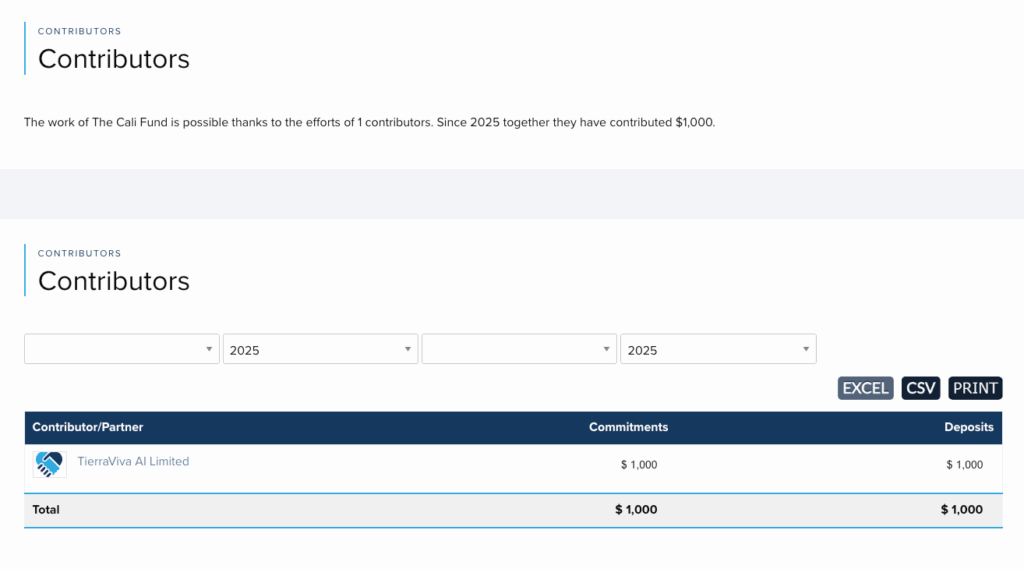
The payment was an “expression of our commitment to the objectives of the Cali Fund”, TierraViva AI chief executive Dr Paul Oldham wrote in a letter to the executive secretary of the CBD, Astrid Schomaker.
The $1,000 is an “initial contribution”, Oldham said, and the company plans to give more “as our business grows”. Based in the UK with a team of programmers in Nairobi, TierraViva AI was set up in 2023 and uses AI to support conservation.
An anthropologist who worked on Indigenous peoples’ rights in the Amazon, Oldham’s research helped inform the list of sectors most likely to “directly or indirectly benefit from the use of DSI”, including “generative biology” and AI companies.
Oldham noted in a speech at the sidelines of COP30 that although the company’s earnings are not large enough to meet the contribution thresholds set out in the Cali Fund agreement, its contribution showed that companies “of any size” can pay in.

He tells Carbon Brief that while “some” companies “are not serious about contributing and are seeking to delay” paying into the fund, others have different concerns, including the “need for a level playing field” and positive incentives to contribute:
“This will be hard-earned company money, so it’s reasonable enough to imagine that one of the first questions companies will want an answer to is: ‘well, what is this actually going to be spent on?’ And: ‘what is the benefit of this to us’, which is likely to vary by sector.
“In my view, the best way forward would be for companies that can to make contributions. That would give everybody, including governments, confidence that there might be constructive ways to address difficult topics.”
Future contributions
A spokesperson for the CBD tells Carbon Brief:
“We are pleased that the Cali Fund is not only ‘open for business’, but that this first contribution also demonstrates it is fully operational. We thank and congratulate TierraViva AI for being the first company to step up.”
“Many discussions” are ongoing around future donations to the fund, the spokesperson says, and the CBD is “hopeful that further announcements can be made soon”, ahead of the next UN biodiversity summit, COP17, in October 2026.
Asked whether the CBD was expecting more contributions at this stage, the spokesperson says the fund was set up in “very short order” and that the first payment shows that companies are “able to contribute”.
US biotechnology company Ginkgo Bioworks was the first to pledge to contribute to the fund earlier this year, but has so far not put forward any money. The company did not respond to Carbon Brief’s request for comment.
Carbon Brief reported earlier this year that at least two companies were contacted by a UK department with opportunities to be involved in the Cali Fund before its launch in February, but no company took up on the offer.
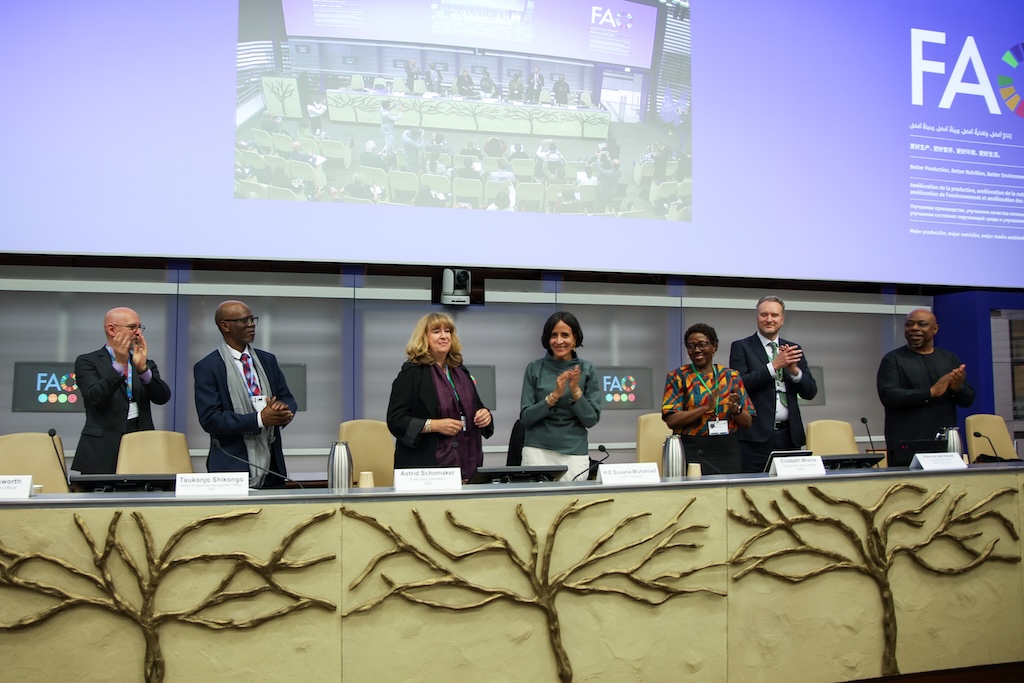
The first contribution coming from a “startup that has just begun operations squarely points the finger to the profit-making enterprises that are not contributing”, Dr Siva Thambisetty, associate professor of law at the London School of Economics, tells Carbon Brief. Thambisetty adds:
“Strident cries of lack of legal certainty, unfairness or stacking obligations [combining responsibilities from different agreements and laws] would be more credible if industry organisations encouraged large firms that use DSI to begin contributing, instead of denying the last 20 years of multilateral [negotiations] that have led to this point.”
Dr June Rubis – Indigenous peoples and local communities (IPLC) lead from Asia on the Cali Fund’s steering committee – welcomes TierraViva AI’s “first step”, but tells Carbon Brief that the “real test lies ahead” and that it is “now time for larger actors to step forward”.
She says the Cali Fund offers “clarity” on how the private sector can directly increase support to UN-backed funds at a time when “states are retreating” from their climate and biodiversity finance obligations:
“It’s not a voluntary offsetting scheme or a…risky or fringe fund; it’s a multilateral mechanism designed to meet the highest fiduciary and equity standards. We invite companies to see this not as philanthropy, but as participation in a globally endorsed system where trust is institutionalised, benefits are traceable and equity is operationalised.
“Contributing to the Cali Fund isn’t just ethical, it’s strategic. [But] It’s about more than funding: it’s about trust, power-sharing and making sure IPLCs are part of the decisions, not just the outcomes.”


The post ‘Cali Fund’ aiming to raise billions for nature receives first donation – of just $1,000 appeared first on Carbon Brief.
‘Cali Fund’ aiming to raise billions for nature receives first donation – of just $1,000

Climate Change
As Storms Pummel Hawaii, the Western U.S. Continues to Bake Amid Record-Breaking Heat Wave
Unusually high March temperatures are shattering records out West—and the heat wave isn’t over yet.
Communities across the Western United States are in for another week of unusually high temperatures amid an ongoing and historic early-season heat wave. It has broken March temperature records in nearly 180 cities, including Phoenix, which hit 105 degrees Fahrenheit last Thursday.
As Storms Pummel Hawaii, the Western U.S. Continues to Bake Amid Record-Breaking Heat Wave
At CERAWeek, Energy Secretary Chris Wright urges a patriotic surge in oil production, but industry titans warn that the U.S.-Iran war has fractured the global energy map beyond the reach of a quick fix.
Energy Secretary Chris Wright, a long-time apostle of fossil fuel expansion, issued a blunt directive to the world’s largest oil and gas producers on Monday: Produce more, and do it now.
White House’s ‘Drill Baby Drill’ Wartime Mandate Meets Volatile Market Reality
In recent years, the monsoon season in Pakistan has taken a new and dangerous turn.
July and August typically bring high levels of rainfall across the country, and while flooding isn’t uncommon, the extent and severity could be readily predicted.
These patterns have now changed. In 2022, extreme rainfall swept Pakistan and huge swathes of the country were under water. Sindh province experienced levels of rain 508% above average for the time of year.
Extreme weather in Pakistan is becoming the norm. The past 15 years have brought widespread flooding, loss of life and billions in financial costs. A post-disaster report, produced by the Pakistan Government, stated that the 2022 floods were “a wake-up call for systemic changes to address the underlying vulnerabilities to natural hazards”, citing the country’s lack of climate-resilient infrastructure.
But heavy rainfall is only one of the water-related issues that Pakistan faces. In a country with huge geographical diversity, from sweltering deserts to freezing mountain tops, the water stresses are equally as varied. In many regions the key concern is a lack of reliable, clean water that can be used to grow crops and feed families.
We must invest in early warning systems to tackle crises like Kenya’s drought
The risks of the Indus
The Indus River plays a critical role in Pakistan. This major artery travels almost the entire length of the country, an estimated 2,000 km, from the Himalayas to the Arabian Sea. It is a crucial economic lever, supporting nearly 90% of Pakistan’s food production and 25% of its overall GDP. What happens to this river – both human and natural impacts – has huge consequences for the rest of the country.
The government and civil society agree that urgent action is required to protect Pakistan’s fragile water resources. A new adaptation project – SAFER Pakistan – is seeking to address these concerns with solutions that can be used to solve similar climate-related issues elsewhere.
The US$ 10 million project is led by ICIMOD, an intergovernmental research centre, alongside UNICEF, and financed by the Adaptation Fund. The intention is to tackle six key issues that people face in the Indus Basin: cryosphere risks, drying springs, groundwater, pollution, unsustainable water use, and community resilience.
In practice this means exploring different solutions that put communities in control of their own adaptive capacity. One solution under development is the use of community early warning systems.
Pakistan’s ‘monster disaster’ brings climate compensation into focus
A warning sign
According to researchers, early warning systems “aim to empower affected communities against hazards and help them to sufficiently prepare before disasters strike.”
The northern provinces of Pakistan – Gilgit-Baltistan and Khyber Pakhtunkhwa – are the main focus for testing these systems. In this mountainous region the Indus is fed by thousands of glaciers which sustain water flow during the dry season. At the same time, increased temperatures and unpredictable weather patterns are changing how these glaciers behave, leading to avalanches, increased snowmelt, and landslides.
As glaciers start to melt due to climate change, they can form large lakes high up on the mountain that can pose a serious threat to the communities living below. When these natural dams fail, huge quantities of water come careening down the mountain, a phenomenon called glacial lake outburst flood.
The SAFER project is exploring how to use local knowledge and observations of the mountain to ensure people know how and when to evacuate when these outbursts occur. This human intelligence will be combined with data from remote sensors to save lives and livelihoods. In total, over 435,000 people will be impacted by the project.
“Early warning systems often serve as the backbone of a multi-faceted response to reduce climate disaster risk,” commented Mikko Ollikainen, head of the Adaptation Fund. “But local information is often just as valuable as the real-time data you receive from sensors or satellites,” he added.
Climate disasters challenge right to safe and adequate housing
Shaping an effective response
Community early warning systems – together with other preventive adaptation measures – are proving a popular solution to extreme weather events.
A separate adaptation project in the mountains of Central Asia is grappling with the same problem of glacial flooding. In this case, with US$6.5 million in funding from the Adaptation Fund, UNESCO has been implementing early warning systems across Kazakhstan, Kyrgyzstan, Tajikistan and Uzbekistan for the past five years, with considerable success.
Diana Aripkhanova, a project officer at UNESCO, and based in Kazakhstan, told Climate Home that glacier lake outburst floods “represent an increasing climate-related hazard across the high mountain regions of Central Asia”.
“These events can trigger destructive floods and debris flows that affect downstream communities, infrastructure, and livelihoods,” she added.
The project utilises real-time data drawn from weather monitoring stations with community preparedness to shape a fast and effective response to life-threatening flooding. This includes training people on evacuation routes, safe locations and simulation drills. In addition, the project has tried preventative measures such as planting hundreds of trees in valleys prone to landslides to provide greater stabilisation.
In total, four early warning systems have been installed across the four countries involved in the project covering seven high-risk areas. As a result, UNESCO estimates these systems are protecting over 100,000 people.
“Early warning systems are a key risk reduction measure, allowing communities to evacuate in time and reduce potential loss of life and damage to assets,” added Aripkhanova.
Community participation
The active role of each community is built into these interventions. Ensuring local people are core contributors is seen as crucial to building long-term climate resilience.
These communities are witnessing the threats from climate change materialise on a yearly basis, and researchers are now tapping into that understanding when implementing adaptation projects.
After the 2022 floods, Pakistan’s development minister, Ahsan Iqbal, wrote that “there is an opportunity to do things differently” and that “enhancing Pakistan’s resilience to shocks and stresses amidst climate change, especially for the poorest…is essential for the country’s future.”
The climate shocks remain as strong as ever, but using the right tools and simple solutions can soften the blow when they occur.
Adam Wentworth is a freelancer writer based in Brighton, UK
The post Early warning systems are saving lives in Central Asia appeared first on Climate Home News.

As Storms Pummel Hawaii, the Western U.S. Continues to Bake Amid Record-Breaking Heat Wave
White House’s ‘Drill Baby Drill’ Wartime Mandate Meets Volatile Market Reality
From Oversupply to Opportunity: AEMC’s Nickel Upside in a Tightening Market
-
Climate Change7 months ago
Guest post: Why China is still building new coal – and when it might stop
-
Greenhouse Gases7 months ago
Guest post: Why China is still building new coal – and when it might stop
-

 Greenhouse Gases2 years ago
嘉宾来稿:满足中国增长的用电需求 光伏加储能“比新建煤电更实惠”
-
Climate Change2 years ago
Bill Discounting Climate Change in Florida’s Energy Policy Awaits DeSantis’ Approval
-

 Climate Change2 years ago
嘉宾来稿:满足中国增长的用电需求 光伏加储能“比新建煤电更实惠”
-
Climate Change Videos2 years ago
The toxic gas flares fuelling Nigeria’s climate change – BBC News
-

 Carbon Footprint2 years ago
US SEC’s Climate Disclosure Rules Spur Renewed Interest in Carbon Credits
-

 Renewable Energy5 months ago
Sending Progressive Philanthropist George Soros to Prison?