

- Formal negotiations
- Finance
- Global review
- Global report
- Digital sequence information
- Harmful subsidies
- Marine biodiversity
- Planning, monitoring, reporting and review
- Article 8(j) implementation
- Biodiversity and climate change
- Links with other bodies
- Around the COP
- Armenian presidency
- Protests
- Lobbying and influence
- Carbon and biodiversity markets

In the face of accelerating climate change, policymakers and scientists are increasingly recognizing the value of Indigenous knowledge in developing effective climate strategies. This intersection of traditional wisdom and modern science represents a powerful approach to understanding and addressing environmental challenges. However, bridging these two knowledge systems is not without its complexities and challenges.
Understanding Indigenous Knowledge
Indigenous knowledge, also known as Traditional Ecological Knowledge (TEK), is a cumulative body of knowledge, practices, and beliefs about the relationship between living beings and their environment. This knowledge has been developed over millennia through direct contact with the natural world and passed down through generations.
Dr. Deborah McGregor, an Anishinaabe researcher and Associate Professor at York University, explains, “Indigenous knowledge is not just about understanding nature; it’s about understanding our place within it. It’s holistic, considering the interconnectedness of all things.”
The Strengths of Western Science
Western science, with its emphasis on empirical observation, measurement, and repeatability, has provided us with crucial insights into climate change. From tracking global temperature rises to modeling future climate scenarios, scientific research has been instrumental in identifying and quantifying the challenges we face.
The Power of Integration
Combining Indigenous knowledge with Western scientific approaches can lead to more comprehensive and effective climate policies. This integration brings several key benefits:
- Long-term Observational Data: Indigenous communities have been observing and adapting to environmental changes for thousands of years, providing valuable long-term data that can complement scientific records.
- Localized Knowledge: While Western science often focuses on broad patterns, Indigenous knowledge provides detailed, location-specific insights that are crucial for developing targeted adaptation strategies.
- Holistic Perspective: Indigenous worldviews often emphasize the interconnectedness of environmental, social, and cultural factors, encouraging more comprehensive policy approaches.
- Adaptive Management: Traditional practices often involve adaptive management techniques that can inform flexible, responsive climate policies.
Case Studies in Integration
The Arctic: Inuit Knowledge and Climate Science
In the rapidly changing Arctic, Inuit knowledge has proven invaluable in understanding and responding to climate impacts. The SmartICE program in Nunatsiavut, Labrador, exemplifies this integration.
Trevor Bell, the program’s founder, describes the approach: “SmartICE combines Inuit knowledge of sea ice with satellite data and in-situ sensors. This not only provides more accurate ice safety information but also validates and preserves traditional knowledge.”
Forest Management in British Columbia
In British Columbia, the integration of Indigenous fire management practices with modern forestry techniques is reshaping approaches to wildfire prevention and forest health.
Satnam Manhas, Forest Ecologist with the Heiltsuk Integrated Resource Management Department, shares, “By incorporating traditional burning practices into our forest management plans, we’re not just reducing wildfire risk; we’re also promoting biodiversity and forest resilience in ways that purely scientific approaches might miss.”
Challenges in Integration
While the benefits of integrating Indigenous knowledge and Western science are clear, significant challenges remain:
- Power Dynamics: Historical and ongoing colonial structures often privilege Western scientific knowledge over Indigenous wisdom.
- Different Worldviews: Indigenous and Western scientific worldviews can differ fundamentally, making integration complex.
- Intellectual Property Concerns: There are valid concerns about the appropriation and misuse of Indigenous knowledge.
- Methodology Differences: Western science’s emphasis on replicability and quantitative data can clash with the often qualitative, context-specific nature of Indigenous knowledge.
Overcoming Barriers: Towards True Collaboration
To address these challenges and foster genuine integration, several approaches are being developed:
Ethical Frameworks for Collaboration
(Image Credit: Getty Images, Licensed from Unsplash+)
Many institutions are developing ethical guidelines for working with Indigenous knowledge. The First Nations Information Governance Centre’s OCAP® principles (Ownership, Control, Access, and Possession) provide a framework for how Indigenous data should be collected, protected, used, or shared.
Co-development of Research
Increasingly, climate research projects are being co-developed with Indigenous communities from the outset. This ensures that Indigenous perspectives and priorities are centred in the research process.
Dr. Gleb Raygorodetsky, Executive Director of the Indigenous Knowledge, Climate Change and Biocultural Diversity initiative at the University of Victoria, emphasizes, “It’s not about Western researchers simply consulting Indigenous communities. It’s about true co-creation of knowledge, where Indigenous people are full partners in every stage of the research process.”
Policy Frameworks for Knowledge Integration
Some jurisdictions are developing policy frameworks that mandate the inclusion of Indigenous knowledge in environmental decision-making. In Canada, the Impact Assessment Act of 2019 requires the consideration of Indigenous knowledge in federal impact assessments.
Indigenous Knowledge in International Climate Policy
The integration of Indigenous knowledge is gaining recognition at the international level. The Intergovernmental Panel on Climate Change (IPCC) has increasingly incorporated Indigenous knowledge in its assessment reports, acknowledging its value in understanding climate impacts and developing adaptation strategies.
Victoria Tauli-Corpuz, former UN Special Rapporteur on the Rights of Indigenous Peoples, notes, “Including Indigenous knowledge in global climate policies isn’t just about better environmental management. It’s about recognizing Indigenous peoples’ rights and their crucial role in protecting biodiversity and mitigating climate change.”
Education and Capacity Building
Bridging Indigenous and Western scientific knowledge systems also requires changes in education and training. Some universities are developing programs that teach both Indigenous and Western scientific approaches to environmental management.
The University of British Columbia’s Indigenous Land Stewardship program is one such example. Program director Janelle Kuntz explains, “We’re training the next generation of environmental managers to work effectively across knowledge systems, respecting and integrating both Indigenous and Western approaches.”
The Way Forward: Co-existence and Mutual Respect
True integration of Indigenous knowledge and Western science in climate policy requires more than just incorporating traditional practices into existing frameworks. It calls for a fundamental shift in how we view knowledge creation and environmental stewardship.
Elder Albert Marshall of the Mi’kmaq Nation articulated this through the concept of “Two-Eyed Seeing”: “We need to learn to see from one eye with the strengths of Indigenous ways of knowing, and from the other eye with the strengths of Western ways of knowing, and then learn to use both of these eyes together.”
A Holistic Approach to Climate Change
As we face the unprecedented challenge of climate change, the integration of Indigenous knowledge and Western science offers a path towards more comprehensive, effective, and just climate policies. This approach not only enhances our understanding of environmental changes but also promotes more sustainable and equitable ways of relating to the natural world.
The journey of integrating these knowledge systems is ongoing, requiring patience, respect, and a willingness to challenge long-held assumptions. However, the potential rewards – in terms of more effective climate strategies, preservation of cultural wisdom, and a more holistic approach to environmental stewardship – are immense.
In the words of Winona LaDuke, Anishinaabe environmentalist and economist, “We don’t have time to argue about whose knowledge system is superior. We need all the wisdom we can get to face the climate crisis. It’s time to listen to the land and to those who have lived in harmony with it for millennia.”
As we move forward in our fight against climate change, this integration of knowledge systems offers not just hope for more effective policies but a model for how different ways of knowing can come together to address the greatest challenge of our time.
Blog by Rye Karonhiowanen Barberstock
(Header Image Credit: ThisIsEngineering, Licensed from Unsplash)
The post Bridging Two Worlds: Integrating Indigenous Knowledge and Western Science in Climate Policy appeared first on Indigenous Climate Hub.
Bridging Two Worlds: Integrating Indigenous Knowledge and Western Science in Climate Policy
Continue Reading
Countries have completed the first “global review” of their progress towards reversing nature loss by 2030 at the COP17 biodiversity talks in Yerevan, Armenia.
The review “notes with deep concern” that, unless action is “rapidly accelerated”, the goal to reverse nature loss and meet a set of 23 targets by 2030 “will not be achieved”.
It “urges” countries to accelerate action, including by “increased ambition in addressing the gaps”.
Much of the discussions in Yerevan focused on how to raise the necessary funds to help developing countries protect nature.
Some major economies pushed to expand the range of nations that are expected to provide finance, with countries agreeing at the end of the two weeks of talks that non-donors that want to contribute can “signal interest” before COP18.
This came after developed countries failed to meet a target to significantly ramp up nature finance over the last few years.
It also came as a landmark fund agreed at COP16 in Colombia to pay communities for the genetic resources derived from nature stands nearly empty two years on.
The Yerevan talks marked the halfway point of the “Kunming-Montreal Global Biodiversity Framework” (GBF), the “Paris Agreement for nature” first made in 2022 and due to be achieved by 2030.
During the nearly 12-hour-long final plenary, countries voted for Quito, Ecuador, to host the COP18 nature talks, which will be held in 2028.
Countries managed to sign off on all the major negotiation texts, marking a stark contrast to COP16, which ran so far over time that the Colombian presidency lost “quorum”, forcing talks to resume in Rome months later.
Below, Carbon Brief has detailed analysis of all of the key outcomes from COP17.
Formal negotiations
Finance
Finance, predictably, was at the heart of the discord and deadlock at the Yerevan talks.
At COP17, discussions on finance had to achieve several outcomes.
The first part – to take stock of biodiversity finance mobilised so far to meet the nature deal’s goals – fell under the global review.
As the global report noted, developed countries failed to meet their commitments to raise “at least $20bn a year by 2025” for nature. Delegates pointed to falling aid levels and a sharp 27% decline in environmental funding for the 2026-30 period.
The second part was to agree on how to mobilise resources for the next four years, to meet the GBF’s goals and targets.
Calls to “broaden the contributor base” of who pays to protect nature – and whether that should include emerging economies – became the most fraught element of the talks.
Eventually, countries agreed on what Switzerland described as a “super, mega-delicate” text. It hinged on major “political compromises”, with “no major winner or loser”, according to Kenya.
Per the decision, countries that want to be included on a list of developed country donors can “signal interest” through bilateral, confidential consultations before COP18 and every alternate COP after.
Finally, countries also agreed on criteria to shape and resource a new, permanent financial mechanism to protect nature after 2030.
However, this did not immediately take the form of a new fund under the COP that biodiverse countries have demanded since 2022, deferring the mechanism’s institutional structure to COP18.
Resource mobilisation discussions at the GBF’s halfway mark were supposed to agree on how to close the “biodiversity finance gap” and to “increase resources from all sources” to “at least” $200bn per year by 2030, as set out in target 19 of the GBF.
The talks were largely dominated by a push, led by the JUSCANZ bloc of developed countries, to “broaden the contributor base”. This could see emerging economies, such as Qatar, China, Saudi Arabia and India, being added to the list of countries that pay to protect nature.
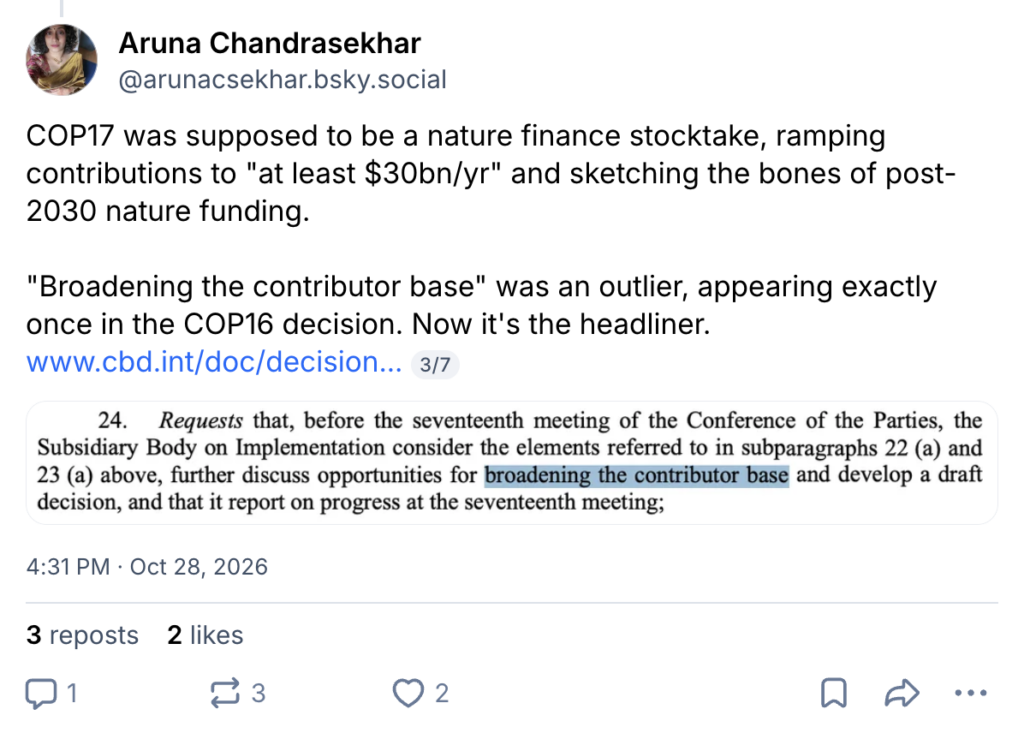
Article 20 of the UN Convention on Biological Diversity (CBD) states that developed countries “shall provide new and additional financial resources” to developing countries to meet the costs of implementing measures to protect nature.
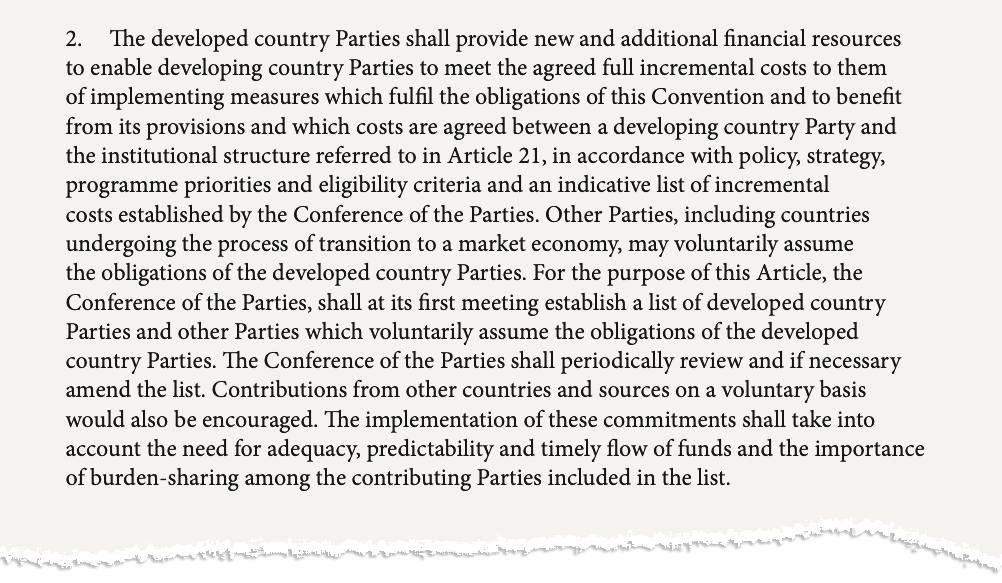
The text states that other countries – including emerging economies – may “voluntarily assume” these obligations to pay. However, it adds that this list of developed countries “shall” be reviewed periodically and amended “if necessary”.
The list was last amended in 2006.
(See this “jargon buster” which explains the specific meaning and legal weight of various terms and verbs used in UN formal documents.)
Discussions around this fraught subject had reached a dead end at intersessional talks this year, but resurfaced in Yerevan.
The first “non-paper” had four different options for expanding the contributor base. These ranged from using the World Bank’s country income groups “as a proxy” to identify high-income countries, to commissioning a study on the impacts of being included on the list.
By 21 October, the number of options swelled to eight, including two from Saudi Arabia and one from Peru.
Some countries “expressed concern” that certain options were based on a CBD secretariat study on “what constitutes a developed country”, Earth Negotiations Bulletin reported.
By the end of the first week, it was clear that the finance deadlock would have to go into informal ministerial consultations for any consensus to emerge.
At a press conference on 28 October, Christopher O’Sullivan, Ireland’s nature minister and representing the EU delegation, told Carbon Brief:
“Our position isn’t that we want to pull back in terms of contributing…but it’s been 20 years since that list was added to, times have changed and there are new realities. We just simply want those new realities reflected. I don’t fully understand why there’s so much opposition to that.”
The EU chose not to comment on which countries it would like to see on that list.
Lim Li Ching from the Third World Network, meanwhile, called the push for others to “assume the obligations” of developed countries “sheer hypocrisy”, adding that any country could make a voluntary contribution. She told Carbon Brief:
“At a forum like the CBD, this linking of income status with finance does not take into account where historical and current responsibilities lie. If you want to generate more funding for biodiversity, let’s look at sovereign debt burdens and rules, which are inequitable for developing countries. But if you can fund wars, and provide resources for your defence industry, then you know where the priorities are.”
On 29 October – at a plenary meant to adopt final texts for the most contentious subjects – Norway’s Gaute Hanssen announced that resource-mobilisation discussions would go into a smaller “friends of the chair” meeting.
Facilitated by Carolina Caceres from Canada and Imèn Meliane from Tunisia, the meeting would discuss the most contentious elements of a draft decision that had swelled to 112 brackets, denoting areas of disagreement on specific details in the text.
While the meeting was open to all, countries that were called to be present included Brazil, Canada, Chile, China, the EU, Fiji, Norway, Russia, Switzerland, Saudi Arabia, South Africa and the UK.
At the same time, a “non-paper” text by finance and environment ministers laid out countries’ red lines and compromises.
At the end of COP17, countries welcomed a final compromise text, with Kenya thanking the “strong women” co-chairs who strove to strike a “delicate” balance.
China, Saudi Arabia, Switzerland and Fiji cautioned against any further interventions, with Brazil warning: “If we open this text, we will never close it again.”
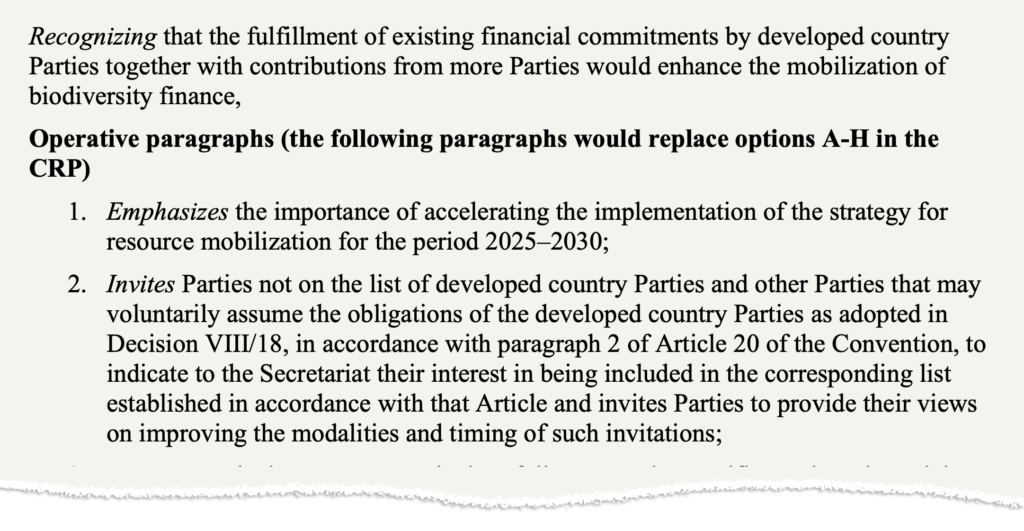
While the final decision “recognises” that “contributions from more parties would improve the mobilisation” of biodiversity finance, it steered away from issuing criteria to expand the list of donor countries.
The text makes it clear that no additions to the list would be made without inviting and confidentially consulting with interested countries, to secure their explicit consent.
Instead, the CBD secretariat “invites” countries keen to be on the list and “assume the obligations” of developed countries to “signal interest” before COP18 and at every alternate COP thereafter.
At the same time, developing countries can contribute to meeting the GBF and biodiversity convention’s goals on a “voluntary basis”, with contributions not implying inclusion on the list.
A negotiator for China told Carbon Brief at the closing plenary:
“We welcome this balanced document. It was a very long discussion that has gone [on] since [2022 nature talks in] Nairobi. But actually this time, there were a lot of sensitive issues, [there were] a lot of critical things we didn’t open in the contact groups; it mainly went to the high-level discussion.”
The decision also establishes a financial mechanism for nature funding after 2030 under the governance of the COP, a key ask from developing countries.
However, it defers decisions on what form this mechanism would take – whether this would be a new fund or based on existing arrangements – until COP18.
Oscar Soria at the Common Initiative told Carbon Brief that the decision on the financial mechanism leaves things “very open”, with “no movement” towards a new fund or money and no upgrades to existing funding arrangements.
The text acknowledges the links between debt and biodiversity eight times, mentioning how debt-related instruments can be included in biodiversity plans, but does not go further.
“It is almost as if the debt studies they called for at COP16 didn’t happen,” said Soria, who had earlier flagged serious metho