

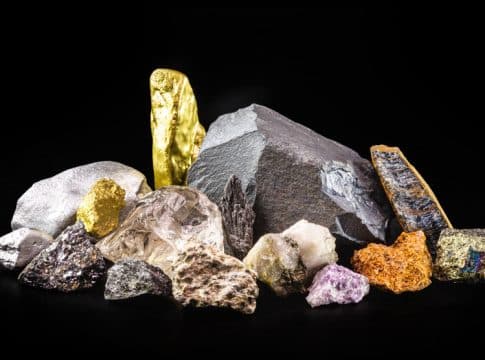
The mining industry faces a critical supply shortage of key metals, despite growth in supply over the past decade. According to BloombergNEF’s Transition Metals Outlook, the world needs $2.1 trillion in new mining investments by 2050 to meet the demand for clean energy technologies. It further illustrates that essential metals like aluminum, copper, and lithium could face deficits as early as this year, which might make EVs, wind turbines, and other low-carbon technologies more expensive.
Kwasi Ampofo, head of metals and mining at BNEF and lead author of the report said,
“The prolonged deficit of these metals will lead to higher prices for raw materials, which increases the cost of clean energy technologies. High costs could slow their adoption, and the energy transition at large”
Interestingly, BloombergNEF’s Economic Transition Scenario (ETS) highlights, that between 2024 and 2050, the world will need about 3 billion metric tons of metals to drive the global energy transition. It further estimates that achieving net zero emissions by 2050 could push that demand to 6 billion metric tons. This means this can spike metal prices and slow the progress of green technologies.

Recycling Metals, A Viable Solution for Supply and Emissions
However, BNEF says recycling metals can ease supply pressures. Sooner, recycled materials will play a crucial role in the supply chain, which will also reduce overall emissions from production.
According to Allan Ray Restauro, a metals and mining associate at BNEF,
“Good government policies are crucial to the industry’s success. For batteries and stationary storage, governments need to establish collection networks, set the requirements for recovery rates, develop the frameworks to trace individual cells and provide the principles on second-life battery management. These actions can build a robust system that oversees the full lifecycle of battery metals.”
Decarbonizing Mining for a Low-Carbon Future
As the world moves toward a low-emissions economy, resource-rich countries face a tough challenge: reducing emissions while developing their mining sectors. This is because the mining industry is significant for supplying minerals needed for clean energy technologies. Sadly, mining still contributes to global emissions, especially in coal extraction.
Minerals used in selected clean energy technologies

Source: IEA, 2022, p. 6. CC BY 4.0
Countries like Chile are showing progress by using renewable energy in mining operations, but many developing nations struggle to balance growth, sustainability, and emissions goals. In this regard, governments must adopt policies that decarbonize mining while ensuring economic growth and meeting Paris Agreement targets. Countries that implement strong climate policies along with robust financing are the ones to succeed in their global commitments.
Southeast Asia Set to Lead in Metal Demand Growth
Certainly, the demand for energy transition metals will vary by region. The research indicated that Southeast Asia is poised to become the fastest-growing market for these materials in the 2030s. The region’s vast mining industry could benefit from this demand surge, helping to accelerate industrialization while contributing to global emissions reductions. Conversely, China’s consumption outpaced the global average between 2020 and 2023. The country’s consumption of transition metals is expected to peak by 2030.
In summary, a $2.1 trillion investment in mining is crucial to meet the global push for clean energy. As metal supplies tighten and prices rise, recycling and supportive policies will be essential to keeping the energy transition on track.

Silver Surges as Coeur Mining Acquires SilverCrest
Coeur Mining is making a strategic move to strengthen silver in the industry. In a $1.7 billion all-share deal, Coeur is set to acquire Canadian silver producer SilverCrest, adding the high-grade, low-cost Las Chispas mine in Mexico to its portfolio.
With this acquisition, Coeur has all the potential to become a major global silver producer, aiming to produce 21 million ounces of silver and 432,000 ounces of gold annually. The Las Chispas mine, which began production in late 2022, has over 10.25 million silver equivalent ounces produced in its first full year of operations. Coeur’s CEO Mitchell J. Krebs highlighted the mine’s strong operational performance and low cash costs of $7.73 per ounce.
The press release reported, that in this partnership Coeur will have a 63% share, and SilverCrest will hold 37%. The acquisition price of $11.34 per share offers an 18% premium to SilverCrest’s recent trading levels. Both companies’ boards have endorsed the deal, which is expected to close in Q1 2025 as regulatory and shareholder approval is pending.
Rising Silver Demand and Market Consolidation
According to the United States Geological Survey (USGS), Mexico led global silver production in 2022, producing an estimated 6,300 metric tons of silver. This output far surpassed China, the second-largest producer, with 3,600 metric tons.
While Mexico dominates in production, Peru holds the largest silver reserves globally, with 98,000 metric tons. Australia follows closely, with reserves totaling 92,000 metric tons. Peru’s stable silver output is supported by its vast reserves and advanced mining infrastructure.
In 2023, silver prices jumped nearly 35% due to heightened demand for solar energy and electronics. This surge has triggered significant mergers in the silver mining sector, including Coeur Mining’s $1.7 billion acquisition of SilverCrest and First Majestic’s $970 million purchase of Gatos Silver. Despite these moves, the market grapples with supply shortages, intensifying the race for reserves. On a positive note, Coeur’s acquisition should be a ray of hope for the global silver industry.
The post BloombergNEF Reveals Mining Needs $2.1 Trillion by 2050 to Fuel Net-Zero Raw Material Demand. Where Does Silver Stand? appeared first on Carbon Credits.

Nature-based carbon investments deserve consideration when they address a specific business dependency and produce outcomes you can measure. Imagine Moonbucks, a global coffee roaster planning next season’s espresso blend. It is considering natural Grade 4 coffee from Jimma, in southwestern Oromia, Ethiopia. Its sourcing decisions affect the roasting schedule and the cash tied up in coffee purchases. Moonbucks needs to understand which measures could protect that supply, what they would cost and how it would judge the results.
1. Define the sourcing problem before choosing a project
Moonbucks needs a dependable component for its espresso blend. Its procurement team wants continuity of volume and an agreed cup profile. Replacing a shipment at short notice could require new sample approval and changes to the blend, and given the schedules for cultivation, processing, and freight delivery, is practically impossible. Moonbucks needs to get this right, and its initial concern is inconsistent deliveries. It commissions an assessment of the supplying farms and post-harvest chain. The questions cover land condition, harvest availability and whether drying or storage problems are affecting saleable lots.
This distinction changes the investment brief. A tree-planting proposal cannot be assumed to fix drying problems. Better storage cannot restore eroded land. The team must establish which problem exists before selecting the response.
CCC’s guide to finding nature-based solutions in your supply chain explains where to look. Here, the next task is to turn a broad concern into a testable proposal.
2. Develop nature-based carbon investments around the actual supply chain
The assessment would trace Moonbucks’ purchases back through the exporter and supplying producer groups. Which farms supply the contracted lots? Who controls land-management decisions? How long does the buyer expect to maintain the purchasing relationship?
Furthermore, Jimma natural Grade 4 cannot be treated as interchangeable with every Ethiopian coffee. Moonbucks would need to test any substitute against its own blend and quality requirements.
Suppose Moonbucks’ assessment identifies an opportunity to maintain shade trees and restore vegetation along exposed streambanks. The IPCC describes agroforestry as a way to store carbon in vegetation and soil, with potential benefits for erosion control and water quality.1 Moonbucks would need local advice on species, growing conditions and maintenance before deciding how these measures fit its sourcing plan.
The proposal now has a defined sourcing connection and a candidate intervention. The next steps are to test its effect on production, assess carbon eligibility and build the financial case.
3. Compare the proposal with other ways to protect supply
WBCSD’s Nature-based Solutions Blueprint recommends comparing nature-based options with other responses across their benefits and costs.2 For Moonbucks, that means evaluating the landscape proposal alongside drying improvements, storage controls and alternative sourcing arrangements.
The product’s natural-process designation matters. Moonbucks should examine the drying and dry-milling chain alongside land conditions. Its team would check storage practices, contamination risks and incoming-lot quality to see whether problems arise before or after the coffee leaves the farms.
The revised proposal might combine land stewardship with separate post-harvest controls. Each component needs its own purpose and budget. A sustainability label should not obscure which activity is expected to solve which problem.
The project develops as the evidence improves. Its scope should follow the diagnosis rather than preserve the first idea unchanged.
4. Establish what the carbon outcome could count toward
Moonbucks’ sustainability team now tests the proposed carbon case separately from the sourcing case. Is the objective a measurable change in Moonbucks’ value-chain emissions, verified credits for separate voluntary use, or distinct outcomes under carefully defined arrangements?
Scope 3 covers value-chain emissions. A purchasing relationship alone does not prove that a farm intervention can be included in Moonbucks’ inventory. The team needs an applicable accounting method, defensible boundaries and evidence supporting attribution.
SBTi’s FLAG Guidance (forest, land and agriculture), version 1.2, says purchased credits used as offsets cannot meet near-term FLAG or energy and industry targets. Eligible land-based removals are subject to accounting requirements.3 Moonbucks needs to test its proposal against those rules before including an outcome in its targets.
For Moonbucks’ Jimma proposal, maintaining existing trees and establishing new vegetation could involve different carbon questions. Specialists must examine the baseline and additionality, meaning what changes because the project proceeds. They must also assess measurement and the risk that stored carbon is lost. CCC’s MRV and additionality article introduces those tests.
Until that work is complete, Moonbucks should not budget an assumed Scope 3 reduction or credit-sale receipt. Direct emissions reductions remain the priority.
5. Build a financial case that survives weaker assumptions
Moonbucks’ finance team would now build a multi-year budget. UNEP’s State of Finance for Nature 2023 compares current finance with the investment needed to meet climate, biodiversity and land-restoration goals.4 The company would cost its proposed activities, farmer participation and ongoing monitoring. Verification, where required, is a separate expense. Maintenance and responsibility for replacing failed plantings must remain visible after the initial establishment budget ends.
Operational benefits need equally careful treatment. If fewer rejected lots reduce emergency purchasing, count that saving once. Do not add “supply resilience” as another financial benefit when it represents the same avoided cost.
Moonbucks should compare a base case with slower benefits, higher implementation costs and no carbon revenue. It should also distinguish production outcomes from quality and shipment outcomes. A single good harvest would not prove that the landscape intervention caused better delivery performance.
A project can remain worth funding even when its carbon case needs more work. That decision must rest on the operational evidence and the company’s objectives, without unsupported environmental claims.
6. Fund a pilot with a clear expansion decision
Moonbucks’ first approval would fund a bounded pilot, rather than commit the entire sourcing program. Before spending, Moonbucks would agree on participating farms, responsibilities and the evidence needed at review.
Its scorecard could track farmer participation, implementation costs and plant survival, alongside accepted coffee volumes and lot-quality results. Carbon measurements would follow the selected method. Farm-level traceability must connect the intervention to the actual sourcing relationship.
Suppose Moonbucks’ review later finds that storage changes explain most quality improvements, while the land measures need longer observation. Those findings would shape the next decision: expand the proven component, adjust the landscape work or pause further spending. They would not justify crediting all improvements to tree planting.
This gives nature-based carbon investments a practical place in a multi-year strategy. Funding increases as the evidence supports it, and the project can change direction before a larger commitment.
Discuss a sourcing opportunity with CCC
Carbon Credit Capital’s nature-based supply-chain investment service uses its Dual-Value Model to examine supply-chain economics alongside potential sustainability outcomes.
Schedule a consultation to discuss your sourcing exposure and the questions to resolve before allocating capital.
Sources
- Intergovernmental Panel on Climate Change (IPCC), Climate Change 2022: Mitigation of Climate Change, Chapter 7, Agriculture, Forestry and Other Land Uses, section 7.4.3.3 (Agroforestry).
- World Business Council for Sustainable Development (WBCSD), Nature-based Solutions Blueprint, 5 June 2024.
- Science Based Targets initiative (SBTi), Forest, Land and Agriculture Science-Based Target-Setting Guidance, version 1.2, March 2026, section 3.1.4, pp. 37–38.
- United Nations Environment Programme (UNEP), State of Finance for Nature 2023, 2023.
A plastic credit funds the collection of plastic waste in places where no formal system exists to collect it. Each credit represents a measured, independently audited quantity of plastic taken out of the environment or returned to use, tracked on a public registry.

EU carbon credit claims changed on 27 September 2026, the day the Directive (EU) 2024/825 began to apply across the European Union. The change is narrow. It changes how a company can talk about the credits it buys. A product can no longer be called neutral on the strength of compensation alone; however, every specific, evidenced statement about what a company measured, reduced, and funded stays fully available.




-
Climate Change1 year ago
Guest post: Why China is still building new coal – and when it might stop
-

 Greenhouse Gases2 years ago
嘉宾来稿:满足中国增长的用电需求 光伏加储能“比新建煤电更实惠”
-
Greenhouse Gases1 year ago
Guest post: Why China is still building new coal – and when it might stop
-

 Climate Change2 years ago
嘉宾来稿:满足中国增长的用电需求 光伏加储能“比新建煤电更实惠”
-

 Renewable Energy1 year ago
Sending Progressive Philanthropist George Soros to Prison?