

Coastal flooding could bring $500bn of annual damages to the Asia-Pacific by the year 2100, if countries do not adapt to rising sea levels.
This is according to new research, published in the journal Scientific Reports, which assesses how coastal flooding is impacting the Asia-Pacific region – and models how the damages could worsen as sea level rises over the 21st century.
The paper finds that coastal flooding is already driving $26.8bn of damage every year across 29 countries in Asia and the Pacific, equivalent to 0.1% of the region’s GDP.
It projects that, under current policies, annual coastal flood damages in the region could rise to $518bn by 2100 – but this could drop to $338bn if warming is capped at 1.5C.
Small island states face the greatest risks from coastal flooding and will continue to bear the brunt of the damage as the planet continues to warm, according to the research.
For example, it finds that Tuvalu will face annual coastal flood damage equivalent to 38% of its GDP by the end of the century.
Meanwhile, small island states such as Kiribati, the Maldives, Micronesia and Tuvalu will permanently lose around 10% of their total land area.
The study’s lead author says the research shows how “rising seas” create “existential” and “economic” risks for low-lying islands in the Asia-Pacific.
He tells Carbon Brief that the paper highlights a “sharp inequality”, as developing nations with little historical responsibility for sea level rise face the brunt of its impacts.
Coastal damage
More than one billion people – about 15% of the world’s population – currently live within 10km of a coast.
Asia is home to some of the largest cities in the world, many of which are located near the sea, such as Mumbai, Tokyo, and Shanghai. The continent is home to 60% of the world’s coastal population.
However, there are hazards to living near the water.
Coastal flooding is caused by a combination of gradually rising sea levels and “episodic extreme sea levels”, such as high tides and storm surges, the study explains.
To assess these two factors, the study combines components including an ocean model and tide-height data.
The authors model flooding in all coastal Pacific and Asian countries that are listed as “developing member countries” by the Asian Development Bank. These 29 countries include Bangladesh, the Philippines and Tuvalu.
They calculate the economic damage caused by flooding, by combining their flood model with data on land use and “asset values” across the residential, commercial, industrial, infrastructure and agricultural sectors.
The authors assume when land floods permanently, the “assets” are completely lost. For areas that only flood periodically, the authors use a model linking flood depth to a percentage of land damaged to calculate the economic consequences.
They find that coastal flooding currently drives $27bn of damage every year in the Asia-Pacific.
China and Indonesia bear the greatest damage, each losing more than $6bn every year. The study authors say this is because both countries have “extensive coastlines, large populations in flood-prone areas and critical economic infrastructure concentrated near the coast”.
However, the study finds that small islands face the greatest economic damage as a percentage of their GDP.
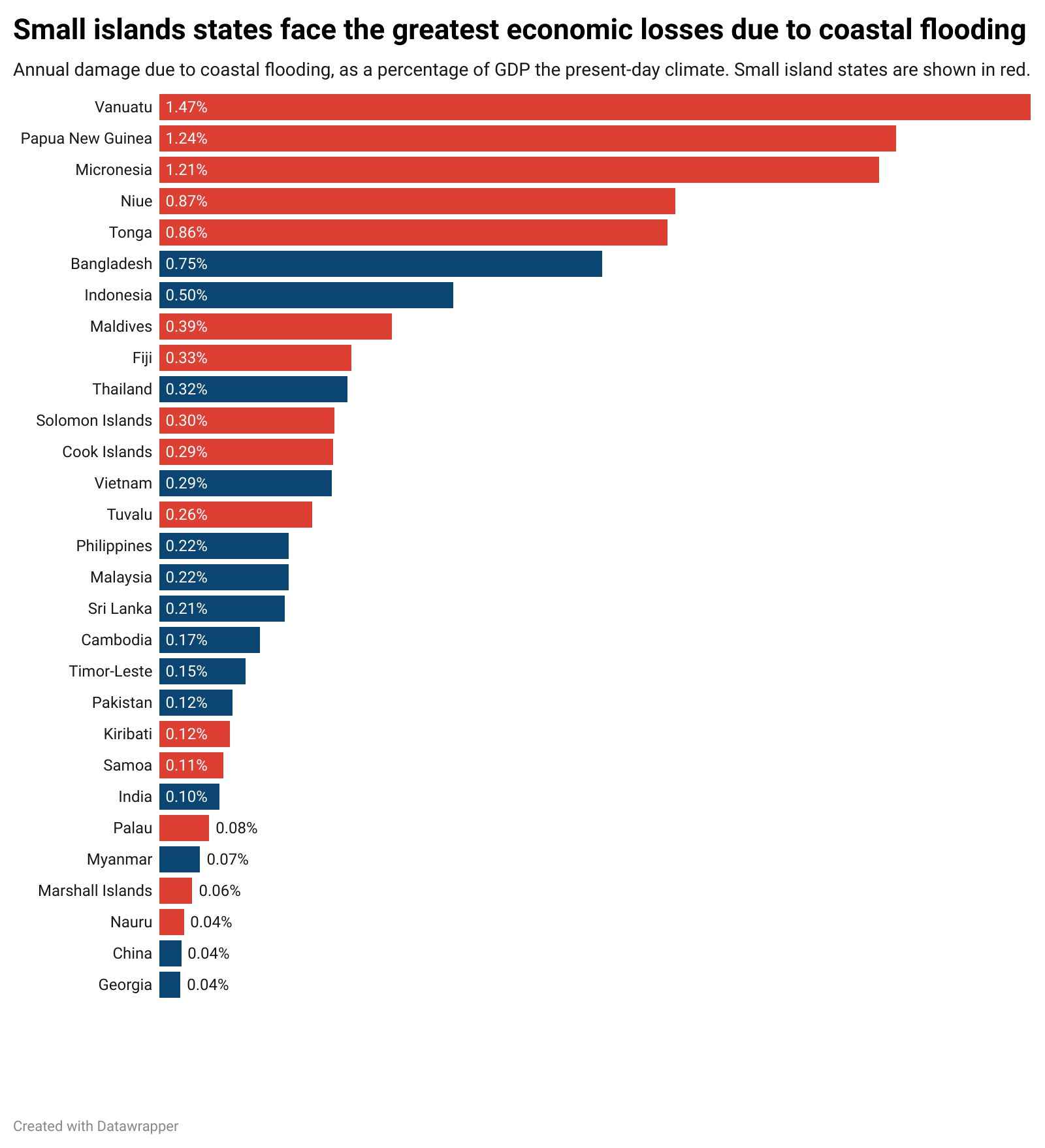
The study shows that the five most-severely affected countries are small island states. Vanuatu tops the ranking, losing 1.5% of its GDP to flooding every year. It is followed by Papua New Guinea and Micronesia.
Dr Michalis Vousdoukas is a researcher in coastal geography at the University of the Aegean in Greece and lead author of the study.
He tells Carbon Brief that even these damage estimates are “conservative” as they do not consider indirect economic losses, such as disruption to business, the loss of critical infrastructure, such as airports, or social impacts, such as migration.
Vousdoukas tells Carbon Brief that the study “highlights a sharp inequality between responsibility and impact”, explaining that the “countries that contributed the least to global emissions, particularly atoll nations, face the highest relative damages”.
Island nations in the Asia-Pacific region made of atolls – ring-shaped coral reefs or islands – include Kiribati, the Marshall Islands and Tuvalu.
Exposure
The authors also calculate population exposure to flooding, by overlaying their flood model with world population data.
Vousdoukas explains that “a person is considered exposed if they live in an area that appears as flooded in our model”.
The paper finds that six million people across the Asia-Pacific are currently at risk of coastal flooding each year, accounting for 0.2% of the region’s total population. The paper says:
“Although this may appear to be a small percentage, it still represents millions of individuals and families whose lives and livelihoods are under constant threat.”
Ranjan Panda is the convenor of the Combat Climate Change Network in India. Panda, who was not involved in the study, tells Carbon Brief that sea level rise is already forcing “millions of people to migrate out in distressed conditions to cities and other countries”.
China and Bangladesh rank the highest, with 2.2 million and 1.5 million people, respectively, exposed to coastal flooding each year.
However, small islands have the greatest percentage of their population exposed to flooding. Vanuatu again tops the table, with 2% of its population facing coastal flooding every year, according to the study. It is followed by Micronesia and the Maldives.
Bangladesh is the highest ranking non-island country, due to its “densely populated and flood-prone delta region”, the study finds.
Rising seas
As the climate warms, coastal flooding is worsening.
Average global sea levels have risen by more than 20cm since 1900, driven mainly by the thermal expansion of the ocean and the melting of glaciers and ice sheets.
Global warming is also “supercharging” hurricanes and typhoons, causing storm surges – the temporary rise in sea level that happens during a storm – to become more intense.
The study uses projections from the IPCC’s sixth assessment report to model sea level rise over the 21st century. These include thermal expansion and meltwater from glaciers and ice sheets, but exclude “low-likelihood, high-impact” events, such as ice-sheet collapse.
The authors assess five future scenarios:
- SSP1-1.9: A very-low emissions reductions pathway that “aligns with” the Paris Agreement’s 1.5C limit
- SSP1-2.6: A “low” emissions pathway achieving net-zero emissions after 2050
- SSP2-4.5: A “moderate” emissions scenario, often described as the trajectory under current climate policies.
- SSP3-7.0: A “high” emissions pathway
- SSP5-8.5: A very-high emissions pathway of “high fossil fuel reliance” throughout the 21st century
They find that, even under the lowest 1.5C warming scenario, countries in the Asia-Pacific will face damages of $338bn due to coastal flooding every year by the end of the century. This accounts for 1.3% of the region’s present-day GDP. (The authors assume no adaptation measures, changes in land use or inflation over the century.)
Under the current policy scenario, annual damage from coastal flooding rises to $518bn by the end of the century.
The chart below shows coastal flood damage as a percentage of annual GDP by the end of the century under the five scenarios for each country. Each horizontal bar shows the damage for one country, with the lowest warming SSP1-1.9 scenario on the left (grey) and highest warming SSP5-8.5 scenario (black) on the right.

The study finds that, by the end of the century, the Pacific island of Tuvalu will face the worst economic consequences from coastal flooding. Even under the 1.5C warming scenario, its annual economic losses due to coastal flooding will reach 38% of its GDP.
The authors also assess the amount of land that will be permanently lost to the sea.
They find that small island states – such as Kiribati, the Maldives, Micronesia and Tuvalu – will experience the highest percentage of their land permanently submerged, each losing around 10% of their total land area.
Two million people currently live in areas of the Asia-Pacific that will be permanently flooded by the end of the century under the 1.5C warming scenario, according to the research.
Finance gap
Countries can reduce the impacts of coastal flooding through adaptation. This can include building flood defenses, making infrastructure more resilient to flooding, or arranging “managed retreat” to move people away from vulnerable areas as the seas encroach.
The study authors model the cost of building defences – such as sea walls, levees, embankments and sand dunes – high enough that the economic damage from coastal flooding over the 21st century does not worsen beyond 2020 levels.
The research highlights that the cost of investing in these defences is substantially lower than the potential economic damages of sea level rise.
The authors estimate that, under a 1.5C warming scenario, building flood defenses to limit flood damage to 2020 levels would cost $9bn in total. However, building these defences would avoid $157bn in damages due to coastal flooding, they find.
Dr Rafael Almar is a researcher at the Laboratory of Space Geophysical and Oceanographic Studies in France and was not involved in the study. He says the study has “significant implications for development banks and financial institutions” as it could help them prioritise investments in “clearly identified hotspots”.
However, he emphasises that building flood defences “is not the only solution”. For example, he argues that “relocation and renaturalisation” – the process of moving people away from the coast and allowing the area to return to its natural state – can make an area “more resilient”.
Panda also warns that physical flood defenses “could actually be triggering further local environmental crises that accelerate the losses and damages faced by people due to sea level rise and flooding impacts”.
Sea walls have been shown to damage wildlife – for example, blocking animals such as turtles from reaching parts of the beach – according to an article in Climate Home News. The piece adds that physical defenses are “inflexible” and “mainly benefit the rich and encourage risky building near the coast”.
Sourcing money for developing countries to adapt to the impacts of climate change is an ongoing talking point at international climate negotiations.
A group of developed nations, including much of Europe, the US and Japan, is obliged under the Paris Agreement to provide international “climate finance” to developing countries. This money can be used for both mitigation – reducing emissions to limit warming – and adaptation.
In 2023, developed nations provided $26bn in international adaptation finance to developing nations, according to a recent UN report. This is roughly the amount that Asia-Pacific countries currently lose every year due to coastal flooding alone.

The post Asia-Pacific faces ‘$500bn-a-year’ hit from rising seas if current policies continue appeared first on Carbon Brief.
Asia-Pacific faces ‘$500bn-a-year’ hit from rising seas if current policies continue

Prepared by a coalition of nine Western Australian union, industry, conservation, and community organisations—including UnionsWA, the Conservation Council WA, and the Smart Energy Council—the WA Clean Energy, Jobs & Industry Plan provides a practical roadmap to transform Western Australia into a clean energy powerhouse while creating thousands of secure local jobs.
Western Australia stands at a pivotal crossroads: lead the global clean energy economy or watch investment, future industries, and secure jobs go elsewhere. The WA Clean Energy, Jobs & Industry Plan outlines a transformative blueprint to harness the state’s world-class solar and wind resources. Discover how legislated renewable targets, green iron manufacturing, and a dedicated regional training strategy can generate tens of thousands of local jobs, lower household bills, and build a resilient, net-zero future for all Western Australians.

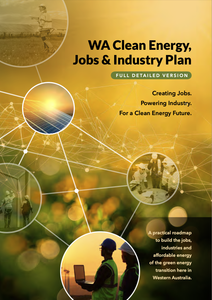
WA needs a clear and forward-thinking plan if it is going to become a competitive renewable energy powerhouse and maintain its economic strength through the energy transition.
“Western Australians know a faster renewable energy transition will lower their household expenses and prevent harmful climate pollution. But the community also needs clear direction to ensure this transition will create jobs, lower costs and not cause undue environmental harm.
“Here, sectors representing a broad range of interests have laid the groundwork for those outcomes, clearly outlining what is needed to create a future for WA that is good for the environment, for the climate, for workers and for the economy.
Summary
The WA Clean Energy, Jobs & Industry Plan sets out a strategic roadmap to position Western Australia as a global clean energy superpower while creating thousands of secure local jobs.
The report establishes three overarching goals:
- Creating local employment.
- Maintaining industrial competitiveness.
- Lowering household energy costs
To realize this vision, the framework details actionable measures to follow on from the recent WA Government announcement of a 75% Renewable Energy Target by 2031 for the South West Interconnected System. This includes developing a statewide Renewable Energy Target, coordinating statewide workforce and training pipelines, strategically planning regional infrastructure to safeguard high-value biodiversity and cultural heritage, and ensuring equitable benefit-sharing through household electrification incentives and First Nations equity partnerships. Ultimately, the plan highlights that establishing clear policy and regulatory certainty will unlock lower energy bills, boost power reliability, and secure the state’s global competitiveness in emerging green commodity export markets.

Key Findings
- Statewide Renewable Energy Target and Emissions Reduction Targets: The report calls for a statewide RET and 1.5°C aligned emission reduction targets to remove policy risk, lower capital costs, and attract clean energy investment.
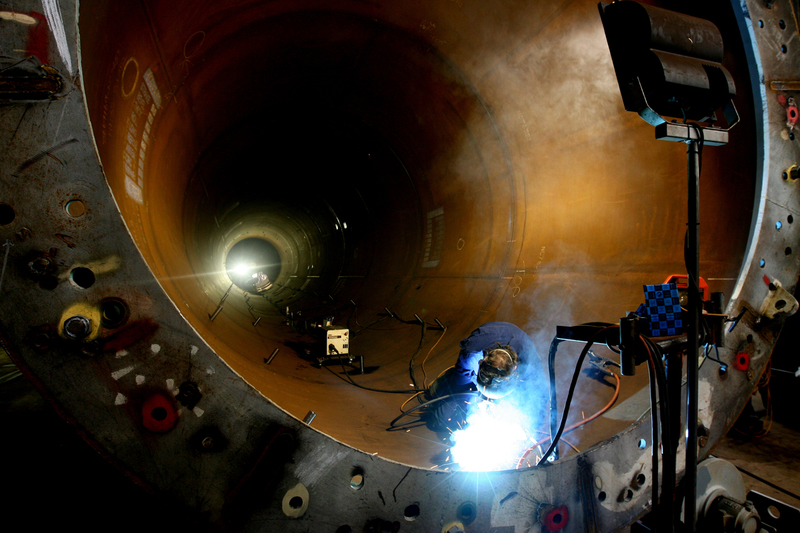
- Transformative Job Creation: Accelerating the transition offers massive employment prospects, including up to 8,800 solar and battery jobs by 2050, as well as 24,000 ongoing and 11,000 construction jobs in a commercial green iron industry.
- Industrial Electrification & Competitiveness: Requiring large gas users to adopt binding electrification timetables and providing concessional financing will protect existing energy-intensive manufacturers from rising energy costs and impending domestic gas shortfalls.
- Green Commodity Export Leadership: Western Australia can build new export markets in green iron, green ammonia, and offshore oil/gas decommissioning by constructing shared common-user infrastructure and setting dedicated Green Commodity Export Targets.
- Coordinated Workforce & Training Pipeline: To address critical skill shortages the plan recommends establishing a WA Clean Energy Jobs Plan 2050, three regional training hubs, and dedicated pathways for female and under-represented apprentices.
- Environmental Safeguards & Community Benefits: Fast-tracked development must be paired with State Planning Policies that avoid high-biodiversity and cultural heritage lands, mandate new data centres to run on additional renewable power, and deliver household electrification rebates and First Nations equity partnerships.
What you can do
WA has an opportunity to lead on sustainable, clean energy and associated industries. You can help by:
- Sending an email to Environment Minister Murray Watt and Prime Minister Anthony Albanese, calling on them to reject Browse.
- Sharing this story to help more Australians understand what’s at stake.
- Encouraging your friends and family to take action.