

The UK’s right-leaning newspapers have unleashed a huge wave of editorials attacking energy secretary Ed Miliband since last year’s general election, Carbon Brief analysis reveals.
In the first half of 2024, newspapers published 16 editorials – articles that are considered the newspaper’s formal “voice” – attacking Miliband. In the second half of the year, since Labour’s election win, this increased to 45 – roughly two every week.
Right-leaning outlets such as the Sun and the Daily Mail repeatedly called Miliband an “eco-zealot”, a “madman” and a “hysterical eco-obsessive”, due to his support for net-zero policies.
More broadly, there were 368 editorials published in UK newspapers last year that were about climate change and energy. This is the second-highest annual tally recorded by Carbon Brief’s long-running project, which tracks UK newspaper editorials back to 2011.
In 2024, unprecedented numbers of these editorials opposed climate action in general, as well as renewable energy, specifically.
As the new Labour government pursues a clean power system by 2030 and other net-zero policies, right-leaning newspapers argued that such measures would be costly and harmful.
This continues a recent trend of the right-leaning press rejecting net-zero policies, after briefly embracing climate action during Boris Johnson’s Conservative government.
Attacking Miliband
In his role as energy security and net-zero secretary, Miliband has been the face of Labour’s plan to achieve a clean power system by 2030 and is a long-standing and staunch defender of climate policies in general.
Last year, newspapers such as the Sun, the Daily Mail and the Daily Telegraph continued to push back against net-zero policies, with much of their criticism personally focused on Miliband himself.
Carbon Brief’s analysis identified 61 editorials that directly criticised Miliband in 2024. All of these, barring one published in the Independent, were in right-leaning newspapers.
A particular uptick followed the general election on 4 July, which saw Miliband enter government for the first time in 14 years. Newspapers published 45 critical editorials between election day and the end of the year, amounting to nearly two a week, on average, as the chart below shows.

By far the biggest critic of Miliband was the Sun, which published 29 editorials attacking him. This was followed by the Daily Mail, with 12, and the Daily Telegraph, with nine. The Sunday editions of these three newspapers also published a handful of critical editorials.
The favoured editorial criticism was that Miliband is a “muddled climate zealot”, prone to “demented fantasies”, who places the “mad rush to net-zero” ahead of – the newspapers claim – more pressing issues. Newspapers alleged – often with little supporting evidence – that “his” policies will lead to higher energy bills and the “lights going out”.
This claim was often in response to Miliband stating that renewables would help curb the UK’s reliance on expensive gas, as well as bring down energy prices.
There were several calls for prime minister Keir Starmer to “rein in” Miliband, calling him a “drag” on the Labour government.
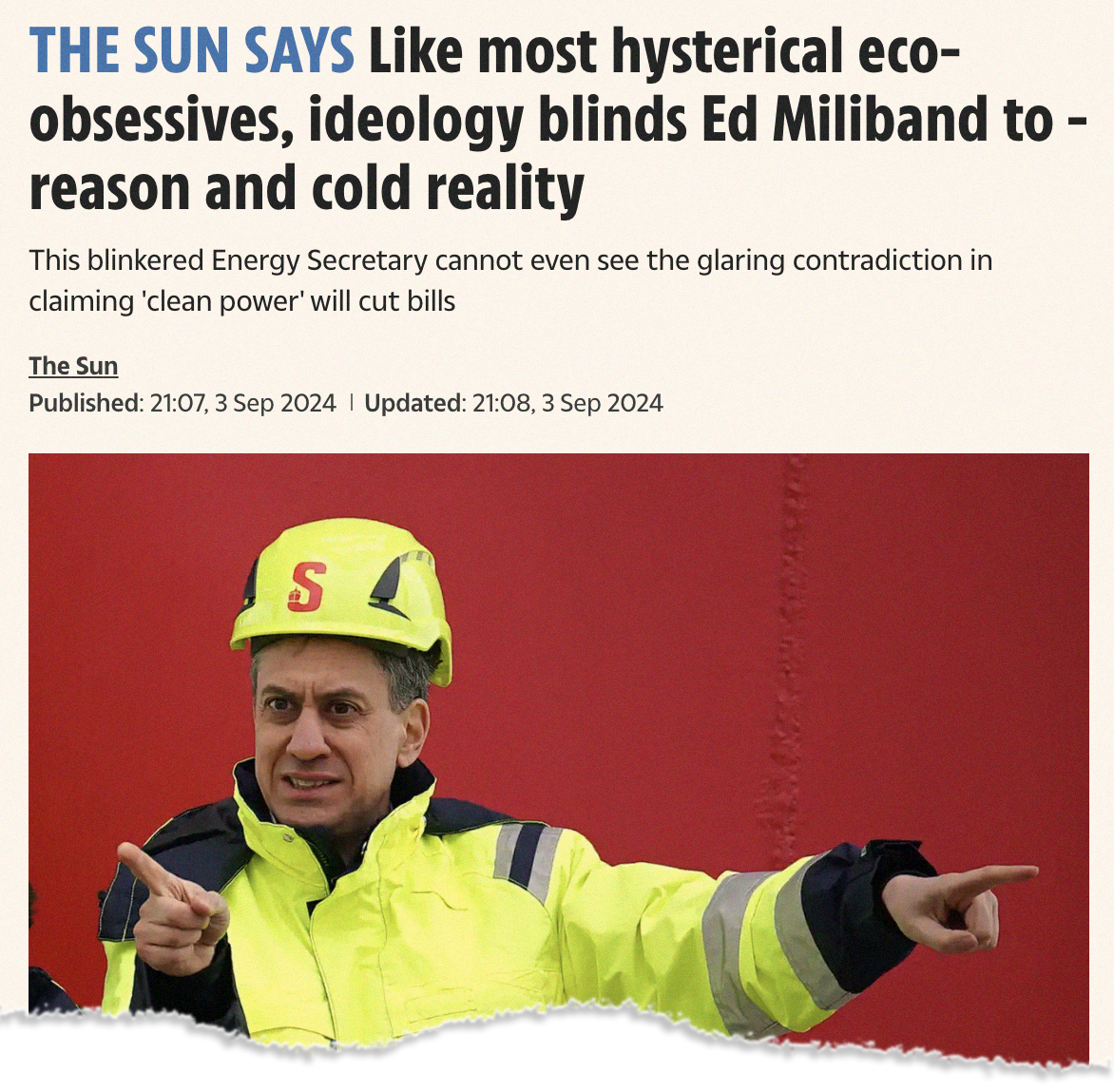
Such specific and personal attacks are not directed at all government ministers. As a comparison, Carbon Brief only identified two editorials in 2024 that took specific aim at Miliband’s Conservative predecessor, Claire Coutinho, even though she held the role for half of the year.
(The criticism of Coutinho was also fairly mild in comparison to the claims about Miliband, focusing on the difficulties of building nuclear power. For example, the Sun said she needed a “reality check” and that “both main parties have been an abject failure” on nuclear.)
Miliband, who introduced the landmark Climate Change Act during his first stint as climate secretary in 2008, has long been a target for the right-leaning press and climate sceptics. The same newspapers criticising him now ran a similarly personal campaign to oppose Miliband becoming prime minister, when he was leader of the Labour party in 2015.
Record climate opposition
In total, Carbon Brief identified 368 editorials that touched on climate and energy issues in 15 UK newspapers last year, averaging one per day
Of these, 169 dealt explicitly with climate change. In an election year that saw Labour take power with a clean energy-focused manifesto, many of these editorials referred to measures the new government was pledging or starting to implement.
According to Carbon Brief’s analysis, a record 44 of the editorials published in 2024 argued for less climate action. This is the third record-breaking year in a row for such editorials in UK newspapers, as the chart below shows.
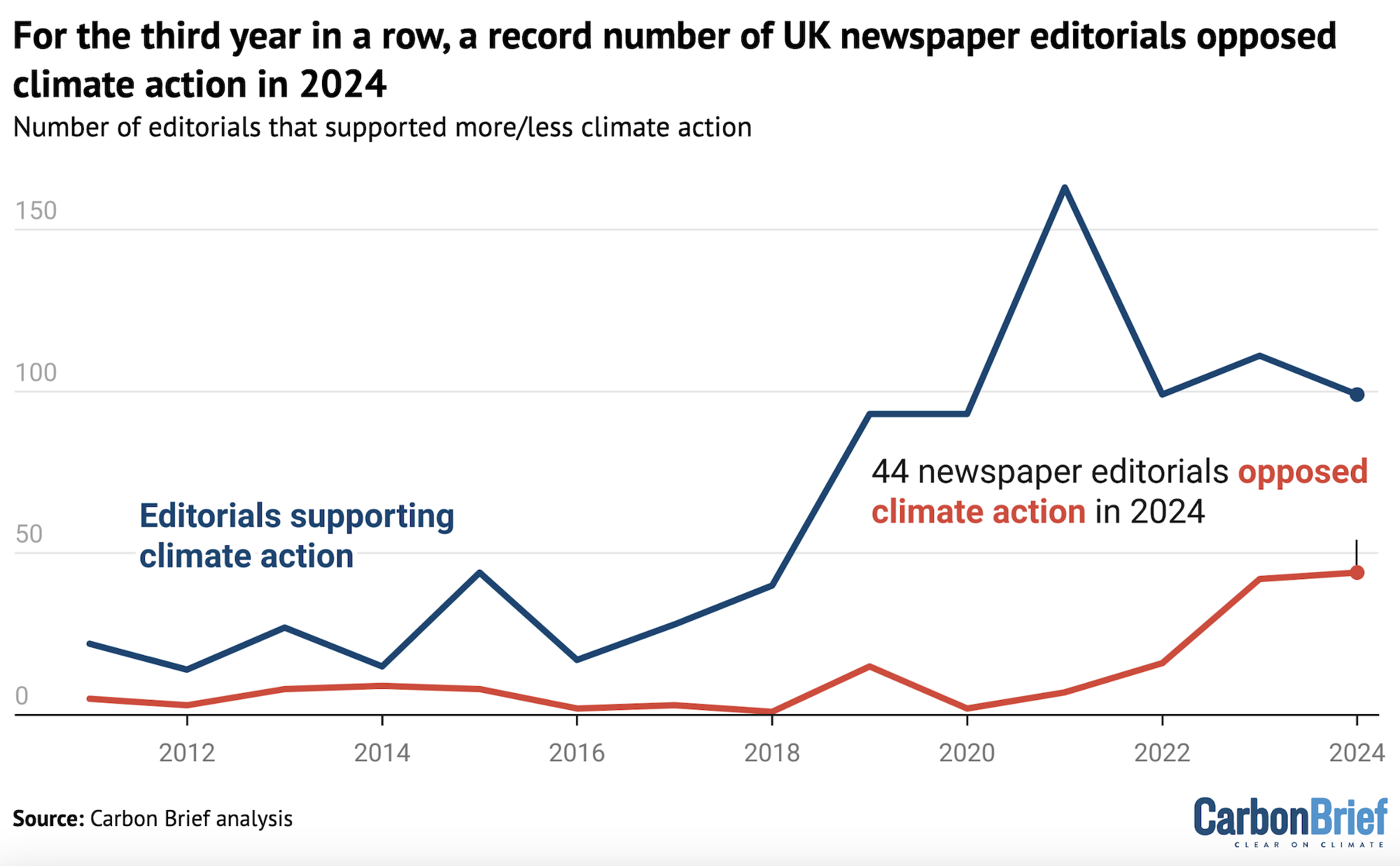
While there were still more than twice as many supportive editorials calling for more climate action, they were heavily skewed towards certain publications.
In total, 80 of the 99 editorials calling for “more action” were published in left-leaning and “centrist” publications, with the Guardian alone publishing 40 of them.
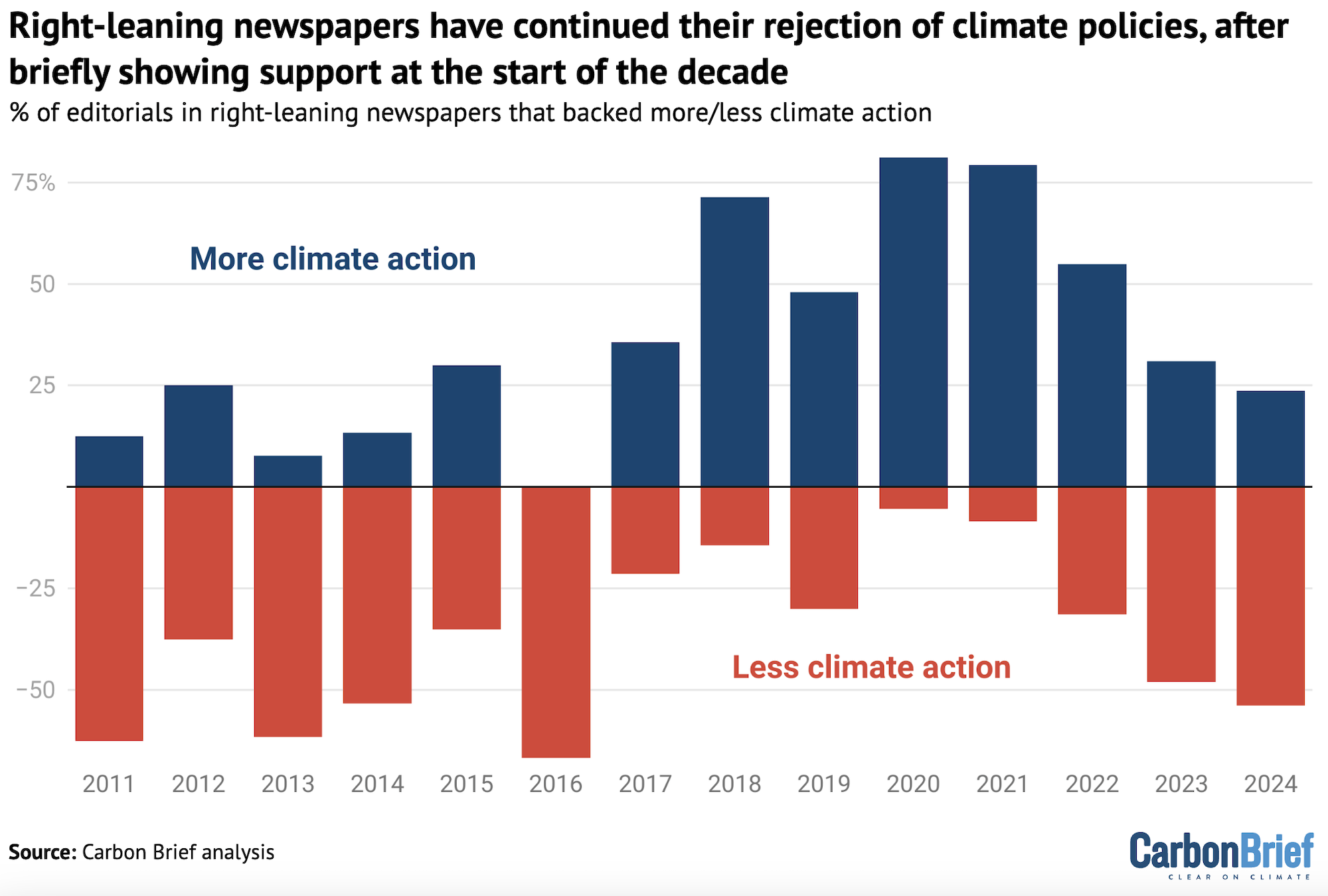
Right-leaning titles, which tend to have higher readerships, published just 19 editorials advocating for climate action, 14 of which were in the Times. The Sun, which is one of the UK’s most-read daily newspapers, did not publish any editorials supporting climate action.
For a brief period, peaking in 2020, these right-leaning publications appeared to have shifted in their attitudes. Publications with long histories of publishing climate-sceptic journalism, such as the Sun and the Daily Express, made public commitments to cover climate change.
This coincided with the Conservative government of Boris Johnson, which made major climate commitments, and the build-up to the UK hosting the COP26 climate summit.
However, since 2020 there has been a steep decline in support for climate action by these newspapers. As the chart below shows, the share of their editorials supporting and opposing climate policies is now back where it was a decade ago.
Carbon Brief’s analysis also assesses the themes present in newspaper editorials.
It shows that, once again, the most common argument against climate action was that there would be a negative economic impact of climate policies. Last year, 35 climate-related editorials, or one-fifth of the total, made this argument.
The “cost of net-zero” has been a key talking point in the right-leaning press. This can be seen in editorial headlines such as “the untenable costs of net-zero” and “it’s time MPs were honest about the true cost of net-zero”, in the Daily Telegraph and Sunday Times, respectively.
Economic benefits of climate policies, on the other hand, were mentioned in 29 climate-related editorials – 16% of the total. Analysis for the UK government has repeatedly demonstrated that switching to clean technologies will save people money, offsetting upfront investment costs, as well as delivering significant social benefits.
Another common negative theme – mentioned in around a sixth of climate editorials – was criticism of climate advocates, from Just Stop Oil to Ed Miliband.
Right-leaning newspapers frequently denounced such advocates for “green piety” and “hypocrisy”, or called them “fanatics” and “extremists”.
Renewable pushback
Carbon Brief analysed 79 editorials that focused specifically on three major energy technologies – renewables, nuclear power and fracking.
Fracking has fallen off the political agenda since plans to overturn a ban on the practice came to nothing in 2022. Only two editorials mentioned it at all in 2024.
Nuclear power was mentioned in 20 editorials, with none expressing anti-nuclear sentiments. Notably, the technology enjoyed support across the political spectrum of newspapers, as it has in previous years.
Renewable energy was far more divisive. Mirroring the results for climate action more generally, 2024 saw a record 25 UK newspaper editorials opposing wind, solar and other renewable energy sources. As the chart below shows, there was also a dip in the number of editorials actively supporting renewables.
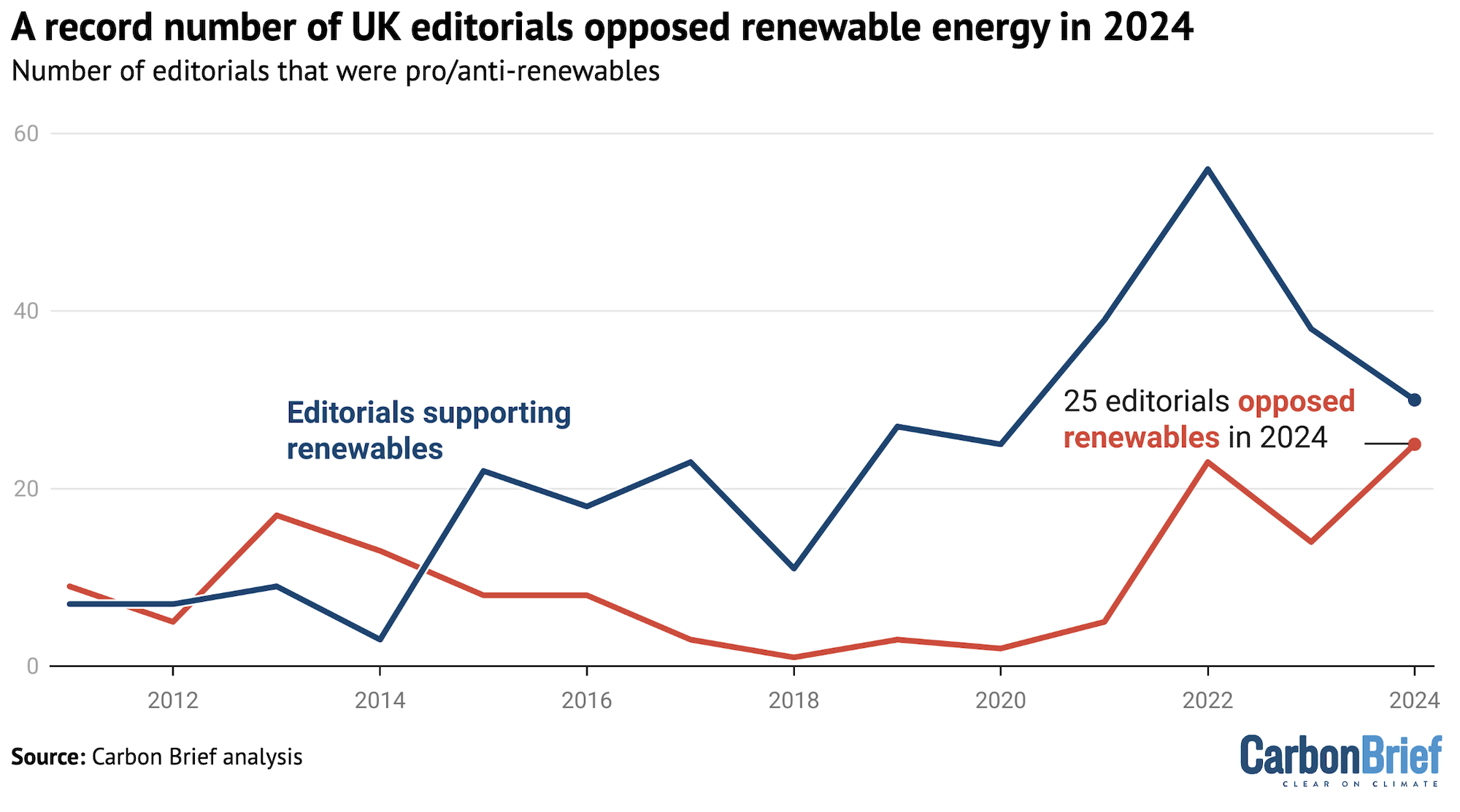
All but one of the editorials opposing renewables were published in right-leaning newspapers, particularly the Daily Mail – with 11 – and the Sun, with seven.
Again, the supposed economic cost of renewables was the main reason cited. The Daily Mail said “eye-watering subsidies” were required to support renewables, while the Sun called the government’s plan to cut reliance on expensive gas, in favour of renewables a “ruinous fantasy”.
In contrast, some newspapers made the economic case for renewables. In an editorial about wind power, the Guardian said that “exploiting the British Isles’ most obvious natural asset is environmentally and economically the right thing to do”.
Methodology
This is a 2024 update of previous analysis conducted for the period 2011-2021 by Carbon Brief in association with Sylvia Hayes, then a PhD researcher and now a research fellow at the University of Exeter. Previous updates were published in 2022 and 2023.
The count of editorials criticising Ed Miliband was not conducted in previous years.
The full methodology can be found in the original article, including the coding schema used to assess the language and themes used in editorials concerning climate change and energy technologies.
The analysis is based on Carbon Brief’s editorial database, which is regularly updated with leading articles from the UK’s major newspapers.


The post Analysis: UK newspaper editorials attacked Ed Miliband relentlessly throughout 2024 appeared first on Carbon Brief.
Analysis: UK newspaper editorials attacked Ed Miliband relentlessly throughout 2024

Drought and heatwaves occurring together – known as “compound” events – have “surged” across the world since the early 2000s, a new study shows.
Compound drought and heat events (CDHEs) can have devastating effects, creating the ideal conditions for intense wildfires, such as Australia’s “Black Summer” of 2019-20 where bushfires burned 24m hectares and killed 33 people.
The research, published in Science Advances, finds that the increase in CDHEs is predominantly being driven by events that start with a heatwave.
The global area affected by such “heatwave-led” compound events has more than doubled between 1980-2001 and 2002-23, the study says.
The rapid increase in these events over the last 23 years cannot be explained solely by global warming, the authors note.
Since the late 1990s, feedbacks between the land and the atmosphere have become stronger, making heatwaves more likely to trigger drought conditions, they explain.
One of the study authors tells Carbon Brief that societies must pay greater attention to compound events, which can “cause severe impacts on ecosystems, agriculture and society”.
Compound events
CDHEs are extreme weather events where drought and heatwave conditions occur simultaneously – or shortly after each other – in the same region.
These events are often triggered by large-scale weather patterns, such as “blocking” highs, which can produce “prolonged” hot and dry conditions, according to the study.
Prof Sang-Wook Yeh is one of the study authors and a professor at the Ewha Womans University in South Korea. He tells Carbon Brief:
“When heatwaves and droughts occur together, the two hazards reinforce each other through land-atmosphere interactions. This amplifies surface heating and soil moisture deficits, making compound events more intense and damaging than single hazards.”
CDHEs can begin with either a heatwave or a drought.
The sequence of these extremes is important, the study says, as they have different drivers and impacts.
For example, in a CDHE where the heatwave was the precursor, increased direct sunshine causes more moisture loss from soils and plants, leading to a drought.
Conversely, in an event where the drought was the precursor, the lack of soil moisture means that less of the sun’s energy goes into evaporation and more goes into warming the Earth’s surface. This produces favourable conditions for heatwaves.
The study shows that the majority of CDHEs globally start out as a drought.
In recent years, there has been increasing focus on these events due to the devastating impact they have on agriculture, ecosystems and public health.
In Russia in the summer of 2010, a compound drought-heatwave event – and the associated wildfires – caused the death of nearly 55,000 people, the study notes.

The record-breaking Pacific north-west “heat dome” in 2021 triggered extreme drought conditions that caused “significant declines” in wheat yields, as well as in barley, canola and fruit production in British Columbia and Alberta, Canada, says the study.
Increasing events
To assess how CDHEs are changing, the researchers use daily reanalysis data to identify droughts and heatwaves events. (Reanalysis data combines past observations with climate models to create a historical climate record.) Then, using an algorithm, they analyse how these events overlap in both time and space.
The study covers the period from 1980 to 2023 and the world’s land surface, excluding polar regions where CDHEs are rare.
The research finds that the area of land affected by CDHEs has “increased substantially” since the early 2000s.
Heatwave-led events have been the main contributor to this increase, the study says, with their spatial extent rising 110% between 1980-2001 and 2002-23, compared to a 59% increase for drought-led events.
The map below shows the global distribution of CDHEs over 1980-2023. The charts show the percentage of the land surface affected by a heatwave-led CDHE (red) or a drought-led CDHE (yellow) in a given year (left) and relative increase in each CDHE type (right).
The study finds that CDHEs have occurred most frequently in northern South America, the southern US, eastern Europe, central Africa and south Asia.

Threshold passed
The authors explain that the increase in heatwave-led CDHEs is related to rising global temperatures, but that this does not tell the whole story.
In the earlier 22-year period of 1980-2001, the study finds that the spatial extent of heatwave-led CDHEs rises by 1.6% per 1C of global temperature rise. For the more-recent period of 2022-23, this increases “nearly eightfold” to 13.1%.
The change suggests that the rapid increase in the heatwave-led CDHEs occurred after the global average temperature “surpasse[d] a certain temperature threshold”, the paper says.
This threshold is an absolute global average temperature of 14.3C, the authors estimate (based on an 11-year average), which the world passed around the year 2000.
Investigating the recent surge in heatwave-leading CDHEs further, the researchers find a “regime shift” in land-atmosphere dynamics “toward a persistently intensified state after the late 1990s”.
In other words, the way that drier soils drive higher surface temperatures, and vice versa, is becoming stronger, resulting in more heatwave-led compound events.
Daily data
The research has some advantages over other previous studies, Yeh says. For instance, the new work uses daily estimations of CDHEs, compared to monthly data used in past research. This is “important for capturing the detailed occurrence” of these events, says Yeh.
He adds that another advantage of their study is that it distinguishes the sequence of droughts and heatwaves, which allows them to “better understand the differences” in the characteristics of CDHEs.
Dr Meryem Tanarhte is a climate scientist at the University Hassan II in Morocco, and Dr Ruth Cerezo Mota is a climatologist and a researcher at the National Autonomous University of Mexico. Both scientists, who were not involved in the study, agree that the daily estimations give a clearer picture of how CDHEs are changing.
Cerezo-Mota adds that another major contribution of the study is its global focus. She tells Carbon Brief that in some regions, such as Mexico and Africa, there is a lack of studies on CDHEs:
“Not because the events do not occur, but perhaps because [these regions] do not have all the data or the expertise to do so.”
However, she notes that the reanalysis data used by the study does have limitations with how it represents rainfall in some parts of the world.
Compound impacts
The study notes that if CDHEs continue to intensify – particularly events where heatwaves are the precursors – they could drive declining crop productivity, increased wildfire frequency and severe public health crises.
These impacts could be “much more rapid and severe as global warming continues”, Yeh tells Carbon Brief.
Tanarhte notes that these events can be forecasted up to 10 days ahead in many regions. Furthermore, she says, the strongest impacts can be prevented “through preparedness and adaptation”, including through “water management for agriculture, heatwave mitigation measures and wildfire mitigation”.
The study recommends reassessing current risk management strategies for these compound events. It also suggests incorporating the sequences of drought and heatwaves into compound event analysis frameworks “to enhance climate risk management”.
Cerezo-Mota says that it is clear that the world needs to be prepared for the increased occurrence of these events. She tells Carbon Brief:
“These [risk assessments and strategies] need to be carried out at the local level to understand the complexities of each region.”




The post Heatwaves driving recent ‘surge’ in compound drought and heat extremes appeared first on Carbon Brief.
Heatwaves driving recent ‘surge’ in compound drought and heat extremes
Greenhouse Gases
DeBriefed 6 March 2026: Iran energy crisis | China climate plan | Bristol’s ‘pioneering’ wind turbine
Welcome to Carbon Brief’s DeBriefed.
An essential guide to the week’s key developments relating to climate change.
This week
Energy crisis
ENERGY SPIKE: US-Israeli attacks on Iran and subsequent counterattacks across the Middle East have sent energy prices “soaring”, according to Reuters. The newswire reported that the region “accounts for just under a third of global oil production and almost a fifth of gas”. The