

Artificial intelligence (AI) has undergone a rapid expansion in recent years.
Tech leaders have hailed an “AI revolution” – predicting “transformative” effects for humanity – while some governments have set their sights on AI-driven economic growth.
Yet, the industry is also facing scrutiny on many fronts, from inaccuracies in AI outputs through to the threat it poses to democracy.
One major critique concerns the environmental impact of AI, particularly the intensive energy use and carbon dioxide (CO2) emissions of the data centres that power it.
Campaigners, journalists and researchers have warned that the rapid expansion of data centres could slow down or even reverse the global shift towards net-zero.
The topic is complex, not least because the future of AI – and the role it could play in increasing or potentially helping to reduce emissions – remains highly uncertain.
Below, Carbon Brief takes a look at some of the best available figures, largely from the International Energy Agency (IEA), to explore the energy and emissions impact of AI.
- Data centres currently account for a small share of global emissions and electricity use
- Around a tenth of the electricity demand growth by 2030 is set to be driven by data centres
- Data centres could account for half of electricity demand growth in some countries
- Fossil-fuel use will likely expand to power data centres, but clean-energy supplies are set to grow faster
- There is a lot of uncertainty about how much data centres will expand
1. Data centres currently account for a small share of global emissions and electricity use
The process of training and deploying AI models relies on data centres – large, energy-intensive facilities that house computing infrastructure.
Data centres already underpin the internet, among other things, making them essential for modern life. But as hype around AI has grown in recent years, investment in new data centres has ballooned.
The global electricity consumption of expanding data centres has grown by around 12% each year since 2017, according to the IEA’s recent “energy and AI” report.
Concerns about “skyrocketing” electricity demand have also prompted warnings of data centres driving up CO2 emissions, as fossil fuels still generate much of the world’s power.
Indeed, companies, such as Google, Meta and Microsoft, have reported large emissions spikes over the past few years due to data-centre expansion, despite their net-zero pledges.
One research paper concludes that the electricity demand of AI “runs counter to the massive efficiency gains that are needed to achieve net-zero”. Others have voiced concerns that data centres will “overwhelm” and “undermine” both national and company-level climate targets.
Reporting often mentions the electricity demand of data centres – or their emissions – “doubling”, “tripling” or increasing by some other large percentage in the coming years.
But these increases, while potentially dramatic in relative terms, are starting from a low baseline. As shown in the chart below, data centres are currently responsible for just over 1% of global electricity demand and 0.5% of CO2 emissions, according to IEA data.

Given this starting point, even as data centres expand, the IEA suggests that they will make a relatively small contribution to climate change, in the short term.
The agency estimates that data-centre emissions will reach 1% of CO2 emissions by 2030 in its central scenario, or 1.4% in a faster-growth scenario.
Nevertheless, it notes that this is one of the few sectors where emissions are set to grow – alongside road transport and aviation – as most will likely decarbonise in the coming years.
2. Around a tenth of the electricity demand growth by 2030 is set to be driven by data centres
The world is entering what the IEA describes as a “new age of electricity”, in which the electrification of transport, buildings and industry drives a surge in demand for power.
Along with electric cars and factories, data centres are frequently highlighted by analysts as a key “emerging driver” of this demand.
Under the IEA’s central scenario for data-centre growth, the sector’s global electricity consumption would more than double between 2024 and 2030, reaching 945 terawatt-hours (TWh) by the end of the decade. This is equivalent to the current electricity demand of Japan.
The IEA describes AI as “the most important driver of this growth”.
As it stands, AI has been responsible for around 5-15% of data-centre power use in recent years, but this could increase to 35-50% by 2030, according to another report prepared for the IEA.
However, the 530TWh rise in electricity demand in data centres by 2030 would only be 8% of the overall increase in demand that the IEA projects, as shown in the chart below.
This is less than electric vehicles (838TWh) or air conditioning (651TWh). It is considerably less than the 1,936TWh growth expected in industrial sectors by 2030.
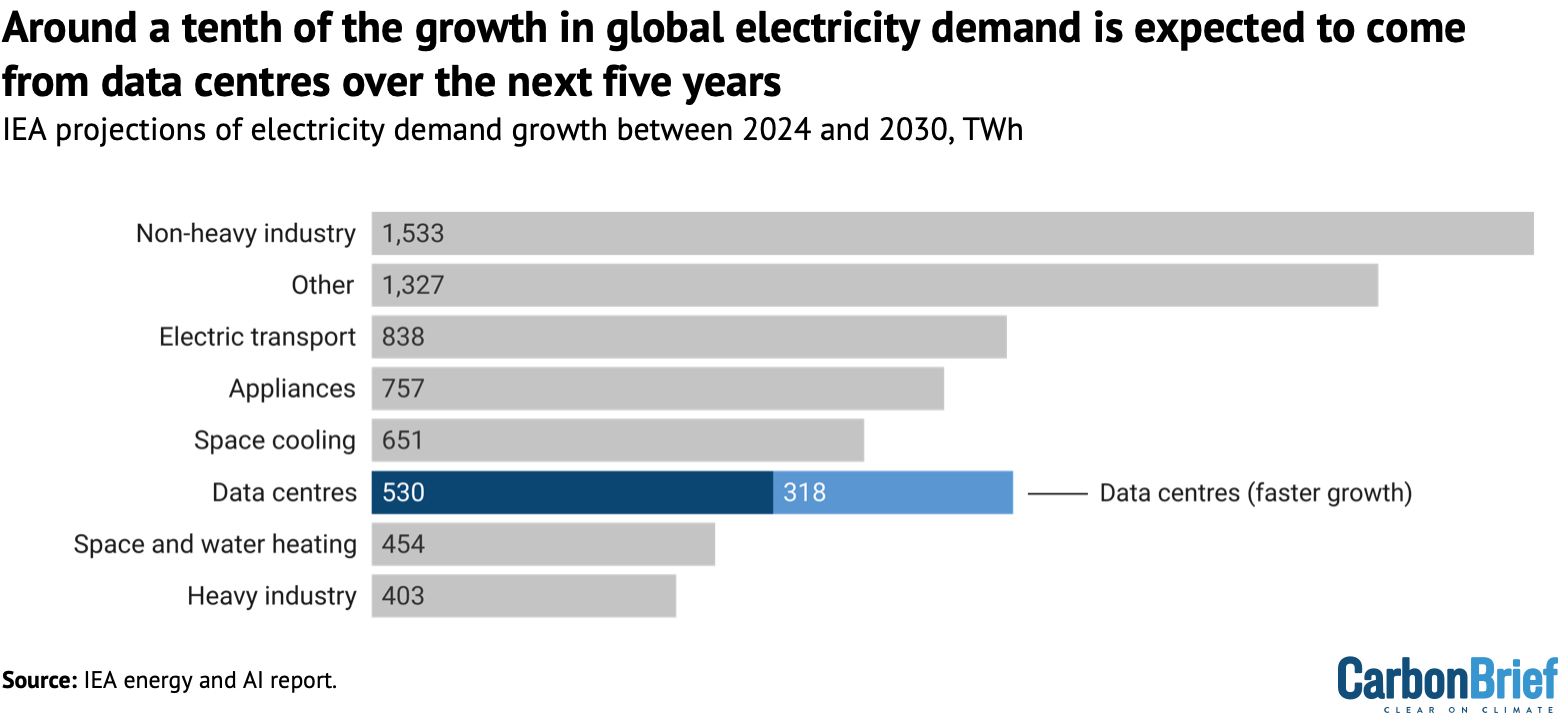
If data-centre electricity use rose in line with the IEA’s faster-growth scenario, the facilities would be responsible for around 12% of global demand growth overall.
While the IEA says “uncertainties widen” when considering electricity demand growth beyond 2030, it expects a continued – albeit slower – increase to 1,193TWh by 2035.
This would mean annual demand growth roughly halving, from around 90TWh per year out to 2030, down to less than 50TWh a year out to 2035.
3. Data centres could account for half of electricity demand growth in some countries
While the global picture suggests a relatively modest role for data centres in driving near-future electricity demand growth, it could be far more pronounced in some countries.
Data centres are very geographically concentrated, both in terms of their global distribution and within leading countries. Today, nearly half of their electricity consumption takes place in the US, 25% in China and 15% in Europe, according to the IEA.
US data centres used around 4% of the nation’s electricity in 2023 and this is set to rise to 7-12% by 2028, according to analysis by the Lawrence Berkeley National Laboratory.
In Ireland – regarded as a European “tech hub” – around 21% of the nation’s electricity is used for data centres. The IEA estimates that this share could rise to 32% by 2026.
Data-centre electricity demand tends to be further localised in certain regions. In the US state of Virginia, these facilities already consume 26% of electricity, while in the Irish capital, Dublin, the figure is 79%, according to analysis by Oeko-Institute.
Much of the commentary on AI threatening climate goals comes from “advanced economies” in the global north, where the IEA estimates that, on average, a quarter of electricity demand growth by 2030 will be driven by data centres.
(In many of these countries, electricity demand has previously been flat or falling for years.)
Roughly half of the power demand growth in the US and Japan over the next five years is expected to come from data centres, according to the IEA, as shown in the figure below.
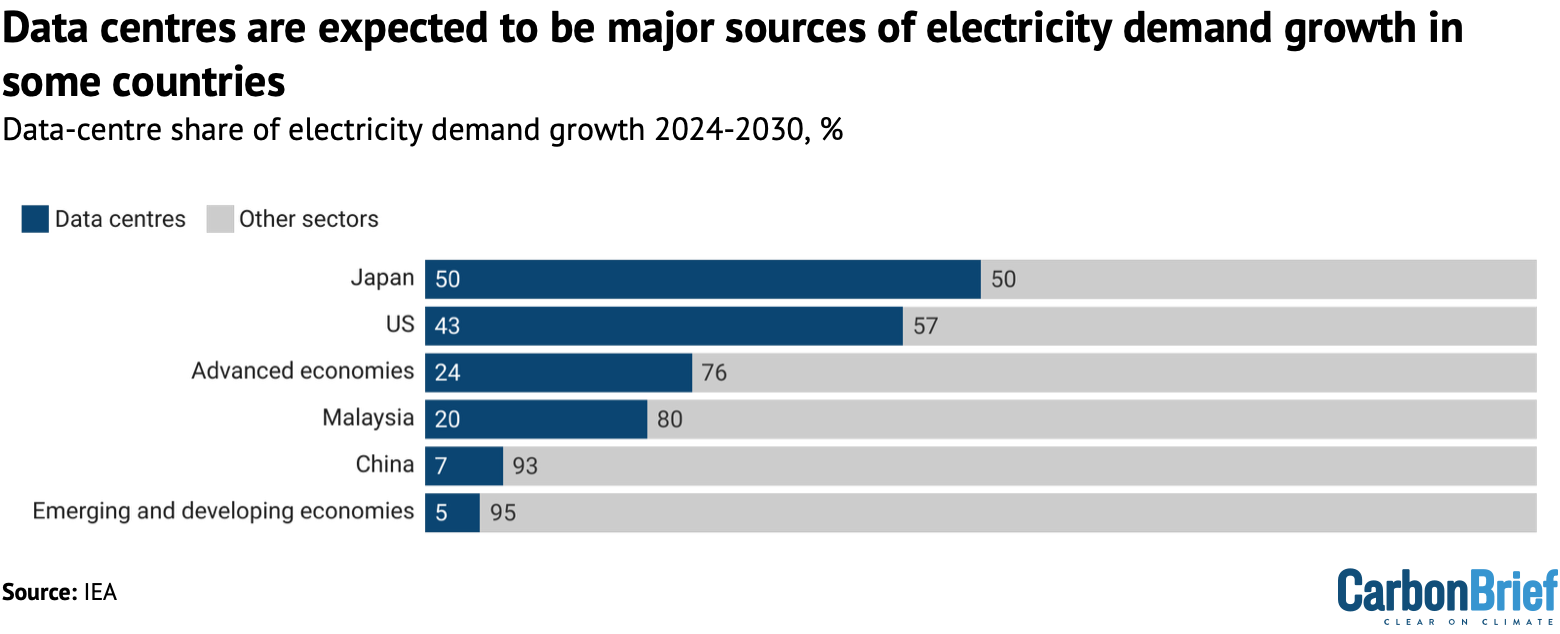
While there are some notable exceptions, such as Malaysia, data centres are set to be a relatively small portion of electricity demand growth in developing and emerging markets.
Around the world, electricity grids are under strain, with many developed countries, in particular, seeing long wait times for grid connections and new transmission lines. Data-centre growth is raising this pressure.
There are also growing concerns, notably in the US, about the impact data-centre growth could have on energy bills.
The IEA says that demand growth presents “advanced economies” with a “wake-up call” for the electricity sector to invest in infrastructure, otherwise “there is a risk that meeting data-centre load growth could entail trade-offs with other goals, such as electrification”.
4. Fossil-fuel use will likely expand to power data centres, but clean-energy supplies are set to grow faster
The extent to which data-centre growth increases emissions depends on which energy sources power those data centres.
Data centres can use power from the grid, in which case their electricity mix will reflect that of the region they are in and could therefore become cleaner as nations decarbonise.
They can also be powered by “captive” sources, built to supply specific facilities, such as solar panels, small nuclear reactors or gas turbines.
There are concerns that data-centre expansion will be used to justify the prolonged use of fossil fuels, “locking in” a future of elevated emissions.
Indeed, the likes of Shell have framed AI in such terms and some data-centre operators have been explicitly seeking gas connections to meet their electricity needs.
Currently, coal is the biggest single electricity source for data centres globally, largely due to the numerous facilities in China.
Overall, fossil fuels provide nearly 60% of power to data centres, according to the IEA. Renewables meet 27% of their electricity demand and nuclear another 15%.
(These figures are based on the electricity these facilities consume, rather than any contracts they have to buy clean energy credits.)
In the IEA’s central scenario, by 2035 the ratio of the data-centre electricity mix switches from around 60% fossil fuels and 40% clean power to 60% clean power and 40% fossil fuels, as shown in the chart below.
This is expected to be driven primarily by the wider global expansion of renewables, although some projects will be funded directly by data-centre companies.
However, the IEA says significantly more gas and coal power would likely still be required to meet data-centre demand, both from ramping up existing plants and building new ones.
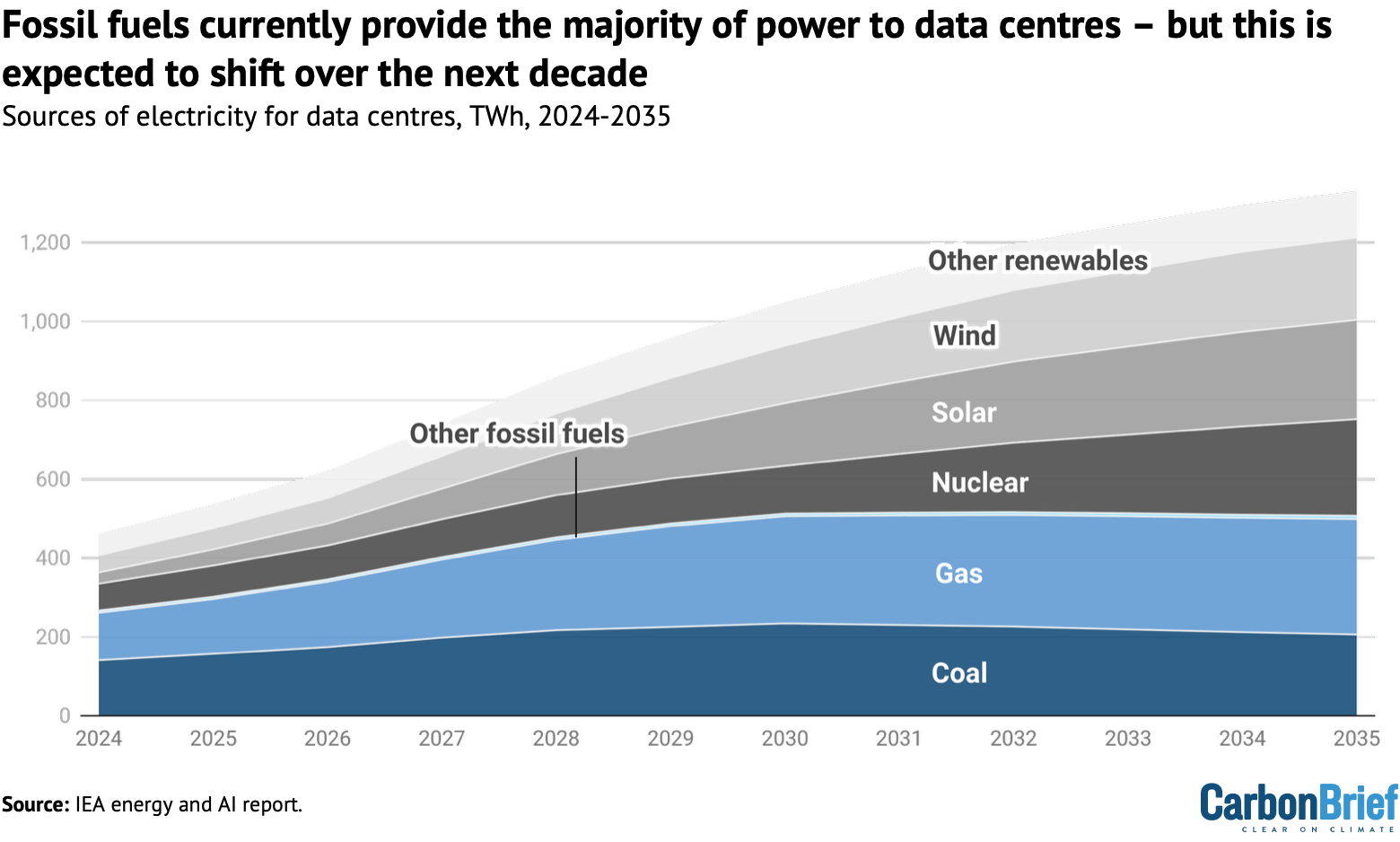
Gas-power generation for data centres is expected to more than double from 120TWh in 2024 to 293TWh in 2035, with much of this growth in the US, according to the IEA.
About 38GW of captive gas plants currently “in development” – roughly a quarter of all such projects – are planned to power data centres, according to Global Energy Monitor (GEM).
The US has doubled the amount of gas- and oil-fired capacity it has in development over the past year, driven partly by the energy demand of the “burgeoning AI industry”, according to GEM.
However, these projects are facing long lead times and “sharply” rising costs, with GEM noting, as a result, that many may never materialise.
5. There is a lot of uncertainty about how much data centres will expand
Currently, there are no comprehensive global datasets available on data-centre electricity consumption or emissions, with few governments mandating any reporting of such numbers.
All figures concerning the energy and climate impact of AI are therefore estimates.
The IEA has assessed hundreds of available estimates and forecasts, noting that even historical data can be “widely divergent”, due in part to a lack of common definitions.
On top of this, there are major uncertainties, including over how quickly AI will be adopted. Despite the enthusiastic uptake of generative AI by individuals and companies, some argue that the business case for continued, rapid growth may be weaker than suggested.
Another uncertainty is how energy-efficient AI will be. Experts have already identified efficiency improvements resulting from better chips, more efficient training algorithms and larger data centres, all of which could continue curbing electricity demand.
(Google has also reported a substantial drop in the electricity use required for individual AI search queries, which is already small compared to the power needed to train AI models.)
A final uncertainty is over how many proposed data centres will actually get built, with some speculative requests for grid capacity relating to plans that may never materialise.
As a result of these knowledge gaps, there have been numerous estimates of short-term electricity demand growth from data centres, which have produced very different results, as shown in the chart below.
Some estimates – such as one from the Gas Exporting Countries Forum arguing that more gas exports will be needed to fuel meteoric rises in electricity demand for AI – have been deemed less credible in reviews by independent experts.

Another area of great uncertainty concerns the impact that the application of AI could have on electricity use and emissions.
Some researchers have attempted to calculate how much AI could curb emissions, by helping to identify efficiency gains in other parts of the energy system, or by making technological breakthroughs.
In some “exploratory” analysis, the IEA says such gains could cancel out any extra data-centre emissions due to the growth of AI.
However, it adds that despite the AI hype, “there is currently no existing momentum of AI adoption that would unlock these emissions reductions”.


The post AI: Five charts that put data-centre energy use – and emissions – into context appeared first on Carbon Brief.
AI: Five charts that put data-centre energy use – and emissions – into context

June Rubis is a steering group committee member for the Cali Fund, from Sarawak in Malaysian Borneo.
At COP16 in Cali, governments made a significant commitment: at least half of the funding from the new Cali Fund should support the self-identified needs of Indigenous Peoples and local communities, including women and youth. It was a watershed moment for multilateral benefit-sharing.
The challenge now is to translate that commitment into access arrangements that recognise the different institutions, priorities and decision-making processes of Indigenous Peoples and local communities.
For generations, biodiversity and traditional Indigenous knowledge have provided significant value to companies who depend on nature’s genetic diversity to discover new drugs that fight diseases, create products that improve health, and grow crops resilient to extreme heat and flooding events. While some compounds are sampled directly from the source country, increasingly the digital blueprints are held in online public databases which are freely accessible to use for innovation and research.
Countries urged to ramp up “insufficient” nature policies at COP17
The Cali Fund was established at COP16 to encourage commercial users of Digital Sequence Information, or DSI, to share benefits arising from its use. Estimates suggest it could generate over $3.5 billion a year – a stark contrast to the modest $10,656 currently committed to the fund from just five SMEs, underlining how much progress must be made at COP17 over the next two weeks.
The COP16 decision that set up the fund offers two routes for money to reach Indigenous Peoples and local communities: through government authorities, and through direct payments to institutions identified by Indigenous Peoples and local communities themselves.
Varied ways of organising
Indigenous Peoples and local communities organise through a wide range of institutions. Some have national or regional organisations experienced in managing international grants. Others work through territorial organisations, customary institutions, community associations, cooperatives or networks. Some have professional finance teams and audited accounts; others have extensive experience governing territories, collective resources or conservation work without having been organised around international funding requirements.
For direct access, some questions are already apparent. Which institutions should be able to receive funds? How should they be identified? What fiduciary standards should apply? How should safeguards and accountability work where institutional capacities differ? What support may be needed where institutions have strong community mandates but less experience with international finance?
Comment: Protecting nature is a public duty, not a Wall Street profit opportunity
If access is designed mainly around institutions that already meet the expectations of large international finance mechanisms, early funding will tend to favour those already familiar to funders. They will gain further experience and become better positioned for future funding, while institutions with less administrative capacity may remain outside the system despite strong community mandates and long histories of stewardship.
These first decisions matter most, because they set the terms for everyone who follows.
The role of intermediaries requires care. Some Indigenous organisations may want a fiscal host to hold and manage funds on their behalf. Communities may choose to work through an NGO they trust. Government-facilitated arrangements may work well in particular national contexts.
What matters is the function an intermediary performs and the authority that comes with it. Providing administrative support is different from deciding which Indigenous organisations qualify, which priorities can receive support, or how success will be assessed. Direct access means communities keep that decision-making authority.
Decision-making power
The COP16 decision refers to institutions that Indigenous Peoples and local communities identify. But authority among Indigenous Peoples does not sit in one kind of body. It may sit with territorial organisations, customary institutions, community associations or combinations of these. Legal recognition and customary authority do not always align neatly.
Global deforestation slowed in 2025 but Brazil’s election could undo “fragile” gains
An important feature of the Cali Fund’s governance is that Indigenous Peoples and local communities participate as full members of the Steering Committee, rather than as observers. Seven Indigenous Peoples and local community representatives, one from each of the seven socio-cultural regions, participate in consensus-based decision-making alongside representatives of governments and UN entities. Six additional representatives from civil society, scientific institutions and the private sector participate as observers.
That representation carries responsibility. Institutional legitimacy, access and representation take different forms across the seven socio-cultural regions. Indigenous Peoples and local communities members therefore have an important role in bringing those differences into the Fund’s governance and in ensuring that arrangements developed for one context do not become the assumed model for everyone else.
Safeguards and clear responsibilities
COP17 can establish the core principles and direction, while allowing operational pathways to develop in ways that respond to different regional contexts. The decisions countries take in Yerevan will shape how that flexibility is realised in practice.
The choices made around access will influence which institutions are able to participate, which routes become established and which forms of authority are recognised within the funding architecture. The aim should be an architecture with enough structure to maintain confidence while allowing for different forms of Indigenous and community governance.
A credible direct-access pathway will need safeguards, financial oversight and clear responsibilities. This would give the 50% commitment a stronger institutional foundation.
The Cali Fund’s importance will ultimately depend not only on how much funding reaches Indigenous Peoples and local communities, but on whether they are able to determine how the money is accessed, governed and used. This requires access pathways that recognise their institutions, priorities and decision-making processes, rather than requiring them to conform to a single predetermined model.
The post COP17 must settle who decides how Cali Fund money is disbursed appeared first on Climate Home News.
COP17 must settle who decides how Cali Fund money is disbursed
The UK government has approved extraction at the Jackdaw gas field in the North Sea, despite acknowledging that this decision could make it harder for Britain to convince other countries to move away from fossil fuel production.
UK energy secretary Miatta Fahnbulleh approved the drilling on Wednesday after months of high-profile debate, f