

South Asian migrant workers building renewable energy projects in Saudi Arabia face exploitation and labour abuses, including excessive hours, high recruitment fees and average monthly salaries of just $370, a report published by a global rights organisation showed on Thursday.
Saudi Arabia, the world’s biggest crude oil exporter, is investing heavily to become a major player in the global clean energy transition and hit net zero by 2060, seeking to reduce its economic dependence on oil as the world shifts away from fossil fuels.
But as the kingdom races to transform its economy with solar and green hydrogen projects, the migrants building them are exposed to abusive hiring practices, low pay, excessive working hours, unsafe conditions and have no way to seek redress, according to the report by the London-headquartered Business & Human Rights Resource Centre (BHRRC).
The researchers interviewed 31 Nepali and three Bangladeshi workers from nine renewables projects, including solar farms and the NEOM Green Hydrogen Project. They found more than half of the workers had been subjected to forced labour.
-
NGOs urge Brazil to prevent fossil fuel capture of COP30 climate summit
More than 200 civil society groups are asking Brazil’s COP30 team to commit to “polluter-free” climate negotiations in Belém -
Russia justifies fossil gas use by citing contentious COP28 loophole
In Dubai two years ago, Russia pushed for a clause on “transitional fuels” which its new UN climate plan uses to justify gas consumption -
Nigeria gives fossil gas a bigger role as “transition fuel” in climate plan
Officials say the country needs time and money to ramp up renewables, but critics say betting on gas is a risky strategy that could prolong the “oil curse”


Saudi Arabia, home to millions of foreign workers, has long been criticised over its rights record for migrant labourers. Trade unions are banned, there is no minimum wage for migrants and the kingdom still enforces the “kafala” system of foreign labourer sponsorship.
A study by another rights group last year found similar labour violations involving migrants working on renewables projects in the United Arab Emirates.
“Saudi Arabia feels like a jail. We’re like prisoners … They brought us here and dumped us in the desert,” a Nepali worker on the Al Kahfah Solar PV Plant told BHRRC, which said the workers’ vulnerability was exacerbated by the isolated desert locations of many of the energy transition developments and project-by-project hiring by sub-contractors.
Saudi Arabia’s ACWA Power, the solar project’s developer, did not reply to the researchers’ requests for comment.
‘Alarming’ heat exposure
All of the workers interviewed were charged non-refundable recruitment fees averaging $1,600. Salaries as low as $250 per month in some instances pushed many of the migrants to work extra hours to send money home – many recounting seven-day weeks.
More than half of them reported suffering wage theft, such as deductions for taking breaks – despite often working in blistering heat above 50 degrees Celsius.
“One of the most alarming patterns of abuse was heat exposure,” said Catriona Fraser, the report’s lead researcher, adding that the abuses they had identified appeared to be “systemic and exacerbated by the structure of the industry”.
They suffered heat-related illness, including fainting, nosebleeds and – in one case – a suspected heart attack that led to death at NEOM Green Hydrogen Project, the report said.
On a few occasions, workers staged protests – which are banned in Saudi Arabia – to denounce their conditions, including at the Sudair Solar PV plant. But Fraser said protesters had been punished, with several dismissed and deported.
Neither of those two projects responded to requests for comment by the report’s authors.
‘Voices must be surfaced, not silenced’
Fraser said the researchers’ findings should increase scrutiny of the kingdom’s efforts to become a major player in global clean energy supply chains, including exporting renewable power to Europe.
“In its bid to host the 2034 FIFA Men’s Football World Cup, the country spotlights its NEOM host-city and the green hydrogen plant where we identified abuse, yet makes no mention of the migrants whose labour is helping power the transition. Their voices must be surfaced, not silenced,” she said.
Rights campaigners have criticised the decision to hold the World Cup in Saudi Arabia due to labour practices including the “kafala” system, which binds workers to their employers, despite 2021 reforms that allowed some migrant workers to leave the country without permission.
Saudi Arabia’s Human Resources and Social Development Ministry did not respond to a request for comment by Climate Home News. The kingdom has previously rejected criticism of its human rights record.
-
Digging beyond oil: Saudi Arabia bids to become a hub for energy transition minerals
The top crude exporter is using its oil riches to position itself as a major player in clean energy supply chains. Investors are interested, but hurdles remain -
The company tracking energy transition minerals back to the mines
Australian firm Source Certain traces minerals back to the exact point where they were extracted from the Earth – a technique that could help make cleantech supply chains more accountable -
Major financiers neglect energy transition risks from mining as demand booms
Financial institutions are lacking safeguards to prevent harms caused by mining the resources needed for the energy transition, analysis of the sector’s financing finds


BHRRC said several global investors were helping to finance the projects at which it identified labour abuses, including Standard Chartered, HSBC and JPMorgan Chase.
Asked to comment by BHRRC, HSBC said “we follow a clear set of sustainability risk policies which guide our approach to financing and include human rights considerations”.
Standard Chartered told the researchers it could not comment on specific cases but outlined its processes for evaluating environmental and social (E&S) risks when providing financial services to clients.
JPMorgan Chase did not respond to their request for comment.
Fraser urged all the companies involved in the projects identified in the research to “commit to investigating these violations”.
“[The rollout] of renewables must be fast, but not at the expense of the human rights of workers and communities,” the report said.
Main image: A view of the cityscape in Riyadh, Saudi Arabia (Photo: REUTERS/Mohammed Benmansour)
The post Migrant workers building Saudi Arabia’s green future face exploitation, report finds appeared first on Climate Home News.
https://www.climatechangenews.com/2025/10/02/migrant-workers-building-saudi-arabias-green-future-face-abuses-and-exploitation-report-finds/

The launch of the Africa Energy Bank (AEB) has been put back yet again, raising doubts about the institution’s future ability to finance fossil fuel projects – its main objective – as global lenders retreat from such investments over climate concerns, experts told Climate Home News.
The bank, which had been billed to launch in September after a series of delays, is now scheduled to begin operations in November, according to the head of the African Energy Chamber, an advocacy body for the continent’s oil and gas sector.
Even as the world aims to transition away from fossil fuels, many African leaders have made clear they want to continue exploring and extracting the continent’s large oil and gas deposits – estimated at around 125 billion barrels of crude and over 600 trillion cubic feet of gas – to boost economic development.
As a group, Africa sided with a number of powerful oil-and-gas producing nations in blocking progress on negotiations to craft a global roadmap to transition away from fossil fuels at last year’s UN COP30 climate talks, although some countries did individually support the proposal.
-
Campaigners oppose Dangote’s planned Kenya refinery over climate and ecological risks
Plans to build Africa’s second largest oil refinery in ecologically sensitive region criticised as “environmental recklessness” -
Tanzania pushed African nations to oppose fossil fuel transition at COP30
While chairing the African group at the summit, the gas-dependent nation advised the continent’s ministers to block language on transitioning away from fossil fuels


Meanwhile, major projects under development across the continent – including the 1,443-km East African Crude Oil Pipeline (EACOP) and Dangote’s 700,000-barrel-per-day Kenyan refinery – show that African governments see oil and gas as playing a significant role in meeting their energy and economic needs for many years to come.
In 2022, at a gathering of the African Petroleum Producers’ Organization (APPO) in oil-rich Angola, ministers from its member states adopted a resolution to create the Africa Energy Bank to finance projects for the production, use and trade of oil, gas and broader energy sources.
African control over energy resources
An article on the APPO website explains that the bank was conceived as a way to overcome “disenchantment” with fossil fuels among “the international community” which it said had crystallised around the “energy transition” concept.
“If Western countries, after having long taken advantage of the energy sources they now revile to develop, can afford the luxury of abandoning them, this is not the case in Africa,” it adds, noting that many of the continent’s economies are still largely dependent on oil and gas revenues.
A separate web page about the bank, also hosted on APPO’s website, says its objectives include financing the exploration, production and refining of oil and gas, as well as supporting member states in transitioning from fossil fuels to cleaner energy sources “while ensuring energy security”.
Said Addi, a former executive with Shell and energy commodities trading house Gunvor, said the new bank was judged necessary because financing for hydrocarbons from many traditional international lenders has become constrained.
In trying to fill this financing gap, Africa is not simply setting up another fund to support oil and gas, he added. “It is also an attempt to give African countries greater control over how their energy resources and infrastructure are financed,” he explained.
Nigeria to host the AEB
The energy bank – a joint initiative of APPO and the African Export–Import Bank (Afreximbank) – has so far suffered several delays and is almost two years behind schedule. The initial plan was to start operations in January 2025, with Nigeria as the host country, but the bank’s opening was delayed to June of that year to allow Nigeria time to finalise the construction of the bank’s headquarters in Abuja.
After the government announced the completion of the offices in late November 2025, a new launch date was set for January 2026, which was moved back to April, June and then September. Now it has shifted again to November, raising concerns that the institution may be losing momentum.
Former Shell executive Addi said that if the capital is eventually paid in, the bank becomes operational and its first projects are commercially credible, then the delays will be regarded as normal teething troubles in setting up a multilateral institution. But, he added, scepticism will be justified if it continues to stall.
Uganda may see lower oil revenues than expected as costs rise and demand falls
Baron Lamarré, an oil and gas expert and former Petronas oil trader, said that missing “three deadlines in a row is not normal”, and warned that if the timeline slips again, “the story flips from ‘ambitious institution finding its footing’ to ‘good idea that lost momentum before it found any’.”
The Nigerian government, APPO and Afreximbank did not respond to requests for comment by the time of publication.
The funding challenge
The Africa Energy Bank is targeting base capital of $5 billion, with plans to scale up to $120 billion within five years by mobilising private-sector funds. However, it is expected to start operations with initial seed capital of $500 million.
The funding plan is to have the 18 member countries of the APPO contribute $83 million each to the bank as equity for a combined $1.5 billion. Afreximbank, other non-APPO African countries and investors outside the continent are expected to provide the remaining $3.5 billion.
But even the initial $500 million has not been easy to mobilise. In May, APPO Secretary-General Farid Ghezali called on members to deliver on their pledges towards the startup goal before the end of June. But the delays suggest this may not have been met, with experts saying Africa may be finding it difficult to self-fund its oil and gas projects in the absence of international capital.
Lamarré said every extension of the deadline points to the fact that “raising fossil fuel capital in Africa without the majors and their financing networks is brutally hard”.
Why the global electrification agenda misses the point on Africa’s energy crisis
Since 2020, Western lenders, export credit agencies and insurers have been in steady retreat from African hydrocarbons, he said, while oil majors are divesting their African assets, handing over fields to smaller local operators whose credit ratings are not high enough to borrow cheaply.
Even capital from China and the Gulf, which has partially filled the gap, cannot match the volume, tenor or pricing that Western investors once offered, Lamarré argued.
“If mobilising the first $500 million of seed capital [for the AEB] has taken this long, that’s the clearest signal yet of how steep the climb to $120 billion looks,” he said, noting that the continent’s energy financing gap is as large as $30 billion-$45 billion per year.
Africa’s investment landscape, meanwhile, has been shifting. While foreign direct investment dropped from a 2024 peak, inflows remained roughly one-third above the continent’s long-term average in 2025, according to the 2026 World Investment Report from UN Trade and Development (UNCTAD). They are concentrated in a few sectors including critical minerals needed for renewable energy technologies, battery manufacturing and advanced industrial production.
At the same time, data on global energy investment from the International Energy Agency (IEA) shows that fossil fuel investment in Africa has declined over the last decade.

“Trojan horse” for fossil fuels
While the Africa Energy Bank struggles to get off the ground, climate campaigners have criticised its primary aim of financing oil and gas on the continent at a time when the world is starting to move away from high-carbon fuels to cleaner alternatives.
Bhekumuzi Dean Bhebhe, founder of Africa Change Lab, described the bank as a “Trojan horse”, arguing that its focus on fossil fuel financing runs counter to the global energy transition and the African Union’s Agenda 2063 goals of sustainable development and inclusive growth.
The energy bank, he warned, “risks locking Africa into a new cycle of debt, dependency and fossil fuel entrenchment”, adding that its financing blueprint does not pave the way for a climate-resilient future. “In truth, it is to deepen the same extractive, carbon-heavy pathways that the continent should be moving away from,” he added.
Ugandan farmers use British court to try to stop East Africa oil pipeline
Kenya-based climate and energy expert Joab Okanda said the AEB’s plan to finance oil and gas is “a misplaced priority” and it should instead back clean energy in line with the policies of some of Africa’s major export markets like Europe.
In addition, the new bank could struggle to mobilise enough resources to advance large-scale oil and gas projects, he added, noting that its proposed $5-billion initial capital is equivalent to the cost of the East African Crude Oil Pipeline alone.
The AEB’s aim of backing more fossil fuels should be flipped “to support countries that are oil-dependent to start working on their transition plans”, Okanda said.
The post Launch of Africa Energy Bank delayed again in blow to oil and gas hopes appeared first on Climate Home News.
Launch of Africa Energy Bank delayed again in blow to oil and gas hopes
A booklet published by the UK’s opposition Conservative party includes a “cost of net-zero” that appears to have been doubled by a spreadsheet error.
The “common sense” policy document argues that “what people ultimately want is a government competent enough to solve the problems for which it takes responsibility”.
In a section that says “sophisticat[ed]…modelling” should not be a substitute for “political judgement”, the “Right Way” document disparages various estimates of the cost of net-zero.
The Conservative document then claims – incorrectly – that the government’s official adviser, the Climate Change Committee (CCC), had put the cost of net-zero at close to £1tn. It says:
“In 2020, the CCC estimated that its route to net-zero would cost £957bn.”
In fact, the CCC’s 2020 estimate was exactly half this amount – £478bn – and last year it published a revised figure of £108bn, largely as a result of the falling cost of electric vehicles (EVs).
Spreadsheet error
The Conservative party’s erroneous claim appears to stem from another report that had accidentally added up numbers twice, using a spreadsheet published by the CCC in 2020.
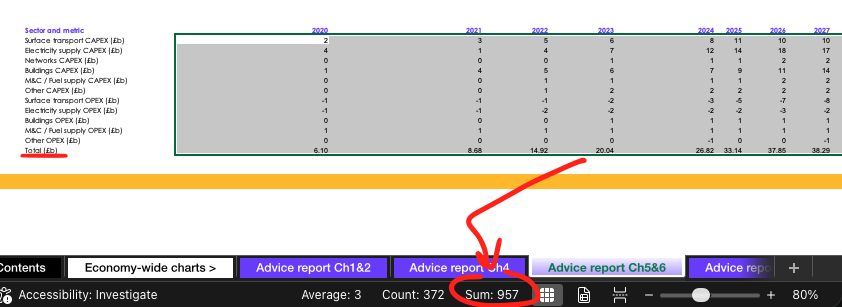
The 2020 spreadsheet contains a table listing the additional investments that would be needed to build a net-zero economy, from low-carbon electricity generation through to heat pumps and EVs.
These extra capital expenditures, listed as “CAPEX”, add up to a total of £1.38tn over the 30 years of 2020-50. They are set against operational savings, listed as “OPEX”, of £0.90tn.
Added up over 2020-50, the combined CAPEX and OPEX figures come to a total of £478bn.
In addition to the annual sectoral CAPEX and OPEX figures, the CCC’s 2020 spreadsheet also has a line giving combined totals for each year. It appears that someone has added all of these numbers together, resulting in the savings and costs being counted twice.
This double-counted total for the cost of net-zero amounts to £957bn – as shown in the image below – and it appears to be the source of the claim in the Conservative booklet.
At the time of publication in 2020, the CCC said that the £478bn net cost of net-zero amounted to less than 1% of GDP over 30 years –