Connect with us

Published

on

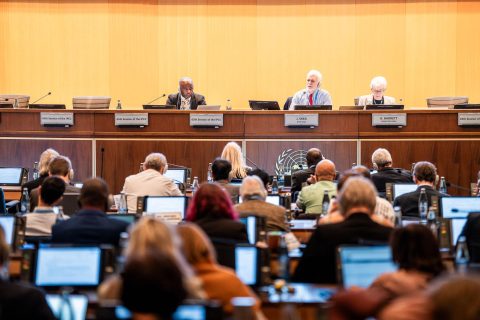
With governments due to announce ambitious emissions reduction targets at a UN summit in New York this week, the UN climate chief warned on Monday they will not add up to what is needed to keep global warming to the limits in the Paris Agreement.

Countries were asked by the UN climate change body to publish their new national climate plans (NDCs) by the end of September, in time to be included in a key summary report next month comparing those pledges with the global cuts scientists say are needed.

With around 110 countries lined up to speak at UN headquarters on Wednesday, a clearer picture will start to emerge on the scale of the gap between emissions-cutting targets and the reductions in planet-heating gases required to meet the 1.5C warming limit – 43% below 2019 levels by 2030 and 60% by 2035.

The European Union was unable to meet the September deadline because of political differences and will only present a range described as a “statement of intent” in New York this week.

China, meanwhile, is not expected to deliver an NDC that would align its efforts with the 1.5C limit. Heads of state from India and Indonesia are not scheduled to participate in the New York summit and so are likely to announce their plans later.

“We know [the NDCs] are going to be softer than what science dictates,” the UN’s climate head Simon Stiell told the opening of Climate Week in New York.

At the COP30 climate negotiations in Brazil in November, he added, “the focus… will not be what countries have presented, but how will they respond to those submissions – and that primary response is about accelerating implementation [of the NDCs], just getting it done.”

    Complex process delivering results

    Despite the expected emissions gap, growing criticism of the UN climate process, and rising global temperatures, Stiell maintained that the 2015 Paris Agreement is working to curb global warming. Projections before it was adopted suggesting a 5C rise are now down to around 3C.

    “It is slower than science dictates. It is a very, very complex process, but it is delivering results,” he said. His agency’s upcoming report will show how much further warming estimates can be lowered towards the 1.5C goal, he added.

    “We won’t be at 1.5 but we… will have inched forward, so progress is being made,” he added.

    The company tracking energy transition minerals back to the mines

    Speaking alongside COP30 president André Corrêa do Lago, both men called for more effort to translate the decisions made by the UN process into stronger climate action in the world outside. For that to happen, they said, the benefits need to be communicated more clearly to the wider public.

    “What I believe is important is for people to have confidence in the process,” Corrêa do Lago said. “We have to show that there are solutions, and we have to show that it is economically intelligent logic and useful to fight climate change – for jobs, for development. And I think this message is not fully perceived.”

    The veteran Brazilian diplomat added that he hoped the “action agenda” at COP30, which aims to encourage businesses, cities and citizens to ramp up action on climate change, would make the mission more popular.

    Stiell agreed, saying one key challenge is to “dejargonise” the COP negotiations, which are notoriously hard for those on the outside to understand, because of their long texts laden with difficult language and fractious discussions. “It is making what we’re doing more consumable in living rooms,” he said.

    Spreading the renewable energy boom

    In a separate speech on Monday afternoon, the UN climate chief said that, despite the negative “noise”, “the facts show a world aligning with the Paris Agreement”. 

    He emphasised how investment in renewable energy has increased ten-fold in the past 10 years, with investment in clean energy hitting $2 trillion last year alone and more than 90% of new renewables now costing less than the cheapest new fossil fuel option.

    “But this boom is uneven. Its vast benefits are not shared by all,” he added. “Meanwhile, climate disasters are hitting every economy and society harder each year.”

    Stiell called on industry to step up its efforts to decarbonise, saying the transition would lead to “stronger economies, more resilient supply chains, lower costs and lower emissions”.

    IEA says some oil and gas projects must shut early to meet 1.5C limit

    In particular, he urged companies running artificial intelligence (AI) platforms to “power it with renewables, and innovate to drive energy efficiency”. He warned of the need to “blunt its dangerous edges” and to use its power “to drive real-world outcomes: managing microgrids, mapping climate risk, guiding resilient planning”.

    Speaking separately at the Climate Week opening, Mark Patel, a senior partner at McKinsey & Company, said the urgency to scale up AI – which is set for investment of $5.2 trillion by the end of the decade – is currently reigniting demand for fossil fuels and competing for natural resources.

    But, he added, it could instead be used to drive accelerated uptake of renewables and cheap battery storage, as well as nuclear energy and more efficient semiconductors.

    Stiell argued that if the real economy powers forward with climate solutions and the UN talks set a higher bar for that action, with both feeding through to the other, it could lead to “a kind of virtuous loop”.

    The post UN climate chief says new national climate plans will fall short on emissions cuts appeared first on Climate Home News.

    UN climate chief says new national climate plans will fall short on emissions cuts

    Continue Reading

    Climate Change

    Women must be a starting point, not an afterthought, for adaptation

    Published

    on

    Alexandria Gordon is manager of policy and development at the Women’s Environment & Development Organization) and Demet Intepe, PhD, is a climate adaptation and resilience expert with Practical Action.

    If the world genuinely intends to help people adapt to climate change, including women cannot be treated as optional. It must be the starting point for every plan and policy.

    Across the Global South, climate impacts are already reshaping daily life. Floods, droughts and heatwaves are destroying homes, crops and livelihoods.

    Evidence consistently shows that when women and girls participate fully in adaptation efforts, entire societies benefit. Putting gender at the centre makes adaptation stronger, more equitable, and more sustainable.

    COP30 was expected to cement this understanding. Touted as “the COP of Adaptation,” it fell far short. Once again, decisions were made without meaningful consideration for the people already facing the harshest climate impacts. Communities trying to protect their homes, harvests and livelihoods are still denied the resources and action they urgently need.

    “Coordinated backlash”: Activists say COP30 gender spat reflects wider threat

    The UN Environment Programme’s annual Adaptation Gap Report outlines the scale of investment required to address escalating climate risks. What remains missing is political will – the willingness to respond to communities already facing loss, and to acknowledge that adaptation fails without women because it ignores half the knowledge and leadership societies depend on.

    Women are central to decisions about land, food, water, care and community organising on farms, in markets, in local government, cooperatives or social movements. When their rights, voices and priorities are excluded, policies address only part of the risk, funding bypasses those best placed to use it, and solutions fail to reflect how communities actually adapt.

    Women leading adaptation on the ground

    Purnima Rani Biswas in Bangladesh rebuilt her livelihood after Cyclone Amphan devastated her village in 2020. When floodwaters finally receded, she and her community received training to restore their fields and strengthen resilience. Purnima began growing crops on elevated dykes above future flood levels.

    Her success inspired neighbours, proving that farming on shifting, flood‑prone land is possible. Recovery has been slow, but the community now believes adaptation is achievable.

    Saraswati Sonar, chair of her local Community Disaster Management Committee in Nepal, plays a crucial role in keeping her community safe. She regularly contacts government hotlines for weather updates and alerts elderly people, pregnant women, and families with young children when evacuation is necessary. Her leadership ensures timely, life‑saving action.

    These examples show that women are not passive victims of climate change ­- they are active agents of resilience.

    What gender‑responsive adaptation really means

    Language shapes action. Terms like “gender‑sensitive” often become symbolic rather than transformative. “Gender‑responsive,” however, demands concrete action. It means:

    • Integrating gender as a priority across planning, budgeting, implementation, and monitoring  
    • Recognising unequal access to land, income, technology, mobility and decision‑making, and how these shape people’s ability to adapt
    • Acknowledging who grows food, collects water, rebuilds homes, and who is left behind during crises.

    Gender-responsive adaptation is not about elevating women above others. It is about making climate policy effective. Without women, climate action fails – and risks deepening existing inequalities rather than reducing vulnerability.

    Yet at COP30, some governments resisted the term “gender-responsive,” preferring weaker language that allows them to avoid meaningful commitments to equity and justice.

    Purnima Rani Biswas harvests bitter gourd (Photo: Practical Action)

    Purnima Rani Biswas harvests bitter gourd (Photo: Practical Action)

    What COP30 achieved and where it fell short

    Despite major shortcomings, COP30 delivered a few important steps for gender and adaptation. A new Gender Action Plan was adopted, intended to help mainstream gender across national plans and global policies. Its impact will depend on whether governments implement it meaningfully.

    Under the Global Goal on Adaptation, countries adopted 59 indicators to track progress, including a gender-specific indicator. This is a significant step forward: for the first time, global reporting will show whether national adaptation policies are genuinely gender-responsive.

    Tripling adaptation finance is just the start – delivery is what matters

    However, progress was uneven. National Adaptation Plans moved in the wrong direction, with gender commitments weakened and made conditional “only when applicable”, rather than central. This risks sidelining gender entirely unless civil society holds governments to account.

    Adaptation finance was COP30’s biggest failure. The decision to “triple adaptation finance by 2035” remains vague and falls short of meeting adaptation needs. The Adaptation Fund, a leader in integrating gender into climate finance, received pledges of only around $135 million – less than half its $300 million target. Without predictable, grant-based finance, even the strongest plans cannot reach the communities that need them most.

    What needs to happen next

    Real adaptation happens in homes, fields, forests and coastal villages, not in negotiation rooms. Communities living through climate impacts already know what works. Community‑led, gender‑just approaches consistently reduce climate risk and build resilience.

    To turn the Gender Action Plan’s commitments into action, governments must:

    • Make gender-responsive adaptation non‑negotiable
    • Invest in locally led solutions that prioritise community leadership and women’s intergenerational knowledge
    • Ensure finance reaches frontline communities without creating new debt
    • Use the GGA indicators to strengthen transparency and accountability

    Organisations such as the Women’s Environment and Development Organization and Practical Action already work with communities using rights-based, gender-just approaches that reflect local needs and priorities. It is crucial for organisations that work directly with most impacted communities to be part of conversations on adaptation, including countries’ policy development.

    From commitments to action

    For COP decisions to matter, they must translate into action on the ground. Adaptation can no longer remain the slow lane of climate action, and gender can no longer be sidelined. Every global decision and national action must now be intentionally gender-responsive.

    Why adaptation fails without women is no mystery. The question is who will act on what we already know?

    The post Women must be a starting point, not an afterthought, for adaptation appeared first on Climate Home News.

    Women must be a starting point, not an afterthought, for adaptation

    Continue Reading

    Climate Change

    Bridging Knowledge Systems: Indigenous Nations and Academia Collaborate on Climate Research in Canada

    Published

    on

    On the tundra in Inuit Nunangat, an Elder kneels by thinning sea ice, pointing to the cracks forming earlier each spring. Nearby, community youth work with researchers to set up monitoring equipment that tracks ice thickness, temperature shifts, and permafrost thaw. Together, they are documenting climate change not from separate vantage points, but in conversation, where Inuit knowledge of the land and Western science meet.

    Across Canada, such collaborations are on the rise. Indigenous Nations and academic institutions are joining forces to confront climate change, weaving together Indigenous ways of knowing with scientific methods. These partnerships hold immense promise: they deepen understanding, inform adaptation strategies, and strengthen resilience for both Indigenous and non-Indigenous communities. But they also raise urgent questions about ethics, ownership, and how to move beyond colonial legacies that have historically extracted and exploited Indigenous knowledge.

    The Promise and Pitfalls of Collaboration

    When done respectfully, Indigenous–academic partnerships generate knowledge that neither system could produce alone. Indigenous expertise, rooted in millennia of relationship with land, water, and sky, offers insights into biodiversity, ecosystem health, and patterns of climate change that Western science is only beginning to measure. Meanwhile, academic research provides tools like data modelling, satellite mapping, and policy advocacy that can elevate Indigenous voices in national and global decision-making spaces.

    Yet the pitfalls are significant. Indigenous intellectual property (IP), the stories, practices, symbols, and innovations that belong to Indigenous Peoples, has too often been taken without consent, acknowledgment, or benefit. In Canadian history, knowledge of plants, medicines, and land-use practices has been extracted and patented, leaving communities with nothing but loss and mistrust. These harms are not distant memories; they shape the caution and hesitation many Indigenous Nations feel when approached by universities today.

    For Indigenous communities, protecting IP is not only about legal safeguards. It is about sovereignty: the right to control how knowledge is shared, by whom, and for whose benefit. Without this, collaboration risks reproducing the very colonial patterns it claims to resist.

    Academia’s Growing Commitment to Ethical Partnerships

    Thankfully, many Canadian academic institutions are beginning to come to terms with this history and adopt new approaches to research. Universities are developing frameworks and policies that embed principles of respect and accountability, such as:

    • Free, Prior, and Informed Consent (FPIC): Research can only proceed with the voluntary and fully informed agreement of Indigenous Nations.
    • Respect for Indigenous data sovereignty: Communities must control how data is stored, accessed, and used.
    • Co-creation of research questions and methods: Projects must be shaped together, not imposed by academics.
    • Equitable sharing of benefits and authorship: Indigenous collaborators must be credited and compensated fairly.
    • Long-term accountability: Partnerships should outlast funding cycles and continue to serve community priorities.

    This shift is not perfect, nor is it complete. But the trajectory is encouraging: Indigenous governance and ethics are increasingly central to climate research in Canada.

    Consequences of Collaboration: Good and Bad

    The outcomes of these partnerships are not abstract. They have real consequences for climate action on the ground. Where research has gone wrong, communities recall sacred sites being surveyed without consent, knowledge of medicinal plants being patented for corporate use, and environmental studies that used Indigenous stories but excluded Indigenous voices from authorship. These failures reinforce mistrust and make communities wary of outsiders.

    By contrast, when done well, collaboration strengthens both knowledge and resilience. For example:

    • The Kainai Nation and the University of Calgary collaborate on drought adaptation, combining climate modelling with traditional food system knowledge to develop locally grounded strategies.
    • The Tłı̨chǫ Government and Carleton University are monitoring permafrost thaw in the Northwest Territories, where Indigenous knowledge guides interpretation while scientific tools quantify the scale of change.
    • The Anishinabek Nation and Lakehead University collaborate to restore wild rice beds, combining ecological monitoring with stewardship practices that sustain both ecosystems and culture.

    These projects illustrate what is possible when Indigenous leadership is respected and academic expertise is aligned with community priorities.

    Youth, Future Generations, and the Global Context

    Collaboration is not only about research results, but also about building capacity for future generations. Training Indigenous youth in both traditional and scientific methods ensures continuity of stewardship and opens pathways into climate sciences, data analysis, engineering, and policy. This intergenerational transfer is critical, as it is young people who will live most directly with the consequences of climate change.
    Canada is not alone in this work. Around the world, Indigenous communities are leading partnerships with academia. Māori researchers in Aotearoa, New Zealand, develop coastal restoration strategies grounded in whakapapa (genealogy), and Sámi leaders in Scandinavia combine herding knowledge with climate models to track changes in snow and migration patterns.

    Canada has an opportunity and a responsibility to lead globally by embedding Indigenous governance within research institutions and climate policy.

    What Indigenous Communities Should Consider

    When invited into research collaborations, Indigenous Nations should feel empowered to set terms, ask questions, and safeguard their knowledge. Key considerations include:

    • Consent: Has Free, Prior, and Informed Consent been obtained, clearly and respectfully?
    • Intellectual Property: Who owns the data and knowledge? How will it be used, stored, and protected?
    • Community Benefit: Does this project address our priorities and bring tangible benefits to our people?
    • Co-creation: Were we part of shaping the questions and methods, or are we being slotted into a pre-existing framework?
    • Cultural Protocol: Are researchers prepared to follow our laws, ceremonies, and privacy requirements?
    • Data Sovereignty: Will data remain under our governance?
    • Capacity Building: Will this train our youth, employ our people, or build local expertise?
    • Publication Rights: Do we have control over how findings are published, and will our members be acknowledged as co-authors?
    • Exit Plan: What happens when the project ends? Will knowledge, data, and benefits remain with us?

    These questions are not barriers; they are safeguards to ensure collaboration is ethical, reciprocal, and grounded in Indigenous sovereignty.

    Strengthening Indigenous–Academic Partnerships

    To move forward, Canada must think beyond project-by-project partnerships and build systemic change built in true collaboration with Indigenous-led initiatives such as:

    • Embedding Indigenous governance in research ethics boards.
    • Supporting Indigenous-led research universities and centres of excellence.
    • Creating funding streams that prioritize Indigenous research sovereignty.
    • Establishing national policy frameworks to protect Indigenous knowledge.
    • Formalizing spaces for reciprocal knowledge exchange that place Indigenous and Western knowledge systems on equal footing.

    These steps shift collaboration from a transactional to a transformational approach.

    A Call to Action

    The convergence of Indigenous knowledge and academic research offers immense promise in confronting climate change. Together, these systems can generate insights grounded in centuries of relational stewardship and sharpened by scientific rigour. But true collaboration demands more than goodwill. It requires dismantling colonial patterns, affirming Indigenous intellectual sovereignty, and ensuring that research benefits the lands and peoples from which it arises.

    To academia: move beyond consultation and share governance of research with Indigenous Nations.

    To governments: fund Indigenous-led research and respect Indigenous sovereignty in climate policy.

    To Indigenous Nations: know your power, set the terms, protect your knowledge, and demand reciprocity.

    The path forward shines brightest when Indigenous and academic knowledge systems walk side by side. If Canada adopts this model, the future will not only be more just, but also more resilient for the land, the waters, and future generations.

    Blog by Rye Karonhiowanen Barberstock

    Image Credit : Julian Gentile, Unsplash

    The post Bridging Knowledge Systems: Indigenous Nations and Academia Collaborate on Climate Research in Canada appeared first on Indigenous Climate Hub.

    Bridging Knowledge Systems: Indigenous Nations and Academia Collaborate on Climate Research in Canada

    Continue Reading

    Climate Change

    “New era of climate extremes” as global warming fuels devastating impacts in 2025

    Published

    on

    In 2025, greenhouse gas emissions produced by human activities turned what should have been a cooler year into one of the hottest ever, fuelling more dangerous and frequent heatwaves, droughts, storms and wildfires, climate scientists said in an annual report.

    Planet-heating emissions primarily caused by burning fossil fuels pushed temperatures this year to “extremely high” levels, worsening extreme weather with devastating consequences – especially for the world’s most vulnerable, concluded scientists working with the World Weather Attribution (WWA) group.

    Despite the return of La Niña – a climate pattern linked to large-scale cooling of the Pacific Ocean, which can temporarily bring milder global temperatures – the EU monitoring service Copernicus has said 2025 is “virtually certain” to end as the second- or third-warmest year on record.

    Nine of our best climate stories from 2025

    In its report released on Tuesday, the WWA research group found that climate change made 17 of the 22 extreme weather events it assessed this year more severe or more likely, while its remaining studies were inconclusive, mostly due to a lack of weather data from remote areas.

    Ranging from heatwaves in South Sudan and Western Europe to extreme rainfall in Southeast Asia and wildfires in Los Angeles, those disasters killed thousands of people and displaced millions from their homes.

    In 2025, the World Weather Attribution group studied 22 new extreme weather events and revisited 6 heatwaves for a special report

    In 2025, the World Weather Attribution group studied 22 new extreme weather events and revisited 6 heatwaves for a special report

    11 extra hot days since Paris Agreement

    Theodore Keeping, a researcher at Imperial College London, said the catastrophic wildfires, record-breaking rainfall, unprecedented temperatures and devastating hurricanes seen in the last 12 months provide “undeniable evidence” of a rapidly changing global environment.

    “We are living in the climate that scientists warned about a decade ago, when the Paris Agreement was signed,” he added.

    Since the landmark accord was adopted in 2015, global average temperatures have risen by about 0.3C, and the world now experiences an average of 11 additional hot days each year, according to WWA’s research.

      For the first time, global average temperatures over the last three years are on track to exceed 1.5C, the most ambitious goal governments agreed in Paris, according to the EU’s Copernicus service. The UK’s Met Office expects 2026 to be between 1.34C and 1.58C hotter than preindustrial levels.

      “The continuous rise in greenhouse gas emissions has pushed our climate into a new, more extreme state, where even small increases in global temperatures now trigger disproportionately severe impacts,” said Sjoukje Philip, a researcher at the Royal Netherlands Meteorological Institute (KNMI). “We are entering a new era of climate extremes, where what was once an anomaly is quickly becoming the norm,” she added.

      Silent-killer heatwaves

      While heatwaves don’t leave a visible trail of destruction and often go underreported, the research group found they were the deadliest extreme weather event of 2025. One study estimated that climate change more than tripled the number of deaths caused by searing temperatures recorded across Europe this summer.

      In South Sudan, extreme heat forced schools to close for two weeks in February 2025 after dozens of children collapsed with heatstroke. Human-made climate change made that heatwave 4C hotter and transformed an exceptionally rare event into a common one, now expected to happen every other year in South Sudan, a WWA assessment found.

      Keeping of Imperial said the impacts are disproportionately shouldered by women and girls who predominantly work in sectors with high heat exposure such as agriculture and street-vending.

      Flood risks rise as adaptation limits near

      Floods were the disasters most studied by the WWA team in 2025, with devastating downpours made worse by climate change hitting Pakistan, Sri Lanka and Indonesia, the Mississippi River Valley in the US and Botswana.

      In the Southern African nation, spells of extreme rainfall are becoming more frequent within a single year, while the rapid expansion of urban centres without adequate infrastructure upgrades makes them more susceptible to severe flooding, according to WWA.

      The research group said this underscores the urgency of investing in measures to adapt to a warming world which can prevent many deaths and widespread destruction but remain critically underfunded.

      However, the scientists also warned that even strong efforts to prepare for disasters cannot prevent all impacts, as climate change is already pushing millions close to the “limits of adaptation”.

      “Jamaica was in a state of preparedness for Hurricane Melissa five days before landfall,” noted Keeping, “but when such an intense storm hits a small island nation in the Caribbean, even high levels of preparedness cannot prevent extreme losses and damages”.

      Fossil fuel dependency is “costing lives”

      Hurricane Melissa caused an estimated $8.8 billion in physical damage in Jamaica, equal to 41% of the country’s 2024 GDP, with only a small share of the losses expected to be covered by innovative insurance schemes.

      In their report, WWA researchers said that drastically reducing fossil fuel emissions remains the key policy to prevent the worst climate impacts.

      “Decision-makers must face the reality that their continued reliance on fossil fuels is costing lives, billions in economic losses, and causing irreversible damage to communities worldwide,” said Friederike Otto, WWA’s co-founder.

      The post “New era of climate extremes” as global warming fuels devastating impacts in 2025 appeared first on Climate Home News.

      “New era of climate extremes” as global warming fuels devastating impacts in 2025

      Continue Reading

      Trending

      Copyright © 2022 BreakingClimateChange.com