

The ocean plays a vital role in regulating the climate, storing roughly 50 times more carbon dioxide (CO2) than the atmosphere.
Marine life plays a significant part in this process, as organisms transfer carbon from the ocean surface to the deep sea upon death or as they migrate.
Our new research, published in Nature Communications, suggests the contribution of ocean biology to climate regulation is more complex than previously thought.
To explore how ocean biology shapes the past, present and future climate, we explore an extreme scenario where all marine life has been wiped out.
We find that – in a pre-industrial climate – CO2 levels would rise by 50% without marine life, leading to 1.6C of global warming.
In a separate study in Nature Climate Change, we estimate that ocean biology sequesters the equivalent of 10bn tonnes of CO2 each year.
This is more than one quarter of annual fossil-fuel emissions from human activity.
We also calculate that the contribution of marine life to carbon storage is worth hundreds of billions of dollars each year.
Biological carbon pump
The ocean takes up and stores vast amounts of CO2 every year through two mechanisms known as “carbon pumps”.
The first is the “solubility pump”. This is the process by which dissolved CO2 in seawater is transported from the ocean’s surface to its depth through the sinking and upwelling of water mass.
The second is the “biological carbon pump”. This is the process where carbon is converted into organic materials by plankton and other marine organisms at the ocean’s surface and then transported to the deep sea when they die or migrate.
Scientists have long known that the biological carbon pump played an essential role in maintaining low atmospheric CO2 levels before the industrial revolution.
However, the conventional view is that the solubility pump has been responsible for the ocean’s steady absorption of rising CO2 emissions caused by human activity.
Our findings challenge this view, by showing the biological carbon pump plays a crucial role in the modern ocean’s sequestration of atmospheric CO2.
We find that, without marine life, the ocean’s capacity to capture CO2 emissions would be significantly diminished.
Two scenarios
To get an estimate of the contribution of the marine carbon pump in a stable pre-industrial climate, we simulate the planet’s climate as it was before the industrial era using a complex Earth system model.
(This is the second generation of the Norwegian Earth system model, which contributed to the sixth Coupled Model Intercomparison Project.)
We then explore what would happen to the Earth’s climate system under two scenarios:
- A reference, “healthy ocean” scenario where ocean biology conditions were as realistic as possible.
- An “abiotic” scenario where all marine life is removed.
In a pre-industrial scenario with no marine life, we find that atmospheric CO2 levels would rise to 445 parts per million (ppm). This is an increase of more than 50% on the “healthy ocean” scenario, where CO2 levels are 282ppm.
(This suggests that the influence of marine life on global CO2 levels is greater than the sum of all human activity, which has – so far – raised atmospheric CO2 concentrations to around 425ppm).
The rise in CO2 levels caused by the absence of marine life would result in about 1.64C of global warming at the surface and a 1.15C increase in global sea surface temperature.
This warming would have considerable impacts on the wider world, including declines in sea ice area at the Arctic and Antarctic of close to 25% and an Atlantic Meridional Overturning Circulation that was around 9% weaker.
The value of exploring such an extreme scenario is to investigate the role biological processes in the ocean play in carbon storage, as well as the implications of damage to marine life.
The role of terrestrial ecosystems
Our estimation that pre-industrial atmospheric CO2 would rise by 163ppm without ocean biology is on the lower end of the 150-240ppm range approximated by some previous studies.
However, previous estimates of the contribution of the biological carbon pump in a pre-industrial climate neglect the interactions between oceanic and terrestrial biospheres.
Our research reveals that terrestrial ecosystems – such as tropical forests and grasslands – play a crucial role in compensating for the increase in CO2 concentrations when ocean life declines. (This is due to the CO2 fertilisation effect, when higher CO2 concentrations speed up photosynthesis).
We find that in the extreme pre-industrial scenario, approximately half the carbon lost from the ocean is absorbed by the land.
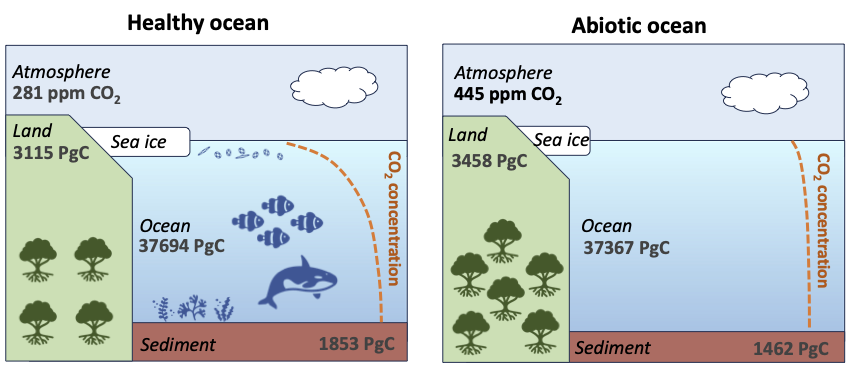
The figure below illustrates the Earth’s carbon reservoirs in a pre-industrial climate with (left) and without (right) marine life. It shows how, if marine life is wiped out, carbon content decreases in the ocean and marine sediment, whereas more carbon accumulates in the atmosphere and on land.
Ramifications for the future
Today, the ocean captures approximately 25% of human-caused CO2 emissions – which allows it to play a crucial role in slowing global warming.
In order to estimate the overall importance of marine life to carbon sequestration in the ocean, we also conduct experiments for various future emission pathways – both with, and without, marine life.
In all cases, we find that more CO2 emitted by human activities remains in the atmosphere when there is no marine life.
One might think that the ocean’s lower concentrations of carbon in the pre-industrial climate, relative to the atmosphere, might mean it would be able to absorb more additional carbon.
However, we find the absence of marine life fundamentally alters the vertical distribution of carbon in the ocean. Although the total amount of carbon stored is lower, there is more carbon at the surface due to an absence of organisms. This, in turn, hinders additional CO2 from entering the ocean.
Another surprising finding of the simulations was that the terrestrial biosphere’s capacity to absorb excess CO2 by increasing its vegetation mass diminishes over time, potentially due to limited nutrients.
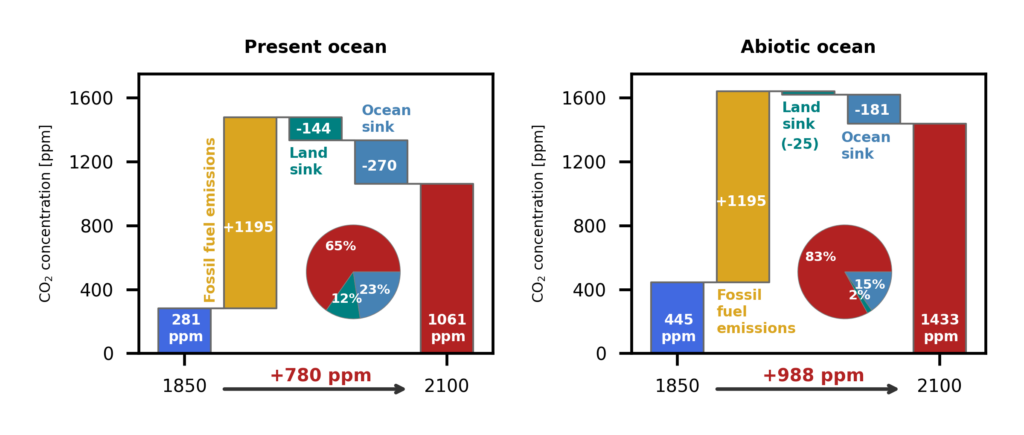
The figure below shows the distribution of human-caused CO2 in the Earth’s carbon reservoirs under two 2100 scenarios. The chart on the left shows a scenario with ocean life, and the chart on the right shows one without ocean biology.
It illustrates how, without marine life, more CO2 stays in the atmosphere and less goes into the land and the ocean.
The study shows that in the absence of marine life, future warming would occur faster and more intensely.
This acceleration in warming would potentially trigger other processes that could further amplify warming, such as greater ocean stratification, longer sea-ice free Arctic summers and greater loss of permafrost.
Economic benefits
Damaging marine life is economically costly given the many and various benefits – or “ecosystem services” – provided by carbon sequestration.
We estimate that the sinking of organic matter sequesters approximately 2.8bn tonnes of carbon annually, locking it away from the atmosphere for at least 50 years.
This carbon sequestration capacity is equivalent to 10bn tonnes of atmospheric CO2 – or roughly 27% of emissions generated by fossil fuels in 2024.
We estimate – based on a carbon price of $90 per tonne of CO2 – that the carbon storage provided by the marine carbon pump is worth $545bn per year in international waters and $383bn per year within national waters. Its total value is projected to exceed $2.2tn by 2030.
Carbon storage is valuable because it helps avoid climate impacts.
This economic value is important for developing countries, particularly small island developing states whose national waters are collectively responsible for 11% of biological carbon pump sequestration activity, in terms of carbon stored.
The top eight countries where the biological carbon pump value is highest in proportion to gross domestic product (GDP) are small island states. These are the Cook Islands, Kiribati, the Marshall Islands, Micronesia, Nauru, Niue, Palau and Tuvalu. Of these nations, just one – the Cook Islands – is classified by the World Bank as high income.
These climate-impacted nations’ key role in preserving ocean health should be considered in discussions of international climate finance.
The figure below shows the economic value of carbon sequestration of the biological carbon pump for each of these eight small island states, calculated on the basis of a carbon price of $90 per tonne of CO2.
For example, it illustrates how Micronesia and Kiribati have an estimated biological carbon pump value of $4,620m and $8,525m each year, respectively.

A healthy ocean buys the world time in the battle against global warming, but the window to protect it is closing rapidly.
Marine ecosystems remain vulnerable to a raft of human activities, including industrial fishing, pollution, shipping and deep-sea mining. Stronger conservation policies, enhanced financial incentives for lower income countries and increased international cooperation are essential to protect the services provided by ecosystems.
These are important steps towards not only protecting 30% of the global ocean as agreed under the new Global Biodiversity Framework – but it will help to reach the Paris Agreement’s climate target.
There are a number of tools at governments disposal to protect the valuable services provided by marine ecosystems. This includes promoting sustainable fishing and ecotourism, establishing marine protected areas and undertaking robust environmental impact assessments.
Nations can also support protection of the biological heat pump within international waters by ratifying the High Seas Treaty, which recognises the importance of protecting biogeochemical cycles.




The post Guest post: How marine life provides climate benefits worth billions of dollars appeared first on Carbon Brief.
Guest post: How marine life provides climate benefits worth billions of dollars

As an extreme El Niño breaks marine temperature records, COP31 is set to boost the profile of the ocean’s role in solving climate change, but finance and clear conservation measures will be needed for it to move the needle, experts said.
The Turkish presidency has announced plans for an Antalya Ocean Declaration that recognises the centrality of the global ocean – the world’s largest carbon sink – in regulating the climate and minimising the now unavoidable overshoot of global temperatures above 1.5C over pre-industrial levels.
Meanwhile, as part of the formal UN negotiations, Australia has announced plans to land a cover decision in Antalya, which, according to veteran former US negotiator Sue Biniaz, would be the only section of the formal negotiations where the role of oceans could be included.
She added that an outcome at COP31 seems likely, given the initiative from both presidencies and a push from over 100 countries – including Brazil, the EU and the African Group of countries – calling for the UN negotiations to deliver a plan for implementing ocean measures.
Governments will arrive in Antalya with a “super El Niño” adding stress to marine ecosystems and expected to continue to intensify until December 2026, with parts of the Pacific averaging almost 30C (86F) – over 3C more than normal – in October, according to monthly EU sea temperature data.
-
COP31 Briefing: What to expect from the Antalya climate summit?
Electrification, the fossil fuel transition, adaptation to rising impacts, climate science and trade are key themes as governments gather for COP31 in Türkiye -
European nations signal support for fossil fuel roadmap, says COP30 president
André Corrêa do Lago told Climate Home News that it’s up to other nations to decide how the fossil fuel and deforestation roadmaps are used -
Nepal seeks stronger recognition of mountain issues in UN climate process
Flood-hit Nepal wants COP31 to adopt a new agenda item formalising work on mountains and climate change and boosting the response to rising risks


Needs for ocean conservation and funding
While elevating the ocean agenda is “critical”, it must lead to funding for ocean conservation and a clear plan for reaching the global target – set at UN biodiversity talks in 2022 – of protecting 30% of the global ocean by 2030, said Pradeep Singh, senior ocean governance expert at Oceano Azul Foundation.
The ocean is precisely where governments are farthest off track from meeting this target – informally known as the 30×30 goal. Even if countries meet all their nature conservation plans, only about 12% of the global ocean would be protected, the UN says.
“Acknowledgment of marine protected areas and the 30×30 target as climate infrastructures will certainly boost efforts and funding for science and management,” Singh told Climate Home News.
Shamini Selvaratnam, director of international climate and clean energy at Ocean Conservancy, said an ocean commitment that makes a difference in coastal communities “takes funding, local capacity and support that countries can actually access”.
An analysis by climate think tank Zero Carbon Analytics shows that investment in the blue economy – through activities like sustainable fisheries or cleaner shipping – is only at about 2% of the needs, which are estimated at $550 billion per year.

Following-through on commitments
Selvaratnam added that countries must also establish mechanisms to follow through on these measures, which currently only exists in the form of a non-binding dialogue that is not expected to produce any negotiated agreements.
She said that countries at COP31 must find ways for their ocean commitments to inform the next global stocktake, the UN’s five-yearly review of progress on climate action. Some countries – including African countries, Latin American nations, small island states and the European Union – have backed a process that culminates in the next global stocktake.
At climate negotiations, countries are not mandated to include ocean conservation measures in their climate plans. But a group of countries led by France and Brazil is pushing them to do so voluntarily through an initiative called Blue NDC Challenge. Seventeen countries have joined the initiative so far.
In its list of COP31 priorities, the EU has called for the “critical role” of oceans to be recognised, but falls short of calling for any specific actions to feature marine action more prominently in climate plans.
As part of their demands, ocean campaign groups have called for the establishment of an “Antalya Ocean Compact”, a platform where countries can coordinate efforts across different environmental treaties, including the UN climate, biodiversity and high seas negotiations.
Ultimately, Selvaratnam said a strong deal “must accelerate emissions cuts, clean energy, and a transition away from fossil fuels, including offshore oil and gas”.
Ilana Seid, chair of the AOSIS group of small island states and permanent representative of Palau to the UN, said during a press briefing last week that “meaningful progress” on emissions reduction is “the best way” to alleviate stress on the ocean.
The post ‘Blue COP31’ set to spotlight need for ocean protections amid record heat appeared first on Climate Home News.
‘Blue COP31’ set to spotlight need for ocean protections amid record heat
In the wake of its recent glacial flooding disaster, Nepal and the kingdom of Bhutan have proposed a new agenda item on mountains and climate change for the COP31 summit which opens on Monday in the Turkish city of Antalya.
In a submission addressed to the COP31 presidency and the head of the UN climate secretariat (UNFCCC), Nepal said the agenda item, entitled “1.5°C Warming in Mountains”, is an effort to strengthen the response of the international community to the climate risks facing the world’s mountain regions.
The item proposes that mountain issues should become a regular part of the formal UN climate change process, with a focus on scientific assessment of the risks associated with warming overshooting 1.5C, an annual high-level dialogue, a dedicated work programme and improved access to climate finance.
Maheshwar Dhakal, chief of the climate change management division of Nepal’s Ministry of Agriculture, Forests and Environment, told Climate Home News that Himalayan countries face similar problems such as collapsing glaciers and flooding from glacial lakes.
“We are trying to bring all Himalayan countries together under this agenda item,” he said.
COP31 Briefing: What to expect from the Antalya climate summit?
At this year’s UN General Assembly, Nepal’s Prime Minister Balendra Shah called for strong global action to ensure climate justice and proposed creating a Himalayan Climate Resilience Mechanism led by India, China and Nepal. It would share satellite data, monitor glacial slopes and lakes, strengthen early warning systems and coordinate cross-border disaster response.
Nepal has experienced significant infrastructure losses and human casualties from flooding every year since 2020. In late August, the collapse of a glacial slope on the border with Tibet caused a torrent of water and debris to course down the Bhote Koshi River, leaving more than 6,000 people dead or missing.
According to a government needs assessment, the disaster caused an estimated $2.7 billion in physical damage and economic losses, while around $4.8 billion will be required for recovery and reconstruction.
More research needed on threats
Although high mountain regions are known to be fragile ecosystems, especially as global warming accelerates glacier melt, the extent of their vulnerability is still not fully understood. When the devastating Bhote Koshi floods hit, it opened the eyes of the world to the risks.
Dhakal said the Bhote Koshi floods “have proved the impacts of climate change in the Himalayan region”, which were linked to rising temperatures by scientists with the World Weather Attribution group. “Therefore, Nepal wants scientific studies, research and political discussions on mountain climate risks to receive greater attention at international climate conferences,” he added.
Nepal has been making efforts on this front since 2009, when it held a cabinet meeting at Kalapatthar near Mount Everest. Since COP28 in Dubai, Nepal has organised high-level events and dialogues on mountain issues at COPs and is co-hosting one at COP31 with Bhutan, Pakistan, Kyrgyzstan and Tajikistan.
Editor’s Desk: Nepal’s disaster has laid bare the world’s adaptation accountability gap
Dhakal said the dialogues held so far have raised awareness, but mountain concerns must become part of the formal UN climate process to unlock climate finance and technical support that can bolster countries’ capacity to tackle climate threats.
If specific indicators and priorities are developed for mountain regions, vulnerable developing countries like Nepal would have better access to finance to help them adapt to the climate warming they have done very little to cause, he added.
More detailed data would enable them to prepare stronger project proposals for international climate funds, including the Green Climate Fund (GCF). In 2025, the GCF backed a project to protect livelihoods from climate-induced flooding in Nepal but it took seven years to get approval.
Sindhu Dhungana, an alternate board member at the GCF, said the problem is becoming more widespread and urgent for the Hindu Kush Himalaya region.
“The economies, cultures and almost everything in Himalayan countries depend on mountains,” he explained. “For us, climate change is mountain change… [it has] affected everything, including the economy and biodiversity.”
Destroyed development projects
Nepal wants the UN climate process to address mountain risks both before and after disasters. Countries need better research, technology, early warning systems and other adaptation measures to protect people and infrastructure. But even when countries take precautions, loss and damage is likely to occur and will require international support to address it.
Nepal has been provisionally allocated $21.6 million from the United Nations’ new Fund for Responding to Loss and Damage (FRLD) to help with the aftermath of the Bhote Koshi disaster, but this is just a fraction of needs and the money will come only months after it made an initial request.
Dhakal pointed to the damage caused by floods to infrastructure built with loans, such as the Melamchi Drinking Water Project, which received $312 million from the Asian Development Bank but was destroyed by a major flood in 2021, shortly after it began operating. The recent Bhote Koshi disaster wiped out a dozen hydropower facilities, as well as solar energy systems.
Nepal flood destruction shows “limits to adaptation”, scientists say
Nepal wants international discussions on what should happen when climate-related disasters destroy development projects built using credit, and how the loans should be treated afterwards.
“Climatic disasters wash out… projects, but the burden of loan is still paid by Nepal,” Dhakal said.
For now, it remains unclear whether the opening session of COP31 will consider or adopt the proposed agenda item on mountains and climate change, with consultations on how to respond still underway among governments and the COP31 co-presidencies.
“If countries agree to discuss the proposal and include it in the agenda, that would be another step forward,” Dhakal said. “Further discussions in the coming years could gradually give the mountain agenda a stronger shape.”
The post Nepal seeks stronger recognition of mountain issues in UN climate process appeared first on Climate Home News.
Nepal seeks stronger recognition of mountain issues in UN climate process