Connect with us

Published

on

Weather Guard Lightning Tech

Revolutionizing Wind Turbine Blade Inspections: Romotioncam Does it With No Downtime

Romotioncam is redefining the way operators inspect wind turbine blades—while the blades keep spinning.

In a recent Spotlight podcast , René Harendt, CTO of Romotioncam, and Dr. Michael Stamm, a researcher at Germany’s Federal Institute for Materials Research and Testing (BAM), spoke with Weatherguard Lightning Tech CEO Allen Hall and CCO Joel Saxum about the company’s unique inspection system.

By combining cutting-edge photographic technology, thermal diagnostics, and structural analysis, Romotioncam’s inspection system delivers accurate, in-depth, actionable data, while eliminating the need to shut down turbines.

How does it work? Read on.

The full interview – which includes a little more physics and some discussions about a blade’s unique thermal signature – was recorded in December, 2024. It can be found here.

A New Lens on Blade Inspections

With a single camera mounted on a pan-tilt head, Romotioncam’s patented tracking system follows wind turbine blades as they rotate, even at high tip speeds. The system tracks the rotor and blade tips in real-time, capturing detailed images that allow inspectors to spot early-stage defects such as cracks, erosion, and structural deformations.

“Our camera system calculates the blade position and rotor speed and adjusts accordingly,” Harendt explained. “Even at high speeds, we can follow the tip, delivering stable, high-resolution imagery, without stopping the turbine.”

The patented process solves long-standing challenges of motion blur and incomplete data during traditional inspections that require turbines to be shut down.
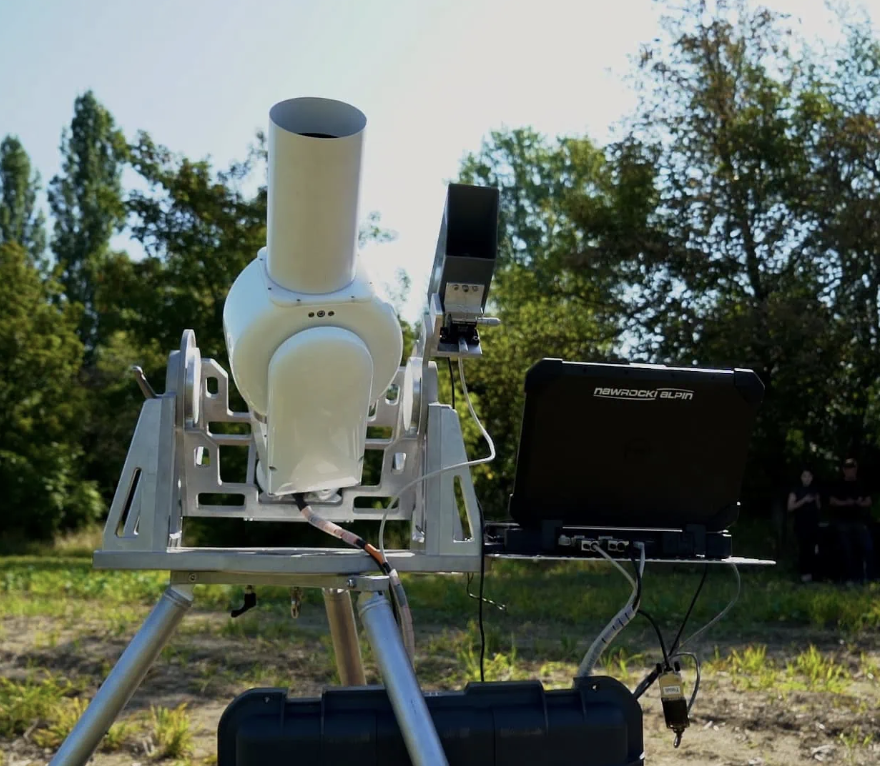
Revolutionizing Wind Turbine Blade Inspections: Romotioncam Does it With No Downtime
Image courtesy of Romotioncam

“The information from this is remarkable,” Hall said.

Seeing Beneath the Surface: Thermal Imaging in Action

Research from BAM’s Dr. Stamm has added another dimension to the innovation: the thermal imaging of turbines while in operation—a practice historically limited by technology constraints.

“We needed synchronized, high-resolution visual imagery to make accurate interpretations of our thermal data,” Stamm said. “That’s where Romotioncam was the perfect match.”

By integrating both thermal and visual data into a single system, Romotioncam can detect aerodynamic inefficiencies and internal blade defects that were previously undetectable without physical access.

“Thermal signatures can tell us about laminar versus turbulent airflow, which in turn highlights surface erosion or leading-edge damage,” Stamm explained. “We can also detect structural anomalies—like delamination—due to variations in heat capacity across different blade materials.”

Need a refresher? Laminar vs. Turbulent Airflow, and Why It Matters

No Downtime Turbine Blade Inspections

For operators, Romotioncam’s biggest advantage may be that inspections can be done without lockout/tagout, and without field crews.

“You give us the location and specs. We capture the data remotely, independently, and you get a full report. You might not even know we were there,” Harendt said.

This remote, approach is a game-changer—especially during winter, when turbine downtime comes at a particularly high cost.

And while “no downtime” blade inspections has an undeniable appeal, the data is uniquely actionable.

“It helps operators assess not only structural safety, but also performance efficiency, which informs decisions on repair timing and can improve operational ROI,” Harendt noted.
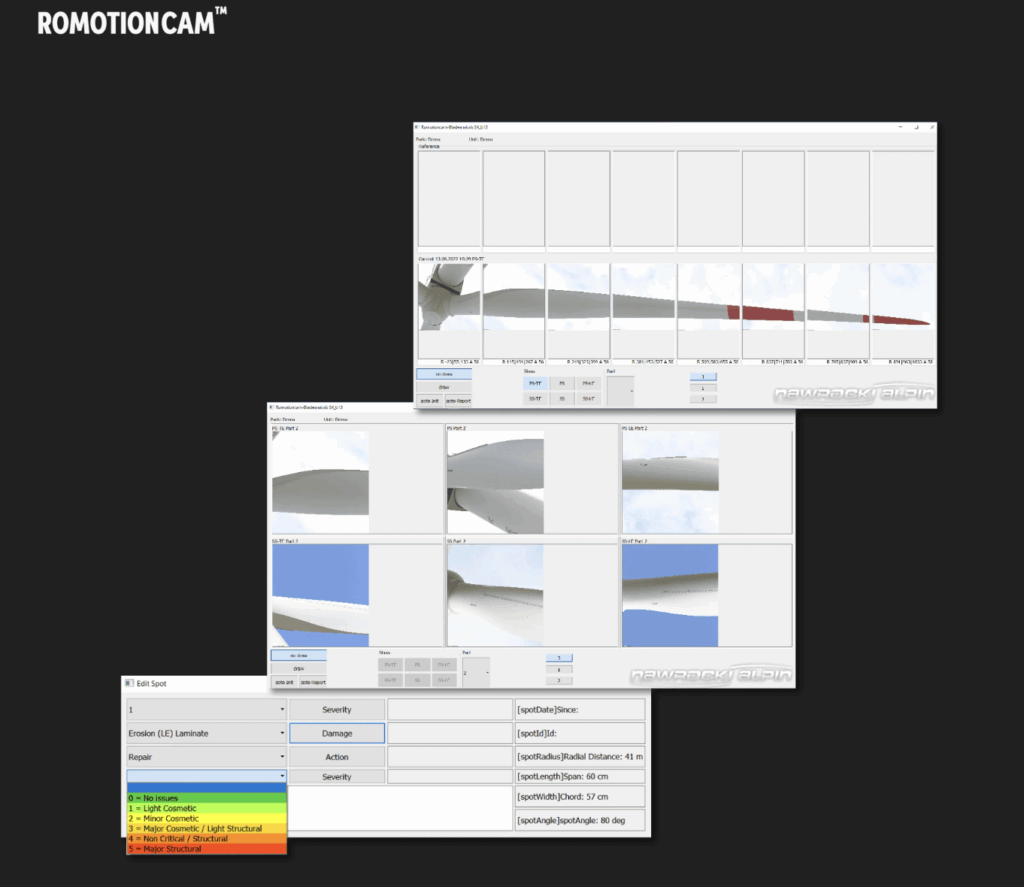
Damage assessment reporting tool
Romotioncam’s DART, or Data Assessment Reporting Tool, informs operational decisions. Credit: Romotioncam

From Research to Real-World Impact

The partnership between Romotioncam and BAM has already generated compelling data. Stamm reports that about 30 turbines have been analyzed using thermal imaging, with results publicly available. (link below) Stamm said the images clearly show how minor defects lead to turbulent airflow and energy losses.

“The visual overlay of turbulence and structural damage is remarkable,” Stamm. “We’re starting to see patterns that weren’t clear before. Sometimes, we find turbulence without visible damage, which raises new research questions.”

As wind farms globally find downtime becoming more expensive, Romotioncam’s fast, remote, intelligent inspections have tremendous appeal, providing high-quality, actionable data without equipment downtime.

What’s Next: Dual-Camera Systems, Deeper Insights – and a US project?

Romotioncam’s next milestone will be to integrate both thermal and visual cameras into a single, compact inspection unit to allow one-shot diagnostics with layered image analysis, providing a fuller picture of both external and internal blade health—potentially up to 10 cm deep.

“It’s not just about seeing damage,” Harendt said. “It’s about confirming that if you don’t see anything, there’s truly nothing there. And that requires understanding the right conditions for inspection.”

While Romotioncam is headquartered in Germany, and works primarily on European wind projects, Harendt said the company continues to look at expanding into the US.

Listen to the full interview here: Romotioncam: Inspections in Motion

See the Romotioncam system at work here

To learn more about the company and its services, call +49-30-443181-75, visit romotioncam.com, or email office@romotioncam.com

To see BAM’s research data and thermal imaging analysis, visit KI-Visir Project or Thermal Imaging Dataset on the BAM website.

https://weatherguardwind.com/revolutionizing-wind-turbine-blade-inspections-romotioncam-does-it-with-no-downtime/

Continue Reading

Renewable Energy

Morten Handberg Decodes Blade Damage Categories

Published

on

Weather Guard Lightning Tech

Morten Handberg Decodes Blade Damage Categories

Morten Handberg, Principal Consultant at Wind Power LAB, returns to discuss blade damage categorization. From transverse cracks and leading edge erosion to carbon spar cap repairs, he explains what severity levels really mean for operators and why the industry still lacks a universal standard.

Sign up now for Uptime Tech News, our weekly email update on all things wind technology. This episode is sponsored by Weather Guard Lightning Tech. Learn more about Weather Guard’s StrikeTape Wind Turbine LPS retrofit. Follow the show on FacebookYouTubeTwitterLinkedin and visit Weather Guard on the web. And subscribe to Rosemary Barnes’ YouTube channel here. Have a question we can answer on the show? Email us!

Welcome to Uptime Spotlight, shining Light on Wind. Energy’s brightest innovators. This is the Progress Powering tomorrow.

Morten, welcome back to the program. Thanks, Allen. It’s fantastic to be back again. Boy, we have a lot to discuss and today we’re gonna focus on categorization of damage, which is a super hot topic across the industry. What does a cat five mean? What does a category three mean? What does a category 5.9 I’ve I’ve seen that more recently.

Why do these defect categories matter?

Morten Handberg: Well, it matters a lot because it really tells you as, uh, either an OEM or as an operator, how should you respond to your current blade issue. So you need to have some kind of categorization about what the defect type is and what the severity is. The severity will tell you something about the repairability and [00:01:00] also something about the part of the blade that is affected.

The type of the defect tells you something about what is the origin From an operational point of view, it doesn’t make as much sense in a way because you really just wanna know, can this be repaired or not? You know? And you know, what does it need to repair? That’s what you need, what you really need to focus on as an operator, whether it’s then del elimination, erosion, peeling.

Uh, transverse cracks, it’ll all come down to repairs. It does matter for you because it will tell you an underlying, you know, are there reason why I’m keep seeing all these damages? So that’s why you need to know the category as well. But purely operational. You just need to know what is the severity side know, what does it take to repair it?

Allen Hall: So as the operator, a lot of times they’re getting information from different service providers or even the OEM. They’re getting multiple inputs on what a damage is in terms of a category. Are we getting a lot of conflicting information about this? Because the complaint from [00:02:00] I hear from operators is the OE EMM says this is a category four.

The ISP says is a category five. Who am I to believe right

Morten Handberg: now? Well, there is a lot of, a bit different opinions of that. It almost becomes a religious issue question at some point, but it, it really dives down to that, you know, there is no real standardization in the wind industry. And we’ve been discussing this, uh, I wanna say decades, probably not that much, but at least for the past 11 years I’ve been, been hearing this discussion come up.

Uh, so it’s, it’s something this was just been struggling with, but it also comes down to that. Each OEM have their own origin. Uh, so that also means that they have trended something from aeronautics, from ship building industry, from, you know, uh, from, from some other composite related industry, or maybe not even composite related.

And that means that they are building their own, uh, their own truth about what the different defects are. There is a lot of correlation between them, but there is still a lot of, lot of tweaks [00:03:00] and definitions in between and different nomenclature. That does add a a lot of confusion.

Allen Hall: Okay,

Morten Handberg: so

Allen Hall: that explains, I mean, because there isn’t an industry standard at the moment.

There is talk of an industry standard, but it does seem like from watching from the outside, that Europe generally has one, or operators specifically have one. Uh, EPRI’s been working on one for a little while. Maybe the IEC is working on one, but there isn’t like a universal standard today.

Morten Handberg: There is not a universal standard.

I mean, a lot of, a lot of OEMs or service providers will, will, will claim that they have the standard, they have the definition in wind power lab. We have our own. That we have derived from the industry and in, in general. But there is not an, uh, an industry agreed standard that everyone adheres to. That much is true.

You could say in Europe, a lot of owners have come together, uh, in the Blade Forum, and they have derived, there’s a standard within that. Um, uh, and with a lot of success, they’d written, the [00:04:00] Blade Hamburg I think was very helpful because it was operator driven, um, approach.

Allen Hall: So there is a difference then between defects that are significant and maybe even classified as critical and other defects that may be in the same location on the blade.

How are those determined?

Morten Handberg: The way that I’ve always approached is that I will look at firstly what kind of blades type it is. So how is it structured? Where are the load carrying elements of the blade? That’s very important because you can’t really say on a business V 90 and a Siemens, uh, 3.6 that the defect in the same position will mean the same thing.

That’s just not true because they are structured in very different ways. So you really need to look at the plate type just to start with. Then you need to look at, is it in a. In a loaded part of the blade, meaning is it over the, the load carrying part, um, uh, laminates? Is it in a, in a shell area? And you know, what is the approximate distance from the roof?

Is that, that also tells you something [00:05:00] about the general loads in the area. So you know, you need to take that into consideration. Then you also need to look at how much of the blade is actually affected. Is it just surface layers? Is it just coating or is it something that goes, uh, through the entire laminate stack?

And if that is on the, on the beam laminate, you’re in serious trouble. Then it will be a category five. If the beam laminate is vectored. And if you’re lucky enough that your blade is still sitting on the turbine, you should stop it, uh, to avoid a complete BA bait collapse. Uh, so, so you need, so, so that, you know, you can, that, that is very important when you’re doing defect categorizations.

So that means that you need

Allen Hall: internal inspections on top of external

Morten Handberg: inspections. If you see something, uh, that is potentially critical, then yeah, you should do an internal inspection as well to verify whether it’s going through, um, the entire lemonade stack or not. That that’s a, that’s a good, good, good approach.

Um, I would say often, you know, if you see something that is potentially critical, uh, but there is still a possibility that could be repaired. Then I might even also just send up a repair [00:06:00] team, uh, to see, you know, look from the outside how much of the area is actually affected, because that can also pretty quickly give you an indication, do we need to take this blade down or not?

Sometimes you’ll just see it flat out that, okay, this crack is X meters long, it’s over sensitive area of the blade. You know, we need to remove this blade. Uh, maybe when, once it’s down we can determine whether it’s repairable or not, but. We, but it’s not something that’s going to be fixed up tower, so there’s not a lot of need for doing a lot of added, um, add added inspections to verify this, this point.

Allen Hall: Let’s talk about cracks for a moment, because I’ve seen a lot of cracks over the last year on blades and some of them to me look scary because they, they are going transverse and then they take a 90 degree and start moving a different direction. Is there a, a rule of thumb about cracks that are visual on the outside of the blade?

Like if it’s how, if they’re [00:07:00] closer to the root they’re more critical than they’re, if they’re happening further outers or is there not a rule of thumb? You have to understand what the design of the blade is.

Morten Handberg: Well, I mean the general rule of thumb is transfers cracks is a major issue that’s really bad.

That’s, uh, you know, it’s a clear sign, something. Severely structural is going on because the transverse crack does not develop or develop on its own. And more likely not once it starts, you know, then the, uh, the, the strain boundaries on the sides of the cr of the crack means that it requires very little for it to progress.

So even if in a relatively low loaded area with low strain, once you have a, a transverse crack, uh, present there, then it will continue. Uh, and you mentioned that it’s good during a 90 degree. That’s just because it’s doing, it’s, it’s taking the least path of the path of least resistance, because it’ll have got caught through the entire shell.

Then when it reaches the beam, the beam is healthy. It’s very stiff, very rigid laminate. So it’s easier for it to go longitudinal towards the [00:08:00] root because that’s, that, that, that’s how it can progress. That’s where it has the, uh, you know, the, the, the strain, uh, um, the, the strain high, high enough strain that it can actually, uh, develop.

That that’s what it would do. So transverse cracks in general is really bad. Of course, closer to root means it’s more critical. Um, if there is a crack transverse crack, uh, very far out in the tip, I would usually say, you know, in the tip area, five, 10 meter from the tip, I would say, okay, there’s something else going on.

Something non load related. Probably causes, could be a lightning strike, could be an impact damage. That changed the calculation a little bit because then, you know, it’s not a load driven issue. So that might give you some time to, you know, that you can operate with something at least. But again, I, I don’t want to make any general rules that people then didn’t go out and say, well, I did that, so, and, but my blade still broke.

That’s not really how it works. You need to really, you need to, to, uh, look at cracks like that individually. You can’t make a a common rule.

Allen Hall: Another [00:09:00] area, which is under discussion across the industry are surface defects and there are a variety of surface defects. We’re seeing a lot of hail damage this year.

Uh, that’s getting categorized as lightning damage. And so there’s obviously a different kind of repair going on. Hail versus lightning. Are there some standards regarding surface defects? Uh, the visuals on them? Is there a guideline about

Morten Handberg: it? Well, I mean, uh, some of the, uh, some of the, how do you say, omic couture, some of the, uh, some of the standards, they do provide some guideline to determine which surface kind of surface defect it is, you could say, on the operational points, as long as it’s surface related.

Then the repair methodology is the same, whether it’s peeling, erosion, voids, chipping scratches, the repair is the same. So that in principle does not change anything. But in the reason why it matters is because we need to understand the [00:10:00] underlying issue. So if you have lot of peeling, for instance, it means you have a very low quoting quality, and that is something that is either post post repair related or it’s manufacturing related, depending on the blade, on the age of your blade.

So that’s very important for you to know because if you have peeling somewhere, then more likely than not, you’ll also have have issues with it elsewhere because, you know, tend to, they tend to follow each other, you know, coding quality issues. So that’s a good thing to know for you as an operator that you, this is just one of many, erosion is important, but often gets miscategorized because erosion is a leading edge issue.

Um, so we only see it on the, on the very edge of the leading edge. So approximately 40 millimeter band. That’s typically what we see, and it’s straight on the leading edge. So if someone’s claiming that they see lead, leading edge erosion on the, on the pressure side, shell or ide, shell, it’s miscategorizing because that’s what you, that’s not why they have to have the ring.

Uh, impacts ring can still, still [00:11:00] hit the shells, but when it hits the, the, the shell areas, it will ricochet because it hits it at an angle. Leading edge gets straight on. So it gets the entire impact force and that’s why you get the erosion issue because of, of fatigue essentially. Uh, coding fatigue. So that’s very important.

There is something that you know you can really utilize if you just know that simple fact that it’s always a leading edge, it’s always uniform. It, you can track that. And if you have leading edge erosion in one area, you will have it in the entire wind farm. So you don’t need to do that much inspection to determine your erosion levels, voids, pinholes.

They are manufacturing driven because they are driven by either imperfections in the coating, meaning you have a sand, grain dust, or you had, uh, air inclusions underneath your coating. And they will weaken the structure. And that means that, um, rain effect or other effects causing strain on your coating will accelerate a lot faster.

So they will develop and create these small, um, yeah, uh, how do you [00:12:00] say, small defined holes in your coating. So that’s why it’s important to know. But if you’re running a wind farm 15 years, 10 years down the line. Then it’s more important for you to know that it’s a surface defect and you need to fix it by doing coating repair.

You don’t need to think so much about the, the underlying issue, I would say.

Allen Hall: Okay. I think that’s been miscategorized a number of times. I’ve seen what I would consider to be some sort of paint adhesion issue because it’s sort of mid cord and not near the leading edge, but sometimes it just looks like there’s massive peeling going on and maybe, uh, it’s easy to assume that maybe is erosion.

It’s just a weak adhesion of paint. That that’s what you’re saying?

Morten Handberg: Yeah. If it’s, if it’s midspan, if it’s shell related, then it’s, it’s a, it’s a coating quality related issue. It doesn’t really have anything to do with erosion. Um, you could say erosion. We can, we can, we can, uh, we can look at in, in, in two areas.

So you have the out or third of the leading edge. [00:13:00] That’s where you would have the theoretical leading edge erosion breakdown, because that’s where you have rain impact high enough that it will cause some kind of degradation, but that all of your leading edge will suffer in the same way because the tip speed of the outer four meters of your blade.

Versus the re the other, you know, uh, 10, 12 meters depending on length of your blade. Sometimes it’s a lot longer, but they are getting degraded in a much different way. So the out of pew meters, they can get what’s called structural erosion. So that means that the erosion goes fast enough and it’s progressive enough that you can start to damage the laminate underneath.

You won’t see that further in because the, the impact is just not that great and you will likely not see structural erosion over the lifetime, but the out a few meters, that’s important. And that’s where you need, need to focus your, that that’s where you need to pay attention on what kind of materials you add because that can save you a lot of repair, re, re repair.

And, uh, down the line, how do you categorize

Allen Hall: leading edge erosion? A lot of [00:14:00] times I see it, uh, from operators. Let’s say it’s, uh, category four because it’s into the fiber. But is it always a structural issue? Is there a lot of loading on the leading edges of these blades where you would have to come back with structural applies to repair it?

Or is it just a aerodynamic shape and does it really depend upon who the OE Em is?

Morten Handberg: Well, I mean, I’ve seen erosion category five as well, and I think it’s a mis misinterpretation. I think it’s, you know, people are trying it to raise awareness that, hey, there was a serious issue with erosion, but it’s a wrong way to use the severities.

Because if we look at severity five, severity five, if you have a critical issue, your blade is about to come down if you don’t do anything. So category five means you need to stop your turbine. Maybe you can repair it, but that really depends on the, uh, on what is damaged by, on, on, on the blade. And you can determine that once you removed it and looked at it on, on, on the ground.

But you need to stop. Category four is a severe structural damage. It’s not something that [00:15:00] is causing an immediate threat, but it’s something that will progress rapidly if you don’t do anything. So here you need to look at the damage itself. So how does it affect the structure and can you operate it curtailed, uh, or can you operate it, uh, or can you operate normally and repair it within a short time window?

That’s what you can use because it’s something that is. Uh, that can, that can develop into an, into an imminent issue if you don’t react to it. Severity three is more for your, is more your annual maintenance schedule. So that is your, your minor structural damages and it’s your erosion issues. So that’s something that there is a severity Three, you need to look at it for next year’s budget.

Severity two means that. Something that’s gradually degradating your coating on the blade, but it’s not something that means anything at this point in time. So one is your coating, is your surface damage or minor surface damage. Pinholes uh, contamination. It’s really light issue, so it’s not something you really need to consider.

So. [00:16:00] Severity ones, you, you really mean that, that it’s, you don’t need to think about this anymore. You know, it’s, it’s not an issue. So erosion will fall typically within severity two to severity four. Severity four being you have a hole in your blade from erosion, basically. Uh, because you can still have structural degradation of deleting it and still being a severity three, because it does not really change your maintenance cycle in any, in any way.

You don’t need to do anything immediate to fix it. Um, so that’s why I would put most of erosion defects in severity three and just say, okay, it’s something we need to plan a leading edge, a leading edge ERO repair campaign next year or the year after, depending on the severity of it. That’s why, how I, I would approach,

Allen Hall: that’s good insight, because I do think a lot of operators, when they do see a hole in the leading edge, think I have to stop this turbine.

But at the same token, I have seen other operators with holes. I could put my fist through. That are continuing to use those blades and they will say, it’s not structural, it’s not [00:17:00] great aerodynamically, but the, we’re still making power here. We’re still making rated power. Even with the hole and the leading edge, it’s not going to progress anymore.

It’s a, it’s a, it’s a progression that we understand. That’s how they describe it. It will get worse, but it’s not gonna get catastrophic worse.

Morten Handberg: I mean, if you run it long enough, at some point, something secondary will happen. Sure. But again, that’s also why we use the severity four category for erosion, where you have severe structural degradation because it does starting to mean something for the integrity of the blade.

It will not mean that it’s coming down right away when you see a hole in the blade from erosion. That’s, that’s the entire purpose of it. But it does it, you use it to raise awareness that there is something you need to look at imminently or at least react to, uh, and make a plan for. You can’t just pull, you can’t just delay it until next year’s, uh, maintenance campaign.

We have an active issue here, so that’s why I think severity four applies to erosion. That has penetrated all structural layers.

Allen Hall: Are there some [00:18:00] blade damages that are just can’t be repaired or, or just have too much difficulty to repair them, that it’s not worth it? And how do you know? How do you understand?

That blade is not repairable versus the one next to it which looks similar, which can be repaired. What goes into that assessment?

Morten Handberg: So one is, is the, is the beam laminate damaged? If it is, then uh, either it comes down to a commercial decision. It’s simply not fixable and, and restoring it in, you know, restoring it back, uh, to original form ship.

And there’s also the, the, uh, the, ever, ever, ever, ever, ever, uh, returning element of carbon fiber, because carbon fiber adds another level of complexity repairs, because you’re so dependent on the pristine quality of the carbon for it to, to, for, to utilize the, the, uh, mechanical strength of carbon. And if you, if you don’t apply it in the right way, then you can create some high stress zones.

Where, you know, the [00:19:00] cure is as bad as the disease really. So that’s why you have to be extra careful with carbon repairs. But they can be done. But it, you know, it really comes down to a commercial decision then. So in principle, unless the blade is deformed, uh, or, or, or damaged in such a way that you have to remove a large part of the s shell lemonade in a loaded area, then most things they can, in principle, be repaired.

It’s just a matter of is the, is the cost of the repair. Cheaper than the cost of a new blade. And that calculation might, you know, depend on are there any, any spare blades available? Is this blade, uh, still in production? And if I don’t repair this, then I don’t have any blade for my turbine and then I can’t operate anymore.

That also changed the calculus right along quite a lot, so I think. For a lot of damages. It, it’s more of a, it’s often more of a commercial decision rather than a technical, because ca glass fiber is very forgiving. You can repair a lot, even if it’s really severe. I mean, I’ve seen blade repairs that took [00:20:00] 3000 hours, but it was deemed worthwhile because you couldn’t get a, a bare blade.

And in most other cases, that would’ve been been scrapped, you know, without, you know, without blinking. Um, so, so, you know, if you really want to, you could repair it. In a lot of cases,

Allen Hall: how difficult is it to repair carbon protrusions, because it does seem like when they manufacture those protrusions, there’s a lot of quality control going into it.

The fibers have to be in the right direction all the time, and they’re really compacted in there. They’re tight, tight block of carbon that you’re purchasing and sliding into into this blade. Are they really repairable in sections or is it you have to take out the whole length of a pultrusion and replace it?

I’m, I’m trying to understand the difficulty here because there’s a lot of operators in the United States now that have some portion of their fleet is carbon spar cap, not a lot of it, but some of it. How [00:21:00] difficult is that to repair?

Morten Handberg: Well, it’s difficult enough that a lot of OEMs, they will say if you have a damage to the carbon, it’s a non-repairable defect.

That is to a large extent the general rule. Um, there are, there are, uh, there are ways and some of it is replacement of the protrusion. Um, other, another method is, is to do a vacuum infusion lamination. I’ve also seen some repairs with success where, uh, glass fiber is utilized instead of carbon fiber. So you reply, so you, you, um, you calculate the mechanical strength of the carbon.

And then replace that with an equal amount, you know, strength wise of glass fiber. The problem is you are to a degree playing with little bit with fire because you are then changing the structure of the blade. You are increasing the thickness and thereby you are changing the stiffness. So it’s, you have to be really [00:22:00] careful, uh, it’s possible.

And uh, again. All if all other options are out and you want this blade really to get up and running again because it’s your only option. Maybe it’s worthwhile to, to investigate, but it requires a lot of insight in and also a little bit of, uh, how do you say, uh, you don’t, you shouldn’t be too risk adverse if you go down that that route, but, but again, it is possible.

It is technically possible. But it’s something you do for the outer, uh, outer areas of the blade where you have less loads and you’re less sensitive.

Allen Hall: Can those carbon repairs be done up tower or are they always done with the rotor set or the blade drop down to ground?

Morten Handberg: I know some carbon repairs have been done up tower, but in general it’s down tower also, just because if you have damage to your carbon, it means you have a severe structural issue.

So you wouldn’t generally try to do it that well, I would, not in general, but, but the, the, the cases I’ve seen that, that has been downturn repairs. Yeah.

Allen Hall: Do you think about the categories differently? If it includes carbon [00:23:00] as a structural element?

Morten Handberg: No, because carbon is part of the load carrying laminate. If you’re to the load carrying laminate, then it becomes a four or five immediately.

Um, so, uh, so I would say the same rule applies because ag again, it’s a very rough scale, but it applied, but it gives you a sense of where, you know, what is the urgency, which is what I think we in generally need. And I like the more simple model because it’s more applicable to the general industry and it’s easier for, uh, you know, it’s easier to, to implement.

Um. And it is easier to understand than if you have a too too gradual, uh, scale because it’s difficult for the people who are sitting and assessing to determine if, uh, you know, what, what category it is. And it’s difficult for the people who have to read the report afterwards. And it’s also about, you know, what is the purpose?

And in general, I would say, well, this, the defect categorization, the severe categorization is to determine can this be repaired or not? That’s what we use it [00:24:00] for. So that, that, that’s how we, it should be applied.

Allen Hall: Is the industry going to have a universal standard? Soon. Is that possible? Or is this really gonna be country by country, region by region?

How we think about blade defects and blade repairs?

Morten Handberg: I think that. Given the, uh, the, how do you say, the individual interests in having their own model from the different OEMs or service providers? I think the, when they’re choosing a pope, they have an easy task ahead of them, you know, deciding that. Then we have the agreeing on an on inte standard and on plate.

Allen Hall: Pope is currently an American, so that tells you something. The world has shifted. There is still hope. Maybe there is still hope because it, it is a very difficult problem and I hear a lot of conflicting opinions about it and they’re not wrong. The opinions I hear when they’re explained to me, they have a rationale as to why.

They’re calling something a cat four versus a cat three. [00:25:00] It all makes sense, but when you get two engineers in the room, they’re rarely are going to agree. So I’m just thinking maybe, maybe there isn’t a, a yeah, maybe there isn’t a time where we’re all gonna come together.

Morten Handberg: I think that, you know, it’s, it’s also about what are you willing to accept and what are you willing to s.

You know, as an OEM, as a blade engineer, as a service provider, in order to make common agreement. Because I think if we were willing to, you know, set aside differences, um, and then agree on, okay, what is the, what, what is that, what is the, the ma the industry needs and what, what fulfills the purpose? We could agree tomorrow, but that’s not where we are, uh, at the moment.

So, so I don’t see that happening anytime soon. But yes, there, there was a way to do an in to make an international standard. Um, for blades and I, I would say maybe it’s, if the IC made, made, made one, then maybe that that could, uh, that could fix it. Uh, maybe if, uh, they’re starting to become more [00:26:00]focused from governments, uh, and you know, that it wind industry becomes recognized as critical infrastructure.

That then there is a requirement for international standards on what are defects, to make it easier to determine what is critical or not, so that proper reaction can be made. That will also help it. But again, as long as it’s only about late experts having to agree with each other and that’s the only then, then we’re, then we will not get to a point where we’re going to agree on, on everything.

No.

Allen Hall: Wow. This is a continual discussion about blade defects and categorization and Morton. I really appreciate. You’re giving us your thoughts about it because I trust you one and two, you’re on the leading edge of what the industry is thinking. So it’s very good to get you in here and explain where categorization is and, and two operators that are listening to this podcast understand you’re probably getting a lot of different opinions about categorization.

You need to sit down and figure it out for yourself, or reach out to Morton who can explain what you should be thinking and how you should be [00:27:00]thinking about this problem. Morton, how do people get ahold of you to learn more?

Morten Handberg: Easiest way is to reach out to me on LinkedIn. Um, I have a very active profile there.

You can always write me and I’ll always write, write, write it back. You can also write to me on my company email, m me h@windpowerapp.com. Um, those are the two easiest way to get, uh, get in, in, uh, get in touch me. And I would say, as an owner, what you need to know. Is it a structural issue or is a surface issue you have?

And then plan your repairs from there. That is, that is the. Basic, yeah, that, that you need to have, and then forget about the others, the other side of it, you know, if it’s one defect type or another, that’s not necessarily what’s going to help you. It’s all about getting the blades repaired. And, uh, and the turbine up and running again.

That should be the focus.

Allen Hall: Absolutely. Morton, we love having you on the podcast. Thank you so much for joining us. It’s good to be here. See [00:28:00] you.

Morten Handberg Decodes Blade Damage Categories

Continue Reading

Renewable Energy

How Sparacino Farms Saved Thousands with Cyanergy Solar? 

Published

on

At the heart of regional NSW, Sparacino Farm is more than just a place that grows avocado and citrus. It’s a family-run operation that was established in 1973 and is currently run by two brothers, Joe and Alf Sparacino.

The family has extensive knowledge about farming and practices ways that make farming more sustainable and productive with their hard work, resilience, and smart decisions.

So, when it came time to tackle rising energy costs, the Sparacinos wanted a solution that would reduce expenses without compromising their values.

With Cyanergy’s smart solution, Sparacino Farm took a strategic step toward energy independence. They planned to install solar panels, thus reducing their dependency on the grid.

For them, this wasn’t just about going solar. It was about making the farm more efficient, more sustainable, and more secure for the future.

With a 99.8 kW solar panel system tailored to their operations, the Sparacino family has cut costs, reduced emissions, and reinvested where it matters most, back into the land that sustains them.

So, if you are thinking of going solar for your business? You’re in the right place.

This blog dives into every detail about how Sparacino Farms Saved Thousands with Cyanergy Solar, how they made it happen, and how you can too.

The Energy Challenge: Rising Electricity Costs on the Farm

Energy expenses are becoming one of the most significant costs for businesses, commercial properties, and farming,
and in Australia, most of the residents strongly agree on that.

Agriculture is an energy-intensive industry. Over the years, as machinery has become more advanced and irrigation
systems run longer hours, the electricity
bill
has soared.

For the Sparacino family, the electricity cost had become a significant issue, too.

Like many others, they found themselves facing unsustainable energy costs that were cutting into profits and limiting
growth opportunities.

So, faced with rising power bills, the Sparacinos began looking for a long-term, cost-effective energy solution.

Why Solar? | Sparacino’s Motivation for Change!

For the Sparacinos, the decision to go solar wasn’t just about saving money; it was about securing the future of the
farm. Also, solar energy made perfect sense, especially in Australia, where abundant sunshine makes it a
reliable and renewable option.

Not only this! Investing in solar energy offered several key benefits to them, which include:

  • Predictable energy costs.

  • Increased energy independence.

  • A reduced environmental carbon
    footprint
    and lower emissions.

For instance, before going solar, the farm’s annual electricity bill hovered around AUD $48,000, which is a high cost
for a mid‑sized agricultural business.

However, after installing solar panels, the bill dropped to $12,000, bringing substantial savings for the Sparacinos.

About Sparacino Farms| Design & Implementation of a Dual System

When the owners of Sparacino farm contacted Cyanergy, our expert team conducted a thorough assessment of the farm’s
energy needs and financial goals.

We proposed a hybrid layout that consists of one large system dedicated to the commercial farm operations, and a
second system for the residence, expanded with battery storage.

Systems Specifications

So, now let’s have a look at the equipment list and the project snapshot of Sparacino Farm for a detailed concept:

For System 1: Commercial System

For System 2: Residential System Paired with Battery

  • 63 JA Solar 440W panel
  • 2 Sungrow 3 Phase 10KW inverter
  • 1 Sungrow 19.2KWh Battery

The Power of Smart Farming: Annual Savings Breakdown!

Farming smarter, not harder, and that’s exactly what the Sparacino farm owners did, and their bottom line proves it all.

After installing solar energy, their savings began to add up quickly. Moreover, besides reducing operational costs, they increased long-term sustainability, making their investment worthwhile.

Here’s a closer look at their annual savings, which gives a clear reflection of how impactful the switch to solar has been for the farm.

Financial Impact:

  • Before adding solar: AUD $48,000 per year in electricity bills
  • After installing solar: around AUD $12,000 per year
  • That’s a 75% reduction in energy bills.
  • Monthly savings average AUD $3,000
  • Projected payback period: 30 months or 2.5 years

After the payback period, every dollar saved is pure gain, drastically improving the farm’s economic resilience.

Other Benefits

  • The system generates 165.87 MWh per year in clean energy, significantly reducing reliance on grid-supplied power.
  • The residential battery adds flexibility, capturing excess solar power for nighttime use, increasing self-consumption, thus offering energy freedom.
  • The system contributes meaningfully to lowering the farm’s carbon footprint, aligning with Australia’s net-zero 2050 emission goal.

From an operations standpoint, the farm now has more predictable energy costs, less exposure to rate hikes, and insulation against volatility.

Project Challenges and Key Takeaways

Even though there were no major hurdles reported in the case materials, from analyzing their approach to solar
project experience, we shared a few insights that can be useful for you.

  1. Accurate energy calculation, modeling, and load profiling are critical
  2. If you are planning to go solar, make sure to perform a proper energy audit. Wondering why?

    Because, depending on your energy
    usage
    , if your system is oversized or undersized, you either waste capital or fall short of
    savings
    expectations.

  3. Proper battery sizing and integration
  4. Adding battery
    storage
    increases capital cost in any solar setup.

    Cyanergy’s choice of a 19.2 kWh battery shows a moderate approach that’s enough to capture excess solar in a
    short
    time.

  5. Regular monitoring and maintenance
  6. For long-term performance and to catch any issues early, real-time or periodic monitoring is essential.

    Cyanergy emphasizes real-time performance monitoring in its broader communications.

  7. Look for incentives or regulatory changes.
  8. Australian businesses can generate Small-scale Technology
    Certificates
    (STCs) or other incentive mechanisms to offset high energy costs.

    At Cyanergy, we help you to understand how these certificates and
    subsidy
    schemes factor into project viability.

  9. Scalability and future growth
  10. It’s wise to design systems with space or modularity in case demand grows or additional assets require extra
    power.

Partnering with Cyanergy: Choosing the Right Solar Experts

The Sparacino Farms case isn’t just a financial win; it’s a milestone for Australians.

It shows that even if you are living in a sector as grounded as agriculture, you can leap forward into innovation.

Their story illustrates a powerful truth that says when you pair vision with technology, backing it with a thoughtful plan, you can turn a solar dream into a profitable reality.

So what are you waiting for? 

Join us today and explore all our solar products to find your perfect deal.
Also, check our recent projects on commercial properties to have a clear idea about our services.

Your Solution Is Just a Click Away

The post How Sparacino Farms Saved Thousands with Cyanergy Solar?  appeared first on Cyanergy.

How Sparacino Farms Saved Thousands with Cyanergy Solar? 

Continue Reading

Renewable Energy

German Bird Study Finds 99% Avoid Turbines, SunZia Progress

Published

on

Weather Guard Lightning Tech

German Bird Study Finds 99% Avoid Turbines, SunZia Progress

Allen, Joel, Rosemary, and Yolanda discuss a German study finding 99.8% of birds avoid wind turbines, challenging long-standing collision risk models. They also cover Pattern Energy’s SunZia project nearing completion as the Western Hemisphere’s largest renewable project, lightning monitoring strategies for large-scale wind farms, and offshore flange alignment technology.

Register for Wind Energy O&M Australia 2026!
Learn more about CICNDT
Download the latest issue of PES Wind Magazine

Sign up now for Uptime Tech News, our weekly email update on all things wind technology. This episode is sponsored by Weather Guard Lightning Tech. Learn more about Weather Guard’s StrikeTape Wind Turbine LPS retrofit. Follow the show on Facebook, YouTube, Twitter, Linkedin and visit Weather Guard on the web. And subscribe to Rosemary Barnes’ YouTube channel here. Have a question we can answer on the show? Email us!

You are listening to the Uptime Wind Energy Podcast brought to you by build turbines.com. Learn, train, and be a part of the Clean Energy Revolution. Visit build turbines.com today. Now, here’s your host. Alan Hall, Joel Saxon, Phil Totaro, and Rosemary Barnes.

Allen Hall: Welcome to the Uptime Wind Energy Podcast. I’m your host Alan Hall in the queen city of Charlotte, North Carolina, where a cold front is just blown through, but we’re not nearly as cold as Joel was up in Wisconsin, Joel, you had a bunch of snow, which is really the first big storm of the season.

Joel Saxum: Yeah, the crazy thing here was the Wind Energy Podcast. So since that storm I, we, we got up in northern Wisconsin, 18 inches of snow, and then we drove down on last Saturday after US Thanksgiving through Iowa, there’s another 18 inches of snow in Des Moines. I talked to a more than one operator that had icing and snow issues at their wind farms all through the northern Midwest of these states.

So from [00:01:00] North Dakota. All the way down to Nebraska, Northern Missouri, over into Indiana. There was a ton of turbines that were iced up and or snowed in from that storm,

Allen Hall: and Rosemary was in warm Australia with other icing knowledge or de-icing knowledge while the US has been suffering.

Rosemary Barnes: But you know, on the first day of summer here, a couple of days ago, it was minus one here overnight.

So. Um, yeah, it’s, uh, unseasonable and then tomorrow it’ll be 35.

Allen Hall: The smartest one of us all has been Yolanda, down in Austin, Texas, where it doesn’t get cold.

Yolanda Padron: Never. It’s so nice. It’s raining today and that’s about it. Traffic’s going crazy.

Joel Saxum: Rain is welcome for us, isn’t it though, Yolanda?

Yolanda Padron: It’s sweet. It doesn’t happen very often, but when it does.

Very rainy for like 24 hours.

Allen Hall: We’ve been saving a story for a couple of weeks until Rosemary is back and it has to do with birds and a year long study over [00:02:00] in Germany. And as we know, one of the most persistent arguments against wind energy has been the risk to birds and permitting and operation shutdowns have been the norm, uh, based on models and predicted collision risks.

Well. A new study comes, has just come out that says, what if the models are all wrong? And the new German study suggests that they may be wrong. The Federal Association of Offshore Wind Energy, known by its German acronym, BWO Commission Research to examine. Actual collision risk at a coastal wind farm in Northern Germany.

The study was conducted by Biocon Consult, a German research and consulting firm, and funded by eight major offshore wind operators, including Sted, Vattenfall, RWE, and E, roa, and. Rosemary using some of the newer technology. They were able to track bird movements with radar [00:03:00] and AI and stereo vision cameras to, to watch birds move through and around, uh, some of these wind farms.

And it analyzed more than 4 million bird movements and over 18 months, and they searched for collision victims and what they found was pretty striking more than 99.8% of both day migrating and night migrating birds. Avoided the turbines entirely. The study found no correlation between migration intensity and collision rates.

And BD and BWO says The combination of radar and AI based cameras represents a methodological breakthrough. Uh, that can keep turbines moving even when birds are in transit. This is pretty shocking news, honestly, Rosemary, I, I haven’t seen a lot of long-term studies about bird movements where they really had a lot of technology involved to, besides binoculars, to, to look at bird movement.

The [00:04:00] 99.8% of the migrating birds are going around The turbines. No, the turbines are there. That’s. Really new information.

Rosemary Barnes: I think. I mean, if you never heard anything about wind turbines and birds, I don’t think you’d be shocked like that. Birds mostly fly around obstacles. That’s probably an intuitive, intuitive answer.

Because we’ve had it shoved down our throat for decades now. Wind turbines are huge bird killers. It’s kind of like, it’s been repeated so often that it kind of like sinks in and becomes instinctive, even though, yeah, I do think that, um, it’s. Not that, that shocking that an animal with eyes avoids a big obstacle when it’s flying.

Um, but it is really good that somebody has actually done more than just trying to look for bird deaths. You know, they’ve actually gone out, seen what can we find, and then reported that they found mostly nothing. We already knew the real risks for birds, like hundreds or thousands, even millions of times [00:05:00] more, um, deadly to birds are things like.

Cats. Cars, buildings, even power lines kill more birds than, um, wind turbines do. In fact, like when you look at, um, the studies that look at wind, um, bird deaths from wind turbines, most of those are from people driving, like workers driving to site and hitting a bird with their cars. Um, you know, that’s attributed to wind energy.

Not a surprise maybe for people that have been following very closely, but good to see the report. Nonetheless.

Joel Saxum: I think it’s a win for like the global wind industry, to be honest with you, because like you said, there’s, there’s no, um, like real studies of this with, that’s backed up by metric data with, like I said, like the use stereo cameras.

Radar based AI detection and, and some of those things, like if you talk with some ornithologists for the big OEMs and stuff, they’ve been dabbling in those things. Like I dabbled in a project without a DTU, uh, a while back and it, but it wasn’t large scale done like this. A [00:06:00] particular win this study in the United States is there’s been this battle in the United States about what birds and what, you know, raptors or these things are controlled or should have, um, controls over them by the governments for wind installations.

The big one right now is US Fish and Wildlife Service, uh, controls raptors, right? So that’s your eagle’s, owls, hawks, those kind of things. So they’ll map out the nests and you can only go in certain areas, uh, or build in certain areas depending on when their mating seasons are. And they put mild buffers on some of them.

It’s pretty crazy. Um, but the one rule in the United States, it’s been kind of floated out there, like, we’re gonna throw this in your face, wind industry. Is the Federal Migratory Bird Act, which is also how they regulate all like the, the hunting seasons. So it’s not, it’s the reason that the migratory birds are controlled by the federal government as opposed to state governments is because they cross state lines.

And if we can [00:07:00] prove now via this study that wind farms are not affecting these migratory bird patterns or causing deaths, then it keeps the feds out of our, you know, out of the permitting process for. For birds,

Rosemary Barnes: but I’m not sure this is really gonna change that much in terms of the environmental approvals that you need to do because it’s a, you know, a general, a general thing with a general, um, statistical population doesn’t look at a specific wind farm with a specific bird and you’re still need to go.

You’re still going to have to need to look at that every time you’re planning an actual wind farm. That’s it’s fair.

Yolanda Padron: And it’s funny sometimes how people choose what they care or don’t care about. I know living in a high rise, birds will hit the window like a few a month. And obviously they will pass away from impact and the building’s not going anywhere.

Just like a turbine’s not going anywhere. And I’ve never had anybody complain to [00:08:00] me about living and condoning high rises because of how they kill the birds. And I’ve had people complain to me about wind turbines killing the birds. It’s like, well, they’re just there.

Joel Saxum: If we’re, if we’re talking about energy production, the, if everybody remembers the deep water horizon oil spill 2010 in the Gulf of Mexico.

That oil spill killed between 801.2 million birds. Just that one.

Speaker 6: Australia’s wind farms are growing fast, but are your operations keeping up? Join us February 17th and 18th at Melbourne’s Poolman on the park for Wind energy o and M Australia 2026, where you’ll connect with the experts solving real problems in maintenance asset management.

And OEM relations. Walk away with practical strategies to cut costs and boost uptime that you can use the moment you’re back on site. Register now at W om a 2020 six.com. Wind Energy o and m Australia [00:09:00] is created by wind professionals for wind professionals because this industry needs solutions, not speeches

Allen Hall: well in the high desert of Central New Mexico, near a lot of what were ghost towns that were abandoned during the Great Depression.

If there is a flurry of activity pattern, energy sunzi, a project is near completion after 20 years of planning and permitting. When. It’s supposed to be finished in 2026. It’ll be the largest renewable energy project in the Western hemisphere. More than 900 turbines spread across multiple counties. A 550 mile transmission line stretching to Arizona and then onward to California, and $11 billion bet that’s being made on American wind.

Now, Joel, it’s a kind of a combination of two OEMs there, Vestus and ge. The pace of building has been really rapid over the last six, eight months from what I can [00:10:00] tell.

Joel Saxum: Yeah. We have talked to multiple ISPs, EPC contractors. Um, of course we know some of the engineers involved in building a thing on the pattern side.

Right. But this sheer size of this thing, right, it’s, it is three and a half gigawatts, right? You’re talking 900 turbines and, and so big that one OEM really couldn’t, I mean, it’s a, it’s a risk hedge, right? But couldn’t fulfill the order. So you have massive ge tur set of turbines out there. Massive set of vestas turbines out there.

And I think one thing that’s not to be missed on this project as well is that transmission line, that high voltage transmission line that’s feeding this thing. Because that’s what we need, right? That was when we built, started building up big time in Texas, the cre, the crest lines that were built to bring all of that wind energy to the major cities in Texas.

That was a huge part of it. And we have seen over the last six months, we have seen loans canceled, uh, permits being pulled and like troubles being in hurdles, being thrown up in the face of a lot of these transmission lines that are planned. [00:11:00] These big ones in the states. And that’s what we need for energy security in the future, is these big transmission lines to go.

So we can get some of this generation to, uh, to the market, get electrons flowing into homes and into industry. But this thing here, man, um, I know we’ve been talking about Sunz, the Sunz project, uh, and all the people involved in it, in the wind industry for a, what, two, three years now? Oh, at least. Yeah.

It’s been in planning and development stage for much longer than that. But the. The, the big bet. I like it. Um, bringing a lot of, um, bringing a lot of economic opportunity to New Mexico, right? A place that, uh, if you’ve driven across New Mexico lately, it needs it in a dire way. Uh, and this is how wind energy can bring a lot of, uh, economic boom to places that, uh, hadn’t had it in the past.

Allen Hall: And this being the largest project to date, there’s a, I think a couple more than a pipeline that could be larger if they get moving on them. We see another project like this five years [00:12:00] from now, or we think we’re gonna scale down and stay in the gigawatt range just because of the scale and the things that Sunzi went through.

Joel Saxum: We have the choke chair, Sierra Madre project up in Wyoming that’s been chugging the Anschutz Corporation’s been pushing that thing for a long time. That’s, that’s along the same size of this unit. Um, and it’s the same thing. It’s, it’s kind of hinged on, I mean, there’s permitting issues, but it’s hinged on a transmission line being built.

I think that one’s like 700. 50 miles of transmission. That’s supposed to be, it’s like Wyoming all the way down to Las Vegas. That project is sitting out there. Um, it’s hard to build something of that size in, like say the wind corridor, the Texas, Oklahoma, uh, you know, all the way up to the Dakotas, just simply because of the massive amount of landowners and public agencies involved in those things.

It’s a bit easier when you get out West New Mexico. Um, I could see something like this happening possibly in Nevada. At some point in time to feed that California [00:13:00] side of things, right? But they’re doing massive solar farms out there. Same kind of concept. Um, I, I think that, um, I would love to see something like this happen, but to invest that kind of capital, you’ve got to have some kind of ITC credits going for you.

Um, otherwise, I mean, $11 billion is, that’s a lot of money

Allen Hall: since Zia will have PTC. Which is a huge driver about the economics for the entire project.

Joel Saxum: Yeah. But you’re also seeing at the same time, just because of the volatility of what’s happening in the states wind wise, uh, there was a big article out today of someone who got wind that EDF may be selling its entire

Allen Hall: US onshore renewable operation or US renewable operation.

That was Wood Mac that. Put that out. And I’m still not sure that’s a hundred percent reliable, but they have been 50% for sale for a while. Everybody, I think everybody knew that.

Joel Saxum: Yeah. I don’t know if it’s a hundred percent reliable as well. I would agree with you there. However, there’s, it’s the [00:14:00] same thought process of European company pulling outta the United States.

That’s where a lot of the renewable energy capital is, or it has been fed to a lot of that capital comes from Canada and other places too. Right. But that’s where it’s been fed through. Um, but you’re starting to see some, some. Uh, purchasing some acquisitions, a little bit of selling and buying here and there.

I don’t, I don’t think that there’s, uh, massive ones on the horizon. That’s just my opinion though.

Allen Hall: Well, won’t the massive ones be offshore if we ever get back to it?

Joel Saxum: Yeah, you would think so, right? But I, that’s gonna take a, uh, an administration change. I mean the, the, all that stuff you’d see out in California, like when we were originally seeing the leases come out and we were like, oh, great.

More offshore opportunity. Ah, but it’s California, so it’ll be kind of tough. It probably won’t be till 20 32, 20, something like that. I don’t think we’ll see possibly California offshore wind until 2040 if we’re lucky.

Allen Hall: Joel, what were the two wind turbines selected for Sunz? They were both new models, right?

One from Renova and then the other one from [00:15:00] Vestas,

Joel Saxum: so the Vestas was 242 V, 1 63, 4 0.5 megawatts machines, and the, and the GE Renova. Just so we get, make sure I get clarity on this. 674 of its three. They were 3.6, but they’re 3.61 50 fours.

Allen Hall: Okay. So both turbine types are relatively new. New to the manufacturer.

CZ has two new turbines styles on the site.

Joel Saxum: Yeah, we were told that when they were originally like getting delivered, that they didn’t have type certificates yet. That’s how new they were.

Allen Hall: So Yolanda. As Sania starts to turn on, what are things that they need to be aware of blade wise,

Yolanda Padron: besides the lightning and the dust in New Mexico?

It’s probably gonna tip them. I don’t know exactly what they’re counting with as far as leading edge protection goes.

Allen Hall: Pattern usually doesn’t, uh, have a full service agreement. Joel, do you remember if that was an FSA? I don’t think so.

Joel Saxum: I would say [00:16:00] because those are Vestas turbines on the one that, yes, Vestas really doesn’t sell a turbine without it.

Knowing internally how big patterns engineering group are, I don’t know if they can completely take on the operations of a thousand more turbine, 900 more turbines overnight. Right? So I think that there is gonna be some OE EMM involvement in these things, uh, simply to be at that scale as well. I don’t know of anywhere else with a 1 54 install a GE 1 54.

So the things that I wouldn’t looking out is the. It’s the brand new type stuff, right? Like do internal inspections when they’re on the ground. You don’t know what kind of condition these things are in, what, you know, what is the, you haven’t, nobody’s seen them. Like you’re the first ones to get to get your hands on these things.

Yolanda Padron: Yeah, I think they’re definitely gonna have to go with some sort of consulting or something externally as far as what exactly they’re dealing with. I know, Rosemary, you’ve touched on it a lot, right about. [00:17:00] How the changing the blade types and changing the turbines every x amount of years is really not conducive to, to being able to repeat the same results.

And if you’re having that for hundreds of turbines at a new site that you’ve already had so much time and money invested in creating, it’ll, it’s, it’s a big undertaking.

Rosemary Barnes: It’s really interesting because. When you have such a large wind farm be, I’m assuming one of the first wind farms may be the first to get this new turbine types, then if there’s a serial defect, it’s gonna be very obvious.

’cause with smaller wind farms, one of the problems is that, uh, the numbers are too small to definitively say whether something is, um, serial or just random bad luck. Um, but when you get. So how many wind turbines is it?

Joel Saxum: Almost a thousand total. It’s [00:18:00] 674 GE turbines and 242 Vesta turbines.

Rosemary Barnes: You can do statistics on that kind of a population and this area.

I mean, there’s lightning there, right? Like this is not an area where you’re not gonna see lightning. You know, in know the first couple of years, like there, there will be. Hundreds of turbines damaged by lightning in the, the first couple of years I would suggest, um, or, you know, maybe not. Maybe the LPS are so, so great that that doesn’t happen.

But, you know, the typical standard of LPS would mean that, you know, even if you only see, say we see 10 strikes per turbine to year and you get a 2% damage rate, that is, you know, lots of, lots of individual instances of blade damage, even if everything works as it should according to certification. And if it doesn’t, if you see a 10% damage rate or something from those strikes, then you are going to know that, you know, the, um, LPS is not performing the way that the standard says that it should.

It’s not like that’s a slam dunk for, um, [00:19:00] proving that the design was not sufficient or the certification wasn’t correct. It’s always really, really tricky. My recommendation would be to make sure that you are monitoring the lightning strikes, so you know exactly which turbine is struck and when, and then go inspect them and see the damage.

Ideally, you’re also gonna be measuring some of the characteristics of the lightning as well. But you do that from day one. Then if there is a problem, then you’re at least gonna have enough information within the, um, you know, the serial defect liability period to be able to do something about it.

Joel Saxum: Let me ask you a question on that, on just the, that lightning monitoring piece then.

So this is something that’s just, it’s of course we do this all the time, but this is boiling up in the thing. How do you, how do you monitor for lightning on 916 turbines? Probably spread, spread across. 200 square miles.

Rosemary Barnes: Well, there’s, there’s heaps of different ways that you can do it. Um, so I mean, you can do remote, remote lightning detection, which is [00:20:00] not good enough.

Then there are a range of different technologies that you can install in the, um, turbines. Um, the most simple and longest standing solution was a lightning cart, which is installed on the down conductor at the blade route. That will just tell you the amplitude of the biggest strike that that turbine has ever seen when it’s red.

I have literally never seen a case where the lightning card definitively or even provided useful evidence one way or another when there’s a, a dispute about lightning. So then you move on to solutions that, uh, um. Measuring they use, uh, Alan, you’re the electrical engineer, but they, they use the, the principle that when there’s a large current flowing, then it also induces a magnetic field.

And then you can use that to make a, a, a change and read characteristics about it. So you can tell, um, well first of all, that that turbine was definitely struck. So there are simple systems that can do that quite cheaply. The OGs ping [00:21:00] sensor, does that really cost effectively? Um, and then OG Ping. Phoenix Contact and Polytech all have a different product.

Um, all have their own products that can tell you the charge, the duration, the um, polarity or the, yeah, the, the, if it’s a positive or a negative strike, um, yeah, rise time, things like that. Um, about the strike, that’s probably, probably, you don’t. Need to go to that extent. Um, I would say just knowing definitively which turbine was struck and when is gonna give you what you need to be able to establish what kind of a problem or if you have a problem and what kind of a problem it is.

Joel Saxum: I think that like an important one there too is like, uh, so I know that Vest is in a lot of their FSA contracts will say if it’s struck by lightning, we have 48 or 72 hours to inspect it. Right. And when you’re talking something of this scale, 916 turbines out there, like if there’s a lightning storm, like [00:22:00]we’ve been watching, we watch a lot of lightning storms come through, uh, certain wind farms that we’re working with.

And you see 20, 30, 40 turbines get struck. Now if a storm comes through the middle of this wind farm, you’re gonna have 200 turbines get struck. How in the hell do you go out without ha Like you need to have something that can narrow you down to exactly the turbines that we’re struck. That being said that next morning or over the next two days, you need to deploy like 10 people in trucks to drive around and go look at these things.

That’s gonna be a massive problem. Pattern has about 3000 turbines, I think in their portfolio, and they, so they’re, they’re familiar with lightning issues and how things happen, but something at this scale when it’s just like so peaky, right? ’cause a storm isn’t through every night, so you don’t have that need to go and inspect things.

But when you do. That is gonna be a massive undertaking. ’cause you gotta get people out there to literally like, at a minimum, binocular these things to make sure there isn’t any damage on ’em. And it’s gonna be, there’s gonna be storms where hundreds of turbines get hit.

Rosemary Barnes: Yeah, well [00:23:00] those three companies, those three products that I mentioned are aiming to get around that.

I mean, it will depend how contracts are worded. I know in Australia it is not the norm to check for lightning ever. So if the contract says someone has to, you know, use human eyeballs to verify lightning damage or not, then. That’s, you know, that’s what has to happen. But all of these technologies do aim to offer a way that you wouldn’t have to inspect every single one.

So Polytech is using, um, different lightning characteristics and then they’ve got an algorithm which they say will learn, um, which types of strike cause damage that could. Potentially progress to catastrophic damage. Um, and then the other one that is interesting is the eLog Ping solution because they’ve also got the, um, damage monitoring.

That’s their original aim of their product, was that if there’s a damage on the blade tip, say it’s been punctured by lightning, it, it actually makes a noise. Like it makes a whistle and they listen out for that. So if you combine the [00:24:00]lightning detection and the, um, like blade. Tip structure monitoring from Ping, then you can get a good idea of which ones are damaged.

Like if it’s damaged badly enough to fail, it is almost certainly gonna be making a noise that the ping can, um, detect

Allen Hall: as wind energy professionals. Staying informed is crucial, and let’s face it, d. That’s why the Uptime podcast recommends PES Wind Magazine. PES Wind offers a diverse range of in-depth articles and expert insights that dive into the most pressing issues facing our energy future.

Whether you’re an industry veteran or new to wind, PES Wind has the high quality content you need. Don’t miss out. Visit PE ps win.com today and this quarter’s PES WIN Magazine. There’s a lot of great articles, and as we roll into December. You’ll have time to sit down and read them. You can download a free copy@pswin.com.

And there’s a, a really interesting article about [00:25:00] offshore, and there’s a number of articles about offshore this quarter. Well, two Dutch companies developed a solution to really one of the industry’s most persistent headaches. And when it’s flange alignment. So when you’re trying to connect the transition piece to the mono paddle out in the water, it’s not really easy to do.

Uh. So PES interviewed, uh, Ontech and Dutch heavy lift consultants to explain their flange alignment system known as FAS. And it started when a turbine installation needed a safer, faster way to try to align these two pieces. So if you can think about the amount of steel we’re talking about, these are really massive pieces you’re trying to line and put bolts in, not easy to do out in the ocean.

Uh, so what this new device can do is it can align the flanges in a couple of minutes. It can reshape deformed, flanges and Joel, as you know, everything offshore can get dinged warped. That’s pretty easy to do, so you don’t want that when you have a, a heavily loaded, bolted joint, like those flanges to be [00:26:00] perfectly, uh, smooth to one another and, and tight.

So these two companies, Amek and Dutch heavy Lifting consultants have come up with some pretty cool technology to speed up. Installations of wind turbines.

Joel Saxum: Yeah, I would say anybody who’s interested in wind, offshore wind, any of that sort, and you have a little bit of an engineering mind or an engineering, uh, quirk in your mind.

As, as I think we said earlier in the episode today, engineering nerds. Um, I would encourage you to go and look at some heavy lift operations offshore, whether it is offshore wind, offshore oil and gas, offshore construction of any time or any type even pipe lay operations and stuff. Just to take, just to take in the, the sheer scale.

At how, uh, at how these things are being done and how difficult that would be to manage. Think about the just tons and tons of steel and, uh, trying to put these pieces together and these different things. And then remember that these vessels are thousands of dollars, sometimes a minute for how specialized they are.

Right? So a lot of money gets put into [00:27:00] how the, like when we’re putting monopiles in that these transit transition pieces get put on. A lot of money has been spent on. The ver like technology to get, make sure they’re super, super tight tolerances on the verticality of those when they’re driving the actual piles in.

And then you’re doing that offshore in a nasty environment, sometimes from a jack up vessel, sometimes not from a jack vessel, sometimes from a mor or like a, you know, a pseudo mor vessel on, uh. Dynamic positioning systems, and then you’re swinging these big things with cranes and all this stuff, like, it’s just a crazy amount of engineering eng engineering and operational knowledge that goes into making this stuff happen.

And if you make one little mistake, all of a sudden that piece can be useless. Right? Like I’ve been a part of, of heavy offshore lifting for oil and gas where they’ve. It’s built a piece on shore, got it out to the vessel, went to go put it off sub sea in 2000 meters of water, lowered it all the way down there and it didn’t fit like you just burned [00:28:00] hundreds and hundreds and thousands of millions of dollars in time.

So this kind of technology that Anima Tech is putting out in Dutch Heavy Lift consultants. This is the key to making sure that these offshore operations go well. So kudos to these guys for solve for seeing a problem and solving a problem with a real solution. Uh, instead of just kind of like dreaming things up, making something happen here.

I’d like to see it.

Allen Hall: Check out that article and many more in this quarter’s. PES Wind Magazine downloaded free copy@pswind.com. Well, Yolanda, as we know, everybody’s out with Sky Specs, uh, doing blade inspections, and so many turbines have issues this year. A lot of hail damage, a lot of lightning damage and some serial defects from what I can tell.

Uh, we’re, we’re getting to that crazy season where we’re trying to get ready for next year and prioritize. This is the time to call C-I-C-N-D-T and actually take a deep hard look at some of this damage, particularly at the blade root area. We’ve seen a lot more of that where, [00:29:00] uh, there’s been failures of some blades at the root where the bolt connection is.

So you’re gonna have to get some NDT done. Boy, oh boy, you better get C-I-C-N-D-T booked up or get them on the phone because they’re getting really busy.

Yolanda Padron: Yeah, you definitely need to schedule something. Make sure that you know at least where you stand, right? Be because imagine going into try to fix something and just have a hammer and then close your eyes and then see what you can fix.

That way, like sometimes it feels like when you’re in operations, if you don’t have the proper. The proper inspections done, which sometimes there’s, there’s not enough budget for, or appetite or knowledge, um, in some of these projects to have early on. You come in and just, you, you see the end result of failure modes and you might see something that’s really, really expensive to fix now.

Or you might think of, oh, this problem happened at X, Y, Z. [00:30:00] Site, so it’ll probably happen here. That’s not necessarily the case. So getting someone like NDT to be able to come in and actually tell you this is what’s going on in your site, and these are the potential failure modes that you’re going to see based on what you’re getting and this is what will probably happen, or this is what is happening over time in your site, is a lot more indicative to be able to solve those problems faster and way.

More way, in a way less expensive manner than if you were to go in and just try to fix everything reactively. You know, if you have half a bond line missing. Then later you, your blade breaks. It’s like, well, I mean, you, you could, you could have seen it, you could have prevented it. You could have saved that blade and saved yourself millions and millions of dollars and, and so much more money in downtime.

Joel Saxum: Yeah. The first time I ran into Jeremy Hess and the C-A-C-N-D team was actually on an insurance project where it was Yolanda, like you said, like [00:31:00] they let it go. The, the operator and the OEM let it go way too long, and all of a sudden they had a, like wind farm wide shutdown costing them millions in production.

Uh, to find these, these issues that, uh, could have been found in a different manner when you talk to the team over there. Um, why we like to recommend them from the podcast is Jeremy has an answer for everything. He’s been around the world. He’s worked in multiple industries, aerospace, race, cars, sailboats, you name it.

Um, he’s been a client to almost everybody, you know, in the wind industry, all the OEMs, right? So he knows the, the issues. He has the right tool sets. To dive into them. You, you may not know, not, you don’t need to be an NDT expert to be able to have a conversation because he will coach you through, okay, here you have this problem.

Alright, this is how we would look at it. This is how we would solve it. Here’s how you would monitor for it, and then this is how you would, you know, possibly fix it. Or this is what the, the solution looks like. Um, because I think that’s one of the [00:32:00] hurdles to the industry with NDT projects is people just don’t.

Know what’s available, what’s out there, what they can see, what they, you know, the issues that they might be able to uncover, like you said, Yolanda. So, um, we encourage, um, anybody that says, Hey, do you know anybody in NDT? Yeah, it’s Jeremy Hanks and the C-I-C-N-D-T team. Call ’em up. They’ve got the solutions, they’ll help you out.

Allen Hall: That wraps up another episode of the Uptime Wind Energy Podcast. If today’s discussion sparked any questions or ideas, we’d love to hear from you. Just reach out to us on LinkedIn and don’t forget to subscribe so you never miss an episode. And if you found value in today’s conversation, please leave us a review.

It really helps other wind energy professionals discover the show and we’ll catch you next week on the Uptime Wind Energy [00:33:00] Podcast.

German Bird Study Finds 99% Avoid Turbines, SunZia Progress

Continue Reading

Trending

Copyright © 2022 BreakingClimateChange.com