More frequent and intense heatwaves, driven by climate change, are harming the health and wealth of sellers at the daily street market in the shadow of Delhi’s iconic Red Fort, a study has found.
Researchers from Greenpeace India and Workers’ Collective for Climate Justice South Asia interviewed ten market sellers from the huge Lal Qila (Red Fort) Market, as well as activists, social workers working with this community.
They found that men and women selling products like shoes, clothes and dried fruits to the local community are standing for hours in the sun and suffering headaches, dizziness and fainting spells.
“By 11am, the sun feels like it’s piercing through the skin,” said one unnamed trader. “By evening, our feet are swollen, and we can’t even feel our toes properly,” said another.

On International Workers Day in Delhi on Thursday, groups representing hundreds of thousands of workers launched the “Workers’ Collective for Climate Justice – South Asia” and signed a petition calling for governments to tax fossil fuel companies to fund climate action.
India heats up
In each of the last three years, India has been hit by summer heatwaves which scientists say have been made much more likely and much hotter by human-induced climate change.
Although far from the typical June peak, this year temperatures are already in the high 30s C (around 100F), harming the capital city’s several hundred thousand market sellers and other informal workers like rickshaw drivers, waste pickers and domestic workers.
Workers are trying to adapt to the changing climate but shade-providing tarpaulins are torn down by authorities and a lack of accessible drinking and toilet facilities means keeping hydrated is a challenge.
Sandeep Verma is an advisory board member for Youth Organisation for Democratic Development and Help in Action, an organisation that campaigns on behalf of market vendors in Delhi. He told Climate Home that using public toilets in Lal Qila costs at least 10 rupees ($0.11) each time.

Because of these “very high charges”, he said, vendors avoid drinking. While men find it easier to urinate publicly, it’s a “very difficult situation” for women, he added. The Greenpeace report finds urinary tract infections and kidney stones are common consequences.
Despite the health impacts, many market traders reported lacking the time, documentation or confidence to access public health systems.
“With clinics often hostile or overcrowded, workers self-medicate, ignore symptoms, or work through illness until their bodies break down. Climate crisis, in this context, is not just ecological, it is deeply biological, marked by silent inflammation, exhaustion, and untreated ailments”, the report found.
Heatwaves have financial costs too. A separate 2023 study in Delhi found that for every degree Celsius increase in the temperature, informal workers lose around a fifth of their net earnings.
On May Day, workers are calling – and climate activists must answer
Verma told Climate Home that Delhi’s residents avoid markets in the extreme heat, reducing customer footfall and vendor earnings. The heat also spoils food and flower products, as vendors lack refrigeration.
Tarpaulins torn down
Traders are trying to adapt to heatwaves by wearing cooler cotton clothes, wearing headscarves, hats and wet clothes, and consuming glucose sugar sachets.
They also use tarpaulin sheets, umbrellas and plastic covers for shade or set up their stalls under trees or near buildings. But municipal authorities often remove this shade, the report says, as these makeshift structures are considered ‘encroachments’.
“They don’t allow us to put up cloth covers, even when everything’s melting,” said one street trader surveyed by researchers.

Verma said that municipal authorities and police officers will seize all a trader’s goods, putting them temporarily out of business, and that the procedure to get goods back takes 15-20 days.
He added that, since the 2014 Street Vendor Act, such seizures are unlawful unless notice has been served. His union is filing legal cases against these seizures but this has proved time-consuming and so far unsuccessful, he said.
The report’s authors say that vendors should be able to use umbrellas, tarpaulins and mobile carts without fear of confiscation and that community cooling centres and designated vending zones with heat-resilient roofs, ventilation, drinking water and sanitation should be set up.
Canada votes to keep Carney as leader, over anti-climate Conservatives
It found that street vendors are getting together to share information and lobby the authorities. They are represented by the National Hawker Federation and Janpahal, who offer legal aid and campaign for them while the Self-Employed Women’s Association supports female vendors.
“These support groups are critical not just during episodes of state-led eviction drives or crackdowns but also during periods of distress” like the Covid-19 lockdown or heatwaves, the report found.
Many market traders have been able to secure identity cards and vending certifications under the 2014 street vendors law, giving them more rights. Verma is calling for the provisions of this law to be enforced in full.
The post Climate-driven heatwaves hit Delhi’s Red Fort market traders appeared first on Climate Home News.
Climate-driven heatwaves hit Delhi’s Red Fort market traders

For the first time, new-energy vehicles (NEVs) made up 67% of new car sales in China in September, according to the latest data from the China Passenger Car Association (CPCA).
The figures show that NEVs, which include battery electric cars and plug-in hybrids, captured a record share of sales, even though fewer were sold than last year.
This is because sales of combustion-engine cars are falling steeply, a trend that the CPCA has attributed to rising petrol prices following the start of the Hormuz crisis.
Indeed, sales of fuel-only cars were down 31% year-on-year in the first nine months of 2026, with plug-in hybrid sales down 26% – whereas battery EV sales were only down 4%.
One analyst tells Carbon Brief that China’s rapidly growing EV fleet has offset demand for 143m barrels of oil since the start of the Hormuz crisis.
Another says that the crisis is “reinforcing China’s electrification of road transport”.
Meanwhile, amid slowing domestic sales, Chinese carmakers’ exports of NEVs more than doubled [in 2026 to date / in September] from a year earlier.
NEV record
A record two out of every three cars sold in September in China were NEVs, according to CPCA data, as shown in the figure below.
(NEVs predominantly include battery electric vehicles – BEVs – and plug-in hybrids – PHEVs. BEVs only run on electricity, whereas PHEVs also have a combustion engine.)
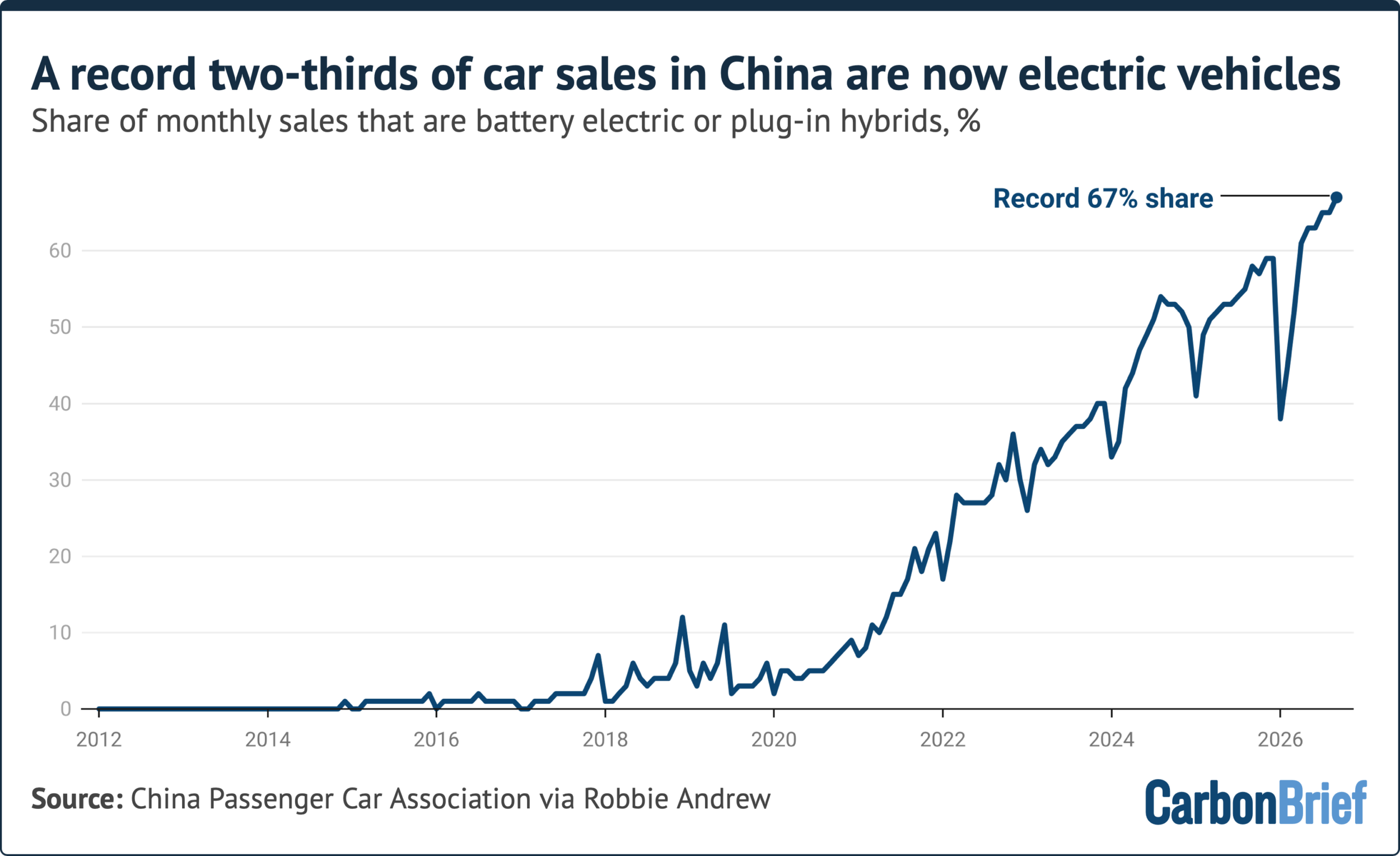
This marks a rapid rise for NEVs from just 6% of new car sales in 2020 up to 58% in 2026 to date – and a record 67% in the month of September.
This year, NEVs’ share of sales has also bounced back from a low of 39% in January, after the full purchase tax exemption that had been in place for more than a decade came to an end in December 2025.
The gain in NEV share in 2026 has come amid a slowdown across the wider domestic passenger-car market, which has hit sales of combustion-engine vehicles particularly hard.
This September, passenger-car retail sales across all categories declined, with overall sales volumes falling 28% year-on-year.
The contraction was led by combustion-engine vehicles, which saw sales fall 43% year-on-year in September and 31% in 2026 to date.
However, sales of PHEVs also fell by 36% year-on-year in September and by 26% in 2026 to date. By comparison, BEVs performed better, although sales still declined 8.5% from a year earlier in September and 4% in 2026 to date.
As a result, NEV sales overall fell by 17% in September and 13% in 2026 to date.
While the market changes in 2026 to date were particularly dramatic, they reflect a broad continuation of trends seen over the past decade.
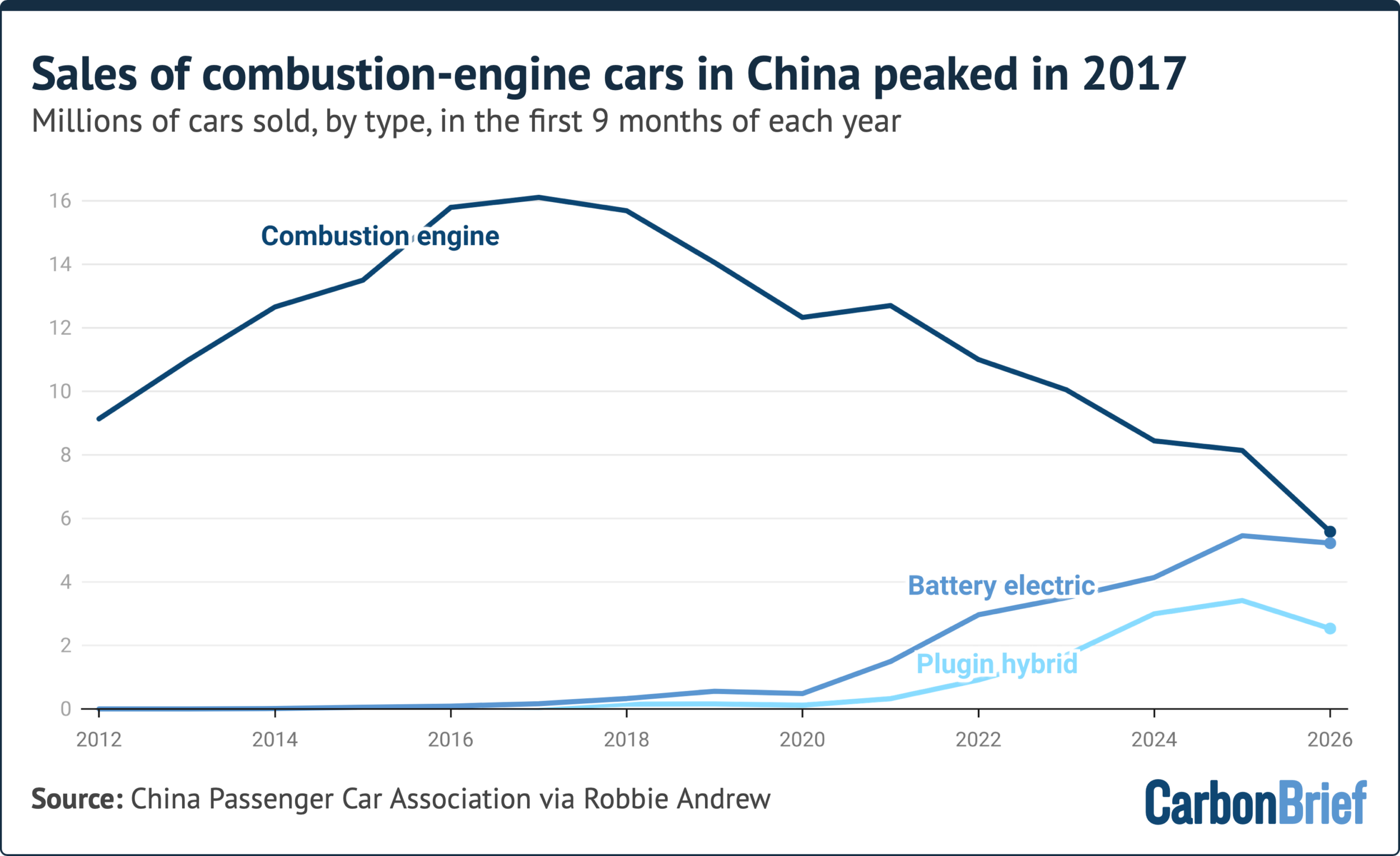
Indeed, sales of combustion-engine cars in China peaked in 2017 and they have been declining ever since, shown in the figure below.
Impact of Hormuz
Part of the reason for the advance of NEVs in 2026, said Chinese technology news outlet OFweek, was petrol cars “giving up market share” as they were outperformed by electric alternatives.
Cui Dongshu, secretary-general of the CPCA, cited higher petrol prices as an explanation for September’s weak combustion-car sales, in comments to financial news outlet National Business Daily.
Imports of oil into China in January-September have fallen 15% compared to 2025, equivalent to 470m barrels, as ongoing conflict tightened supply and drove up prices.
China’s passenger-car NEV fleet has displaced 143m barrels of oil so far during the strait of Hormuz crisis, Euan Graham, senior energy analyst at thinktank Ember, tells Carbon Brief.
EVs “accounted for 12% of the decrease in China’s oil use post-Hormuz”, according to an estimate provided to thinktank the Brookings Institute by an unnamed analyst.
Erica Downs, a senior research scholar at Columbia University’s Center on Global Energy Policy, tells Carbon Brief that the strait of Hormuz crisis and higher oil prices are “reinforcing China’s electrification of road transport”.
She says the “world’s largest oil supply disruption” vindicates China’s early bet on EVs, which was partly driven by concerns about oil-supply security.
NEV demand down
Nevertheless, NEV sales have fallen year-on-year, albeit at a slower rate than overall car sales. The growth in NEV market share has also been decelerating.
Zhang Yichao, a partner at consulting firm AlixPartners, tells Carbon Brief that NEVs benefit from government trade-in policies and a “strong pipeline” of new models, particularly those involving innovation.
He says these factors help explain why NEVs sales have fallen at a slower rate to their combustion-car counterparts.
Cui told the state-run China National Radio that the fall for NEVs and for cars overall in September 2026, is also due to a high baseline of sales from the same month in 2025, as well as changes to trade-in policies and disruptions from the holiday period.
Other factors, says consulting firm Wood Mackenzie, are the weakened demand due to “demand pull-forward” in 2025 caused by the end of subsidies, as well as “tighter financing conditions”.
Zhang tells Carbon Brief he does not “see much more room ahead” for further growth in NEVs’ market share.
He adds that, in his view, their share in China is unlikely to exceed 80%, as some premium-market segments and specific use cases will continue to require combustion-engine vehicles.
Exports surge
Meanwhile, while domestic NEV retail sales fell 17% in September 2026, exports more than doubled, increasing 164% year-on-year, according to the CPCA.
This extends the decline in domestic sales and very strong growth in exports seen across 2026 to date, as shown in the figure below.
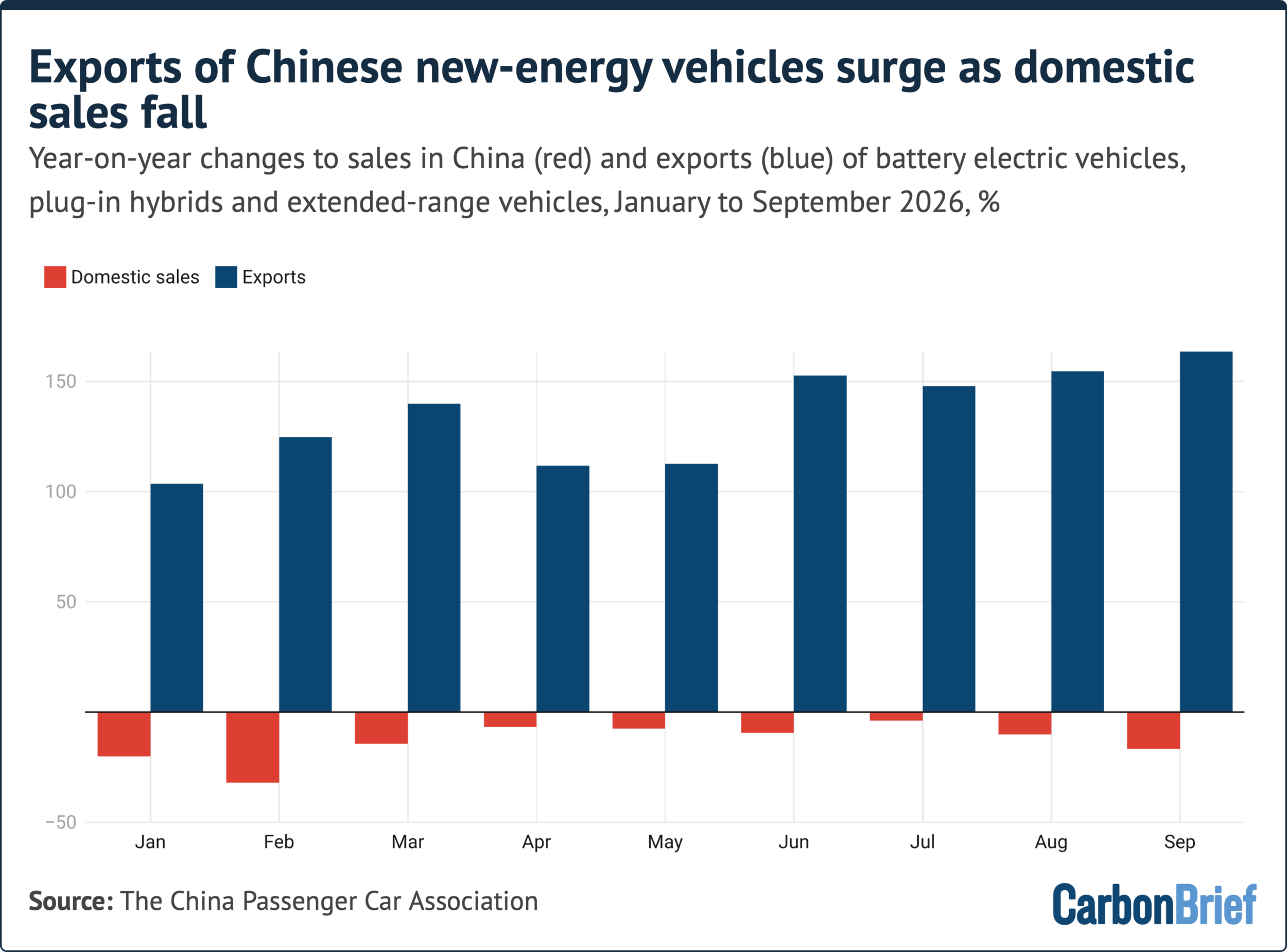
In September, 1,084,000 NEVs were sold domestically in China, while 558,000 NEVs were exported.
Exports are becoming increasingly important to Chinese carmakers, in the face of weaker domestic demand and cut-throat industrial competition.
The CPCA says exports have become “a core priority” for some carmakers.
However, the surge in exports from China has created concern in the EU, which has placed tariffs on imports of EVs from China and recently agreed plans to cut imports of hybrids.
Countries including Mexico and Turkey have also placed tariffs on Chinese EV imports.
At the same time, the Chinese government is putting policies in place that might be expected to disincentivise exports, such as cutting VAT export rebates.
Analysts differ on what impact this policy shift will have, with some saying it will be limited, while others believe it could cause the price of exported cars to rise.