Anabella Rosemberg is senior advisor on Just Transition at Climate Action Network International (CAN-I).
This May Day, the battle lines are clear: workers’ rights and climate justice must stand together – or we will all fall together.
Jobs or the environment? For too long, politicians and corporations have framed the conversation as a false choice. Too often, environmentalists were lured into that same trap – crafting climate strategies aimed at convincing the privileged, while working people, especially those in polluting industries, were sidelined. Solidarity existed in moments, but the struggles for climate justice and labour rights ran on parallel tracks.
Then came an idea that reshaped our movements: Just Transition.
This Australian coal community is co-designing its own green future
Born in the US labour movement in the 1970s, Just Transition began as a simple, urgent demand: no worker should have to choose between a pay cheque and their health. Since then, it has grown into a global framework recognised by the International Labour Organization and the Paris Agreement, linking climate ambition to dignity, rights and economic justice. But on the ground, the promises remain far from reality.
This week, a new call for help reached us.
Court backs Colombian coal workers
The Colombian unions SINTRAMINERGETICA and SINTRACARBÓN have raised the alarm over Glencore’s conduct in Cesar and Magdalena, where the mining multinational is shutting down coal operations through its subsidiary Prodeco. More than 1,200 direct workers and 5,000 contractors have already been dismissed since 2020, as the company handed back its mining licenses in the country’s first “Just Transition” pilot zone.
Despite posting $10.6 billion in profits last year, Glencore has been accused of conducting only a single, superficial community meeting before walking away – prompting Colombia’s Constitutional Court to rule that it violated due process and failed to properly consult affected communities. The court has now ordered the company to reopen talks with more than 20,000 impacted people across four municipalities.
Critics argue the company is rushing the coal closure to cut costs, sidestepping the comprehensive social, environmental and labour measures a true just transition would require. Without proper investment, it is Colombian workers and communities – not Glencore – who will be left to bear the long-term costs.
This injustice is not isolated.
Spain shows the way
From Mpumalanga in South Africa to East Kalimantan in Indonesia, from Katowice in Poland to Cesar in Colombia, corporations are abandoning the very communities that built their wealth – sometimes even daring to call it climate leadership.
Transitions are happening without justice – without workers, without communities, without dignity. But none of this is inevitable. Deciding who designs and who pays the cost of the transition is a political choice.
But many countries, especially in the Global South, do not have such resources, nor the chance to diversify their economies. Without international support, they will be left behind.
Coal-reliant South African provinces falling behind on just transition
Examples of a different path are already out there. When a coal phase-out was decided, the Spanish government forced negotiations with trade unions, delivered sweeping support plans, and mobilised EU resources through the Just Transition Mechanism.
We will stand with our brothers and sisters in Colombia and all those on the frontlines of the transition. However, playing whack-a-mole with each crisis, site by site, is no strategy. We need something bigger. We need a global plan for Just Transition.
Time for a Global Just Transition Mechanism
Two years ago, at the UN climate talks, governments created the Just Transition Work Programme – a breakthrough for embedding social justice into climate action. Despite setbacks – especially at COP29 in Baku – the Work Programme still holds transformative potential.
Now, as we look toward COP30 in Brazil, the stakes could not be clearer.
At COP30, governments must act. They must agree that Just Transition policies – social protection for those losing their jobs and income, re-skilling, community investment, cleaning up polluted areas – are not optional extras, but fundamental to real climate ambition and justice.
After Baku setback, activists call for ‘just transition’ to be front and centre at COP30
They must launch a Global Just Transition Mechanism: to coordinate efforts internationally; to channel support to countries without the means to act alone; and to ensure true accountability and community participation. They must commit to the inclusion of workers, unions, civil society and impacted communities, to diversify economies and to produce real sectoral transition plans.
Ideas can be powerful drivers of change. And Just Transition is one of those ideas. But we must protect it from being hijacked by those who seek to delay climate action under its name, and from corporations that try to greenwash exploitation.
Movement rising for COP30
The enemies of Just Transition wear two masks: one, the face of denial and delay, bankrolled by fossil fuel interests; the other, the smiling face of companies across all sectors who talk about “green growth” while sacrificing workers on the altar of market logic. Both serve the few – and betray the many.
The only path forward lies with the majority: the workers, the communities, the people who today commemorate the Martyrs of Chicago (who were wrongly convicted of murder when they opposed their city’s elite businessmen) and the long, unfinished struggle for dignity and rights. It is only with these working people that we will build a just, livable future. Now is the time to put people and planet before private profit.
The mainstream media may not fully capture it yet. But a movement for Just Transition is rising. Trade unions, social movements, environmentalists, working people – we are converging. And our next fight will be at COP30 in Brazil: a fight for workers and communities.
This May Day, the call is clear: green must be just – or it will not be green at all. COP30 will find us united, fighting for dignity for all on a living planet.
The post On May Day, workers are calling – and climate activists must answer appeared first on Climate Home News.
On May Day, workers are calling – and climate activists must answer

For the first time, new-energy vehicles (NEVs) made up 67% of new car sales in China in September, according to the latest data from the China Passenger Car Association (CPCA).
The figures show that NEVs, which include battery electric cars and plug-in hybrids, captured a record share of sales, even though fewer were sold than last year.
This is because sales of combustion-engine cars are falling steeply, a trend that the CPCA has attributed to rising petrol prices following the start of the Hormuz crisis.
Indeed, sales of fuel-only cars were down 31% year-on-year in the first nine months of 2026, with plug-in hybrid sales down 26% – whereas battery EV sales were only down 4%.
One analyst tells Carbon Brief that China’s rapidly growing EV fleet has offset demand for 143m barrels of oil since the start of the Hormuz crisis.
Another says that the crisis is “reinforcing China’s electrification of road transport”.
Meanwhile, amid slowing domestic sales, Chinese carmakers’ exports of NEVs more than doubled [in 2026 to date / in September] from a year earlier.
NEV record
A record two out of every three cars sold in September in China were NEVs, according to CPCA data, as shown in the figure below.
(NEVs predominantly include battery electric vehicles – BEVs – and plug-in hybrids – PHEVs. BEVs only run on electricity, whereas PHEVs also have a combustion engine.)
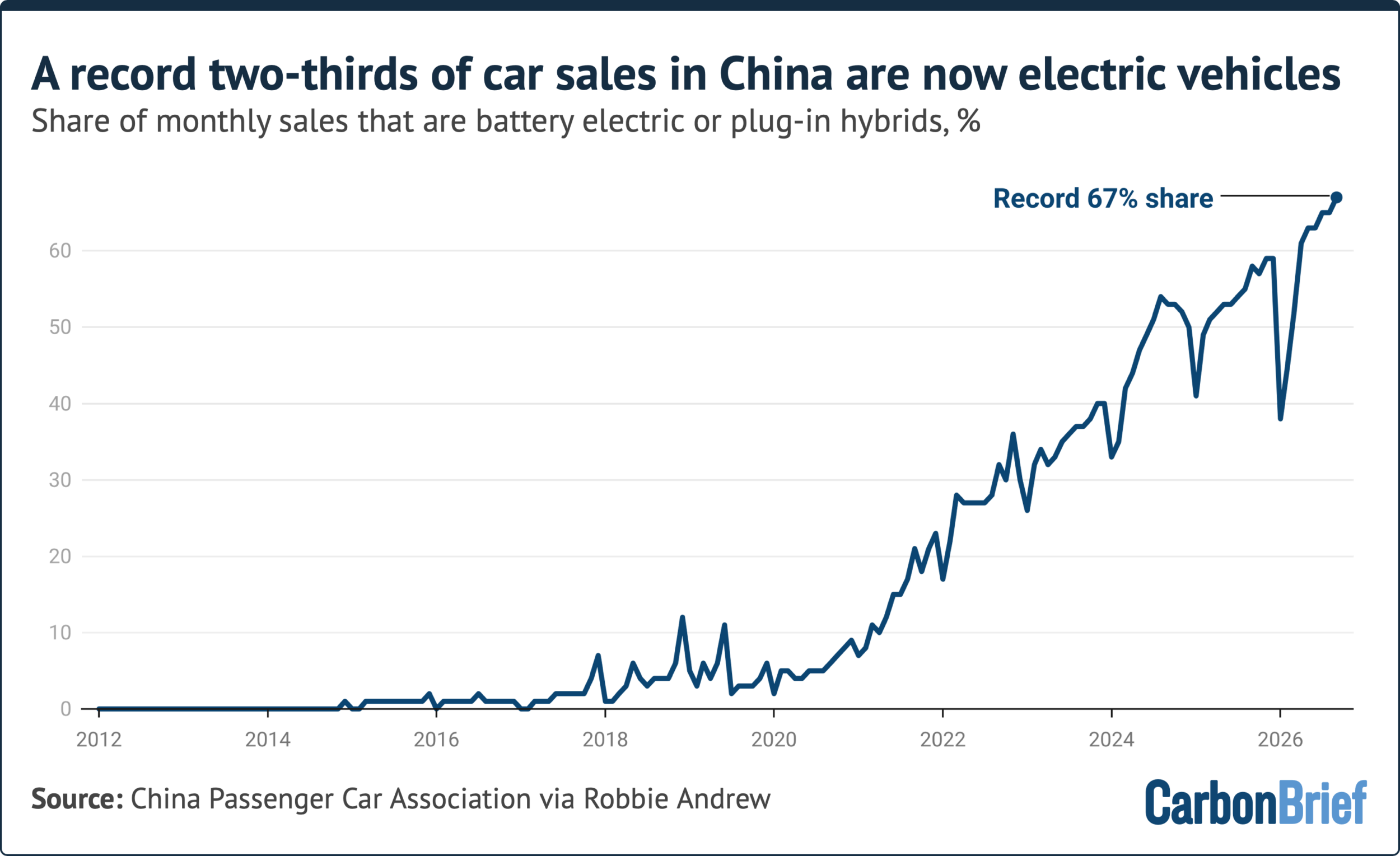
This marks a rapid rise for NEVs from just 6% of new car sales in 2020 up to 58% in 2026 to date – and a record 67% in the month of September.
This year, NEVs’ share of sales has also bounced back from a low of 39% in January, after the full purchase tax exemption that had been in place for more than a decade came to an end in December 2025.
The gain in NEV share in 2026 has come amid a slowdown across the wider domestic passenger-car market, which has hit sales of combustion-engine vehicles particularly hard.
This September, passenger-car retail sales across all categories declined, with overall sales volumes falling 28% year-on-year.
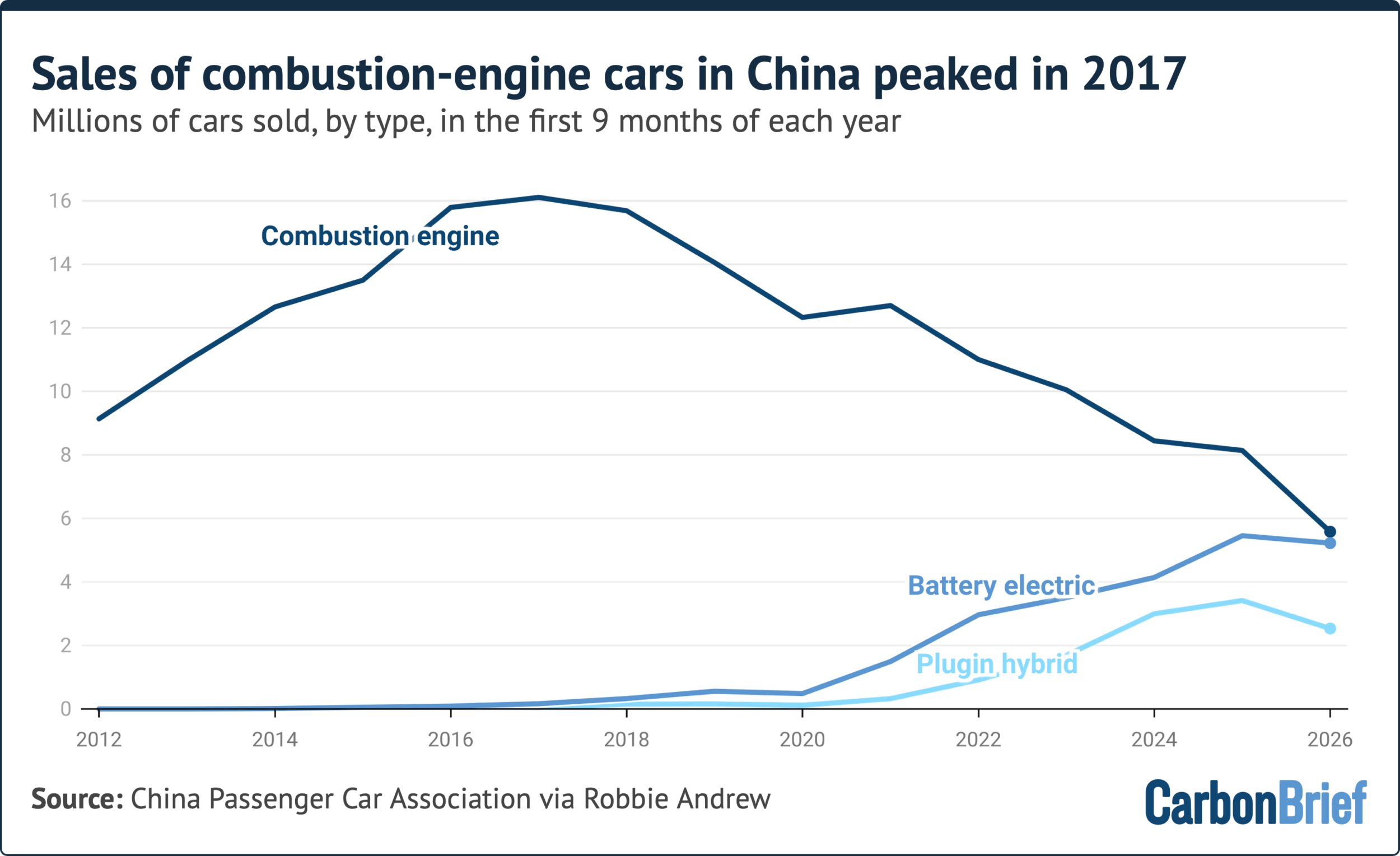
The contraction was led by combustion-engine vehicles, which saw sales fall 43% year-on-year in September and 31% in 2026 to date.
However, sales of PHEVs also fell by 36% year-on-year in September and by 26% in 2026 to date. By comparison, BEVs performed better, although sales still declined 8.5% from a year earlier in September and 4% in 2026 to date.
As a result, NEV sales overall fell by 17% in September and 13% in 2026 to date.
While the market changes in 2026 to date were particularly dramatic, they reflect a broad continuation of trends seen over the past decade.
Indeed, sales of combustion-engine cars in China peaked in 2017 and they have been declining ever since, shown in the figure below.
Impact of Hormuz
Part of the reason for the advance of NEVs in 2026, said Chinese technology news outlet OFweek, was petrol cars “giving up market share” as they were outperformed by electric alternatives.
Cui Dongshu, secretary-general of the CPCA, cited higher petrol prices as an explanation for September’s weak combustion-car sales, in comments to financial news outlet National Business Daily.
Imports of oil into China in January-September have fallen 15% compared to 2025, equivalent to 470m barrels, as ongoing conflict tightened supply and drove up prices.
China’s passenger-car NEV fleet has displaced 143m barrels of oil so far during the strait of Hormuz crisis, Euan Graham, senior energy analyst at thinktank Ember, tells Carbon Brief.
EVs “accounted for 12% of the decrease in China’s oil use post-Hormuz”, according to an estimate provided to thinktank the Brookings Institute by an unnamed analyst.
Erica Downs, a senior research scholar at Columbia University’s Center on Global Energy Policy, tells Carbon Brief that the strait of Hormuz crisis and higher oil prices are “reinforcing China’s electrification of road transport”.
She says the “world’s largest oil supply disruption” vindicates China’s early bet on EVs, which was partly driven by concerns about oil-supply security.
NEV demand down
Nevertheless, NEV sales have fallen year-on-year, albeit at a slower rate than overall car sales. The growth in NEV market share has also been decelerating.
Zhang Yichao, a partner at consulting firm AlixPartners, tells Carbon Brief that NEVs benefit from government trade-in policies and a “strong pipeline” of new models, particularly those involving innovation.
He says these factors help explain why NEVs sales have fallen at a slower rate to their combustion-car counterparts.
Cui told the state-run China National Radio that the fall for NEVs and for cars overall in September 2026, is also due to a high baseline of sales from the same month in 2025, as well as changes to trade-in policies and disruptions from the holiday period.
Other factors, says consulting firm Wood Mackenzie, are the weakened demand due to “demand pull-forward” in 2025 caused by the end of subsidies, as well as “tighter financing conditions”.
Zhang tells Carbon Brief he does not “see much more room ahead” for further growth in NEVs’ market share.
He adds that, in his view, their share in China is unlikely to exceed 80%, as some premium-market segments and specific use cases will continue to require combustion-engine vehicles.
Exports surge
Meanwhile, while domestic NEV retail sales fell 17% in September 2026, exports more than doubled, increasing 164% year-on-year, according to the CPCA.
This extends the decline in domestic sales and very strong growth in exports seen across 2026 to date, as shown in the figure below.
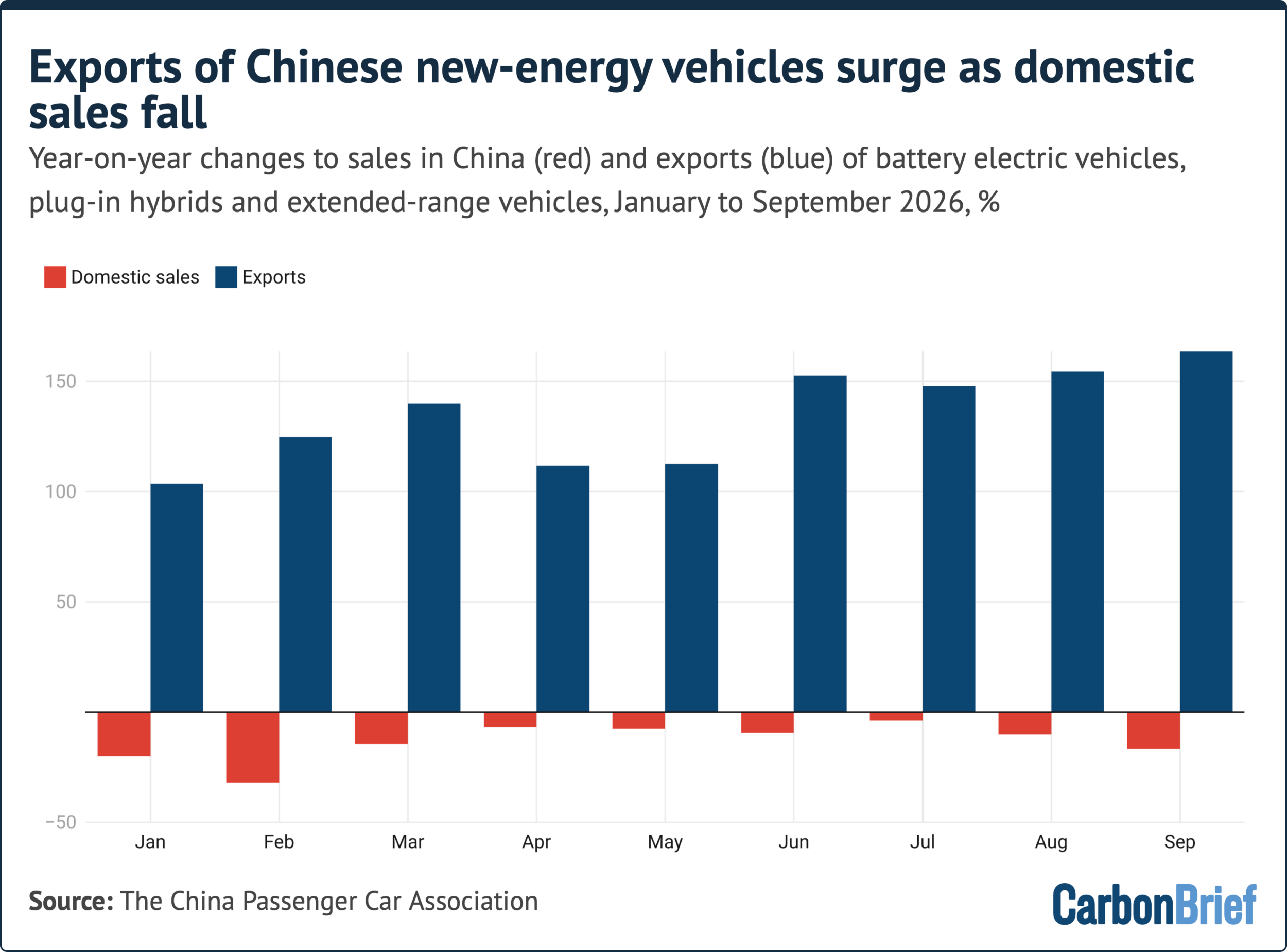
In September, 1,084,000 NEVs were sold domestically in China, while 558,000 NEVs were exported.
Exports are becoming increasingly important to Chinese carmakers, in the face of weaker domestic demand and cut-throat industrial competition.
The CPCA says exports have become “a core priority” for some carmakers.
However, the surge in exports from China has created concern in the EU, which has placed tariffs on imports of EVs from China and recently agreed plans to cut imports of hybrids.
Countries including Mexico and Turkey have also placed tariffs on Chinese EV imports.
At the same time, the Chinese government is putting policies in place that might be expected to disincentivise exports, such as cutting VAT export rebates.
Analysts differ on what impact this policy shift will have, with some saying it will be limited, while others believe it could cause the price of exported cars to rise.