

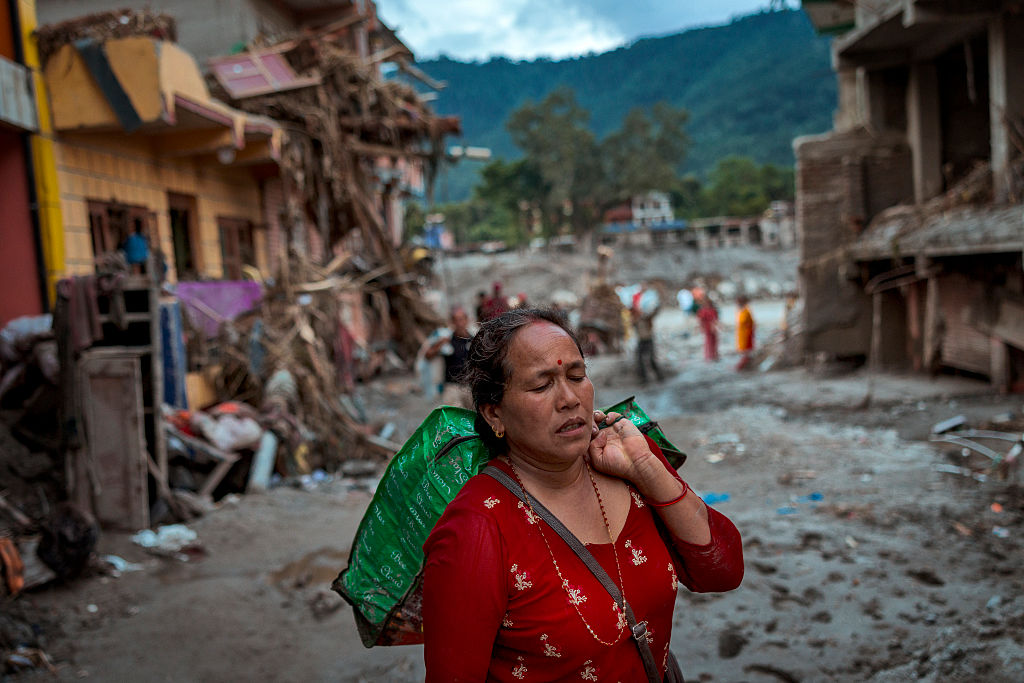
The board of the UN’s Fund for Responding to Loss and Damage agreed on Thursday to set aside $20 million to help Nepal recover from the devastating climate-driven flood it suffered in August.
At an extraordinary online meeting, board members unanimously invited Nepal’s government to submit a proposal for how to use the money, which will be considered at a future board meeting.
The board’s co-chair Camila Minerva Rodriguez described the decision as “truly historic” as it is the first time the new fund has allocated any money since it was set up three years ago. It is expected to approve its first set of projects at its next board meeting in December.
Maheshwar Dhakal, a senior official at Nepal’s climate ministry, told the meeting the decision was “a powerful expression of humanity, compassion, solidarity and hope” and, for the flood victims, a “recognition of their suffering, respect for their dignity and hope that they are not alone in their darkest hour”.
While board members were united in approving the $20 million, plus $1.6 million of administrative costs, representatives of developed and developed countries were divided over the extent to which the decision should set a precedent for the fund’s long-term way of operating.
Germany and Czechia’s board members said it should not set a “precedent” while Japan’s representative said the decision is “truly exceptional” and that the fund’s support must be “in accordance with established rule and procedure”.
Learning the lessons?
Responding, Pakistan’s Ali Sheikh said the lessons from the Nepal case should “feed the long-term model and its work on rapid disbursement” of funds.
He added that he had heard Jan Dusik, Czechia’s board member saying that “we are open for learning but not in setting precedent”. “Please do not define the boundaries for learning,” he emphasised.
Sheikh complained that the decision approved by the board – the result of negotiations between a group of four developed and four developing-country representatives – was narrower than developing countries had hoped for.
“We are saying it is a one-time and Nepal-only window, a sentiment against which many developed countries have raised their voice,” he said, adding there had been no time to review the decision.
Walter Schuldt from Ecuador echoed Sheikh, saying “we should not put limits on lesson learning”. He said the decision, which he was involved in negotiating through “intense exchanges”, tells the fund’s staff to assess the lessons learned.
The fund is currently in a start-up phase and the board will debate its long-term model – including whether and how to rapidly disburse funds in response to climate-driven disasters – at its next board meeting in the Philippines in December.
At Thursday’s meeting, several developing-country board members called for wealthy nations to put more money into the fund. Recovery and reconstruction from Nepal’s flood alone is estimated to cost $4.8 billion – in comparison, the fund has only around $350 million to allocate, with a current cap of $20 million per project.
The post Loss and damage fund agrees $20m for Nepal but rich nations warn it should not set precedent appeared first on Climate Home News.
Loss and damage fund agrees $20m for Nepal but rich nations warn it should not set precedent

Climate Change
Albanese must deliver credible action to end fossil fuel chokehold, not just rhetoric
ANTALYA,Türkiye, Thursday 12 November 2026 — In response to Prime Minister Albanese’s COP31 Leaders’ Summit address, Shiva Gounden, Head of Pacific at Greenpeace Australia Pacific, speaking from Antalya said:
“Prime Minister Albanese’s COP31 address was full of nice rhetoric, but once again failed to confront or even mention the root cause of the climate crisis — fossil fuels.
“In Antalya, UN climate chief Guterres told leaders to “tell the truth”. The truth is Australia can not credibly talk about its clean energy transition while continuing to expand the industry it needs to leave behind. Australia must reckon with reality; its damning track record of 38 coal and gas approvals since it took office in 2022.
“We meet in Antalya amidst a global energy shock and dire projections of 1.5°C overshoot. Overshoot means something in the Pacific — it means irreversible harm, lives and cultures lost forever, entire nations at stake. We must face the fierce urgency of now.
“Never before has the need to end the fossil fuel chokehold been so abundantly clear, as our Pacific communities again suffer the consequences of a global economy hooked on coal, oil and gas. The Pacific needs credible roadmaps and clear timelines to unhook from fossil fuels — Australia can’t keep saying implementation and not reflect it with credible action.”
ENDS
COP31 images and video available here in Greenpeace Media Library
Media contact: Kate O’Callaghan in Antalya (GMT+3) on +61 406 231 892 (Whatsapp/Signal)
Albanese must deliver credible action to end fossil fuel chokehold, not just rhetoric
A second set of world leaders give their speeches on Thursday before heading out of town and leaving their negotiators to it. After around 40 leaders spoke on Wednesday, today there will be just 25 or so including the UK’s Andy Burnham, Venezuela’s Delcy Rodriguez and Bangladesh’s Tarique Rahman.
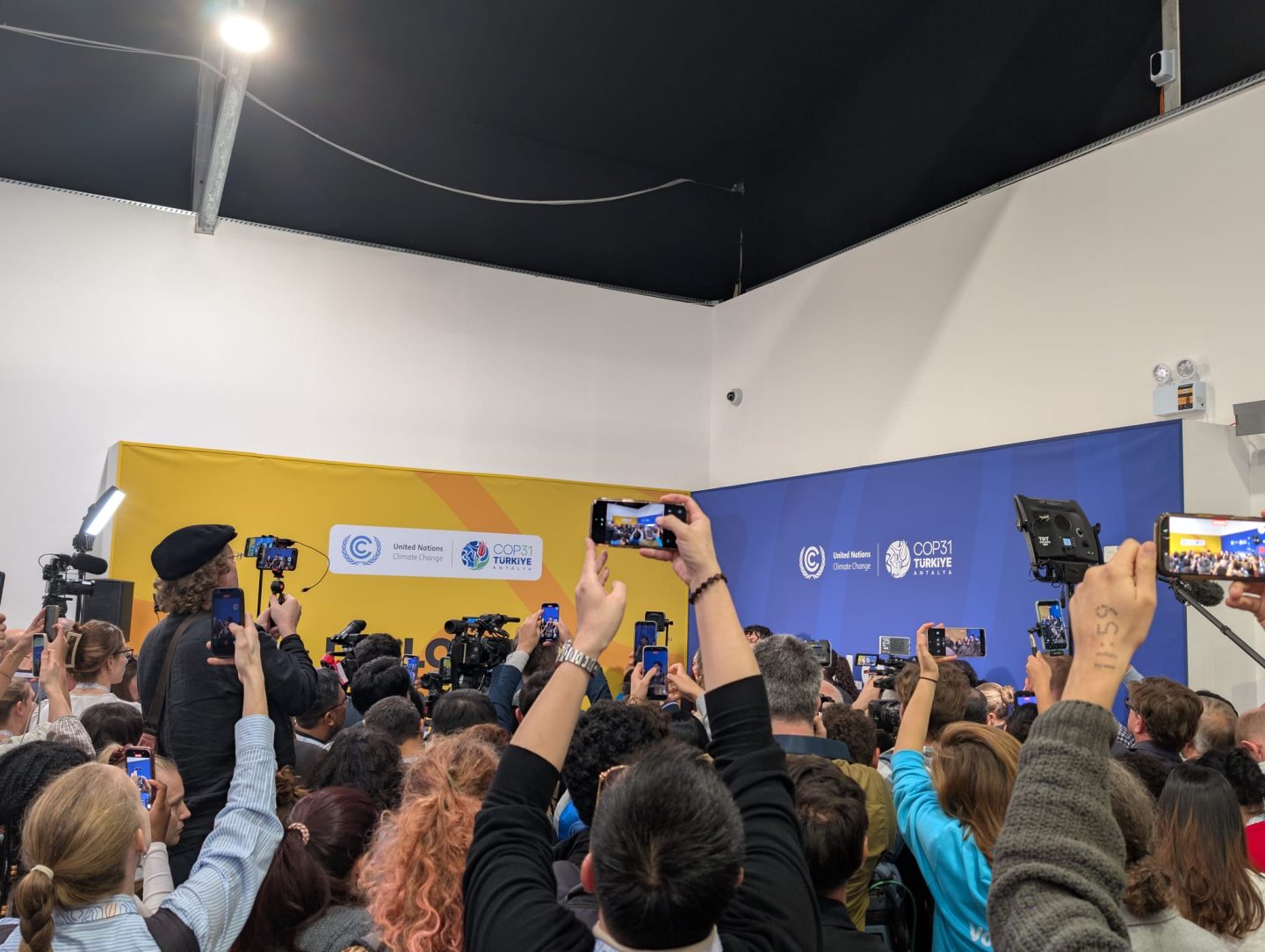
But Brazil’s President Lula is still there and is expected to keep grabbing headlines, along with California’s Governor – and maybe next US president – Gavin Newsom – and Swedish climate activist Greta Thunberg who has lost none of her star power, if the crowd around her in the press centre was anything to go by.
We’ll bring you highlights through the day on issues ranging from finance to methane, and update you on a pledging event for the Pacific Resilience Facility, which the climate-vulnerable region is relying on to keep small island nations as safe as possible in the face of intensifying storms, drought and sea level rise.
The post COP31 Bulletin Day 4: Burnham speaks with UK climate policy under fire appeared first on Climate Home News.
COP31 Bulletin Day 4: Burnham speaks with UK climate policy under fire
Climate Change
Australia must ‘pull all available levers’ to deliver fossil fuel phase out, following Albanese’s COP31 address
ANTALYA, Türkiye, Wednesday 11 November 2026 — In response to Prime Minister Albanese’s COP31 Leaders’ Summit address, Dr Susie Byers, Head of Advocacy at Greenpeace Australia Pacific, speaking from Antalya said:
“Prime Minister Albanese’s Leaders’ Summit address emphasised the power and clarity of Pacific climate leadership and that we must all fight to return warming to below 1.5°C. To inject the momentum these talks critically need, Australia must lead by example.
“Australia takes the reins of the COP31 talks at a critical moment where global instability can spark transformative change, or entrench more of the same inaction and paper pledges. Australia must pull all available levers over the next two weeks, taking the baton from Brazil and sprinting forward.
“The world’s most important job in Antalya is to deliver tangible action to end the fossil fuel era. Communities in Australia, the Pacific and around the world who are grappling with climate disasters and a cost of living crisis need concrete dates and credible plans. We know the transition is coming, one way or another. Our Government has a responsibility to make a plan for this change, which is based on the best available science, and a commitment to put people, energy security and our environment ahead of fossil fuel profits.
“In his address, UN climate chief Guterres told leaders to “tell the truth”. Prime Minister Albanese told an important truth today: that we all have solemn responsibilities to return warming to below 1.5°C. We also know that the best way for Australia to lead through this summit is to start by making its own commitments to turn the temperature down, by stopping developing and exporting fossil fuels.
“Australia’s domestic progress on renewables, and the ‘35 by 35’ electrification goal, are welcome and important. Now we must ensure electricity comes from clean, renewable sources that actually displace fossil fuels and align with the science of 1.5°C.
“The pressure on Australia is building. COP31 must deliver real action to advance multilateral climate cooperation, accelerate the just transition away from fossil fuels, and advance Pacific priorities — including significantly scaling-up climate finance and keeping 1.5°C alive.”
ENDS
COP31 images and video available here in Greenpeace Media Library
Media contact: Kate O’Callaghan in Antalya (GMT+3) on +61 406 231 892 (Whatsapp/Signal)



-
Climate Change1 year ago
Guest post: Why China is still building new coal – and when it might stop
-
Greenhouse Gases1 year ago
Guest post: Why China is still building new coal – and when it might stop
-

 Greenhouse Gases2 years ago
嘉宾来稿:满足中国增长的用电需求 光伏加储能“比新建煤电更实惠”
-

 Climate Change2 years ago
嘉宾来稿:满足中国增长的用电需求 光伏加储能“比新建煤电更实惠”
-

 Renewable Energy1 year ago
Sending Progressive Philanthropist George Soros to Prison?
-
Greenhouse Gases1 year ago
嘉宾来稿:探究火山喷发如何影响气候预测
-

 Climate Change2 years ago
Analysis: China’s CO2 falls 1% in Q2 2024 in first quarterly drop since Covid-19
-

 Climate Change1 year ago
嘉宾来稿:探究火山喷发如何影响气候预测