

There is a “mismatch” between the importance of peatlands and their current level of protection, a new study warns.
The paper, published in Conservation Letters, combines maps showing global peatlands, protected areas and human impact in the year 2020, to provide a snapshot of the current level of global peatland protection.
The authors stress that peatlands are crucial carbon stores, holding more carbon than all the world’s forest biomass combined.
However, they find that only 17% of peatlands fall within protected areas – a “substantially lower” proportion than other “high-value ecosystems”, such as mangroves, saltmarshes and tropical forests, they say.
The study finds that 22% of global peatlands are under “high human pressure”, with regions in Europe and the east coast of the US under particular threat.
Furthermore, one-third of the global peatlands in protected areas and Indigenous people’s lands still experience “medium to high human pressure”, the paper finds.
‘Disproportionate’ carbon stores
Despite peatlands’ relatively small footprint – they cover only 3% of the Earth’s land surface – the ecosystems store a “disproportionate amount” of carbon.
Research has shown that there is more carbon contained in peatlands than in all of the world’s forests combined – around 600bn tonnes (GtC).
They also provide myriad other “ecosystem services”, such as regulating air temperatures, storing water and creating habitat for many species.
Peatlands are wetland ecosystems that form slowly over time. When plant matter in one of these habitats dies, the high water content of the soils prevents it from decomposing completely.
As a result, plant matter accumulates, building up as carbon-rich peat over time. Peatlands are found on every inhabited continent, primarily in the high latitudes of the northern hemisphere and in the tropics.
The degradation and destruction of peatlands is a significant carbon source, contributing 2-4% of human-driven greenhouse gas emissions each year. Peatlands are often drained or degraded during use for agriculture, and about 16% of peatlands globally have been drained to date. In some places, peat is intentionally removed to be used as fuel or fertile soil.
Prof Chris Evans, a biogeochemist at the UK Centre for Ecology & Hydrology, who was not involved in the study, tells Carbon Brief:
“Peatland degradation is second only to tropical deforestation as a source of greenhouse gas emissions from land use, yet peatlands are often overlooked in conservation and climate policy.”
At the same time, climate change itself is putting peatlands at risk.
Increased temperatures are causing permafrost thaw, allowing the once-frozen peat to decompose and release CO2 into the atmosphere. Warmer temperatures also increase microbial activity, leading to faster rates of decomposition, while warmer, drier peatlands are more susceptible to fires.
Losing peatlands has “cascading effects on local water supplies, agriculture and fisheries, disproportionately affecting Indigenous and rural communities”, says Dr Michelle Kalamandeen, a geospatial scientist at McMaster University in Ontario, who was not involved in the study.
Protected areas
This study centres on an existing map of global peatland. The map divides the world into grid cells and, using a machine learning model trained on data collected on the ground, estimates the proportion of each cell that contains peatland at least 30cm deep.
The map identifies around 4m square kilometres (km2) of peatland globally. More than 60% of this is “boreal peatland” – found in the high-latitude northern regions, such as Canada, Russia and Scandinavia – and the rest is found in temperature or tropical regions, according to the study.
The authors then cross-reference the map with a database of global protected areas. The database encompasses both “strict” protection areas, such as national parks and nature reserves, as well as less strict land-management regimes where some human activity is permitted.
The database also shows Ramsar sites, a subset of protected areas designated to be of international importance under the Ramsar convention – also known as the “Convention on Wetlands”. (The convention seeks to promote “the wise use of all wetlands” in participating countries and encourage international co-operation with other countries.)
The authors find that only 17% of peatlands are located in protected areas. This is “substantially lower than other high-value ecosystems such as mangroves, 42% of which are within official protected areas globally, saltmarshes (50%) and tropical forests (38%)”, the study says.
Dr Kemen Austin is the director of science at the Wildlife Conservation Society‘s forests and climate change programme, and lead author of the new study. In a press release, she says that the study “reveals that these vital ecosystems don’t have anywhere near the level of protection they need”.
The authors also present case studies of individual countries. For example, they find that nearly 90% of peatland in the Republic of the Congo is protected. However, they warn that “most of this falls within a designated Ramsar site that has not yet been backed-up by strong government commitments”.
The study identifies a large body of literature showing that “Indigenous land rights and community-based management result in positive environmental outcomes, such as reduced deforestation and forest degradation”. The authors analyse data on Indigenous stewardship and find that one-quarter of global peatlands sit on land owned by Indigenous groups.
Human impact
The authors assess human pressures on peatland using the Human Impact Index (HII). This metric quantifies the “cumulative anthropogenic pressures” on a region, using a scale of 0-50 that incorporates factors such as accessibility, land use and population density.
The map below shows human pressure in areas that contain more than 5% peatland by area. Light pink shows “low-pressure” regions, medium pink shows “medium-pressure” regions and dark pink shows “high-pressure” regions.
The top map shows the whole planet, while the three inset maps below highlight chosen case studies in Peru, the Congo Basin and Indonesia.
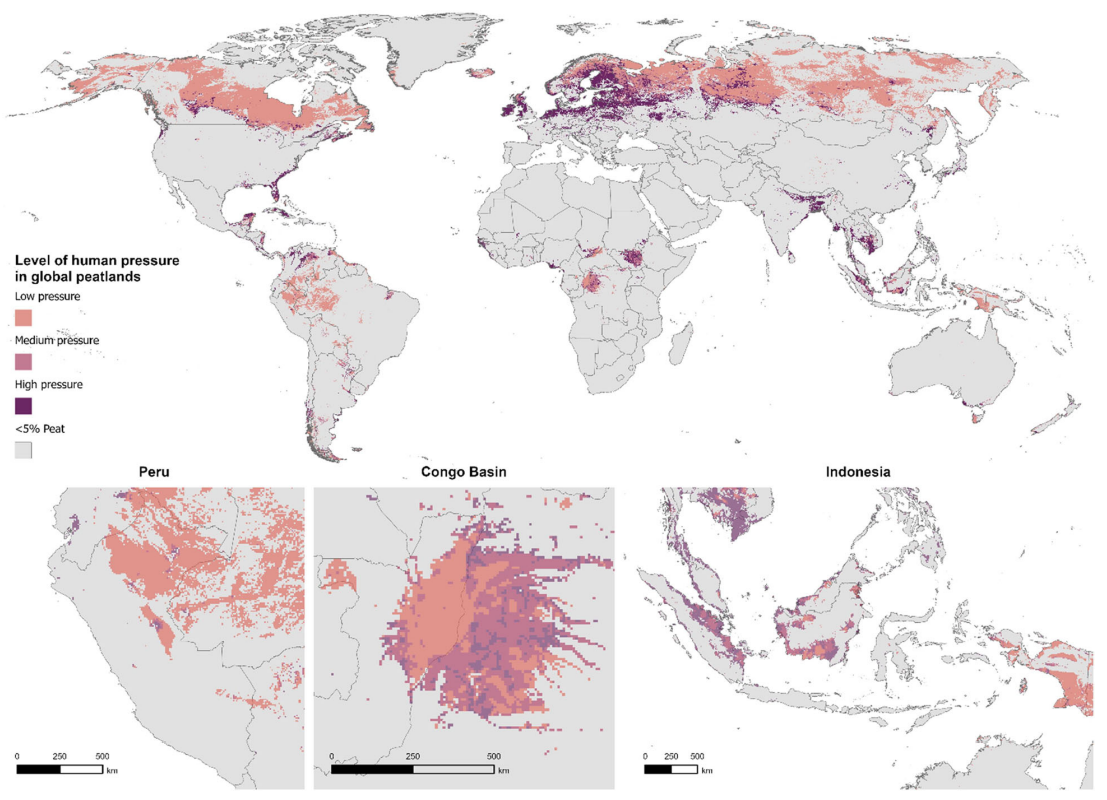
The authors find that globally, 22% percent of peatlands are under high human pressure, 12% are under medium pressure and 61% are under low pressure. The remaining 5% are in areas without reported HII data.
The authors find that almost half of peatlands in temperate regions are facing high human pressure, adding that Europe and the US east coast are under particular stress. At the other end of the scale, they estimate that human pressure is low in Brazil, the lowlands of Peru, the Republic of the Congo and eastern Indonesia.
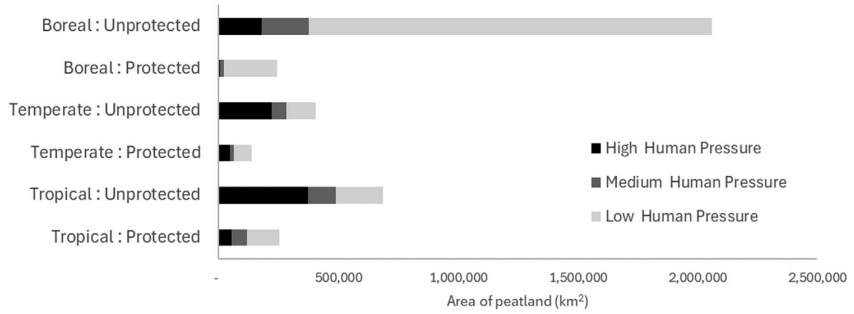
The study says that, as expected, human pressure is “somewhat higher” in unprotected peatlands than protected peatlands. However, it adds:
“Nearly one-third of global peatlands, and nearly half of temperate and tropical peatlands in protected areas and Indigenous people’s lands, still experience medium-to-high human pressure.”
The chart below shows the area of peatland in protected and unprotected boreal, temperate and tropical regions that is facing high (black) medium (grey) and low (light grey) human pressure.
Kalamandeen tells Carbon Brief that the study “underscores a fundamental disconnect between conservation priorities and real-world climate needs”.
However, she notes that there are some limitations to the methodology. For example, she tells Carbon Brief that the underlying peatland map “performs well in data-rich regions”, but says that “its accuracy drops where ground-truth data is lacking, notably in Africa, South America and boreal regions”.
Furthermore, the map only recognises peatlands deeper than 30cm, meaning that “shallower, but still ecologically valuable peatlands, are ignored”.
She continues:
“This study is an excellent starting point, but if we are serious about peatland protection, countries need to invest in better mapping and monitoring technologies such as using Earth observations and improving ground surveys to help refine conservation strategies.”
Peatland conservation
The new research “quantifies an issue that was previously known: that peatlands are under-protected when compared to other critical ecosystem types”, Dr Julie Loisel, a palaeoecologist at the University of Nevada, Reno, tells Carbon Brief. Loisel, who was not involved in the study, adds:
“In the face of rapid environmental change, ensuring that peatlands can ‘do their job’ of storing CO2 into their soils for the next few thousands of years is very important and any policy or land management effort that is enabling this simple goal should be put forth and prioritised.”
The study notes that several international policy frameworks, such as the global stocktake process under the Paris Agreement and the Kunming-Montreal Global Biodiversity Framework, can be applied to further the protection of wetlands.
For example, the authors note that Peru’s nationally determined contribution includes strategies for improving peatland management, such as establishing new conservation areas and recognising Indigenous peoples’ knowledge about peatlands.
However, Peru is one of the few countries with plans for the preservation of peatlands, alongside the UK, according to the study. Austin adds:
“Based on the nationally determined contributions countries have submitted to date, the continued disturbance and damage to global peatlands is getting very little attention as a significant and avoidable source of greenhouse gas emissions.”
In addition to protection of intact peatlands, peatland restoration “will be necessary for managing peat fires and meeting climate targets nationally”, the study says. Restoration typically involves altering the wetland’s water flows to “rewet” drained peat. It can also encompass controls on pollution, protection from burning and grazing and regrowing plants.

But while restoration can slow the release of CO2 and promote some ecosystem services, it is not an adequate substitute for peatland protection. The study notes:
“Notably, once emitted to the atmosphere, the carbon lost from peatlands cannot be restored on timescales that matter for preventing dangerous climate change.”
Promoting Indigenous peoples’ land rights is one way to support the protection of peatlands, Loisel says. She tells Carbon Brief:
“Conservation efforts do not necessarily imply ‘protection from use’, but are rather meant to ensure their ‘proper use’, or ‘sustainable use’. Indigenous community uses of peatlands have been known to be sustainable.”
Kalamandeen tells Carbon Brief that, while legal protections are “crucial”, their impact “depends on enforcement, management capacity and local engagement”. Meanwhile, she says that “Indigenous and community-managed lands, even without formal protection, often demonstrate strong conservation outcomes”.
Dr Adam Todd Hastie is the leader of the carbon and wetlands group at Charles University, and was not involved in the study. He agrees, calling Indigenous stewardship “often the best and most simple solution” to protecting peatlands.
However, he adds that global-north countries “need to be thoughtful in our calls for less economically developed countries to protect their peatlands”. He tells Carbon Brief:
“If we want less economically developed countries to take a different path of protecting their peatlands – and peat carbon – and to forgo short-term economic benefits, such as revenue from plantations or mining, we (especially Europe and North America) must contribute in real terms to developing alternative sustainable solutions, both environmentally and economically.”


The post Just 17% of world’s peatlands are protected, new study warns appeared first on Carbon Brief.
Just 17% of world’s peatlands are protected, new study warns

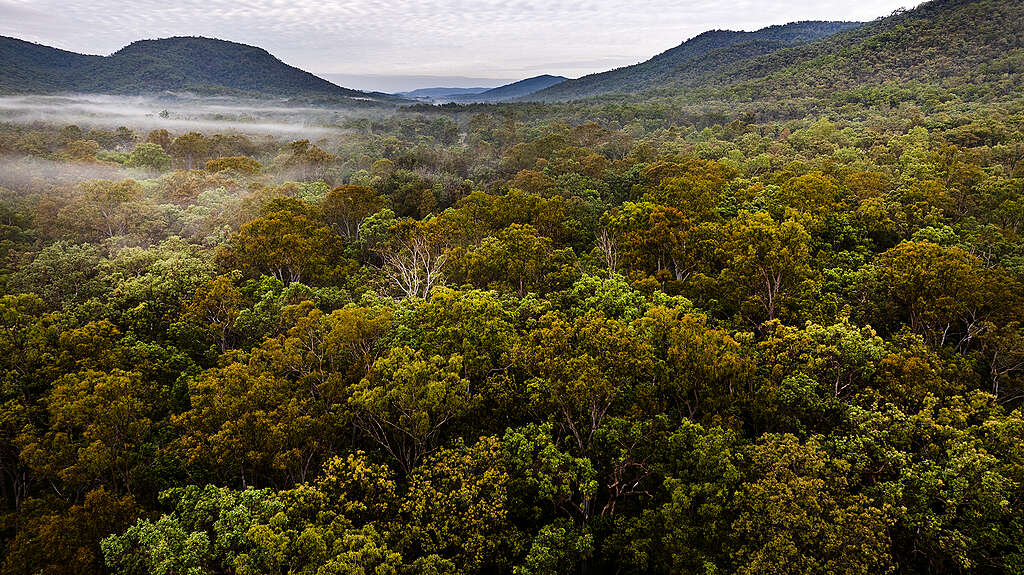
The vast majority of Australians and all mainstream nature protection groups—including Greenpeace—agree that Australia should end native forest logging, and that governments should create vast new national parks to protect and manage some of our most magnificent remaining forests. But there is significant disagreement about how this transition should come about and now a decision is coming up before the Australian Parliament.
On 15 September the Australian Senate is due to vote on a motion about a new carbon credit method for forest protection—the “Improved Native Forest Management” (INFM) Method. Lifelong forest protection champions and people of good will and intentions find themselves on opposing sides of this debate. That’s okay–people of good faith can have legitimate differences of view, and this should be honoured in our democracy.
The NSW government has promised to create the Great Koala National Park on the Mid North Coast of the state. The government has also said that the final creation of the park is dependent on the successful registration of a carbon project under the Improved Native Forest Management (INFM) Method. The creation of the park will effectively mean an end to native forest logging in the region.

Native forest logging is not something on which Greenpeace has actively campaigned on in Australia for some decades, but we are making our position clear on this issue now, because it is a matter of significant public note that falls clearly within our environmental mission remit.
After careful consideration, Greenpeace believes this method should not be voted down by the Senate, and we call on Senators of all parties to vote against the disallowance motion.
To be abundantly clear, Greenpeace holds longstanding opposition to the carbon credit system, but in these circumstances we cannot in good conscience conflate that position with de facto opposition to the creation of massive new national parks. Although it is uncomfortable to do so, our position here is to recognise that suboptimal architecture can still be turned to good ends. We genuinely rejoice in the imminent possibility of new national parks, including the Great Koala National Park in NSW which so many community members and scientists have tenaciously argued for, over very many years, and which are so desperately needed for the forests and the wildlife which inhabits them.
In reaching our view, we also take strong notice of the opinion of the INFM among leading forest scientists, including leading forest ecologist Professor David Lindenmayer who supports the INFM as do a range of other experts. We have also taken special note of the position of the peak body for nature in New South Wales, the NSW Nature Conservation Council, and of local forest activist conservation groups, who support the INFM not being voted down in the Senate.
The politically fraught nature of forest protection
The fight to save Australia’s magnificent native forests from logging has been a decades-long battle. It has reshaped both the ecological and political landscape of the nation as vast forests have been levelled or–thankfully–sometimes saved, and political parties and leaders have risen and fallen on the back of moves to ruin or protect them.
It is no surprise then that the latest chapter in Australian forest protection has become politically fraught.
In 2024 Western Australia and Victoria officially ended native forest logging on the back of both overwhelming public pressure to do so combined with the clearly unviable financial state of the industry. This forest protection has not been bullet proof—some areas still being targeted under the guise of fire management and “salvage logging”–and other drivers of deforestation including for bauxite mining–remain a significant problem. Nonetheless, these announcements were still a very significant leap forward for forest conservation and to the credit of the advocates, communities, and scientists who fought for these outcomes–and the governments who made the decisions.
But native forests continue to fall to logging in Tasmania, New South Wales and to an extent in Queensland. So the political battle has now concentrated mostly on these states, with a renewed push by communities and environment groups to finally end native forest logging once and for all, including via the creation of large new national parks for the benefit of the whole community and for nature to flourish.
Protection with or without carbon markets?
In New South Wales, thanks to the extraordinary effort and vision of forest advocates and ecologists, proposals have been drawn up for two large national parks to protect forests currently targeted for logging and link them up with already protected areas—the Great Koala National Park in the north and the Great Southern Forest National Park in the south.
The creation of national parks requires resources. In the step up phase, the provision of public funding enables workers and communities to be supported to exit the logging industry. Significant funding is then required on a permanent basis to manage the National Parks that are created, including crucially to carefully manage fire to support forest health and regeneration, particularly as global warming continues to raise the risk of repeated catastrophic bushfires.
Along with many others, Greenpeace has a long held and strong view that nature should be protected for its own sake (rather than having to justify a monetary benefit) and that this funding should be provided by governments as a public good. Many forests and extraordinary places across Australia have been protected on this very basis for decades. Public funds for the shared good of nature protection for all Australians. Yet it is also the case that far too little public money is spent on taking care of nature.
Australians are not only justifiably proud of and love our natural heritage–our iconic wildlife and fantastic wild places–we also depend on the web of life for our own flourishing. And yet significantly less than 1% of all public money in Australia is spent on taking care of nature across our magnificent continent. It is inadequate to do what is needed in the face of the extinction crisis and the severe climate damage caused by global warming.
So, it is on the question of sources of revenue where fierce disagreement has emerged amongst forest champions. As noted above, the position taken by the New South Wales Government is that the creation of the Great Koala National Park hinges on raising the necessary funds by selling carbon credits to companies as an offset to the greenhouse gas emissions they are producing (recognising the value of carbon stored in forests). For this reason, whether the Great Southern National Park proposal progresses or not is also likely to depend on the ability to create carbon credits from it.
Some advocates are understandably steadfastly opposed and outraged that the creation of a National Park would rely on carbon credits to be established, while others see this a reluctantly pragmatic yet effective pathway to a rapid end to native forest logging, not just in New South Wales but also in Tasmania and elsewhere. People of good will can disagree–and on this, they do.
We also recognise that it is a difficult debate to have in the public realm–because those not across the debates over policy and principle will be fairly inclined to bewilderment that anyone who cares about nature could possibly oppose the creation of new national parks on what might seem like quite arcane grounds.

Australia’s troubled and troubling carbon market
Like forest protection, curbing Australia’s climate pollution has been another politically vexed problem for decades. Climate policies have come and gone, taking political leaders with them.
In 2011 the Carbon Farming Initiative was established by the Gillard Labor government and supported by the Greens (then led by Bob Brown and Christine Milne). This set up a system whereby farmers and Indigenous communities could generate carbon credits to better manage forests (including with better fire management) to receive funding from the Federal Government or corporations as a means of storing or reducing carbon emissions on the land, while also (ostensibly) protecting nature and creating regional jobs.
This scheme then morphed into the Abbott Coalition government’s Emissions Reduction Fund and Safeguard Mechanism in 2014. This policy was cynical in nature, designed to do virtually nothing given Tony Abbott’s aggressive rejection of the need for greenhouse gas emission reduction, essentially expanding a voluntary market where carbon polluters could buy carbon credits to offset their emissions. There was very little obligation for polluters to actually reduce emissions at site or be forced to buy carbon credits at all.
Then, in 2023 the Albanese government reformed the Safeguard Mechanism, setting stricter emission baselines for polluters and forcing many to buy carbon credits to offset their emissions.
The problem is this latest reform of the Safeguard Mechanism has not worked. This is partly due to the emission baselines being set too low but also because many polluters have simply been buying up carbon credits rather than attempting to actually reduce their emissions.
Furthermore, the very concept of carbon credits is highly problematic. Unlike fossil fuels found in their natural state, carbon and greenhouse gases stored in forests and the land are more volatile and exposed to rapidly being released to the atmosphere from fires, disease, floods and other natural or global heating-driven events. Greenpeace holds a longstanding position of deep scepticism about the efficacy of carbon credits. That has not changed.
In practice most of the existing carbon credit methods have been under sustained criticism from experts and scientists with deep knowledge of the system, arguing that currently, most projects are receiving credits for little or no actual storing of carbon in the land.
So when advocates for forest protection and climate action raise concerns about protecting forests via carbon credits, it’s clear why.

The INFM method
Chief public critic and whistleblower of the historic carbon credit system in Australia, Professor Andrew Macintosh, has been the lead architect behind the creation of the Improved Native Forest Management (INFM) which has been developed in partnership with the New South Wales Government. This is because despite having been a critic of the carbon credit system as it was operating, Professor Macintosh is not against carbon credits per se, but rather a poorly designed and executed system.
Regardless of what one thinks of the morality or efficacy of the method; the fiscal truth is that the INFM would create a new means for state governments to generate significant revenue by ending native forest logging in key areas and protecting and managing the forests.
Professor Macintosh and other supporters of the method argue that unlike other carbon credit methods, the INFM is of the highest integrity possible. That’s because the carbon that is credited is conservative, accounting for approximately 1/10th of potential carbon stored, a regional cap prevents logging simply commencing elsewhere, and significant financial penalties apply for non delivery of credits. If all the forests threatened by logging were protected by this method that would represent about 5% of carbon credits in the system. Significantly, the New South Wales Government has also pledged that no carbon credits from the Great Koala National Park would be sold to fossil fuel companies.
Leading ecologist and staunch forest advocate Professor David Lindenmayer also supports the method. Other prominent ecologists Professor Brendan Mackey, Dr Don Butler and Dr Heather Keith also provided input into the method.
Key environmental groups in New South Wales such as the North East Forest Alliance and South East Forest Alliance as well as the Nature Conservation Council of NSW (which is the peak body for nature in NSW) strongly support the INFM and see it as key to creating large forest National Parks in the state and effectively ending native forest logging.
The logging industry is vehemently opposed to the method because they are rightly worried it will shut down what remains of this industry. They are supported by One Nation and the Nationals, both of which have pledged to vote against the method down when it comes to a vote in the Senate on September 15th.
The opponents to forest protection are also joined in the against camp by some climate and forest advocates, including the Australia Institute and Wilderness Australia, who are strongly against carbon credits overall, in particular relying on them to protect forests and are concerned at the potential for perverse outcomes in the context of the broader need to reduce Australia’s greenhouse gas emissions.
The Greenpeace Position
Greenpeace opposes carbon credits and accepts the analysis that the Safeguard Mechanism is failing. The creation of new forest National Parks should not be contingent on the commodification of nature and the sale of carbon credits. Nature should be protected for nature’s sake. Much more public funding should be available for the protection of nature. Our position will not change on the intrinsic value of ecology. Our mission is to secure an earth capable of nurturing life in all of its magnificent diversity.
However, we cannot in good conscience de facto oppose the creation of a massive new national park in these circumstances—especially when Australia’s leading forest ecologists, the foremost critic of carbon credits, and the grassroots forests activists from the jurisdiction in question support the outcome of moving ahead with the INFM to secure massive new national parks.
For that reason, in our view is that in these circumstances the Senate should not vote down the INFM method.
Further, fossil fuel companies should not have access to the INFM credits. The existing sham carbon credit methods should be urgently taken out of the system. The fight for more public funding for the protection of nature must go on until common sense prevails. And the Safeguard Mechanism should be substantially overhauled to significantly constrain the use of carbon credits more broadly and force polluters to rapidly reduce emissions on site. We believe that this is the fight which forest and climate advocates should be focussed on, together.
KOROR, PALAU, Friday 4 September 2026 – At the closing of the 55th Pacific Islands Forum Leaders Meeting in Palau overnight, Greenpeace Australia Pacific called out Australia for promising climate action while expanding fossil fuel production, and is urging Pacific leaders to unite ahead of the Pacific Pre-COP.
The meeting was rocked by the UN’s 1.5°C overshoot report a day before Australia approved the extension of one of the country’s largest coal mines.
Speaking from Palau, Shiva Gounden, Head of Pacific at Greenpeace Australia Pacific, said:
“Against the backdrop of the 1.5°C UNEP report, this Forum was a vital opportunity for Pacific leadership to shine by firmly calling out fossil fuels and banding together for our shared Pacific future. While the final communique reaffirmed the need to accelerate the transition away from fossil fuels, Pacific leaders missed the opportunity to hold the Australian government accountable for their continued approval of new coal and gas projects.
“At Pacific Pre-COP in Nadi, we are calling for Pacific priorities to be centred and respected by Australia and our global partners: they must support the ambition of a Fossil Fuel Free Pacific, ensure access to adequate climate finance and lead a global push to hold the line on 1.5°C as a matter of Pacific survival.
“Leaders fell short at the Pacific Islands Forum, and Pacific Pre-COP is the opportunity to match the ambition with urgency, and set the vaka on course toward a peaceful, just Pacific future.”
Speaking from Palau, Dr Simon Bradshaw, COP31 Lead and climate expert at Greenpeace Australia Pacific, said:
“The Pacific Islands Forum was an opportunity for Prime Minister Albanese to show real commitment to climate action and to its Pacific partnership. Instead, this week the Australian Government ‘celebrated’ the first extraction of polluting gas from the Beetaloo Basin and approved an extension of one of Australia’s largest coal mines. All amidst a still unfolding flood crisis in Nepal-Tibet and the devastating news that the world will blow through 1.5°C of warming — a survival line for Pacific communities.
“These are not the actions of a government aspiring to be a global climate leader and effective middle power in turbulent times, they are the actions of a government still beholden to the fossil fuel industry. Australia, get it together.
“As we head towards the Pacific Pre-COP, our Prime Minister and Government must remember the responsibility we have taken on. We must hold the line on returning warming to 1.5°C as our legal and moral obligation. This means doing everything possible to accelerate the global transition away from fossil fuels, starting at home.”
—ENDS—
Australia blows PIF climate opportunity as Pacific leaders urged to band together
As efforts to expand energy access across Africa grow, experts and policymakers have called this week for greater coordination and investment to power food production with renewables, arguing the sector has been treated separately from energy policy and therefore faces barriers in going green.
Hailemariam Desalegn, former prime minister of Ethiopia, said energy is critical across the food value chain – from irrigation and processing to cold storage and transport – and should therefore be considered a key pillar of strengthening food systems for the future.
“Energy is not separate from the nutrition challenge. Irrigation needs energy. Cold storage, transport, processing, as well as markets – all need reliable energy,” Desalegn told a panel at the 20th session of the Africa Food Systems Forum in Kigali. He said investments in sustainable energy systems could help reduce post-harvest losses and make nutritious food more accessible and affordable.
Africa loses up to 30% of its food before it reaches markets annually, largely due to poor roads, weak storage and inadequate cold chains, according to a 2025 report by the Alliance for a Green Revolution in Africa (AGRA).
-
Climate adaptation helps African nations tackle rising conflict over resources
The growing overlap between insecurity and climate vulnerability is forcing governments and development agencies to rethink adaptation efforts

Akinyi Walender, Africa director at development charity Practical Action, said poor energy supply in rural communities – where much of Africa’s food is produced – is also limiting productivity. Across the continent, about 600 million people currently live without access to electricity.
“The lack of energy access goes well beyond the inconvenience of not having lighting at home,” Walender said, adding that renewable energy has the potential to power local economies. “When people can access this sort of energy, it can raise rural incomes, improve food security, improve resilience, empower women and stimulate enterprise while creating jobs,” she added.
Breaking down silos
Unlocking the potential of energy across food systems requires greater coordination, Walender argued, pointing to institutional fragmentation and isolated pilot projects as major barriers.
“Organisations working on agriculture and energy often operate according to different modalities and the interdependence between agricultural and energy markets is often overlooked,” Walender said, adding that finance institutions also tend to work in silos.

Dana Rysankova, global lead for energy access at the World Bank, told a separate event at the forum that the bank is working to break down those barriers through its newly established Productive Use of Energy (PUE) Centre of Excellence based in Nairobi, which has a mandate to foster collaboration and help develop and design programmes across different sectors.
Can giant batteries unlock Africa’s green industrial future?
In June, the World Bank Group and the African Development Bank Group said that over 50 million people had been connected to electricity across 40 African countries under their Mission 300 initiative, which aims to provide electricity access to 300 million Africans by 2030.
Rysankova said the programme has shown that energy access is just the foundation for linking with other sectors to deliver real economic transformation by boosting productivity and local incomes.
Mission 300 also aims to electrify schools and healthcare services, as well as bringing power to farmers so that they can use it for irrigation, cold storage and other agricultural activities, she added.
Bridging the finance and infrastructure gap
Experts said bigger investments are needed in infrastructure and finance to turn energy access into increased productivity and economic value.
AGRA’s 2026 foresight report, launched at the forum, puts the annual agrifood financing gap at $180 billion, while estimating that closing Africa’s yearly $67 billion-$108 billion shortfall in infrastructure finance could halve post-harvest losses and increase farmer incomes by up to 40%.
However, the cost of transitioning to clean energy is still a major barrier for farmers and agribusinesses.

Atinuke Lebile, CEO of Nigerian food processing company Cato Foods, told Climate Home News she would like to switch to using renewables but has been held back by the upfront cost of setting up the systems the firm needs.
Rwandan farmer Gezel also said she would like to invest in a solar irrigation pump, but “it is so expensive”.
Practical Action’s Walender said the challenge is no longer whether solutions exist, but how financial support can reach the communities and businesses where it could have the greatest impact.
“Customers are dispersed and have low incomes. Markets are fragmented, and there are high upfront costs for much energy equipment,” Walender said, adding that financial institutions also often perceive agriculture as a high-risk sector.
Egypt seeks to unlock renewable potential to power regional clean energy hub
For food processing, the business case for using cleaner energy more efficiently is particularly strong, said Vivian Maduekeh of Partners in Food Solutions, which has worked with more than 2,000 companies across Africa.
Maduekeh said food processing firms account for between 42 and 70% of energy use across food systems, while energy represents 15-22% of their total production costs. African food businesses also use roughly twice as much energy per kilogramme of product as their global competitors, putting them at a competitive disadvantage.
The problems they face in shifting to clean energy are “risk, perception of risk and the cost”, she explained, adding that financial mechanisms are needed to help businesses overcome those issues.
Maduekeh encouraged policymakers to consider measures like tax rebates on imported equipment and spending more on research and development to bring down the cost of productive-use technologies.
Making a range of affordable equipment available – such as smaller irrigation pumps – could also help make the transition more accessible, she said. The evidence in favour “is very clear”, she added. “We just need to package it and communicate it to the priorities of investors.”
The post More support needed to power Africa’s food systems with renewables, experts say appeared first on Climate Home News.
More support needed to power Africa’s food systems with renewables, experts say



-
Climate Change1 year ago
Guest post: Why China is still building new coal – and when it might stop
-

 Greenhouse Gases2 years ago
嘉宾来稿:满足中国增长的用电需求 光伏加储能“比新建煤电更实惠”
-
Greenhouse Gases1 year ago
Guest post: Why China is still building new coal – and when it might stop
-

 Climate Change2 years ago
嘉宾来稿:满足中国增长的用电需求 光伏加储能“比新建煤电更实惠”
-
Climate Change2 years ago
Bill Discounting Climate Change in Florida’s Energy Policy Awaits DeSantis’ Approval
-

 Renewable Energy11 months ago
Sending Progressive Philanthropist George Soros to Prison?
-
Greenhouse Gases1 year ago
嘉宾来稿:探究火山喷发如何影响气候预测
-

 Carbon Footprint2 years ago
US SEC’s Climate Disclosure Rules Spur Renewed Interest in Carbon Credits