

Vaishali Nigam Sinha is co-founder and chairperson for sustainability at ReNew, a leading Indian provider of decarbonisation solutions.
India has emerged as a renewable energy superpower in the Global South in recent years, with record auctioning of nearly 70 gigawatts taking place in the last financial year. This rapid expansion is set to continue, with new capacity additions expected to double by 2026, surpassing the pace of many major economies.
The recently announced Union Budget from the Indian government further accelerates the country’s energy transition, with strong support for clean tech manufacturing. It sets a target of 10,000 fellowships, including research positions in India, to lead in sustainable energy.
Additionally, the focus on women’s empowerment – whether through expanded credit schemes for women entrepreneurs or enhanced participation in economic activities – demonstrates a commitment to inclusive growth.
Ambitious renewable energy targets demand a skilled workforce, but there remains work to do, with only 10% of our youth currently receiving formal or informal training for emerging green jobs, meaning we are facing a significant “green skills gap”. If left unattended, this gap threatens to impede progress toward climate goals. By improving women’s representation in India’s green workforce, we can bridge this gap, whilst ensuring the energy transition is just and inclusive.
Women behind in clean energy roles
Demand for green jobs is soaring globally, particularly in sectors such as renewable energy, waste management, energy efficiency, and climate adaptation. The International Renewable Energy Agency predicts that the global renewable energy sector will require a workforce of 38 million by 2030, more than triple the 12 million employed in 2020.
In India, the renewables sector currently employs 1.02 million people, with the potential to add 3.4 million new jobs by 2030 – but the current skills deficit could hinder India’s ability to meet its climate and clean energy commitments.
Weak gender focus at COP29 risks leaving women behind in greener future
While challenging, this context presents a huge opportunity to redress gender disparity in India’s workforce. Looking specifically at the renewable energy sector, women make up an average of 32% of the global workforce, but the proportion is significantly lower in India, at 11%. This gap is even starker when we examine women involved in roles such as operations and commissioning: women make up only around 1% of the workforce in operations and maintenance, and less than 3% in construction and commissioning.
The existing gender gap is reflective of broader structural inequalities that have historically limited women’s participation in the energy and technology industries. If these trends persist, India’s energy transition risks excluding a substantial portion of its population from its burgeoning green sector.
Ensuring a just transition
Women’s inclusion in the green economy is essential for creating a just and sustainable transition. Diverse workforces are proven to foster innovation and drive better business outcomes. Women’s participation in the energy transition can bring new perspectives and solutions to the complex challenges of climate change.
At ReNew, we are focusing on building a clean energy system that benefits all. Through our work, we are ensuring access to affordable clean energy in remote areas while reducing carbon emissions and promoting the socio-economic empowerment of women and children.
ReNew’s Project Surya, developed in collaboration with UNEP and SEWA, is training up to 1,000 women working in rural salt-pan marshes to be solar pump technicians, demonstrating the potential to lift women out of poor working conditions and low pay, and into a modern, geographically representative clean energy workforce. By empowering women and rural communities with the skills and opportunities to participate in the green economy, India can ensure that its energy transition benefits everyone.
Expanding women’s participation in green jobs also helps address broader gender inequality in India. While fast-growing, only around 33% of women are engaged in the workforce as of 2023. By creating targeted programmes that promote women’s inclusion in green industries, India can both close the employment gender gap and unlock an economic potential of $770 billion by 2025.
Indian start-ups mine e-waste for battery minerals but growing industry has a dark side
Government strategies
Government policies play a critical role in bridging the green skills gap. Over the years, the Indian government has focused various programmes on social opportunities around the transition, prioritising green jobs and skills, enhancing working conditions, and supporting impacted communities.
Through the Green Skill Development Program, the government has committed to training 7 million youth in the environment, forestry, and climate change sectors and the Skill Council for Green Jobs alone has trained over 100,000 workers as of FY22 for the clean energy workforce.
The government has also focused on deploying gender-specific strategies for improving women’s representation in the sector through initiatives such as the Women’s Empowerment Scheme and the Decentralised Renewable Energy Policy.
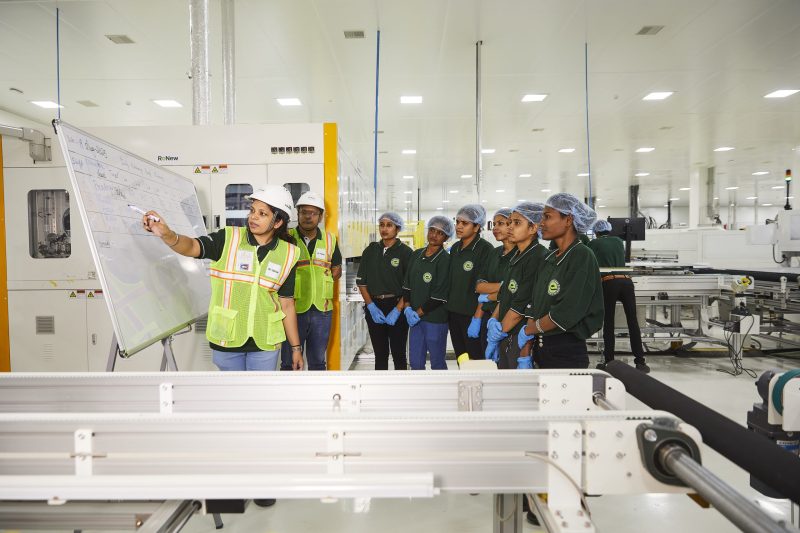
Plant engineers at ReNew’s solar manufacturing plant in Jaipur, Rajasthan, India (Photo: ReNew)
Incentives for business
Businesses and policymakers can support the green transition in India by prioritizing and upskilling the female population. Measures could include providing incentives for businesses that invest in new or adapted green skills training programmes, with a focus on gender inclusion. Starting at the root will ensure meaningful progress is made.
We will be passing the torch to future generations to continue progressing the green transition, and fostering a future green workforce will be key. ReNew’s Lighting Lives initiative powers schools with limited access to electricity, enabling more effective learning, and ensures environmental studies are included in curriculums. By empowering younger generations with the skills needed, we can help to ensure a demographically inclusive future workforce.
India’s green skills gap presents both a challenge and an opportunity. By addressing this gap through targeted education, training and initiatives, India can ensure that it meets its climate goals and builds a robust green economy. However, this transition must be inclusive -particularly for women, who are at present under-represented in the energy sector. By implementing policies and frameworks that focus on inclusion and participation, India can create a just and equitable energy transition that benefits all.
The post India can plug its green skills gap by elevating women in the workforce appeared first on Climate Home News.
India can plug its green skills gap by elevating women in the workforce

Delegates will soon gather in the Turkish resort city of Antalya for UN climate negotiations, against a backdrop of war, energy crisis and climate extremes.
At COP31, nations will try to find agreement on various issues, including climate finance for developing countries and a global “just transition” towards a cleaner economy.
This summit is unusual due to its joint presidency, which means that Australia is leading the negotiations while Turkey hosts the conference.
Outside the formal negotiations, Turkey is also pushing its own priorities as part of a wider “action agenda”, including electrification, oceans and “green industrialisation”.
In order to track parties’ positions on key negotiating points and wider issues at COP31, Carbon Brief has analysed around 100 documents and captured them in the interactive table below.
The first column shows the countries and UN negotiating blocs, the second shows the topics up for debate and the third indicates specific issues within those topics.
The final column indicates the positions that the parties have expressed on each topic. These range from “priority” – meaning the party is likely to be pushing the issue – to “oppose”, meaning it is likely to push against it.
This is a “living document” that will be updated over the course of COP31.
Please get in touch if you would like to offer additions by emailing policy@carbonbrief.org.
Brief explanations of the key issues and jargon-filled language that permeate the talks can be found below the interactive table.
Just transition
At COP30 in Brazil in 2025, nations agreed to establish a practical mechanism to help drive a “just transition” to a low-carbon economy.
Key aspects of this “Belém-Antalya mechanism” (BAM) – often referred to as the “just transition mechanism” (JTM) – were agreed during the June climate negotiations this year, but many details are missing and dividing lines remain between parties.
Parties have disagreed about the scope of the mechanism and whether it should be tied to the provision of finance.
Nevertheless, following progress in June within the “just transition work programme” (JTWP), civil society groups highlighted that getting the mechanism up and running is a “key expected outcome” from COP31.
Climate finance
Climate finance is always a highly contested issue at UN climate negotiations.
Developing countries have successfully pushed for a “work programme” on climate finance to feature on the conference agenda.
These parties see this programme as a way to pressure developed countries into providing more funding from their public coffers, specifically under Article 9.1 of the Paris Agreement. Some are even proposing a “burden sharing” arrangement for climate-finance provision.
This comes against a backdrop of major donors cutting their aid budgets and the Trump administration in the US pressuring multilateral development banks (MDBs) to drop their climate objectives.
Developed countries, which have traditionally been responsible for providing finance, would prefer to keep a broader focus on issues such as improving access to existing finance and broadening the range of donors. Some developing countries, such as small-island states, also support these goals.
Nations have also been discussing Article 2.1c of the Paris Agreement under the “Veredas dialogue”. This focuses on making all global “financial flows” consistent with climate action.
Countries have different views about what this involves, with developing countries again hoping to keep the focus on developed countries’ responsibilities to financially support them.
Adaptation and mitigation
At negotiations in June, parties were unable to agree on the details of a “global goal on adaptation” (GGA), which is intended to drive climate adaptation worldwide.
Having agreed at COP30 on a list of 59 “indicators” – ways to assess progress towards the GGA – nations now need to refine these before COP32 in Addis Ababa, Ethiopia. This is a highly technical process that involves a taskforce working out how to use and track these indicators.
Broadly, developing countries stress the importance of finance to fund adaptation efforts, rather than simply to track progress. They also want reassurances about a pledge made last year to “triple adaptation finance”.
At the June climate negotiations, negotiators also failed to make any progress when discussing the mitigation work programme (MWP) – the only formal agenda item that concerns cutting greenhouse gas emissions.
Among other things, parties disagreed on whether the MWP should continue running over the next few years, or simply be brought to a close.
Global stocktake and NDCs
Back in 2023, the first “global stocktake” (GST) of the Paris Agreement set out the state of climate action and what needed to be done to set the world on course.
On mitigation, nations agreed to a package of measures, including “transitioning away from fossil fuels”, tripling renewable energy and “halting and reversing deforestation” by 2030.
Some of these outcomes remain contentious among certain parties, particularly large, developing countries and those with economies that rely on fossil-fuel exports.
Developing countries have persistently argued that they need more climate finance to implement the global stocktake outcomes.
Parties were meant to update their climate plans under the Paris Agreement, informed by the first global stocktake, by 2025. These plans, known as nationally determined contributions (NDCs), cover the period out to 2035.
So far, only 150 parties – responsible for three-quarters of global emissions – have submitted new NDCs.
Iran, Vietnam, Egypt and Argentina are among those without new NDCs – and the US has withdrawn its climate plan under the Trump administration.
Some parties, such as the EU, have stressed the need for countries to submit their new NDCs ahead of COP31 – and to ensure they are aligned with the 1.5C temperature limit.
COP31 will also see the launch of the second global stocktake, which will conclude in 2028.
Action agenda and other issues
Turkey will be pushing its “action agenda” priorities at COP31, including global targets for electrification, reducing waste and reducing building-sector emissions.
(The Australian “presidency of negotiations” is intending to pursue a “cover text” decision at COP31 that may capture some of these wider targets, such as the electrification goal.)
The action agenda is meant to provide a complementary track to the formal negotiations, where governments and non-state actors can advance specific, real-world solutions.
A new COP31 presidency effort dubbed the “climate implementation bridge” is also meant to complement these ambitions by turning NDC goals into an “investable project portfolio”
Some parties have explicitly signalled their support for various elements beyond the formal negotiations, in the run-up to COP31.
For example, a joint letter signed by 105 parties called for COP31 to “put the ocean at the heart of climate action” by embedding ocean-based climate action in the UNFCCC architecture.
The post Interactive: Who wants what at the COP31 climate change summit appeared first on Carbon Brief.
Interactive: Who wants what at the COP31 climate change summit
Prepared by a coalition of nine Western Australian union, industry, conservation, and community organisations—including UnionsWA, the Conservation Council WA, and the Smart Energy Council—the WA Clean Energy, Jobs & Industry Plan provides a practical roadmap to transform Western Australia into a clean energy powerhouse while creating thousands of secure local jobs.
Western Australia stands at a pivotal crossroads: lead the global clean energy economy or watch investment, future industries, and secure jobs go elsewhere. The WA Clean Energy, Jobs & Industry Plan outlines a transformative blueprint to harness the state’s world-class solar and wind resources. Discover how legislated renewable targets, green iron manufacturing, and a dedicated regional training strategy can generate tens of thousands of local jobs, lower household bills, and build a resilient, net-zero future for all Western Australians.

WA needs a clear and forward-thinking plan if it is going to become a competitive renewable energy powerhouse and maintain its economic strength through the energy transition.
“Western Australians know a faster renewable energy transition will lower their household expenses and prevent harmful climate pollution. But the community also needs clear direction to ensure this transition will create jobs, lower costs and not cause undue environmental harm.
“Here, sectors representing a broad range of interests have laid the groundwork for those outcomes, clearly outlining what is needed to create a future for WA that is good for the environment, for the climate, for workers and for the economy.
Summary
The WA Clean Energy, Jobs & Industry Plan sets out a strategic roadmap to position Western Australia as a global clean energy superpower while creating thousands of secure local jobs.
The report establishes three overarching goals:
- Creating local employment.
- Maintaining industrial competitiveness.
- Lowering household energy costs
To realize this vision, the framework details actionable measures to follow on from the recent WA Government announcement of a 75% Renewable Energy Target by 2031 for the South West Interconnected System. This includes developing a statewide Renewable Energy Target, coordinating statewide workforce and training pipelines, strategically planning regional infrastructure to safeguard high-value biodiversity and cultural heritage, and ensuring equitable benefit-sharing through household electrification incentives and First Natio