Carbon Brief is looking for someone special to help support our busy and growing team.
- Do you have administration experience and good interpersonal skills?
- Are you organised and clear-thinking, with the ability to multitask?
- Do you have meticulous attention to detail?
Job description
Working closely with our journalists, editors, multimedia producers and digital content executives, you’ll play a key role in supporting the whole Carbon Brief team in producing world-class journalism and in ensuring a happy, efficient and inclusive workplace.
Reporting to the Office Manager, this role would suit an motivated and organised individual looking for a hybrid position with a variety of PA and admin duties. These will include office administration, travel and meeting coordination, and supporting HR processes as core tasks, but you may have other responsibilities that grow and change as the role develops.
You’ll have exceptional organisational skills and an ability to prioritise tasks efficiently and effectively. You will be comfortable working on your own initiative, yet able to build strong working relationships. With a flexible attitude and constructive outlook, you’ll enjoy the prospect of making sure our in-house processes work efficiently and contribute new ideas for supporting our team and the work we do.
Please note that this particular role is not a route into journalism. A different role within Carbon Brief would be better suited to anyone with aspirations to write.
Responsibilities
- Being a contact point: Liaise with building management, update the team about notices/events and ensure the correct processes are followed.
- Inbox management: Review, respond to and flag emails that come into Carbon Brief’s general inbox – e.g. media requests, feedback and general enquiries.
- Meetings and events: Coordinate availability, schedule meetings, check facilities, liaise with venues, make bookings and organise materials/provisions.
- Coordinating travel: Process team travel requests; organise itineraries and make bookings; prepare travel guidance and check health and visa requirements.
- Supporting HR: Book line-management meetings, monitor annual leave, assist with recruitment, process expenses and keep accurate records via our Sage HR platform.
- Office/team equipment: Order IT and other office equipment, as required, and maintain an up-to-date inventory of IT assets.
- Administrative support: Ad-hoc support for the Office Manager and wider Carbon Brief team, including marking team social events and milestones.
Experience
Essential
- One year’s previous experience in a similar role.
- Excellent organisational and planning skills.
- Proven collaboration and team-working skills.
- Meticulous attention to detail and a commitment to accuracy.
- Excellent communication skills, both written and verbal.
- Discretion and an understanding of confidentiality issues.
- Proficient in Microsoft Office and Google Docs.
Desirable
- Experience of using the Sage HR platform.
- An interest in climate change, the environment and/or journalism.
- An awareness of Carbon Brief and the kind of organisation we are.
Location: Carbon Brief’s office is in central London. For this particular role, we would prefer the successful candidate to be based in the UK and able to come into the office 2-3 days per week.
Hours/Duration: Regular office hours of 9:00am to 5:00pm, Monday to Friday. This is a full-time permanent (non-sponsored) position.
Salary: £30,000 per year, dependent on experience. Generous benefits, including pension and group protection insurance.
How to apply
To apply, please send:
- Your CV.
- A cover letter explaining why you would be a good fit for the role and the organisation.
Please start “Team Coordinator application – Carbon Brief” in the email subject line.
Applications must be submitted by 9AM GMT on Monday 11 March. First interviews will be held on Monday 18 March and Thursday 21 March. Shortlisted candidates will be invited back for a second interview on Tuesday 26 March, with a view to making a decision by the end of the week.
Carbon Brief is committed to encouraging equality, diversity and inclusion among our workforce. Our aim is to be truly representative of all sections of society and for each employee to feel respected and able to give their best. We strongly encourage applications from those who feel underrepresented in climate journalism, including ethnic and social minorities.
About Carbon Brief
Carbon Brief specialises in clear, evidence-based articles and data visualisations to help improve the understanding of climate change, both in terms of the science and the policy response. We publish a wide range of content, including Q&As, in-depth analysis, interviews, newsletters, interactives, infographics and maps. Our audience is global and diverse, but particularly serves policymakers, journalists, NGOs and academics. We are proud of the reach and engagement we have with our audiences, who value our rigorous and authoritative brand of ‘explainer journalism’.
The post Vacancy: Team Coordinator appeared first on Carbon Brief.

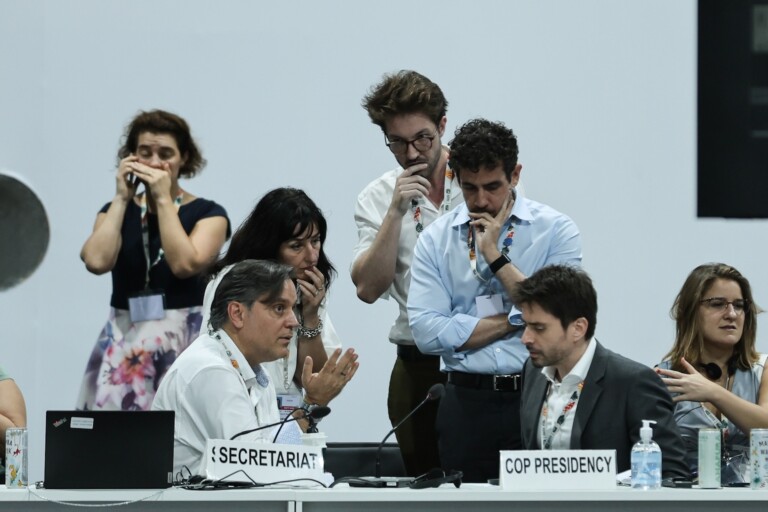
More than 92,000 people have registered to attend the COP31 climate summit in Antalya, Turkey, potentially making it the largest COP in history.
Carbon Brief analysis of the provisional lists of delegates, published by the United Nations Framework Convention on Climate Change (UNFCCC), reveals that more than 14,000 delegates have been registered as “host country guests”.
For comparison, the provisional list for COP30 in Belém, Brazil, last year included only around 1,000 delegates in this category.
As with COP30, Donald Trump’s US government has not sent a delegation. Other no-shows include Israel and Myanmar.
It was reported ahead of the summit that Taliban officials from Afghanistan had been registered for the event as observers; however, there are no delegates from observer states in the provisional lists.
With more than 3,000 “virtual” delegates signed up to attend the summit online, the total number of people registered for the event surpasses 95,000.
Further analysis of the participant lists will be added to this article in due course.
Party delegates
With 92,934 participants registered, COP31 is provisionally the largest COP in history – topping COP28 in Dubai, which was attended by more than 80,000 people.
This total is based on the delegates that have registered to be at the summit in person. The UNFCCC releases the final figures – based on participants collecting a physical badge at the venue – after the summit has ended.
The chart below shows how the provisional figures for COP31 compare to the final totals in previous COPs – going back to COP1 in Berlin in 1995.
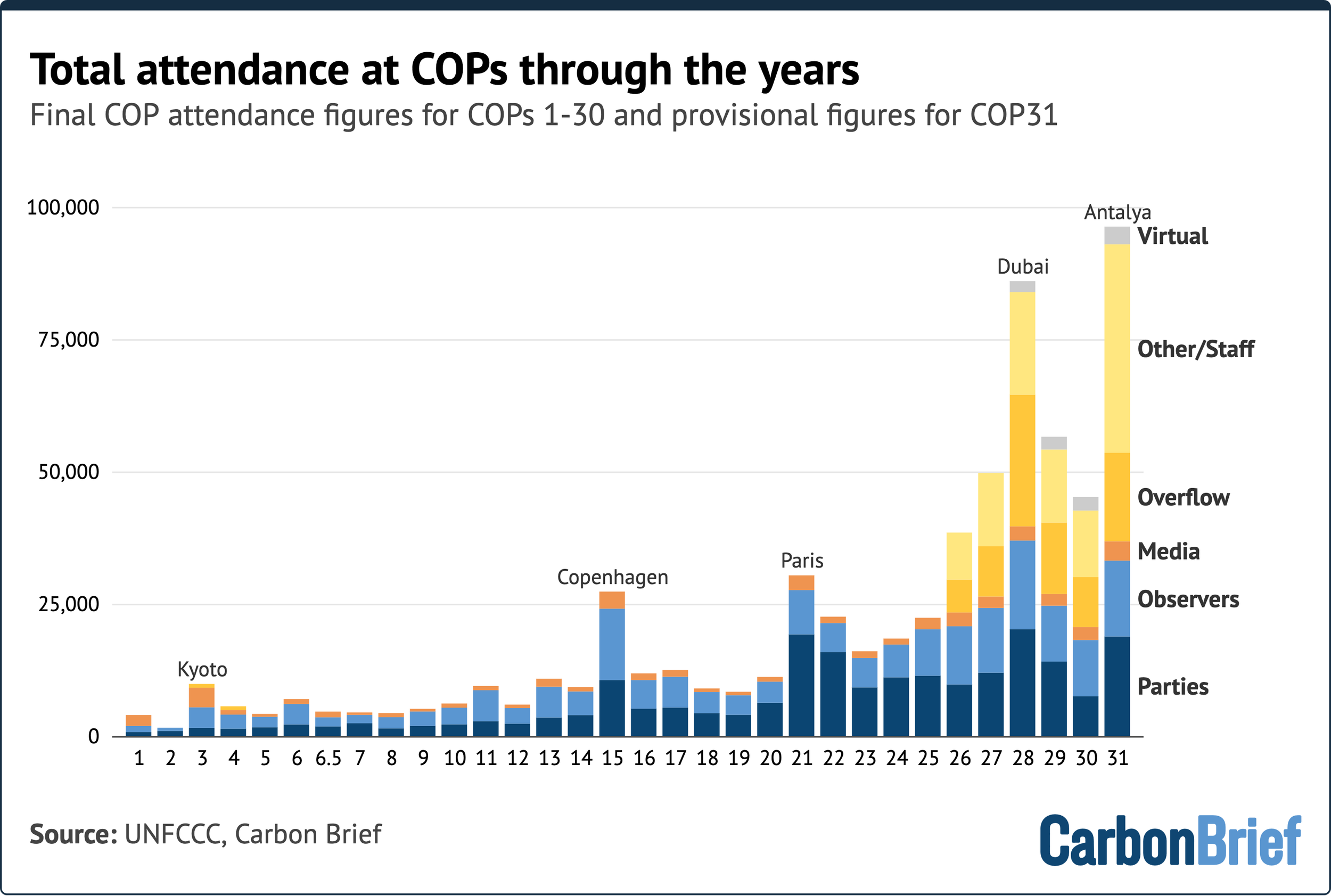
The participant lists provided by the UNFCCC are divided between the different types of groups and organisations attending the summit. The largest group at COP31 is for delegates representing parties. These are nation-states, plus the European Union, that have ratified the convention and play a full part in negotiations.
This group adds up to 18,812 delegates – the second largest after COP28.

Membership
Support award-winning climate journalism
(In keeping with recent COPs, the UNFCCC has published spreadsheets that name every single person that has registered for the summit – excluding support staff. Previously, COPs have typically included thousands of “overflow” participants in which countries and UN agencies could nominate delegates without their names appearing on their official lists.)
For consistency with Carbon Brief’s analysis of previous COPs, the above chart includes overflow delegates as a single group. However, the participant lists do divide the overflow delegates between parties and observer groups. Including the overflow numbers takes the total for party representatives to more than 34,000.
Nations
The map and table below present the delegation size – split between party and overflow badges – for all the countries registered for COP31. The darker the shading, the more delegates that country has signed up. Use the search box to find the data for a specific party.
Unsurprisingly, host nation Turkey has registered the largest delegation for COP31 – with 2,950 people.
Following behind are Brazil (1,994 people), Nigeria (1,506), China (1,021) and Indonesia (978).
The rest of the top 10 is made up of Australia (835), Uganda (627), Italy (607), Japan (588) and Kazakhstan (557).
The UK comes someway down the list with a delegation of 255.
The smallest delegation comes from North Korea (two), followed by Eritrea and Nicaragua (three) and San Marino and Trinidad and Tobago (four).
(It is worth noting that some countries – such as Brazil – allocate some of their party badges to NGOs, which can artificially inflate the size of their official delegation.)
The post Analysis: Which countries have sent the most delegates to COP31? appeared first on Carbon Brief.
Analysis: Which countries have sent the most delegates to COP31?
Some big fossil fuel-producing countries – among them India, Nigeria and Germany – have swung behind the Brazil-led roadmap to phase out coal, oil and gas, while the UN chief said on Tuesday that all countries should start to make progress on cutting fossil fuels by 2028.
COP30 President André Corrêa do Lago presented the newly published global roadmap on Transitioning Away from Fossil Fuels (TAFF) to a packed plenary room in Antalya, cheered on by rounds of applause from delegates and civil society.
Nigeria – an OPEC oil producer that participated in the Santa Marta conference on phasing out fossil fuels earlier this year – welcomed the roadmap and said its recognition that countries have different starting points is “fundamental”.
“As a developing country with significant energy resources, energy access challenges and growing industrial ambitions, we must industrialise and decarbonise simultaneously,” the Nigerian delegate told the event.
She welcomed the roadmap’s proposed system for nations to self-identify their fossil fuel demand, supply and exposure of their wider economies, but said the “real test of this roadmap” will be translating transition pathways into “investable opportunities”.