Connect with us

Published

on

Oscar Berglund is a senior lecturer in international public and social policy at the University of Bristol and Tie Franco Brotto is a PhD candidate at the University of Bristol’s School for Policy Studies.

Climate and environmental protest is being criminalised and repressed around the world. The criminalisation of such protest has received a lot of attention in certain countries, including the UK and Australia. But there have not been any attempts to capture the global trend – until now.

We recently published a report, with three University of Bristol colleagues, which shows this repression is indeed a global trend – and that it is becoming more difficult around the world to stand up for climate justice.

This criminalisation and repression spans the global north and south, and includes more and less democratic countries. It does, however, take different forms.

Our report distinguishes between climate and environmental protest. The latter are campaigns against specific environmentally destructive projects – most commonly oil and gas extraction and pipelines, deforestation, dam building and mining. They take place all around the world.

Climate protests are aimed at mitigating climate change by decreasing carbon emissions, and tend to make bigger policy or political demands (“cut global emissions now” rather than “don’t build this power plant”). They often take place in urban areas and are more common in the global north.

Four ways to repress activism

The intensifying criminalisation and repression is taking four main forms.

1. Anti-protest laws are introduced

Anti-protest laws may give the police more powers to stop protest, introduce new criminal offences, increase sentence lengths for existing offences, or give policy impunity when harming protesters. In the 14 countries we looked at, we found 22 such pieces of legislation introduced since 2019.

2. Protest is criminalised through prosecution and courts

This can mean using laws against climate and environmental activists that were designed to be used against terrorism or organised crime. In Germany, members of Letzte Generation (Last Generation), a direct action group in the mould of Just Stop Oil, were charged in May 2024 with “forming a criminal organisation”. This section of the law is typically used against mafia organisations and had never been applied to a non-violent group.

In the Philippines, anti-terrorism laws have been used against environmentalists who have found themselves unable to return to their home islands.

Criminalising protest can also mean lowering the threshold for prosecution, preventing climate activists from mentioning climate change in court, and changing other court processes to make guilty verdicts more likely. Another example is injunctions that can be taken out by corporations against activists who protest against them.

3. Harsher policing

This stretches from stopping and searching to surveillance, arrests, violence, infiltration and threatening activists. The policing of activists is carried out not just by state actors like police and armed forces, but also private actors including private security, organised crime and corporations.

In Germany, regional police have been accused of collaborating with an energy giant (and its private fire brigade) to evict coal mine protesters, while private security was used extensively in policing anti-mining activists in Peru.

4. Killings and disappearances

Lastly, in the most extreme cases, environmental activists are murdered. This is an extension of the trend for harsher policing, as it typically follows threats by the same range of actors. We used data from the NGO Global Witness to show this is increasingly common in countries including Brazil, Philippines, Peru and India. In Brazil, most murders are carried out by organised crime groups while in Peru, it is the police force.

Protests are increasing

To look more closely at the global picture of climate and environmental protest – and the repression of it – we used the Armed Conflicts Location Event database. This showed us that climate protests increased dramatically in 2018-2019 and have not declined since. They make up on average about 4% of all protest in the 81 countries that had more than 1,000 protests recorded in the 2012-2023 period:
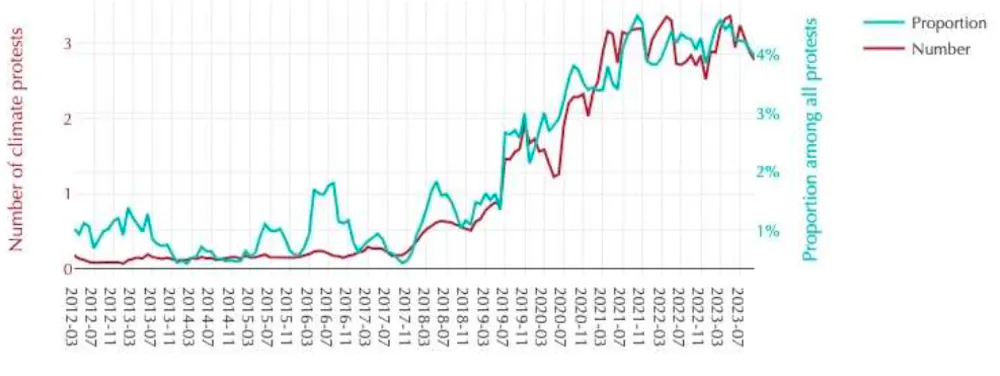
Graph
Climate protests increased sharply in the late 2010s in the 14 countries studied. (Data is smoothed over five months; number of protests is per country per month)
Berglund et al; Data: ACLED, CC BY-SA

This second graph shows that environmental protest has increased more gradually:
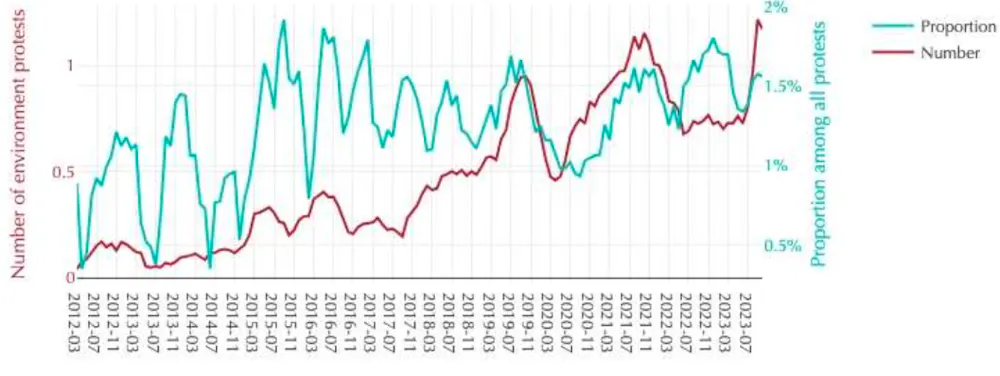
Graph
Environmental protests in the same 14 countries
Data: ACLED, CC BY-SA

We used this data to see what kind of repression activists face. By looking for keywords in the reporting of protest events, we found that on average 3% of climate and environmental protests face police violence, and 6.3% involve arrests. But behind these averages are large differences in the nature of protest and its policing.

A combination of the presence of protest groups like Extinction Rebellion, who often actively seek arrests, and police forces that are more likely to make arrests, mean countries such as Australia and the UK have very high levels of arrest. Some 20% of Australian climate and environmental protests involve arrests, against 17% in the UK – with the highest in the world being Canada on 27%.

Meanwhile, police violence is high in countries such as Peru (6.5%) and Uganda (4.4%). France stands out as a European country with relatively high levels of police violence (3.2%) and low levels of arrests (also 3.2%).

In summary, while criminalisation and repression does not look the same across the world, there are remarkable similarities. It is increasing in a lot of countries, it involves both state and corporate actors, and it takes many forms.

This repression is taking place in a context where states are not taking adequate action on climate change. By criminalising activists, states depoliticise them. This conceals the fact these activists are ultimately right about the state of the climate and environment – and the lack of positive government action in these areas.The Conversation

This article is republished from The Conversation under a Creative Commons license. Read the original article.


The post Repression of climate and environmental protest is intensifying across the world appeared first on Climate Home News.

Repression of climate and environmental protest is intensifying across the world

Continue Reading

Climate Change

Clean power shields China from oil shock more than any other country

Published

on

China’s rapidly-expanding clean energy generation and deepening electrification has made the country more resilient to energy shocks, bolstering its position ahead of the COP31 climate talks in Türkiye, where speeding up the world’s electrification is set to dominate.

The growth of China’s renewable energy capacity protected it from the economic fallout from the energy crisis triggered by the closure of the Strait of Hormuz, according to analysis by the Centre for Research on Energy and Clean Air (CREA) published on Thursday.

As oil and gas stopped flowing through the key fossil fuel trade route, leading prices to soar, China’s crude oil imports – the largest in the world – fell sharply, leading the country to start drawing down on its reserves and curbing its exports of petroleum products.

“Yet, the import reduction did not produce the economic and social disruption in China one might normally expect from a shock of this scale,” the report found.

As temporary adjustment cushioned the oil-import shock, clean power and the electrification of the transport sector buffered the economic costs.

The rise of renewable energy and nuclear power have reduced China’s fossil fuel imports bill by more than $9 billion since 2020, more than any other country, according to CREA.

“China remains exposed to imported fuels, particularly where oil is used as a chemical feedstock, but reducing fossil-fuel demand already contributes to energy security,” said Qi Qin, the report’s author.

The view from Beijing: vindicated

CREA’s analysis found the roll-out of electric vehicles (EVs) displaced 38 million tonnes of oil equivalent between March and August, equivalent to around 13% of China’s crude oil imports in the same period the previous year.

China’s ongoing reliance on coal-fired power plants also protected the country against oil and gas supply disruptions, although coal power generation remained broadly flat in the six months since the start of the Iran war, according to the report.

    Li Shuo, director of China Climate Hub at the Asia Society Policy Institute, told Climate home News that China’s all-of-the-above approach to energy development has provided the country with the strategic flexibility to face the oil shock.

    “While China has often been criticised in previous years for moving too slowly away from coal, this year’s global energy market volatility has given Chinese policymakers a renewed sense of confidence. There is a growing sentiment in Beijing that recent events have vindicated China’s energy strategy as both prudent and pragmatic,” he said.

    Can China support the electrification pledge?

    Despite its vast cleantech build-out and rapid electrification boosting its energy resilience, China has stopped short of endorsing an initiative by COP31 host Türkiye to increase the global share of electricity to 35% in final energy use by 2035.

    Li Gao, vice minister at the Ministry of ​Ecology and Environment, who will lead the Chinese delegation at COP31, told a press conference the electrification target was in line with Chinese policy. “We believe that increasing electrification levels will help promote a green and low-carbon energy transition and address climate change,” he said.

    China’s position on the electrification initiative is one of the major questions hanging over the COP31 talks beginning in Antalya next week.

    “What is clear is that China has the most to gain from accelerated electrification because of their manufacturing capabilities,” said Bruce Douglas, CEO of the Global Renewables Alliance.

    In 2026 alone, China’s exports of solar panels, batteries, EV and other cleantech are on track to avoid emissions equivalent to Brazil’s annual emissions.

      Türkiye’s proposal doesn’t include a commitment to produce the power from clean energy, nor does it explicitly link electrification to the transition away from fossil fuels – issues on which the EU has signalled it is ready to push back.  

      But Chinese analysts say Beijing is unlikely to support linking a global electrification goal to commitments on phasing out fossil fuels.

      Former French climate envoy Laurence Tubiana, the outgoing CEO of the European Climate Foundation, told Climate Home News that the EU and developed countries such as Brazil – which is influential within the BRICS group of large emerging economies – have a responsibility to push China to show leadership in the talks.

      Driving the world’s electrification

      The electrification of the Chinese economy has outpaced that of any other major economy.

      In the US and the EU, the share of electrification has stagnated just above 20%. In China, it has doubled since 2005, reaching close to 30% in 2025.  

      The International Energy Agency (IEA) expects China will remain the single largest driver of global electricity demand growth through to 2030, as it electrifies its manufacturing sector as well as growing demand for cooling and EV charging.

      Over the next five years, the IEA forecasts that China will increase its electricity consumption by as much as the total electricity consumption of the EU today.

      In August, the Chinese government set a target to boost the share of electricity in its final energy consumption to 35% by 2030 – five years ahead of Türkiye’s proposed goal.

      From laggard to frontrunner

      Clean-power growth and electrification could meet all of China’s rising power demand, according to CREA. By 2030, this would mean renewable and nuclear energy could reach 54% of power generation – exceeding China’s target to generate half its electricity from non-fossil sources by the end of the decade.

      Clean electricity already met all of China’s demand growth in 2025. “The challenge lies in sustaining such growth over several years,” said Qin.

      From Beijing’s perspective, the global targets such as the electrification pledge “no longer appear particularly ambitious or threatening”, said Li, of the Asia Society Policy Institute.

      “China, long perceived as a climate laggard, is increasingly moving ahead of countries in the Global North. A global ceiling target is increasingly only a floor for China,” he emphasised.

      The post Clean power shields China from oil shock more than any other country appeared first on Climate Home News.

      Clean power shields China from oil shock more than any other country

      Continue Reading

      Climate Change

      Q&A: What is the Brazil-led ‘deforestation roadmap’?

      Published

      on

      Article Contents