

Welcome to Carbon Brief’s China Briefing.
China Briefing handpicks and explains the most important climate and energy stories from China over the past fortnight.
Subscribe for free here.
Key developments
Voices from China
‘TRUE MULTILATERILIAM’: Although not attending COP29 in person, Chinese president Xi Jinping issued a call for the global south to “work together to practise true multilateralism, and to advocate for an equal and orderly multipolar world and universally beneficial and inclusive economic globalisation”, state-run newspaper China Daily reported.
-
Sign up to Carbon Brief’s free “China Briefing” email newsletter. All you need to know about the latest developments relating to China and climate change. Sent to your inbox every Thursday.
CLIMATE FINANCE: Ding Xuexiang, Xi’s “special representative” at COP and China’s executive vice-premier, notably used the UN language of climate finance to describe Chinese overseas aid for the first time (see below). Speaking at a “high level segment” on Tuesday, Ding added that the “complete transformation of growth models is the fundamental solution to climate change”. He also called for “strengthening early-warning systems for all and enhancing climate adaptation capacity” – a ”specific requirement” from Xi, according to state news agency Xinhua.
‘ENHANCED’ ACTION: At a methane summit co-hosted by China and the US, and attended by Carbon Brief, climate envoy Liu Zhenmin said that “co-operation on global climate action will continue to be enhanced.” (See below.) Speaking at China’s large and very busy “pavilion”, Liu said climate change is a global challenge and China, in particular, has experienced more severe extreme weather events recently. He touted investments worth $676bn in energy transformation and said China’s export of wind and solar products had helped the world cut emissions by 810m tonnes of carbon dioxide equivalent.
‘PUSHING FORWARD’: Speaking at a separate China pavilion event, Zhao Yingmin, vice minister of China’s Ministry of Ecology and Environment (MEE), said that “addressing climate change is a global consensus” and that China is taking the responsibility of “pushing forward green and low-carbon development”. He also emphasised the role of women and young people in tackling climate change, saying “we need to mobilise all forces”.
‘CRITICAL POINT’: Xia Yingxian, director of the climate department of the MEE, commented at a press conference ahead of COP29 that this year is a “critical point for climate-finance negotiations” and that developed countries must “fulfil their commitment”, according to business news outlet 21st Century Business Herald. Back at the COP29 China pavilion, Carbon Brief heard an official speaking on behalf of Xia again supporting multilateral cooperation and saying China had an “unswerving” commitment to climate action. He added that an energy transition covering “all aspects” of society is needed. The official representing Xia closed his remarks in English, saying: “China is very willing to cooperate…to promote a low-carbon and sustainable future.”
STEPPING UP: Wen Hua, deputy director-general of the Department of Resources Conservation and Environmental Protection of the National Development and Reform Commission (NDRC), China’s top planner, told the methane event that “China is willing to take a more active role in global climate governance”.
Agenda fight
TRADE CONCERNS: China, on behalf of the BASIC group (Brazil, China, India and South Africa), “submitted a proposal” ahead of COP29 to include “concerns with climate-change related unilateral restrictive trade measures” in the conference’s agenda, Reuters reported. According to the full text of the request, BASIC argued that “unilateral trade-restrictive measures adopted by developed country parties under the guise of climate objectives [have] disproportionate adverse effects on developing country parties”. The text added that parties must “send a clear and strong signal of commitment to multilateralism and global cooperation”.
HORSE-TRADING: The request was largely interpreted as pushback to the EU’s carbon border adjustment mechanism (CBAM), which China has “strongly criticised” in the past. Climate Home News noted that “BASIC countries have long opposed” the CBAM and “made a similar agenda proposal” for COP28. The BASIC request – ultimately shunted into unofficial “presidential consultations” – was at the heart of an “agenda fight” that dominated the first day in Baku. The fight also encompassed a broader, ongoing argument over how to take forward the COP28 pledge on “transitioning away from fossil fuels”, with the LMDC group, including China, opposing this being part of the so-called UAE dialogue.
Climate finance
‘HUGE DIVISIONS’: China entered the “finance COP” under pressure to play an upgraded role in climate finance, as “huge divisions” emerged over how much money should be paid into the “new collective quantified goal” (NCQG) and by whom, the Financial Times reported. Beijing has “firmly rejected” these calls, according to Agence France-Presse, which quoted a Chinese official “warning on Sunday during a closed-door session that the talks should not aim to ‘renegotiate’ existing agreements”. The state-run broadcaster China Global Television Network (CGTN) quoted envoy Liu calling on “developed countries to take the lead in providing financial assistance to developing nations”.
$1.3 TRILLION: Early on in negotiations, the G77+China negotiating bloc also rejected the proposed text for a NCQG framework, the New Indian Express reported, adding that they called for $1.3tn per year to be provided by developed countries and for “a fresh, equitable text…prioritis[ing] the needs of developing countries and uphold[ing] the principles of equity and ‘common but differentiated responsibilities and respective capabilities’”.
OLIVE BRANCH: In his COP29 speech, vice premier Ding offered an olive branch by telling delegates that China has already “provided and mobilised project funds of more than 177bn yuan ($24.5bn) for developing countries’ climate response”. This is the first time China has used the language of climate finance, Kate Logan, director at the China climate hub at the Asia Society Policy Institute (ASPI), wrote on Twitter. She added that this “plac[ed China’s contributions] on the same order – if not higher than – many developed countries’ efforts” and gave China “teeth in pushing developed countries to do more”.
SOLUTION PROVIDER: Speaking to Carbon Brief in May, Li Shuo, director at ASPI’s China climate hub, said that one possible solution, in his view, was to leverage China’s position as “the biggest solution provider” for low-carbon technologies to encourage it to “provide finance or facilitate investment” in developing countries’ energy transitions, allowing China to find a palatable role for itself in an outer layer of a potential “onion” structure for the NCQG.
US-China climate cooperation
LOOMING SHADOW: China and the US entered COP29 after a series of meetings between climate envoys John Podesta and Liu Zhenmin, but without an equivalent to last year’s Sunnylands statement – a document that “signalled Biden and Xi’s shared intent to address the climate crisis”, according to thinktank the Lowy Institute. Liu told reporters that China is “concerned” about US climate policy under a second Trump administration, although he emphasised that “international multilateral climate cooperation should continue”. Meanwhile, Podesta said in a press conference attended by Carbon Brief that China has an “obligation…to come forward with a 1.5C-aligned, all-greenhouse-gas, economy-wide [NDC climate pledge]”, adding that, on the climate-finance question, expanding the donor base is “long warranted” and that “large emitters must be accountable”. (Ding confirmed in his COP29 address that China’s climate pledge would be economy-wide and cover all greenhouse gases.) However, the New York Times noted that it may be difficult at COP29 to replicate the “key roles” US negotiators have played in “persuading countries like China…to commit to tougher emissions targets”.
CHINA LEADS: As the world awaits a US retreat from the global climate stage, China “appears more committed to the [Paris] agreement than ever”, the Wall Street Journal reported, quoting former climate negotiator Jonathan Pershing saying: “Everyone looks to China now…I think with the US out, China will step up, but in a very different way.” In a press conference watched by Carbon Brief, Yuan Ying, chief China representative at Greenpeace, echoed this message, saying that the US election results should not cause China to “lower their ambition level” and that it should instead fill the “climate leadership vacuum”. ASPI’s Li, speaking at a Carbon Brief event ahead of COP29, said that it is crucial for China to note that its actions in negotiations will send a “strong signal” to the rest of the world on the “future of global climate governance”, adding that “China has invested a lot” in its image as a climate leader.
BRIGHT SPOT: Methane remains one area where US-China cooperation has traction. While China did not make any new announcements at the COP29 summit on methane and non-CO2 greenhouse gases, attended by Carbon Brief, Liu did use the platform to state that “China-US co-operation on enhancing climate action had been effective over the past year”, adding that he “hope[d]” that US-China climate cooperation “will continue to be enhanced”. Ryna Cui, associate research professor and acting director of the Center for Global Sustainability at the University of Maryland, told Carbon Brief that both countries underscored their “strong interest to continue [cooperation], especially on issues like methane” at the summit , adding that “strong” channels at the subnational and non-government levels “will become increasingly critical to make engagement [in methane and other areas] more robust” in the years ahead.
Emphasising energy transition
TRANSITION PATHWAYS: “Energy transition” has been emphasised by multiple high-level Chinese officials at this year’s COP. At the China pavilion, the Energy Research Institute of the Academy of Macroeconomic Research (ERI), a research thinktank under the supervision of the NDRC, launched its 2024 China energy transition report – a key document illustrating China’s potential energy transition pathways. Lyu Wenbin, head of the institute, told Carbon Brief: “The Chinese government has proposed the ‘dual-carbon’ goal and energy transition is an important part of it. With the goal being clearly set, what we can do for delivering it is to choose the best pathway.” Bai Quan, director of the energy study centre, told Carbon Brief that the biggest difference between the 2023 and 2024 report was the “emphasis on global cooperation”. He said: “Our report has absorbed [energy transition] experiences from different places…We would love to discuss more new ideas with everyone else in the world.”
COAL CRITICISM: The International Energy Agency’s (IEA) executive director Fatih Birol said at the launch of the report that there are few countries that are prepared for the new era of electricity and that China is the “leading one”. However, he cautioned that China “needs to pay attention to its coal-fired power plants sooner than later”, adding that “renewable energy with batteries will be a better solution for China’s energy demands than coal”.
Captured
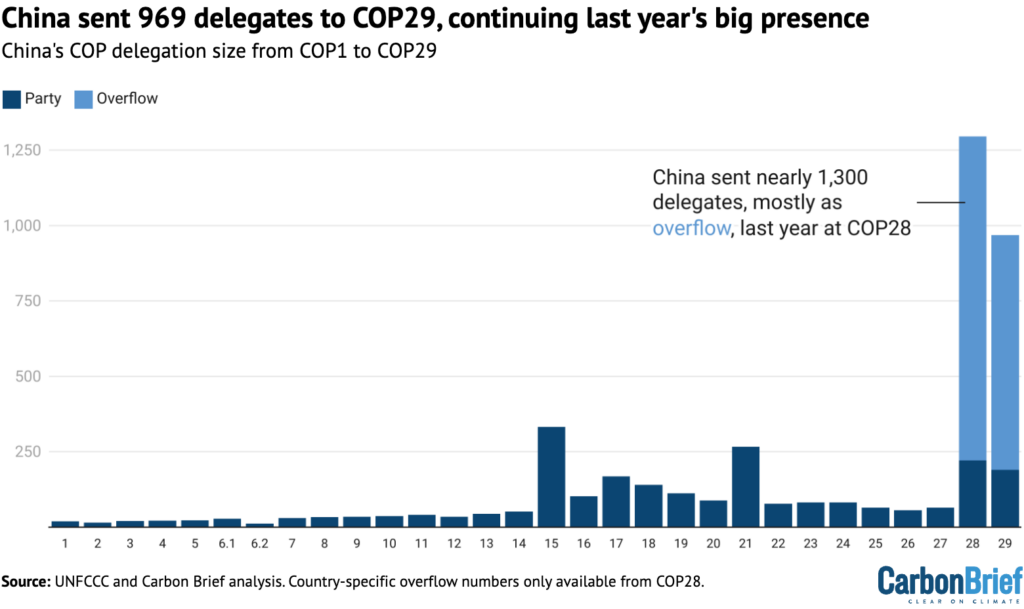
China sent a delegation of 969 people to COP29, according to new analysis by Carbon Brief, as the country seeks to boost its influence in climate diplomacy. The numbers are lower than they were for COP28, when the China delegation included 1,296 people. Nevertheless, the size of the official “party” delegation, at 190, is double the average party delegation China sent from COP20 to COP27. A further 779 members of the Chinese delegation went to Baku as “overflow” participants.
Watch, read, listen
CHINESE LENDING: A new report by ODI explored recent “diversification of Chinese lending” to infrastructure projects, including energy infrastructure, in African countries.
NCQG: A new article by the Asia Society Policy Institute assessed how China could be incentivised to contribute more to the new COP29 finance goal.
EXPERT VIEWS: Greenovation Hub published a readout from a closed-door session, in which they hosted a number of China’s climate experts to “discuss the mobilisation of climate finance and the strengthening of climate goal setting” ahead of COP29.
NEW ERA: The European Council on Foreign Relations described how the EU could use its “diplomatic and regulatory toolbox” to encourage China to set ambitious climate targets in the absence of “crucial” US climate diplomacy.
$24.5 billion
The amount of money (alternatively, 177bn yuan) China has “provided and mobilised” for “other developing countries” to address climate change since 2016, according to Chinese executive vice-premier and politburo standing committee member Ding Xuexiang in his COP29 address, using UN-speak for climate finance “provided and mobilised” for the first time. It is not clear how this figure, which is lower than other recent estimates of China’s climate finance provision, was calculated.
New science
The 2024 China report of the Lancet Countdown on health and climate change: launching a new low-carbon, healthy journey
The Lancet Public Health
A new report found that “China is faced with an increase in health threats from hot and dry weather conditions, such as heatwaves, droughts, and wildfires”, with the country seeing an average of 16 heatwave exposure days per person in 2023, which “resulted in a 1.9 times surge in heatwave-related deaths”. This is the Lancet’s fifth annual China report. Zhang Shihui, co-first author of the research, told Carbon Brief at COP29 that they noticed China’s action on talking climate-related health problems has become more systematic, but there is still an “urgent need to increase funding, actively promote synergistic governance for pollution reduction and carbon emission abatement, strengthen interdepartmental collaboration, and enhance refined health meteorological services”.
A new study found that the greenhouse gas emissions intensity (GEI) – defined as GHG emissions per unit planting size – in crop production in rural China is falling, but that the inequality in GEI is increasing. The authors used survey data taken from more than 430,000 farming households over 1993-2020 to explore the driving forces of GEI in crop production. They found that overall GEI increased until 2015 and then began dropping, but that inequality in GEI continued to increase 13%.
Fewer than 15% of coal power plant workers in China can easily shift to green jobs by 2060
One Earth
Fewer than 15% of coal power plant workers in China will be able to easily access “green jobs” by 2060, according to new research. The study found that difficulties stand in the way of this transition, such as workers travelling long distances to access “green” job opportunities. The transition rate could be even lower in provinces dominated by coal power, the research found, with just 2% of workers making the move in Shandong province, for example.
China Briefing is compiled by Wanyuan Song and Anika Patel. It is edited by Wanyuan Song and Dr Simon Evans. Please send tips and feedback to china@carbonbrief.org

The post China Briefing 14 November 2024: COP29 special edition appeared first on Carbon Brief.

Climate Change
“Sink or swim”: WA Gov hugely underestimating decline in regional gas demand while sleeping on green exports, new report finds
PERTH, Tuesday 13 October 2026 — A new report from Greenpeace Australia Pacific and Springmount Advisory reveals green commodity exports are an untapped economic opportunity for Western Australia in a declining Asian gas market, while offering a genuine solution for decarbonising Asia.
From Gas to Green: Building Western Australia’s Future State is a comprehensive analysis of the declining gas market in Asia, and the untapped economic opportunity for WA to become a global leader in green commodity exports while driving the regional shift away from fossil fuels.
The report offers key recommendations for the WA Government to support regional decarbonisation through an orderly phase out of gas exports in favour of green iron and other green exports. It comes as global climate leaders from across business, politics and advocacy prepare to meet for the Global Citizen Now: Perth event focused on decarbonising WA.
Key findings:
- Gas demand is falling across WA’s core markets in Asia: Gas demand fell in 2025 and is projected to continue to decline, driven by a combination of global geopolitical factors and domestic concerns.
- Policy shifts in key markets since the war on Iran now prioritise renewables and nuclear over gas: Japan, South Korea and China have legislated energy plans that prioritise renewables and nuclear over gas.
- New WA gas would arrive in a saturated, uncertain Asian market filled with cheaper gas: The US is now the world’s largest liquefied gas producer and plans to double its capacity as it also targets Asian markets.
- Green commodities offer a real solution to sustain WA’s economy: WA can lead Australia’s green commodity exports, which by 2060 could be worth almost a trillion dollars.
- Exporting more WA gas is likely to delay or impede Asia decarbonisation: Despite claims by the gas industry, there is no evidence that WA gas is displacing coal in Asia, and in fact diverts resources from genuine decarbonisation options.
Geoff Bice, WA Campaign Lead at Greenpeace Australia Pacific said: “As our export partners in Asia shift away from expensive and polluting gas, the WA Government has a golden opportunity to pivot our economy to green exports, like green iron, which is the most effective way to help our region to decarbonise.
“The writing is on the wall: gas is in decline, renewables are our future. In this context, it makes zero sense for the government to encourage high risk projects like Woodside’s reckless Browse gas proposal at Scott Reef.
“This report clearly shows that the WA Government faces a choice: sink or swim. They can either allow the gas industry to keep ripping off West Australians and continue propping up its decline, or choose the path that will deliver enormous benefits to the state and the world by becoming a leader in the rapidly expanding green economy.”
Tom Quinn, Managing Director of Springmount Advisory: “Western Australia prospers when it looks to the future and builds for future demand. Twenty years from now, what the world needs is green commodities made using WAs abundant renewable resources. Just like it did with iron ore in the 1950s and gas in the 1970s, WA should look to the future and build what the world will need, not sunsetting industries like gas that are already past their peak.”
-ENDS-
Media contact
Kate O’Callaghan on 0406 231 892 or kate.ocallaghan@greenpeace.org
Lucy Keller on 0491 135 308 or lucy.keller@greenpeace.org
A report from Greenpeace Australia Pacific and Springmount Advisory reveals the untapped green economic opportunity for Western Australia in a declining Asian gas market, which also offers a genuine solution for decarbonisation in Asia.
Is Western Australia clinging to a fading gas industry while a thriving green future passes it by? As major Asian trading partners rapidly pivot away from volatile gas imports toward cheap solar and battery storage, this report exposes a high-stakes choice: risk becoming stranded in an oversupplied fossil fuel market, or harness WA’s unmatched sun and wind to lead the global clean energy transition.
Summary
From Gas to Green: Building Western Australia’s Future State reveals that Western Australia (WA) faces a critical juncture as falling Asian gas demand, geopolitical gas supply volatility and accelerating renewable energy deployment undermine the long-term economic viability of gas exports. By harnessing its world-class wind and solar resources, the report demonstrates that WA can execute an orderly phase-out of gas and pioneer a green commodity export economy that could generate $987 billion in economic value by 2060, create 24,000 ongoing jobs, and drive a 9.6% reduction in global greenhouse gas emissions.
Key Findings
- Gas demand is falling in Asia – WA can no longer rely on gas exports: Gas demand in core Asian markets fell in 2025 and is projected to continue to decline in 2026. Legislated energy plans in Japan, South Korea, and China now prioritise renewables and nuclear over gas.
- Asia is increasing renewables, importing gas just gets in the way: Evidence from markets like Thailand suggests that gas imports are increasingly crowding out cheaper renewable energy investments and battery storage rather than displacing coal, locking in more emissions over time.
- Green commodities offer a real solution to decarbonise Asia – this is a major win for WA: With world-class renewables, WA can lead Australia’s green commodity exports, which by 2060 could be worth almost a trillion dollars ($987 billion) and support a genuine 9.6% reduction in global emissions.
Recommendations to WA government
Recommendation 1: Plan an orderly gas phase-out aligned with a trading partner pivot plan
Implement a managed, orderly phase-out of gas exports aligned with trading partners’ decarbonisation pathways, rather than waiting for demand to collapse, by:
- Developing and implementing a staged phase-out of gas facilities aligned with feedstock supply expiry or typical end of facility lifespans.
- Committing to no new gas development for gas expansion, including Browse and Kimberley fields.
- Developing new, reciprocal trade relationships with existing gas trade partners, structured to progressively replace gas exports with green commodities – integrated with recommendation 2.
Recommendation 2: Develop an integrated green commodity export strategy, positioning WA as a global green iron manufacturing hub
Establish an integrated green commodity export strategy that immediately prioritises green iron development, positioning WA as a global green iron manufacturing hub, by:
- Committing to green commodity export targets to give industry and investors a clear demand signal.
- Prioritising green iron as the lead sector within the broader green commodity strategy, given WA’s iron ore endowment and first-mover potential.
Recommendation 3: Reject false solutions such as carbon dumping (CCS) and blue hydrogen
Reject carbon dumping (also described as carbon capture and storage, or CCS) and blue hydrogen as viable decarbonisation technologies, and prioritise green hydrogen and proven renewables for clean energy and fuel production by:
- Excluding blue hydrogen projects (and CCS-dependent projects) from all government support programs.
- Requiring existing hydrogen-based production (including ammonia, methanol, synthetic fuels) to have clear, near-term transition timelines to switch to green hydrogen production.