

- Formal negotiations
- Finance
- Global review
- Global report
- Digital sequence information
- Harmful subsidies
- Marine biodiversity
- Planning, monitoring, reporting and review
- Article 8(j) implementation
- Biodiversity and climate change
- Links with other bodies
- Around the COP
- Armenian presidency
- Protests
- Lobbying and influence
- Carbon and biodiversity markets

“In the end, we are not following this track, in agreement between India and us,” said Jochen Flasbarth, state secretary in the German ministry for economic cooperation and development. “We realised that the approach is not attractive for India,” he told Clean Energy Wire in an interview at the UN climate change conference COP29 in Baku, capital of Azerbaijan.
Why India is rebuffing a coal-to-clean deal with rich nations
It has been clear for some time that the agreement is unlikely to materialise, but the governments have never been as clear as the state secretary about the end of the talks.
“I can speak openly about it because I openly discussed it with my Indian friends,” Flasbarth said.
To push forward the climate-friendly transition in emerging nations through financial as well as technical support and capacity building, the COP26 UN climate change conference in Glasgow in 2021 birthed the world’s first JETP. The U.S., the UK, France, Germany and the European Union had joined together and made a deal worth 8.5 billion U.S. dollars with South Africa to help the country move away from coal.
Under Germany’s presidency, the large economies in the Group of Seven (G7) agreed to establish similar partnerships with Indonesia, Senegal, Vietnam – and India. India’s prime minister Narendra Modi attended the summit in southern Germany in 2022.
India’s reluctance
The other partnerships came through, but a little over two years later, negotiations on a JETP for India are discontinued.
India, the world’s most populous nation with an ever-growing energy demand, has resisted a coal-focused JETP from the time conversations with wealthy countries began, seeking instead one focused on renewable energy and investment in skills.
The country remains heavily dependent on coal to meet its energy demand and increased coal production by 12 percent in 2023-24 (compared to 2022-23), with the government aiming for an up to seven percent annual rise in production over the next six years to reach 1.5 billion tonnes in domestic coal production by 2030.
The country is also investing big in renewable energy projects, aiming to achieve 500 GW in clean energy capacity by 2030.
Flasbarth’s statement has not come as a surprise for analysts tracking dialogue on JETP, though they said this was the first official statement on the matter.
Indian coal giants pushed for lax pollution rules while ramping up production
An Indian analyst familiar with the country’s reluctance with a JETP said the United States and Germany were leading the discussions, but India had not shown much interest. “But this has never been spoken about,” the analyst said, who asked to remain anonymous, because they were not authorised to speak to the media on behalf of their organisation. The analyst added that the International Partners’ Group (IPG) of donor countries, which was trying to get India to the table, will not pursue a JETP anymore.
A coal-focused JETP, like the one with South Africa and Indonesia, would not have worked for India as the fossil fuel not only remains a stable source of energy but is also an income source.
Analysts say that a JETP arrangement does not capture the complexities of the transition of a coal-dependent nation like India, where at least five states have coal-dependent economies and where ten to 15 million people depend directly or indirectly on the planet-heating fossil fuel, according to researchers.
Trade unions had also feared that a JETP focused largely on technical and financial issues would ignore the social aspect of transition.
And then there was the question of lending.
“For G7 countries India was a key country under consideration for striking a JETP. However, the momentum has faded over the past year,” said Srestha Banerjee, director of just transition at the International Forum for Environment, Sustainability & Technology (iFOREST), a global research and policy think tank. “The Indian government has been measured about entering into a JETP given their nature, which has been loan heavy.”
While India is “cautious about taking on additional loans through these partnerships,” it remains open to international engagement and also financial support, which must not increase the debt burden of developing countries, Banerjee said.
Germany’s Flasbarth argued that the architecture of the JETPs has the advantage that donor countries coordinate well. “It means that the different donor countries do not knock on the recipient’s door every few days with a slightly different approach on how to achieve a climate-friendly economy,” he said. “I see this as an advantage, as do many of our recipient countries. India does not.”
Renewables financing as way forward
Flasbarth sees a key reason for the end of the talks in “some kind of suspicion over whether the country remains in the driver’s seat” on its plans for a just transition. He said donor governments had repeatedly tried to assure that the worries were unfounded, “because you cannot organise a transition in your own country without ownership over the essential decisions.”
“As there was a lot of this suspicion, we put the approach aside, and discussed other ways with India,” said the state secretary.
Instead of the coal exit, a key focus of cooperation could be renewable energies. “India targets 500 gigawatts of solar power, but the country is not on track,” said Flasbarth. “We talked about what we could do together to get this done.” Germany had helped organise an investors’ conference on renewable energy with a focus on India, as well as started a joint discussion on diversifying global supply chains, he said.
“We as Germans have learned our lessons about where you end up with mono-dependencies, in our case with gas,” said Flasbarth. “We do not want that to happen again in the transformative industries, and countries like India also do not desire that.”
Putting a pause on the JETP is not necessarily a “negative thing,” said Madhura Joshi, a senior associate with climate change think tank E3G, where she leads the work on India’s energy transition, as it opens an avenue for taking forward conversation on renewable energy.
India, she said, was pursuing a long-term transition plan with more ambition expected on renewable energy and storage. The transition could now be strategically planned to align with the country’s adaptation plans and also to finance flow, she said.
India could use this opportunity to consider developing a country platform in partnership with multilateral development banks to garner public, private and international investments to finance action, she said.
This article was produced as part of the COP29 Cross-Border Energy Transition Reporting Fellowship, a programme organised by Clean Energy Wire and the Stanley Center for Peace and Security and originally published in Clean Energy Wire.
The post India, donor countries give up on Just Energy Transition Partnership – German official appeared first on Climate Home News.
India, donor countries give up on Just Energy Transition Partnership – German official
Continue Reading
Countries have completed the first “global review” of their progress towards reversing nature loss by 2030 at the COP17 biodiversity talks in Yerevan, Armenia.
The review “notes with deep concern” that, unless action is “rapidly accelerated”, the goal to reverse nature loss and meet a set of 23 targets by 2030 “will not be achieved”.
It “urges” countries to accelerate action, including by “increased ambition in addressing the gaps”.
Much of the discussions in Yerevan focused on how to raise the necessary funds to help developing countries protect nature.
Some major economies pushed to expand the range of nations that are expected to provide finance, with countries agreeing at the end of the two weeks of talks that non-donors that want to contribute can “signal interest” before COP18.
This came after developed countries failed to meet a target to significantly ramp up nature finance over the last few years.
It also came as a landmark fund agreed at COP16 in Colombia to pay communities for the genetic resources derived from nature stands nearly empty two years on.
The Yerevan talks marked the halfway point of the “Kunming-Montreal Global Biodiversity Framework” (GBF), the “Paris Agreement for nature” first made in 2022 and due to be achieved by 2030.
During the nearly 12-hour-long final plenary, countries voted for Quito, Ecuador, to host the COP18 nature talks, which will be held in 2028.
Countries managed to sign off on all the major negotiation texts, marking a stark contrast to COP16, which ran so far over time that the Colombian presidency lost “quorum”, forcing talks to resume in Rome months later.
Below, Carbon Brief has detailed analysis of all of the key outcomes from COP17.
Formal negotiations
Finance
Finance, predictably, was at the heart of the discord and deadlock at the Yerevan talks.
At COP17, discussions on finance had to achieve several outcomes.
The first part – to take stock of biodiversity finance mobilised so far to meet the nature deal’s goals – fell under the global review.
As the global report noted, developed countries failed to meet their commitments to raise “at least $20bn a year by 2025” for nature. Delegates pointed to falling aid levels and a sharp 27% decline in environmental funding for the 2026-30 period.
The second part was to agree on how to mobilise resources for the next four years, to meet the GBF’s goals and targets.
Calls to “broaden the contributor base” of who pays to protect nature – and whether that should include emerging economies – became the most fraught element of the talks.
Eventually, countries agreed on what Switzerland described as a “super, mega-delicate” text. It hinged on major “political compromises”, with “no major winner or loser”, according to Kenya.
Per the decision, countries that want to be included on a list of developed country donors can “signal interest” through bilateral, confidential consultations before COP18 and every alternate COP after.
Finally, countries also agreed on criteria to shape and resource a new, permanent financial mechanism to protect nature after 2030.
However, this did not immediately take the form of a new fund under the COP that biodiverse countries have demanded since 2022, deferring the mechanism’s institutional structure to COP18.
Resource mobilisation discussions at the GBF’s halfway mark were supposed to agree on how to close the “biodiversity finance gap” and to “increase resources from all sources” to “at least” $200bn per year by 2030, as set out in target 19 of the GBF.
The talks were largely dominated by a push, led by the JUSCANZ bloc of developed countries, to “broaden the contributor base”. This could see emerging economies, such as Qatar, China, Saudi Arabia and India, being added to the list of countries that pay to protect nature.
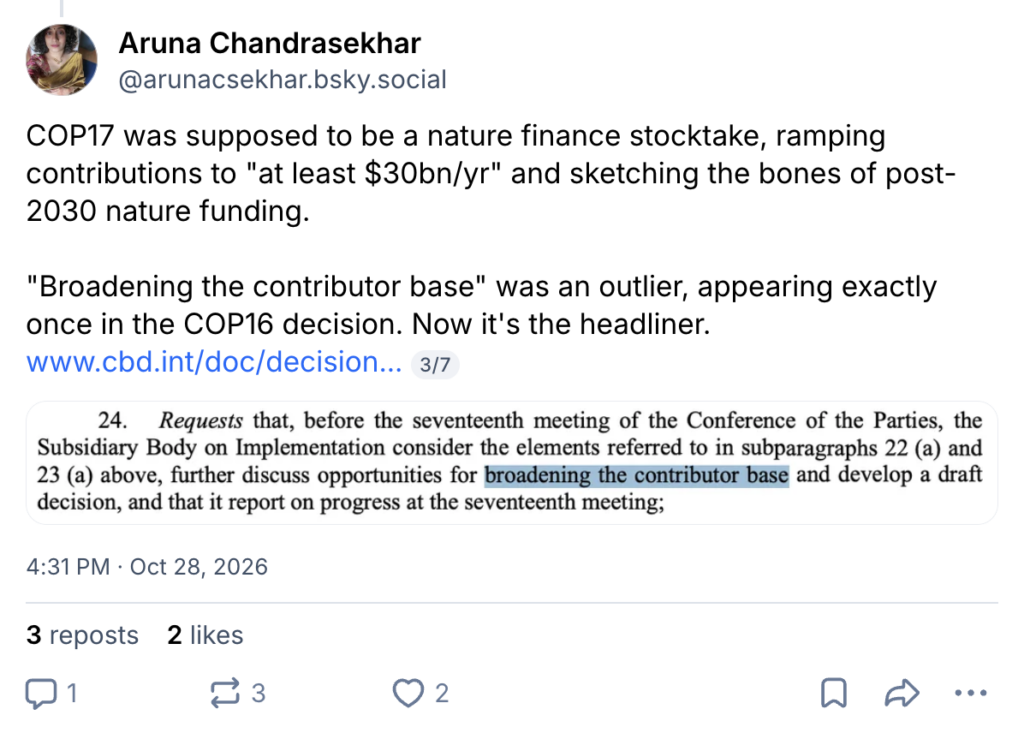
Article 20 of the UN Convention on Biological Diversity (CBD) states that developed countries “shall provide new and additional financial resources” to developing countries to meet the costs of implementing measures to protect nature.
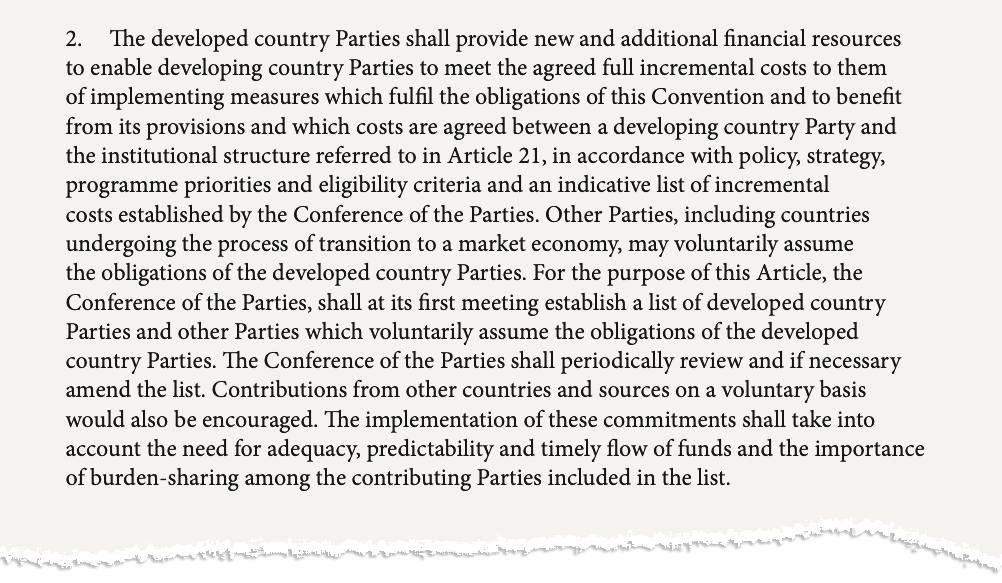
The text states that other countries – including emerging economies – may “voluntarily assume” these obligations to pay. However, it adds that this list of developed countries “shall” be reviewed periodically and amended “if necessary”.
The list was last amended in 2006.
(See this “jargon buster” which explains the specific meaning and legal weight of various terms and verbs used in UN formal documents.)
Discussions around this fraught subject had reached a dead end at intersessional talks this year, but resurfaced in Yerevan.
The first “non-paper” had four different options for expanding the contributor base. These ranged from using the World Bank’s country income groups “as a proxy” to identify high-income countries, to commissioning a study on the impacts of being included on the list.
By 21 October, the number of options swelled to eight, including two from Saudi Arabia and one from Peru.
Some countries “expressed concern” that certain options were based on a CBD secretariat study on “what constitutes a developed country”, Earth Negotiations Bulletin reported.
By the end of the first week, it was clear that the finance deadlock would have to go into informal ministerial consultations for any consensus to emerge.
At a press conference on 28 October, Christopher O’Sullivan, Ireland’s nature minister and representing the EU delegation, told Carbon Brief:
“Our position isn’t that we want to pull back in terms of contributing…but it’s been 20 years since that list was added to, times have changed and there are new realities. We just simply want those new realities reflected. I don’t fully understand why there’s so much opposition to that.”
The EU chose not to comment on which countries it would like to see on that list.
Lim Li Ching from the Third World Network, meanwhile, called the push for others to “assume the obligations” of developed countries “sheer hypocrisy”, adding that any country could make a voluntary contribution. She told Carbon Brief:
“At a forum like the CBD, this linking of income status with finance does not take into account where historical and current responsibilities lie. If you want to generate more funding for biodiversity, let’s look at sovereign debt burdens and rules, which are inequitable for developing countries. But if you can fund wars, and provide resources for your defence industry, then you know where the priorities are.”
On 29 October – at a plenary meant to adopt final texts for the most contentious subjects – Norway’s Gaute Hanssen announced that resource-mobilisation discussions would go into a smaller “friends of the chair” meeting.
Facilitated by Carolina Caceres from Canada and Imèn Meliane from Tunisia, the meeting would discuss the most contentious elements of a draft decision that had swelled to 112 brackets, denoting areas of disagreement on specific details in the text.
While the meeting was open to all, countries that were called to be present included Brazil, Canada, Chile, China, the EU, Fiji, Norway, Russia, Switzerland, Saudi Arabia, South Africa and the UK.
At the same time, a “non-paper” text by finance and environment ministers laid out countries’ red lines and compromises.
At the end of COP17, countries welcomed a final compromise text, with Kenya thanking the “strong women” co-chairs who strove to strike a “delicate” balance.
China, Saudi Arabia, Switzerland and Fiji cautioned against any further interventions, with Brazil warning: “If we open this text, we will never close it again.”
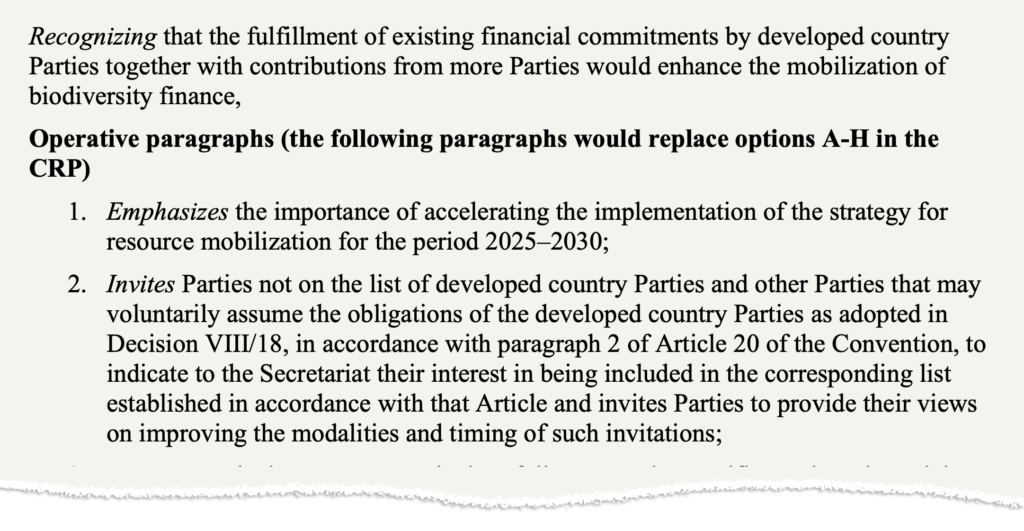
While the final decision “recognises” that “contributions from more parties would improve the mobilisation” of biodiversity finance, it steered away from issuing criteria to expand the list of donor countries.
The text makes it clear that no additions to the list would be made without inviting and confidentially