

- Formal negotiations
- Finance
- Global review
- Global report
- Digital sequence information
- Harmful subsidies
- Marine biodiversity
- Planning, monitoring, reporting and review
- Article 8(j) implementation
- Biodiversity and climate change
- Links with other bodies
- Around the COP
- Armenian presidency
- Protests
- Lobbying and influence
- Carbon and biodiversity markets

Dr. Sindra Sharma is senior policy advisor at Pacific Climate Action Network, Shady Khalil is global policy senior strategist at Oil Change International, and Andreas Sieber is associate director of policy and campaigns at 350.org.
At the COP28 climate summit last year, nations took a historic step by agreeing to call on each other to transition away from fossil fuels and pledging to triple renewable energy capacity globally by 2030.
COP29 starts next week in Azerbaijan. It is rightfully positioned as a financial COP and is the opportunity to make significant progress on paying for this transition. At the same time, it must build on the outcomes from last year’s Global Stocktake , and further steps on emissions cuts and energy transition urgently.
The president of Azerbaijan has called fossil fuels a “gift from god” rather than providing proposals on how to transition away from them. Thankfully, several more progressive governments have been stepping up instead – openly or behind the scenes – to advance proposals and ideas to implement the transition to renewable energy. Here’s what we need from COP29:
No new fossil fuels
As we approach COP29, governments’ current UN climate plans (NDCs) put the planet on track to reach 2.6-2.8C of warming. To avoid this catastrophe, rich countries must lead the energy transition with the urgency the crisis demands or the target of limiting global warming to 1.5C will slip out of our hands, exacerbating the extreme climate events already intensifying worldwide.
Science leaves no ambiguity: all NDC climate plans must commit to ending new oil, gas and coal project approvals. The International Energy Agency calculates that fossil fuel production must decline 55% by 2035 to align with the 1.5C limit.
It’s important to remember that just five rich countries – the US, Canada, Australia, Norway and the UK – are responsible for more than half of all planned oil and gas expansion.

Oil Change International’s analysis of data from Rystad Energy (July 2023)
But the presidencies of COP28, COP29 and COP30 (UAE, Azerbaijan and Brazil) have a particular responsibility to align with climate action and ambition. Despite this, research from Oil Change International shows that collectively these countries plan to increase oil and gas production by about a third by 2035 .
They need to rise to the challenge and draw inspiration from countries like Colombia, which have halted new oil and gas exploration and prioritized climate action and the lives of billions of people over short-term profits.
Finance goal
If we want to see a truly just and equitable transition to renewable energy, the new post-2025 climate finance goal being negotiated at COP29 must deliver on the scale of finance, across sub-goals of emissions cuts (mitigation), adapting to climate change (adaptation) and loss and damage.
We must also see progressive reform around policy, debt, fossil fuel subsidies and transparency mechanisms, including monitoring and tracking. The success of COP29 hinges on agreeing to an ambitious new financial goal of trillions every year, in grants not just loans.
Global South countries are facing a worst-in-history debt and inequality crisis that is blocking climate action. Communities need real support for climate adaptation and mitigation, not more debt. The good news is that governments can find the money by ending fossil fuel handouts, making big polluters pay,
Cover Decision
Most COP summits agree on a headline text called a cover decision, which gets branded according to where it is held – the Glasgow Agreement or the Sharm el-Sheikh Implementation Plan. These cover decisions have become pivotal political signals from COPs. Azerbaijan has shown no signs of preparing one but must do so to cement steps forward.
Any cover decision should aim to affirm the COP28 outcome, mandate that the next round of NDC climate plans end the expansion of fossil fuels, and specify equitable phaseout dates for their production and use.
While nations have pledged to pursue efforts to limit warming to 1.5C, current NDCs fall short of that goal. It is unthinkable to accept this as inevitable. Therefore, the cover decision should empower COP30 to demand further revisions if collective NDCs do not align with the Paris Agreement’s climate targets.
Global Clean Power Alliance
The energy transition landscape is crowded with initiatives, from Just Energy Transition Partnerships and multilateral funds to alliances like Beyond Oil and Gas and Powering Past Coal.
Yet, these efforts remain less than the sum of their parts. At COP29, the UK and several partners are set to launch the Global Clean Power Alliance, an initiative intended to address this fragmentation including through a “finance mission”.
While unlikely to bridge the vast and drastically underestimated energy support gap on its own for a true energy transition, the Global Clean Power Alliance could be a promising development if it manages to mobilize additional resources, foster true coordination and ensure that Global South nations take leadership roles.
Crucially, to be a legitimate initiative supporting the energy transition, the Alliance must not only aim to scale up renewables — without replicating the harmful nature of extractive industries — but make actively phasing out fossil fuels a cornerstone of its vision.
Institutionalize energy transition
While the COP28 energy decision was unprecedented, it currently lacks a clear home within the UN climate process where its implementation can be discussed and taken forward. The UN climate negotiations need to institutionalize ways to put the energy and other transitions into practice.
There is a negotiating track called the ‘Mitigation Work Programme’ – but it has failed to be the productive space we need it to be. Unlocking this space with a meaningful outcome at COP29 will demand bold leadership and bridge-building to overcome entrenched resistance, especially from countries like Saudi Arabia , which have actively obstructed substantive outcomes.
Similarly, wealthy developed nations have diluted the ‘Just Transition Work Programme’ by insisting on the exclusion of the international dimension of this transition and avoiding their historic responsibility for causing climate change.
Plans to turn Europe’s biggest coal mine into a leisure lake prove divisive
Brazil has stepped forward with an initial proposal : transforming the Mitigation Work Program from a negotiating forum into an implementation-focused body with a concrete focus on the energy transition.
This is the kind of leadership COP29 desperately needs, but Brazil must be prepared to defend its vision against expected swift opposition from Saudi Arabia. As we look to COP30 in Belém, Brazil’s political resolution will be crucial to keeping the energy transition on course. Floating bold ideas without putting one’s weight behind them as the future COP presidency is political theater not leadership. Brazil can and should be one of the first countries to lead.
True climate leadership requires the courage to confront fossil fuel dependency head-on and to invest deeply in the energy transition and provide the finance for it. Last year saw the UN climate process take a big step in the right direction. At COP29, we can further normalize and institutionalize the energy transition in this critical multilateral space.
The post COP29 must deliver on the world’s energy transition promises appeared first on Climate Home News.
COP29 must deliver on the world’s energy transition promises
Continue Reading
Countries have completed the first “global review” of their progress towards reversing nature loss by 2030 at the COP17 biodiversity talks in Yerevan, Armenia.
The review “notes with deep concern” that, unless action is “rapidly accelerated”, the goal to reverse nature loss and meet a set of 23 targets by 2030 “will not be achieved”.
It “urges” countries to accelerate action, including by “increased ambition in addressing the gaps”.
Much of the discussions in Yerevan focused on how to raise the necessary funds to help developing countries protect nature.
Some major economies pushed to expand the range of nations that are expected to provide finance, with countries agreeing at the end of the two weeks of talks that non-donors that want to contribute can “signal interest” before COP18.
This came after developed countries failed to meet a target to significantly ramp up nature finance over the last few years.
It also came as a landmark fund agreed at COP16 in Colombia to pay communities for the genetic resources derived from nature stands nearly empty two years on.
The Yerevan talks marked the halfway point of the “Kunming-Montreal Global Biodiversity Framework” (GBF), the “Paris Agreement for nature” first made in 2022 and due to be achieved by 2030.
During the nearly 12-hour-long final plenary, countries voted for Quito, Ecuador, to host the COP18 nature talks, which will be held in 2028.
Countries managed to sign off on all the major negotiation texts, marking a stark contrast to COP16, which ran so far over time that the Colombian presidency lost “quorum”, forcing talks to resume in Rome months later.
Below, Carbon Brief has detailed analysis of all of the key outcomes from COP17.
Formal negotiations
Finance
Finance, predictably, was at the heart of the discord and deadlock at the Yerevan talks.
At COP17, discussions on finance had to achieve several outcomes.
The first part – to take stock of biodiversity finance mobilised so far to meet the nature deal’s goals – fell under the global review.
As the global report noted, developed countries failed to meet their commitments to raise “at least $20bn a year by 2025” for nature. Delegates pointed to falling aid levels and a sharp 27% decline in environmental funding for the 2026-30 period.
The second part was to agree on how to mobilise resources for the next four years, to meet the GBF’s goals and targets.
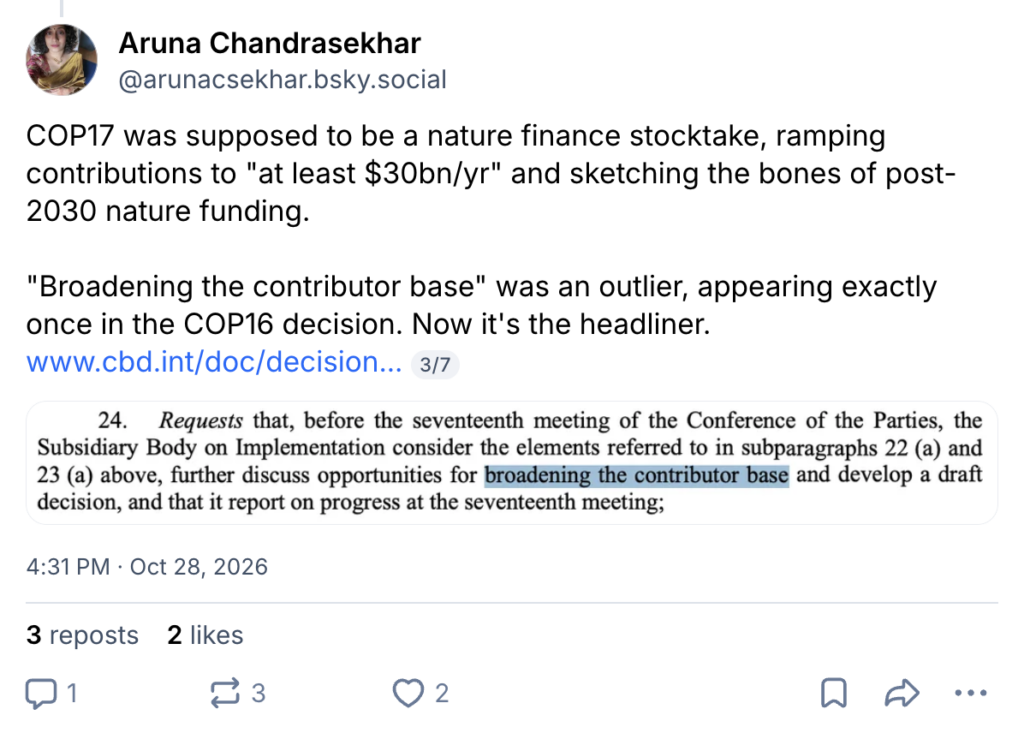
Calls to “broaden the contributor base” of who pays to protect nature – and whether that should include emerging economies – became the most fraught element of the talks.
Eventually, countries agreed on what Switzerland described as a “super, mega-delicate” text. It hinged on major “political compromises”, with “no major winner or loser”, according to Kenya.
Per the decision, countries that want to be included on a list of developed country donors can “signal interest” through bilateral, confidential consultations before COP18 and every alternate COP after.
Finally, countries also agreed on criteria to shape and resource a new, permanent financial mechanism to protect nature after 2030.
However, this did not immediately take the form of a new fund under the COP that biodiverse countries have demanded since 2022, deferring the mechanism’s institutional structure to COP18.
Resource mobilisation discussions at the GBF’s halfway mark were supposed to agree on how to close the “biodiversity finance gap” and to “increase resources from all sources” to “at least” $200bn per year by 2030, as set out in target 19 of the GBF.
The talks were largely dominated by a push, led by the JUSCANZ bloc of developed countries, to “broaden the contributor base”. This could see emerging economies, such as Qatar, China, Saudi Arabia and India, being added to the list of countries that pay to protect nature.
Article 20 of the UN Convention on Biological Diversity (CBD) states that developed countries “shall provide new and additional financial resources” to developing countries to meet the costs of implementing measures to protect nature.
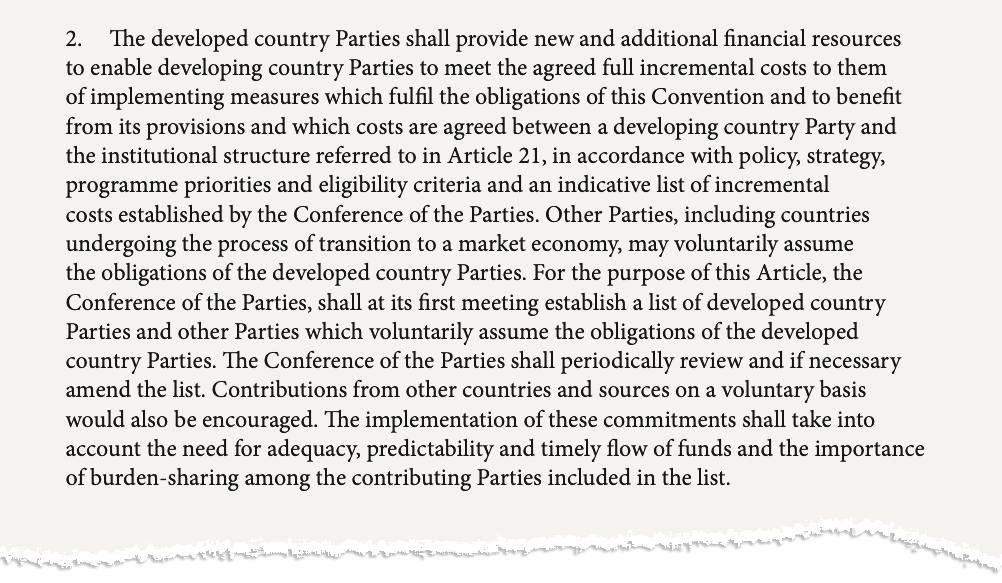
The text states that other countries – including emerging economies – may “voluntarily assume” these obligations to pay. However, it adds that this list of developed countries “shall” be reviewed periodically and amended “if necessary”.
The list was last amended in 2006.
(See this “jargon buster” which explains the specific meaning and legal weight of various terms and verbs used in UN formal documents.)
Discussions around this fraught subject had reached a dead end at intersessional talks this year, but resurfaced in Yerevan.
The first “non-paper” had four different options for expanding the contributor base. These ranged from using the World Bank’s country income groups “as a proxy” to identify high-income countries, to commissioning a study on the impacts of being included on the list.
By 21 October, the number of options swelled to eight, including two from Saudi Arabia and one from Peru.
Some countries “expressed concern” that certain options were based on a CBD secretariat study on “what constitutes a developed country”, Earth Negotiations Bulletin reported.
By the end of the first week, it was clear that the finance deadlock would have to go into informal ministerial consultations for any consensus to emerge.
At a press conference on 28 October, Christopher O’Sullivan, Ireland’s nature minister and representing the EU delegation, told Carbon Brief:
“Our position isn’t that we want to pull back in terms of contributing…but it’s been 20 years since that list was added to, times have changed and there are new realities. We just simply want those new realities reflected. I don’t fully understand why there’s so much opposition to that.”
The EU chose not to comment on which countries it would like to see on that list.
Lim Li Ching from the Third World Network, meanwhile, called the push for others to “assume the obligations” of developed countries “sheer hypocrisy”, adding that any country could make a voluntary contribution. She told Carbon Brief:
“At a forum like the CBD, this linking of income status with finance does not take into account where historical and current responsibilities lie. If you want to generate more funding for biodiversity, let’s look at sovereign debt burdens and rules, which are inequitable for developing countries. But if you can fund wars, and provide resources for your defence industry, then you know where the priorities are.”
On 29 October – at a plenary meant to adopt final texts for the most contentious subjects – Norway’s Gaute Hanssen announced that resource-mobilisation discussions would go into a smaller “friends of the chair” meeting.
Facilitated by Carolina Caceres from Canada and Imèn Meliane from Tunisia, the meeting would discuss the most contentious elements of a draft decision that had swelled to 112 brackets, denoting areas of disagreement on specific details in the text.
While the meeting was open to all, countries that were called to be present included Brazil, Canada, Chile, China, the EU, Fiji, Norway, Russia, Switzerland, Saudi Arabia, South Africa and the UK.
At the same time, a “non-paper” text by finance and environment ministers laid out countries’ red lines and compromises.