

- Formal negotiations
- Finance
- Global review
- Global report
- Digital sequence information
- Harmful subsidies
- Marine biodiversity
- Planning, monitoring, reporting and review
- Article 8(j) implementation
- Biodiversity and climate change
- Links with other bodies
- Around the COP
- Armenian presidency
- Protests
- Lobbying and influence
- Carbon and biodiversity markets

Mohamed Adow is the founder and director of Power Shift Africa
There’s no getting around it. The recently concluded climate talks in Bonn have left the goal of limiting global heating to under 1.5C in peril. The reason: rich countries are backtracking on their financial pledges.
The crucial deadline for next year’s new national climate plans, known as NDCs – which are the bedrock for the collective global effort to tackle climate change – are now in danger. This is because developing countries have no assurances that the climate finance they were promised, and which fund the NDCs, will be there.
The theme of this year’s COP29 summit in Baku, Azerbaijan, is supposed to be climate finance. It is the meeting where the world is tasked with agreeing a new long-term global finance goal.
This goal is the key ingredient to tackling climate injustice, and how we help vulnerable people adapt to the climate crisis and fund the transition to a zero-carbon energy system. However, at the mid-year talks in Bonn this month, rich countries dragged their feet, blocked progress and deliberately offered only vague signals about their intentions.
UN climate chief warns of “steep mountain to climb” for COP29 after Bonn blame-game
They also attempted to unpick the commitment they made at COP28 in Dubai: to have an annual dialogue specifically on climate finance. They are now suggesting it cover other issues.
Rich countries also used up valuable time arguing about who should pay the bill, trying to get some developing countries to also be included in the donor base. This was something they continued to talk about in the G7 summit communique issued this weekend. Delay and fudging on the new climate finance goal are hugely dangerous because the Bonn session was crucial to ensuring a successful COP29.
Waiting for US election?
COP summits take a huge amount of preparation with negotiators taking all year to lay the groundwork for the final landing zones that will be finalised this year in Baku. Leaving it all to the last minute would be disastrous and could result in a failure that derails international momentum on climate change just as Donald Trump is elected US President.
The infuriating go-slow in Bonn seems to be because countries are waiting for the result of this election before making any finance commitments. This is folly.
The need for a coalition of the sensible – to counter the ignorance and malice emanating from a potential Trump White House – will only be greater should the Republican candidate win.
The victims of the climate crisis will need support, and the energy transition will need to be funded, whoever is elected as the next US president. Dragging out the process to the point where Baku might end up being a chaotic rush will only make things worse.
COP29 host lacks influence
The horrors of climate change continue to rage daily. Heatwaves mercilessly ravage lives, with over 100 people reported dead in India and over 50 lives claimed in Sudan during the Bonn talks. These are not just statistics; they are human lives from vulnerable countries, who once dared to hope for a better tomorrow.
The dark clouds forming over Baku are compounded by the fact that the Azeri presidency for COP29 is inexperienced, with few diplomatic allies and lacking in geopolitical or economic weight to knock heads together as needed. The lack of a strong host in 2024 means we need to see leadership from other quarters.
Bonn talks on climate finance goal end in stalemate on numbers
Those other would-be leaders must ensure that the negotiators see the coming dangers ahead and work to catch up and avoid them. The crucial opportunities for this are the UN General Assembly summit in September and the pre-COP meeting in Baku. It’s vital that much clearer and more ambitious negotiations take place so that ministers have a streamlined process when they get to Baku in November.
Without that, we risk getting an underwhelming finance goal or even a failed COP. That would imperil millions of people who need climate finance, as well as taking the wind out of the sails of the NDCs from developing countries, which are due to be published next year. How can these poorer countries be expected to slay the climate dragon with paper swords, having gotten zero assurances on the long-term finance they need?
If countries can set a clear and unambiguous path for future finance in Baku, then the world will be set up for a hope-filled and ambitious round of climate action plans next year. This is the best way to protect the world from the volatility of the US election. The work to achieve that starts now.
The post New finance goal needed to protect climate momentum from a Trump win appeared first on Climate Home News.
New finance goal needed to protect climate momentum from a Trump win
Continue Reading
Countries have completed the first “global review” of their progress towards reversing nature loss by 2030 at the COP17 biodiversity talks in Yerevan, Armenia.
The review “notes with deep concern” that, unless action is “rapidly accelerated”, the goal to reverse nature loss and meet a set of 23 targets by 2030 “will not be achieved”.
It “urges” countries to accelerate action, including by “increased ambition in addressing the gaps”.
Much of the discussions in Yerevan focused on how to raise the necessary funds to help developing countries protect nature.
Some major economies pushed to expand the range of nations that are expected to provide finance, with countries agreeing at the end of the two weeks of talks that non-donors that want to contribute can “signal interest” before COP18.
This came after developed countries failed to meet a target to significantly ramp up nature finance over the last few years.
It also came as a landmark fund agreed at COP16 in Colombia to pay communities for the genetic resources derived from nature stands nearly empty two years on.
The Yerevan talks marked the halfway point of the “Kunming-Montreal Global Biodiversity Framework” (GBF), the “Paris Agreement for nature” first made in 2022 and due to be achieved by 2030.
During the nearly 12-hour-long final plenary, countries voted for Quito, Ecuador, to host the COP18 nature talks, which will be held in 2028.
Countries managed to sign off on all the major negotiation texts, marking a stark contrast to COP16, which ran so far over time that the Colombian presidency lost “quorum”, forcing talks to resume in Rome months later.
Below, Carbon Brief has detailed analysis of all of the key outcomes from COP17.
Formal negotiations
Finance
Finance, predictably, was at the heart of the discord and deadlock at the Yerevan talks.
At COP17, discussions on finance had to achieve several outcomes.
The first part – to take stock of biodiversity finance mobilised so far to meet the nature deal’s goals – fell under the global review.
As the global report noted, developed countries failed to meet their commitments to raise “at least $20bn a year by 2025” for nature. Delegates pointed to falling aid levels and a sharp 27% decline in environmental funding for the 2026-30 period.
The second part was to agree on how to mobilise resources for the next four years, to meet the GBF’s goals and targets.
Calls to “broaden the contributor base” of who pays to protect nature – and whether that should include emerging economies – became the most fraught element of the talks.
Eventually, countries agreed on what Switzerland described as a “super, mega-delicate” text. It hinged on major “political compromises”, with “no major winner or loser”, according to Kenya.
Per the decision, countries that want to be included on a list of developed country donors can “signal interest” through bilateral, confidential consultations before COP18 and every alternate COP after.
Finally, countries also agreed on criteria to shape and resource a new, permanent financial mechanism to protect nature after 2030.
However, this did not immediately take the form of a new fund under the COP that biodiverse countries have demanded since 2022, deferring the mechanism’s institutional structure to COP18.
Resource mobilisation discussions at the GBF’s halfway mark were supposed to agree on how to close the “biodiversity finance gap” and to “increase resources from all sources” to “at least” $200bn per year by 2030, as set out in target 19 of the GBF.
The talks were largely dominated by a push, led by the JUSCANZ bloc of developed countries, to “broaden the contributor base”. This could see emerging economies, such as Qatar, China, Saudi Arabia and India, being added to the list of countries that pay to protect nature.
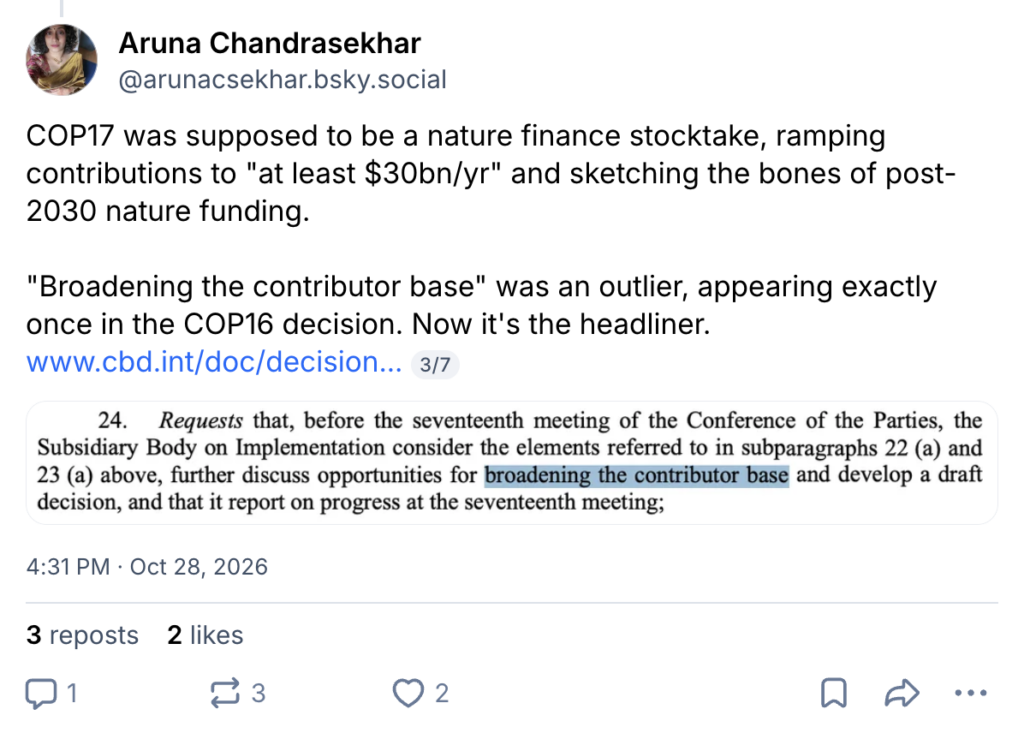
Article 20 of the UN Convention on Biological Diversity (CBD) states that developed countries “shall provide new and additional financial resources” to developing countries to meet the costs of implementing measures to protect nature.
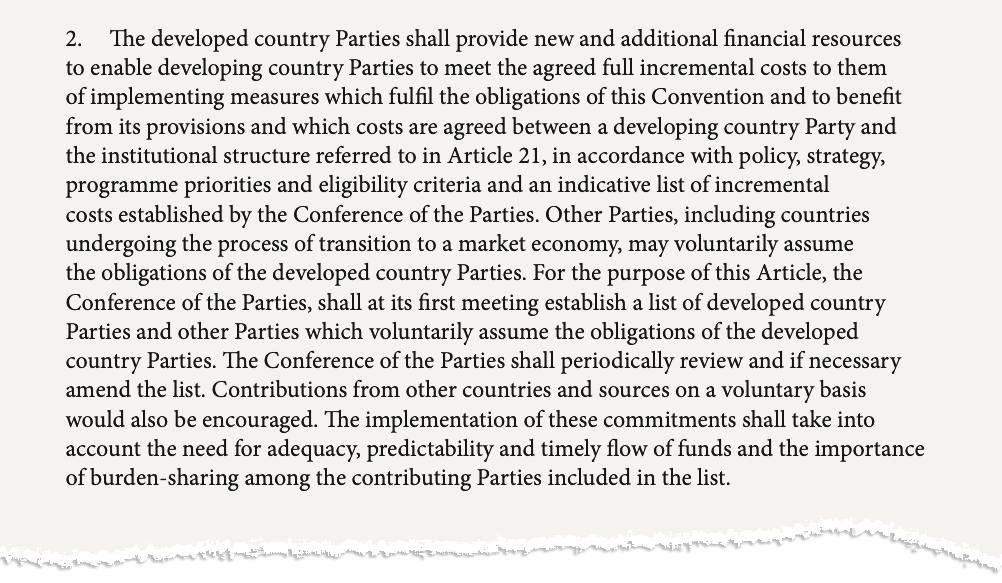
The text states that other countries – including emerging economies – may “voluntarily assume” these obligations to pay. However, it adds that this list of developed countries “shall” be reviewed periodically and amended “if necessary”.
The list was last amended in 2006.
(See this “jargon buster” which explains the specific meaning and legal weight of various terms and verbs used in UN formal documents.)
Discussions around this fraught subject had reached a dead end at intersessional talks this year, but resurfaced in Yerevan.
The first “non-paper” had four different options for expanding the contributor base. These ranged from using the World Bank’s country income groups “as a proxy” to identify high-income countries, to commissioning a study on the impacts of being included on the list.
By 21 October, the number of options swelled to eight, including two from Saudi Arabia and one from Peru.
Some countries “expressed concern” that certain options were based on a CBD secretariat study on “what constitutes a developed country”, Earth Negotiations Bulletin reported.
By the end of the first week, it was clear that the finance deadlock would have to go into informal ministerial consultations for any consensus to emerge.
At a press conference on 28 October, Christopher O’Sullivan, Ireland’s nature minister and representing the EU delegation, told Carbon Brief:
“Our position isn’t that we want to pull back in terms of contributing…but it’s been 20 years since that list was added to, times have changed and there are new realities. We just simply want those new realities reflected. I don’t fully understand why there’s so much opposition to that.”
The EU chose not to comment on which countries it would like to see on that list.
Lim Li Ching from the Third World Network, meanwhile, called the push for others to “assume the obligations” of developed countries “sheer hypocrisy”, adding that any country could make a voluntary contribution. She told Carbon Brief:
“At a forum like the CBD, this linking of income status with finance does not take into account where historical and current responsibilities lie. If you want to generate more funding for biodiversity, let’s look at sovereign debt burdens and rules, which are inequitable for developing countries. But if you can fund wars, and provide resources for your defence industry, then you know where the priorities are.”
On 29 October – at a plenary meant to adopt final texts for the most contentious subjects – Norway’s Gaute Hanssen announced that resource-mobilisation discussions would go into a smaller “friends of the chair” meeting.
Facilitated by Carolina Caceres from Canada and Imèn Meliane from Tunisia, the meeting would discuss the most contentious elements of a draft decision that had swelled to 112 brackets, denoting areas of disagreement on specific details in the text.
While the meeting was open to all, countries that were called to be present included Brazil, Canada, Chile, China, the EU, Fiji, Norway, Russia, Switzerland, Saudi Arabia, South Africa and the UK.
At the same time, a “non-paper” text by finance and environment ministers laid out countries’ red lines and compromises.
At the end of COP17, countries welcomed a final compromise text, with Kenya thanking the “strong women” co-chairs who strove to strike a “delicate” balance.
China, Saudi Arabia, Switzerland and Fiji cautioned against any further interventions, with Brazil warning: “If we open this text, we will never close it again.”
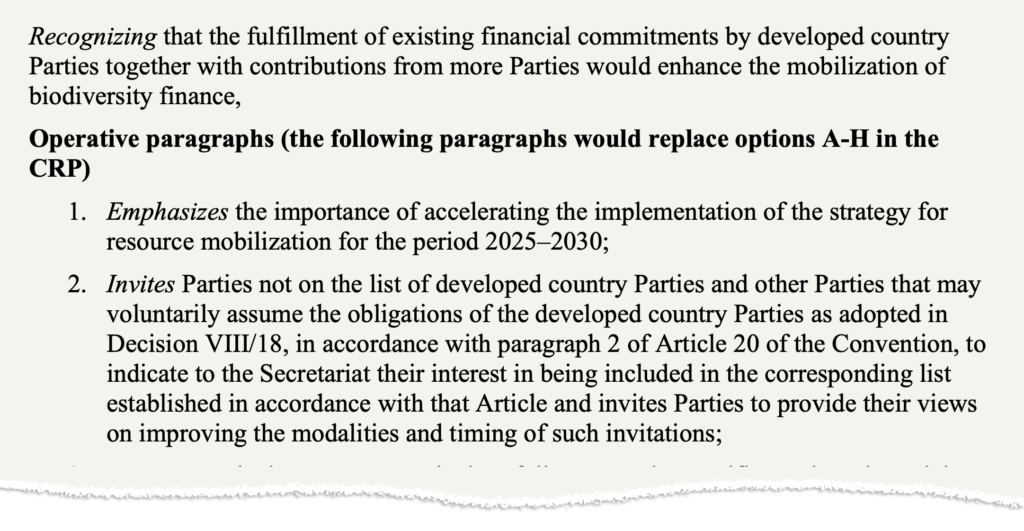
While the final decision “recognises” that “contributions from more parties would improve the mobilisation” of biodiversity finance, it steered away from issuing criteria to expand the list of donor countries.
The text makes it clear that no additions to the list would be made without inviting and confidentially consulting with interested countries, to secure their explicit consent.
Instead, the CBD secretariat “invites” countries keen to be on the list and “assume the obligations” of developed countries to “signal interest” before COP18 and at every alternate COP thereafter.
At the same time, developing countries can contribute to meeting the GBF and biodiversity convention’s goals on a “voluntary basis”, with contributions not implying inclusion on the list.
A negotiator for China told Carbon Brief at the closing plenary:
“We welcome this balanced document. It was a very long discussion that has gone [on] since [2022 nature talks in] Nairobi. But actually this time, there were a lot of sensitive issues, [there were] a lot of critical things we didn’t open in the contact groups; it mainly went to the high-level discussion.”
The decision also establishes a financial mechanism for nature funding after 2030 under the governance of the COP, a key ask from developing countries.
However, it defers decisions on what form this mechanism would take – whether this would be a new fund or based on existing arrangements – until COP18.
Oscar Soria at the Common Initiative told Carbon Brief that the decision on the financial mechanism leaves things “very open”, with “no movement” towards a new fund or money and no upgrades to existing funding arrangements.
The text acknowledges the links between debt and biodiversity eight times, mentioning how debt-related instruments can be included in biodiversity plans, but does not go further.
“It is almost as if the debt studies they called for at COP16 didn’t happen,” said Soria, who had earlier flagged serious methodological issues with the first-ever COP-commissioned report on debt and biodiversity.
Global review
In Yerevan, countries agreed on the first stocktake of progress towards the 2030 nature targets – known as the “global review”.
The review was one of the keenly anticipated outcomes from COP17 and was seen as less controversial than some of the other major negotiation strands.
It was swiftly signed off by countries at the start of the final COP17 plenary, with just one last-minute addition.
The concept of carrying out a global review on “collective progress” was set out in the GBF and its underlying documents.
The details of how this review would be carried out were supposed to be agreed at COP16, but it was not discussed before the plenary in Cali was suspended for loss of “quorum”. It was instead adopted at the resumed COP16 negotiations in Rome in February 2025.
The global review was based largely on the findings of the global report and other information provided by countries.
The final text “welcomes” and also “notes with deep concern” the findings of the global report. It then homes in on various ways countries can increase their biodiversity action to get on track to meet the targets.
As of 19 October, when COP17 officially began, the non-paper contained 152 brackets, which indicate areas of disagreement in UN texts.
Smaller “contact group” discussions took place to try and reduce the number of brackets throughout the first week. This group was co-chaired by Sanne Kruid from the Netherlands and Sivendra Michael from Fiji.
A few days into the talks, Kruid told Carbon Brief that the progress on the global review was “relatively positive”, with countries “engaging quite well”.
One contentious section of the 11-page text was paragraph 15, which “urges” countries to accelerate implementation of nature targets, “including by increased ambition” in addressing key challenges.
Some developing countries were wary of including the word “ambition” in this section, arguing that higher ambition requires more nature finance, which is already falling “far short”.
Kirsty Leong, a policy expert at WWF, told Carbon Brief:
“You have one side wanting to have very strong language and high ambition in what countries should do…and the other side of the room saying the main problem in implementation is that they don’t have the means to do it.”
But the word made it into the final text, which “urges” parties to accelerate implementation of the GBF, “including by increased ambition”, while recognising that developing countries need more support to “allow for higher ambition in their actions”.
Another hotly debated secti