Connect with us

Published

on

At an event on the sidelines of Wednesday’s talks, the “Troika” of COP presidencies was very clear that the next round of national climate plans (NDCs) must be aligned with a global warming limit of 1.5C. The three countries – the UAE, Azerbaijan and Brazil – have all promised to set an example by publishing “1.5-aligned” plans by early next year.  

What their negotiators were not so clear on, however, was what it means for an NDC to be 1.5-aligned.

Asked by Destination Zero’s Cat Abreu about the risk of “1.5 washing”, Brazil’s head of delegation Liliam Chagas replied that “there is no international multilaterally agreed methodology to define what is an NDC aligned to 1.5”. “It’s up to each one to decide,” she said.

The moderator, WWF’s climate lead Fernanda Carvalho, pointed out that IPCC scientists say 1.5C alignment means cutting emissions globally by 43% by 2030 and 60% by 2035 – but without giving national breakdowns.

She added that Climate Action Tracker does have a methodology. This shows that no major nations so far have climate plans aligned with 1.5C.

E3G expert Alden Meyer followed up, telling the negotiators that “while we may have some disagreements on exactly what an NDC must include to be 1.5-aligned, we know now what it must exclude – it must exclude any plans to expand the production and export of fossil fuels”.

All three Troika nations are oil and gas producers with no plans to stop producing or exporting their fossil fuels and are in fact ramping up production.

Claudio Angelo, international policy coordinator for Brazil’s Climate Observatory, said the onus is on rich countries to move first, but “this is no excuse for doing nothing”. Even yesterday, he noted, President Lula was talking to Saudi investors about opening a new oil frontier on Brazil’s northern shore.

Whether 1.5-aligned or not, no government has used Bonn as an opportunity to release an early NDC. Azerbaijan’s lead on Troika relations Rovshan Mirzayev said “some”, but “no more than 10”, are expected to be published by COP29 in November.

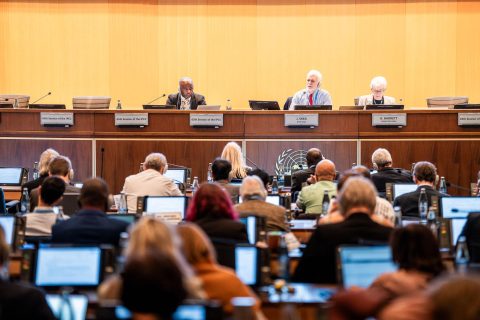
Rovshan Mirzayev (left), Fernanda Carvalho (centre-left), Liliam Chagas (centre-right) and Hana Alhashimi (right) in Bonn yesterday (Photo: Observatorio do Clima/WWF/Fastenaktion/ICS)

Climate commentary

Napping on NAPs or drowning in paperwork?   

As he opened the Bonn conference last week, UN climate head Simon Stiell bemoaned that only 57 governments have so far put together a national adaptation plan (NAP) to adjust to the impacts of climate change.

“By the time we meet in Baku, this number needs to grow substantially. We need every country to have a plan by 2025 and make progress on implementing them by 2030,” he said.

The South American nation of Suriname is one of the 57. Its coast is retreating, leaving the skeletons of homes visible in the sea and bringing salt water into cropland – and its NAP lays out how it wants to minimise that.

Tiffany Van Ravenswaay, an AOSIS adaptation negotiator who used to work for Suriname’s government, told Climate Home how hard it is for small islands and the poorest countries to craft such plans.

“We have one person holding five or seven hats in the same government,” she said. These busy civil servants often don’t have time to compile a 200-page NAP, and then an application to the Green Climate Fund or Adaptation Fund for money to implement it, accompanied by a thesis on why these impacts are definitely caused by climate change.

“It takes a lot of data, it takes a lot of work, and it takes also a lot of human resources,” she said. What’s needed, she added, are funds for capacity-building, to hire and train people.

Cecilia Quaglino moved from Argentina to the Pacific Island nation of Palau to write, along with just one colleague, its NAP. She told Climate Home they are “struggling” to get it ready by next year. “We need expertise, finance and human resources,” she said.

According to three sources in the room, developing countries pushed for the NAP negotiations in Bonn to include the “means of implementation” – the code phrase for cash – to plan and implement adaptation measures, but no agreement was reached.

Talks on the Global Goal on Adaptation are also centred on finance. Developing countries want to track the finance provided towards each target, whereas developed countries want to avoid quantification – and any form of standalone adaptation finance target for the goal.

They are also divided on the extent to which negotiators themselves should run the process for coming up with indicators versus independent experts. Developed countries want more of a role for the Adaptation Committee, a body mainly of government negotiators, whereas developing nations want non-government specialists with a regional balance to run the show.

Bonn bulletin: Fears over "1.5 washing" in NDCs

The island of Pulo Anna in Palau, pictured in 2012, is vulnerable to rising sea levels (Photo: Alex Hofford/Greenpeace)

Just transition trips up on justice definitions 

At COP27 in Sharm el-Sheikh, governments agreed to set up a work programme on just transition. But justice means very different things to different governments and different groups of people.

For some, it’s about justice for workers who will lose their jobs in the shift away from fossil fuels. For others, it’s more about meeting the needs of women or indigenous people affected by climate action.

Many developing countries view it as a question of justice between the Global South and North, and trade barriers that they believe discriminate against them. Or it can be seen as all of the above.

That’s why negotiations in Bonn about how to work out what to even talk about under the Just Transition Work Programme have been so fraught – resulting in “deep exasperation”, according to the Fossil Fuel Non-Proliferation Treaty Initiative’s Amiera Sawas.

While the elements of justice that could be discussed seem infinite, the UNFCCC’s budget is very much not – a fact brought up by some negotiators when trying to limit the scope of the talks.

Ultimately what does make it onto the agenda for discussion matters, because climate justice campaigners hope there will be a package agreed by COP30 in Belem that can help make the clean energy transition fairer and mobilise money for that purpose.

Caroline Brouillette from Climate Action Network Canada has been following the talks. “The transition is already happening,” she told Climate Home. “The question is: will it be just?”

E3G’s Alden Meyer described it as a “very intense space”. Rich countries, he said, don’t want a broader definition of just transition in case that opens the door to yet more calls for them to fund those efforts in developing nations.

Despite these divisions, after a late night and long final day of talks, two observers told Climate Home early on Thursday afternoon that negotiators had reached an agreement to present to the closing plenary session – where it’s likely to be adopted.

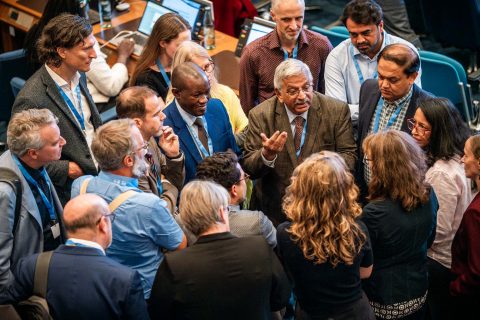
Just Transition Working Group negotiators huddle for informal talks yesterday (Photo: Kiara Worth/IISD ENB)

The post Bonn bulletin: Fears over “1.5 washing” in national climate plans appeared first on Climate Home News.

Bonn bulletin: Fears over “1.5 washing” in national climate plans

Continue Reading

Climate Change

Greenpeace’s Dutch Anti-SLAPP Case Against Oil Pipeline Giant Advances

Published

on

But a $345 million U.S. verdict against the environmental group hangs over the case.

A lawsuit filed by Greenpeace International against the U.S.-based fossil fuel company Energy Transfer in the Netherlands is moving forward after a Dutch court recently ruled in favor of the environmental organization in rejecting the company’s bid to toss out the case.

Greenpeace’s Dutch Anti-SLAPP Case Against Oil Pipeline Giant Advances

Continue Reading

Climate Change

The Search for Super Reefs

Published

on

Go behind the scenes with executive editor Vernon Loeb and oceans correspondent Teresa Tomassoni as they discuss the search for heat-resilient coral reefs that are somehow defying the odds to survive a warming planet.

The world has already lost more than half of its coral reefs, and most of what remains is at risk of disappearing in the next 25 years.

The Search for Super Reefs

Continue Reading

Climate Change

DeBriefed 19 June 2026: Bonn talks end in ‘gridlock’ | Energy’s ‘new era’ | Oceans in climate negotiations

Published

on

Welcome to Carbon Brief’s DeBriefed.
An essential guide to the week’s key developments relating to climate change.

This week

Bonn talks close

‘SIDE-STEPPING AND STALLING’: UN climate talks in Bonn have ended in “gridlock”, according to Climate Home News. The outlet reported on the failure to balance developing countries’ need for climate-adaptation finance with “richer nations’ desire to move forward” on emissions cuts. It added that both topics were subject to “rule 16”, meaning no agreement could be reached and work will be pushed to the COP31 summit in Turkey. Inside Climate News quoted UN climate executive secretary Simon Stiell, who said the talks had seen “side-stepping and stalling”.

JUST TRANSITION: One “glimmer of hope” came from negotiations on achieving a “just transition”, reported Euronews. The news outlet said negotiators “made headway on operationalising the Belém-Antalya mechanism”, intended to support people in the shift to a low-carbon economy. However, Politico concluded that much of the focus in Bonn had “shift[ed] to efforts outside diplomatic talks – raising questions about the future of global climate negotiations”.

‘ATTACKING SCIENCE’: Agence France-Presse reported on the EU, Switzerland and “dozens of developing nations” warning of “attacks on science” by a “small group of fossil-fuels interests” in Bonn. Table Briefings explained that “the 1.5C target is increasingly being challenged” and the role of the UN climate-science panel – the Intergovernmental Panel on Climate Change (IPCC) – in an upcoming assessment of global climate progress “remains controversial”. See Carbon Brief’s full write-up of the talks for more detail.

US-Iran deal

PRICE DROP: The US and Iran announced that they have reached an interim agreement to halt the war and reopen the strait of Hormuz, reported Bloomberg. Oil prices have fallen, as the “long-awaited deal” began the process of “eas[ing]” the global energy crisis triggered by the conflict, according to the New York Times. The Associated Press noted that high fuel prices will “likely outlast the Iran war”.

‘OIL GLUT’: The Financial Times reported that the International Energy Agency (IEA) has forecast a “glut of oil” emerging next year, if the peace deal holds. The IEA said this would allow countries to build new strategic reserves, as they “review their energy strategies and policies in response to the crisis”, according to Reuters.

‘NEW ERA’: Agence France-Presse reported that oil and gas companies have “few illusions about a return to normal for the Gulf energy industry after more than three months of blockage”. One analyst told the newswire that the war “showed the oil and gas industry that Hormuz risk is no longer just a geopolitical headline”.

Around the world

  • OCEAN MONITOR: The Trump administration is “abandoning its plan” to dismantle a $368m ocean monitoring system key for tracking climate change after a “bipartisan backlash on Capitol Hill”, reported the New York Times.
  • CORAL HAVEN: The New York Times covered preliminary research, presented at the Our Ocean Conference in Kenya, suggesting there could be three times as many “coral refugia” – where corals are relatively safe from climate change – than previously thought.
  • BAD CREDIT: Down to Earth reported that the first carbon credits issued under the Paris Agreement’s new Article 6.4 mechanism are “facing scrutiny over alleged links to institutions controlled by Myanmar’s military junta”.
  • OIL BACKTRACK: Reuters reported that oil-and-gas company Equinor has dropped a renewable-energy target and scaled back clean investments, while another Reuters story noted that Shell is selling off its offshore wind assets.

1.1 billion

The number of children facing “at least three overlapping climate hazards”, according to a new Unicef report covered by Agence France-Presse.


Latest climate research

  • Including the “permafrost carbon-climate feedback” in climate models increases the chance of exceeding “tipping elements” – such as the Greenland ice sheets, Atlantic Meridional Overturning Circulation or Amazon rainforest – by up to 50% | Environmental Research Letters
  • The intensity of influenza outbreaks could decline in temperate regions, but increase in tropical areas over the next century, as the climate warms | PNAS Nexus
  • European snow cover has declined by 20% for December and January since the start of the industrial era, revealing an “unprecedented ongoing shrinkage of European winters” | Communications Earth & Environment

(For more, see Carbon Brief’s in-depth daily summaries of the top climate news stories on Monday, Tuesday, Wednesday, Thursday and Friday.)

Captured

The more than 2m battery electric vehicles (BEVs), 1m “plug-in” hybrids (PHEVs) and 100,000 electric vans on UK roads are already saving drivers a total of around £3bn a year, according to new Carbon Brief analysis. This amounts to savings of more than £1,100 a year in fuel costs for each BEV driver in the UK. The analysis comes amid reports in UK media this week that the government is considering “watering down” its EV sales targets.

Spotlight

Oceans rising at UN climate talks

The state of the world’s oceans is inextricably linked to the changing climate – and many delegates at UN climate talks want to see more focus on this issue, reports Carbon Brief.

Oceans are often described as the world’s “greatest ally” against climate change – absorbing 30% of carbon dioxide (CO2) emissions and most of the heat generated by those emissions.

They are also the site of important climate solutions, such as huge offshore windfarms and the shipping industry’s transition to cleaner fuels.

At the same time, the oceans themselves present a growing danger to coastal communities and sea life due to sea level rise, marine heatwaves and ocean acidification.

These diverse issues have led to growing calls within the UN climate process for more focus on oceans. During climate negotiations this week in Bonn – known as SB64 – nations and civil society had a chance to air these views during an “ocean and climate change dialogue”.

‘Elevate action’

Oceans first entered UN climate outcomes in 2019, when the final COP25 negotiated text requested a new “dialogue” on “the ocean and climate change to consider how to strengthen mitigation and adaptation action”.

The following years saw this dialogue established as an annual event. However, the political weight of these discussions has been limited.

COP31 is being co-led by Turkey and Australia, but with Pacific islands playing a supporting role. These small islands sometimes self-identify as “large ocean states”, stressing the ocean’s centrality in their societies.

In Bonn, figures from across the presidency threw their weight behind this issue. Chris Bowen, an Australian minister and incoming COP31 “president of negotiations”, told attendees:

“Australia, Turkey and the Pacific see an important opportunity to elevate ocean-based climate action.”

Ocean dialogue breakout group. Credit: IISD/ENB, Maja Schmidt-Thomé.

Strategies and finance

The two-day dialogue in Bonn involved a series of panels, statements and breakout groups.

One of the main topics was how oceans are integrated into national climate plans under the Paris Agreement, known as “nationally determined contributions” (NDCs).

Three-quarters of the latest round of NDCs mention oceans, with conservation of “blue carbon” ecosystems the most frequently described action. (Landscapes such as mangroves can both absorb CO2 and protect coastal areas.)

Delegates also discussed alignment with the UN biodiversity process, as well as ocean finance, which currently makes up less than 1% of all climate finance.

(As discussions were taking place in Bonn, country officials also gathered in Mombasa, Kenya for the 11th Our Ocean Conference. Carbon Brief’s associate editor Giuliana Viglione attended the conference and will publish a full summary shortly.)

Developing countries were clear that many of the ocean-related actions in their NDCs would depend on receiving more financial support.

‘Political momentum’

With the backing of the COP31 presidency, delegates were hopeful about where this year’s dialogue could lead.

Charles Hamilton, an advisor for the Bahamas who spoke for the Alliance of Small Island States (AOSIS) in the dialogue, told Carbon Brief that island representatives “are not traveling thousands of miles to just talk and pat ourselves on the back”. He added:

“A dialogue that just remains a dialogue is just more talk – no action.”

Given that, he said “discussions in the dialogue must move into COP decisions and the decisions must be actioned”, noting the importance of finance.

Marina Corrêa, oceans lead at WWF-Brazil, pointed to an upcoming UN climate change Standing Committee on Finance forum as a space to ramp up pressure on ocean finance.

More broadly, she wanted to see the presidencies translate their support into a “leader-level ocean initiative” that could “mainstream” oceans across negotiations.

“We have a really interesting opportunity, in terms of political momentum,” Corrêa told Carbon Brief.

Watch, read, listen

‘HOTTER THAN HELL’: An episode of the BBC’s Rare Earth podcast titled “hotter than hell” considered the issue of extreme heat, with input from experts and “people facing up to the hottest temperatures on the planet”.

NOT BROKEN?: John Drake, a professor of ecology at the University of Georgia, wrote an essay for Aeon – also re-published as a Guardian “long read” – questioning the framing of ecosystems and climate systems “breaking down”.

ON COURSE: On his Volts podcast, US climate journalist David Roberts interviewed UK climate minister Katie White, quizzing her about whether the UK will “stay the course with its climate plans”.

Coming up

Pick of the jobs

DeBriefed is edited by Daisy Dunne. Please send any tips or feedback to debriefed@carbonbrief.org.

This is an online version of Carbon Brief’s weekly DeBriefed email newsletter. Subscribe for free here.

The post DeBriefed 19 June 2026: Bonn talks end in ‘gridlock’ | Energy’s ‘new era’ | Oceans in climate negotiations appeared first on Carbon Brief.

DeBriefed 19 June 2026: Bonn talks end in ‘gridlock’ | Energy’s ‘new era’ | Oceans in climate negotiations

Continue Reading

Trending

Copyright © 2022 BreakingClimateChange.com